
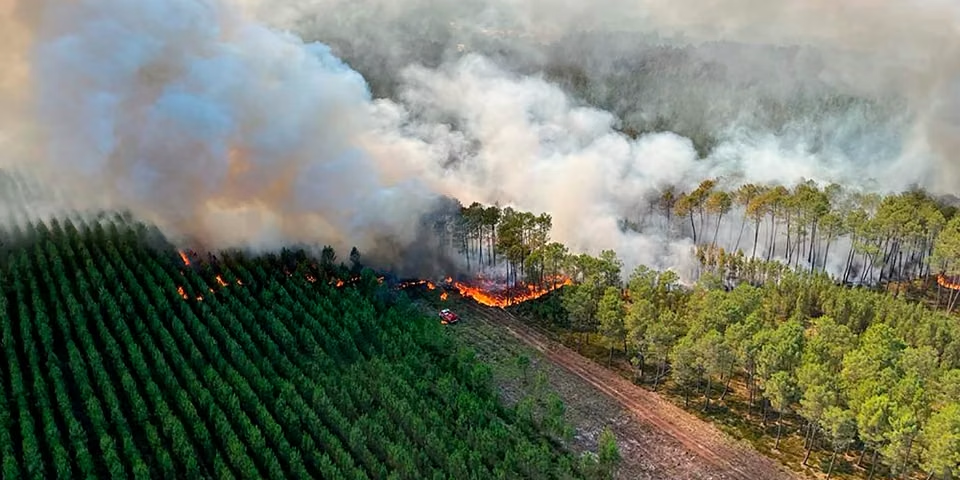
With wildfires in recent months threatening vineyards from Bordeaux and the surrounding Gironde to Spain’s Meseta region and British Columbia’s Okanagan Valley, smoke taint will certainly be a factor of terroir for the 2026 vintage in affected areas. But to what degree do the flavors it imparts negatively impact wine?
Smoke taint is primarily a problem in red grapes, although it can affect whites as well. Volatile compounds from wildfire smoke are trapped by the waxy cuticle on the berry skin and end up contaminating the wine during fermentation. Grapes are most vulnerable during and after veraison, which, for winegrowers in the regions mentioned above, began in early July. There’s little doubt that vineyards there will be impacted to some degree by the recent fires.
Determining the degree of taint by measuring the compounds in the grape alone doesn’t guarantee the fruit will produce smoke-free wine. Smoke is composed of many different volatile phenols—the most common of which are guaiacol and 4-methylguaiacol—but these compounds don’t act alone. The family of cresols, syringol, and a recently discovered compound known as thiophenol create a synergistic effect that results in the ashy
aftertaste commonly associated with tainted wine.

Ironically, many of the same compounds that are found in wildfire smoke are also found in toasted wood barrels and contribute desired secondary characteristics to wine (although at much lower levels). Heavily charred barrels produce cresols, syringol, and guaiacol, while lighter toasts and seasoned wood contribute flavors of diacetyl (butter), malt, vanillin, clove, and hay, to name a few.
Depending on the amount of smoke exposure and the resulting taint, winemakers have only a few options. They can gently press whole clusters and make white wine or rosé; they may also be able to use oak aging to mask and integrate any undesirable compounds or simply blend with untainted wine to mimic oak aging.
After the 2020 fires in Napa and Sonoma counties, many Cabernet Sauvignon producers used a combination of laboratory analysis and small-scale bucket fermentations to check volatile phenols in an attempt to gauge the level of taint in their wines. Some ultimately chose not to harvest: One winemaker who left over 200 acres of Cabernet Sauvignon on the vine felt the amount of taint in the wines would not have been detected by consumers but would have never made it past the critics and buyers who were aware of vintage conditions and understand that smoke taint increases with bottle age.
When nature sends you smoke, make rosé
In 2017, winemakers in Oregon and Washington used techniques like whole bunch pressing to minimize smokiness in Pinot Noir and Dolcetto and made rosé that they could get to market quickly. While the wines were a hit with consumers and ultimately sold, it was the reactions of the aforementioned gatekeepers that the wineries feared the most.
According to the Australian Wine Research Institute, about 20% of tasters cannot detect smoke taint, but for those who can, there is a relatively low threshold at which its flavors go from complex to unappealing. Winemakers in the globally affected regions will be faced with some tough decisions in the weeks and months
ahead.
Funny taint of any kind that detracts from a nice tasting wine is a throw away wine.
Nice taint, Deb!