
Where There’s Smoke, There’s Taint
With wildfires in recent months threatening vineyards from Bordeaux and the surrounding Gironde to Spain’s Meseta region and British Columbia’s[…]
Read more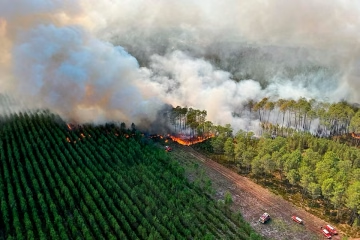
With wildfires in recent months threatening vineyards from Bordeaux and the surrounding Gironde to Spain’s Meseta region and British Columbia’s[…]
Read more
Wines made from old vines have a more powerful phenolic structure, greater aromatic complexity, and more intensity with respect to expressing the characteristics of the vineyards they were sourced from.
Read more
Professionals who consider detecting and identifying aromas part of their stock in trade would be far more confident about their abilities if they had a better understanding of how the senses work together to interpret aromas.
Read more
Thanks to new research about quercetin, the list of culprits in wine falls into three primary categories: tannins, biogenic amines (BAs), and alcohol.
Read more
Anywhere from 1% to 4% of the population is affected by aphantasia, meaning their mind’s eye is effectively blind.
Read more
Bubbles are the hallmark of all sparkling wines, and they play a significant role in the cachet that surrounds this category. Even the terms “bubbles,” “mousse,” and “Champagne” elicit a pleasurable response in expert and novice consumers alike.
Read more
Of the more than 1,000 compounds that make up wine’s aromatic profile, desirable aromas are represented by a combination of 82 different volatile compounds, only some of which are detectable when present above threshold.
Read more
A wine’s scent is one of the best indications of its quality. The hedonic effects of wine are influenced by hundreds of volatile aroma compounds, making it one of the most complex of food and
beverage products.
With the creation of a new Tawny Port and White Port categories in March 2022, bottles sporting a 50-year age[…]
Read more
Wine aromas are t work when we pour a glass of grassy Sauvignon Blanc and feel a deep sense of relief.
Read moreResearchers have identified compounds responsible for coconut and dried fruit aromas in red grape must and new wine.
Read more
As a species, we’ve been eating and drinking to intentionally alter our states of perception ever since. For generations, the indigenous peoples of the Congo, Nigeria, and Ghana have used the fruit (and leaves) of Synsepalum dulcificum, a shrub indigenous to West
and Central Africa, in ethnomedicine. The taste-altering properties of this flavorless, bright-red berry—dubbed “the miracle fruit,” it’s about the size of a coffee bean—make for a fascinating sensory experience.

Of the five senses, smell in Western culture has gotten a bad rap. In the English language there are fewer positive equivalents for the sense of smell than there are for the other four senses. You might sniff out a deal or smell a rat but the terms for nose in our vocabulary particularly as they relate to wine are more often than not derogatory (snobby, snooty, snotty, etc.).
Read more
In the course of developing software for predicting consumer wine preferences, a Houston-based start up, VineSleuth, shed new light on[…]
Read more
Primary wine flavors (the combination of aromas and tastes) come from the grape variety itself and are almost always fruity except when they’re not. Secondary aromas are those associated with post-fermentation winemaking and include yeast, lees, yogurt, cream, butter or cheese and a full spectrum of flavors derived from oak. Tertiary flavors are defined as deliberate oxidation, fruit development, bottle age or any combination thereof.
Read more
There’s no question that glassware can alter our perceptions of wine. It’s a phenomenon experienced by every resourceful consumer who[…]
Read more
A Cornell University study suggests that including sensory descriptors on tasting sheets can reduce sales in the tasting room. Contrary[…]
Read more