Alcohol plays a synergistic role in amplifying the tannins and amines that cause wine headaches.
The unwelcome side effects that can result from drinking wine including headaches and hangovers are a common complaint, particularly among red wine drinkers. Determining why you’re experiencing symptoms begins with understanding the compounds in wine that can cause problems and then taking measures to reduce their negative effects.
Thanks to new research about quercetin, the list of culprits in wine falls into three primary categories: tannins, biogenic amines (BAs), and alcohol. While the compounds that trigger hangover symptoms for one individual may have no impact on another, alcohol impedes our ability to metabolize them and, in the case of the amine histamine, even stimulates the production of more.
Although the synergy between these compounds is complex, once you’ve determined which are responsible for triggering your individual response, it’s very likely you can reduce or even eliminate their effects. While histamines and sulfites can pose challenges for wine drinkers who are particularly sensitive to those compounds, quercetin has been identified as the likely culprit for most wine-related headaches.
Quercetin, a pigment found in many plants, fruits, and vegetables, is one of the most common and well-researched flavonoids. With more antioxidant power than vitamin C, vitamin E, or beta-carotene, it is highly beneficial to human nutrition. However, high levels of quercetin like those found in ultra-premium red wines can interfere with the metabolism of alcohol by inhibiting the production of aldehyde dehydrogenase (ADLH), an enzyme produced by the liver that breaks down acetaldehyde. When acetaldehyde isn’t metabolized fast enough, it can trigger hangover symptoms like flushing, headaches, and nausea.
The amount of quercetin present in a finished red wine is initially determined by the vineyard. Studies like an August 2006 report in the Journal of Food Composition and Analysis have found that prolonged sunlight exposure during the growing season produces grape clusters with as much as ten times higher quercetin content than that found in shaded clusters.
The way we metabolize compounds like histamines and tannins like quercetin varies and is probably linked to our genetics. For example, about 40% of East Asians have a dysfunctional form of ADLH, which is why they disproportionately experience facial flushing and hangovers when drinking alcohol.
Relief from wine headaches
For those afflicted by these headaches, there may be some relief in sight in the form of a compound extracted from the Japanese raisin tree (Hovenia dulcis). Dihydromyricetin (DHM) is widely known for its ability to promote alcohol metabolism in the liver and reduce hangover symptoms. While DHM supports the breakdown of alcohol and lessens its intoxicating effects, it doesn’t directly influence the specific metabolic pathway involving quercetin’s conversion to quercetin glucuronide that results in acetaldehyde buildup.
According to Daniel Morando, a wine industry veteran and founder of supplement brand The Wine Fix, DHM helps reduce excess acetaldehyde by enhancing the activity of ALDH. By accelerating the breakdown of acetaldehyde, DHM helps to clear it from the body more quickly.
Morando, who has spent the past 15 years working in wholesale wine sales across Southern California, discovered DHM while searching for relief from wine-induced headaches. “Two glasses of Napa Cabernet were giving me worse headaches than four bourbon Manhattans,” he says. “I wasn’t overindulging; I was reacting to something.” That “something” was acetaldehyde.
For those afflicted by these headaches, there may be some relief in sight in the form of the compound dihydromyricetin which is extracted from the Japanese raisin tree.
Following a tip from a fitness influencer, Morando began exploring DHM. When he experienced relief, he founded The Wine Fix, selling bottles of 90 650-milligram capsules of pure DHM (no additives) online for $50. After trialing various dosages, he recommends taking one capsule for every two glasses of wine. “One of my greatest pleasures is a blockbuster Cabernet Sauvignon—something I thought I’d never be able to enjoy again without consequences,” he says.
Our sense of smell (olfaction) is more powerful when paired with sight. Photo credit: Shutterstock
Although we can discriminate between an estimated 1 trillion different odors, human olfaction compared to that of other species is much maligned. Professionals who consider detecting and identifying aromas part of their stock in trade would be far more confident about their abilities if they had a better understanding of how such aromas are interpreted by our bodies.
Over the years I’ve discussed olfaction from many different angles, but I’ve never drilled down much past transduction— the conversion of volatile aroma compounds into the electrochemical signals our brains process—to understand what’s actually taking place within our expanded olfactory system.
Interestingly, the human olfactory genome contains a large number of what are known as pseudogenes, or products of gene replication, which suggests that olfaction became less important over the course of our evolution. More than 70% of the olfactory receptors encoding genes in humans are actually pseudogenes, differentiating us from rats or primates, which have less than 5%. The African elephant tops the mammalian olfactory gene chart with 2,000 genes; dogs can possess up to 1,200, while humans have only about 400.
Despite this, accessory functions gained during evolution allow us to identify thousands of aromas. Once early humans became bipedal, their noses were farther from the ground, making smells easier to perceive individually. Although our olfactory organs grew smaller, they did so without many sacrifices to sensation.
Meanwhile, our adoption of fire radically diversified the odors and tastes of food. It can be said that no other species of mammal or primate ever benefited from this type of olfactory stimulation during their period of evolution.
Anthropologists initially thought that when the size of our brains increased, our olfactory receptor organs became secondary to the senses of vision and hearing. But they overlooked the integration areas of olfaction, which are many. For example, olfaction is enhanced by a secondary system through the sensitive branches of our trigeminal nerve, and many odorants can produce sensations that are transmitted by them. My favorite example of this is camphor, which produces a cold sensation via the trigeminal nerve. Researchers postulate that about 70% of odors also stimulate the trigeminal nerve, albeit with less intensity than our receptors.
Cognition amplifies olfaction
The cognitive component of olfaction, which according to researchers is not found in other species, includes the ability to discriminate between and compare odors. The process of analyzing olfactory perception is a synergistic one that uses not only smell but also taste, language, and memory. In other words, our reduced repertoire of genes for olfactory receptors is compensated for by the great processing capacity of our brains.
While our sense of smell is no longer necessarily vital to survival in humans, it plays a part in attaching emotional resonance to things (think homecooked meals). That said, it is more powerful when paired with sight. Humans may use their sense of sight more, but through smell, we can determine such things as the quality and consistency of the foods and beverages we are about to ingest.
The maxim “the nose smells what the eyes see” refers to cross-modal interactions in which our senses communicate. Visual cues can strongly influence our perception of smells; they can make us think we smell something even if the odor isn’t there (a phenomenon known as phantosmia).
Conversely, smells can alter what we see: Through the phenomenon of spatial perception manipulation, for instance, cool scents such as cucumber can make a room seem larger, while warm ones like barbecue spice can make it seem smaller. These make for a richer but sometimes misleading olfactory experience.
Fleur Geffrier, Antoine Chappey and Tomohisa Yamashita in “Drops of God,” now streaming on Apple TV.
French wines takes center stage in sequal
In season two of “Drops of God,” what begins as a pursuit of legacy for Camille (FleurGeffrier) and Issei (TomohisaYamashita) becomes a search for truth that spans continents and centuries. Their challenge: to uncover the origin of the world’s greatest wine, a mystery so profound that even their legendary father, Alexandre Léger, could not solve it.
Their search pushes them to the edges of the world, and in to the darkest corners of themselves — unearthing forgotten histories, hidden rivalries and secrets buried for generations. Camille and Issei must decide how much they are willing to sacrifice. The answer could shatter their bond as siblings or spell disaster for them both. Read the Wine Spectator’s interview with Fleur Geffriere about season two here.
The wine professional behind the series is Seb Pradal who returns this season as the series’ sommelier consultant, working closely with the actors and the creative team to ensure authenticity in the wine-related scenes, as well as ensuring accuracy in the professional techniques portrayed. I interviewed him in this article during the debut of season one and dined at his restaurant La Petite Régalade restaurant when in Paris later that year. Pradal selected the wines for both seasons and not surprisingly, the majority are French.
A Guide To The Wines Featured in “Drops of God” Season Two
France: Champagne Billecart-Salmon, Champagne Pol Roger, Champagne Jacques Selosse, Hermitage Domaine Jean Louis Chave, Bourgogne Domaine Marquis d’Angerville, Terrasse du Larzac Mas Jullien, Sauternes Chateau d’Yquem, Bourgogne Domaine Roulot, Saint-Joseph Domaine Merlin, IGP Aveyron Domaine Montrozier «Calibre 12», Bourgogne Domaine des Comtes Lafon, Volnay Domaine Y. Clerget, Crozes Domaine Emmanuel Darnaud, Château Grillet, Bourgogne Clos des Tart (cases seen), Bourgogne Domaine d’Eugenie (cases seen)
Season two was filmed across five countries: Japan, France (Rhône Valley, Provence, Paris, Marseille), Greece, Spain and Georgia, a region rich in winemaking history, which influenced the selection of wines featured this season. You can find additional details linked in the production notes for the seriesHERE.
Pradal whose credentials are lenghty and impressive served as a sommelier consultant throughout the writing of the Apple TV series “Drops of God.” He worked closely with the actors and the creative team to ensure authenticity in the wine-related scenes, as well as ensuring accuracy in the professional techniques portrayed.
He was awarded Best Young Sommelier, Chapoutier of France in 1997. He is a passionate entrepreneur and artistic consultant. With a rich background in the world of wine, he combines technical expertise, a strong sense of hospitality, and strategic vision. His activities span fine dining, wine distribution, viticultural consulting, and professional training.
As the founder and director of Les Vinosaures, he supports winegrowers in their commercial development. The agency specializes in selecting and representing prestigious wine estates from Burgundy, Bordeaux, the Rhône Valley and beyond; prospecting with ORECA networks; organizing professional tastings; and leading wine-related events.
He is owner of La Petite Régalade restaurant in Paris where he showcases French gastronomy in a warm and convivial atmosphere. The wine list, designed as an invitation to travel, highlights independent producers and distinctive cuvées.
In 2022, together with his long-time business partner Joël Léger and chef Juan Arbelaez, Pradal co-founded an importing company in Mexico, later expanding into Colombia. The wines from leading winegrowers are distributed to restaurants, including those recognized by the Michelin Guide, which began awarding stars in Colombia in 2024.
Calls for optimism are the theme of new year missives from wine industry colleagues near and far. One in particular came from a Northern California winemaker who is puzzling over the lack of adoption by Gen Z consumers, an increasingly fragmented and dispirite domestic market and included a request for insights that might inspire hope.
In response, I shared some of the Gen Z survey data that I’ve been gathering as part of a research study of these novice consumers at San Jose State University. His response; “[this] gives me hope” which in turn inspired me to share some of the more interesting points from the study here.
Hundreds of Gen Z students enroll in wine appreciation classes at San Jose State each year many of whom profess to never having tasted wine or even to outright dislike. Curiosity seems to be the driving force behind their willingness to commit 18 weeks to the subject of wine. But why they enroll has not been a primary concern of the study.
Using a course curriculum designed specifically to develop wine likers – students can choose to taste sweet/off dry and dry wine styles during the course – which covers everything from sensory awareness and wine history to the fundamentals of the world’s key wine producing regions.
At the conclusion of the course, students are asked to complete a survey designed to gauge their preferences and attitudes towards wine. The results offer some surprises and provide direction for future studies that will shed more light on how quickly different types of tasters embrace dry styles.
Gen Z Wine Appreciation Survey 2025
Deeper analysis of the survey responses is underway so, for the time being, take what you will from the below summary.
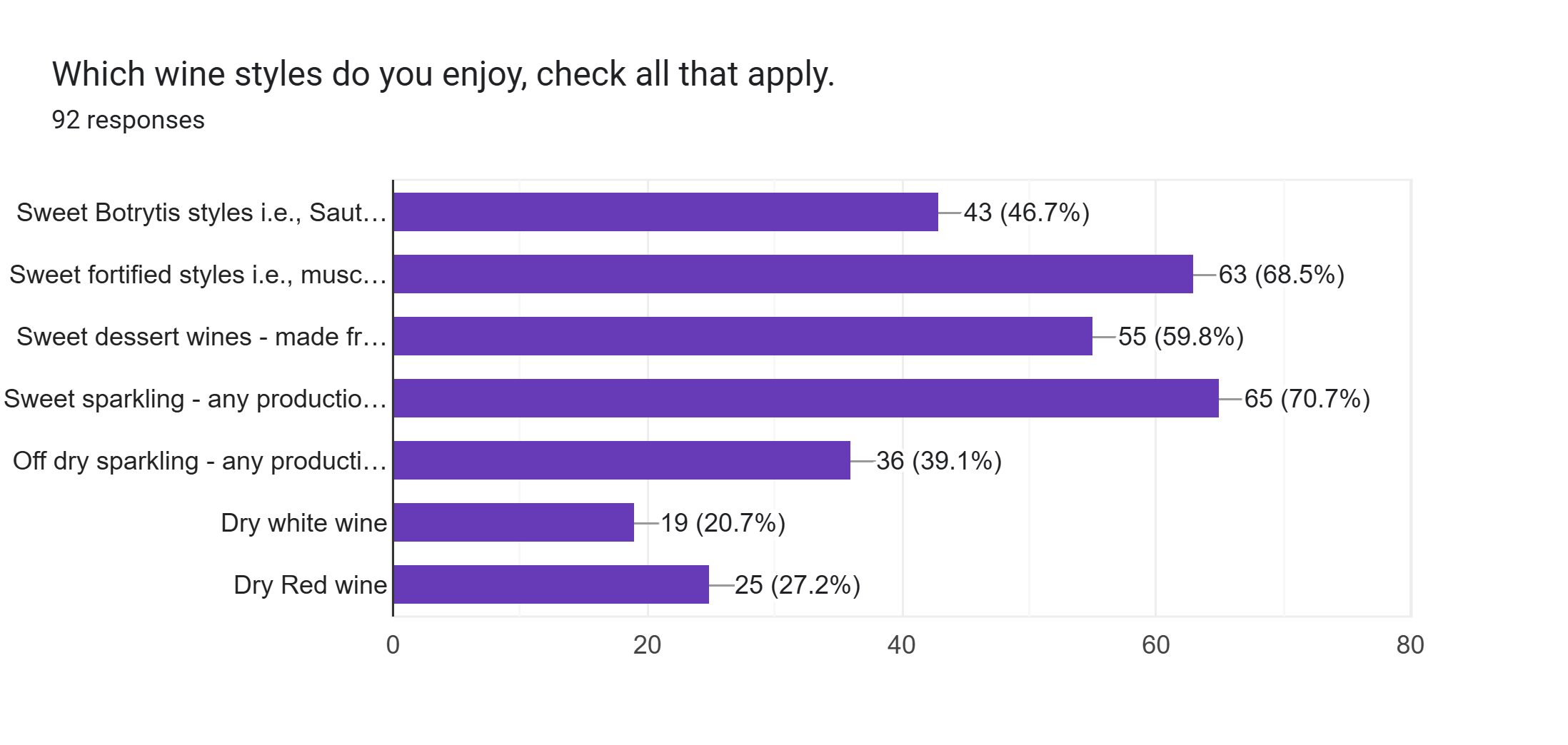
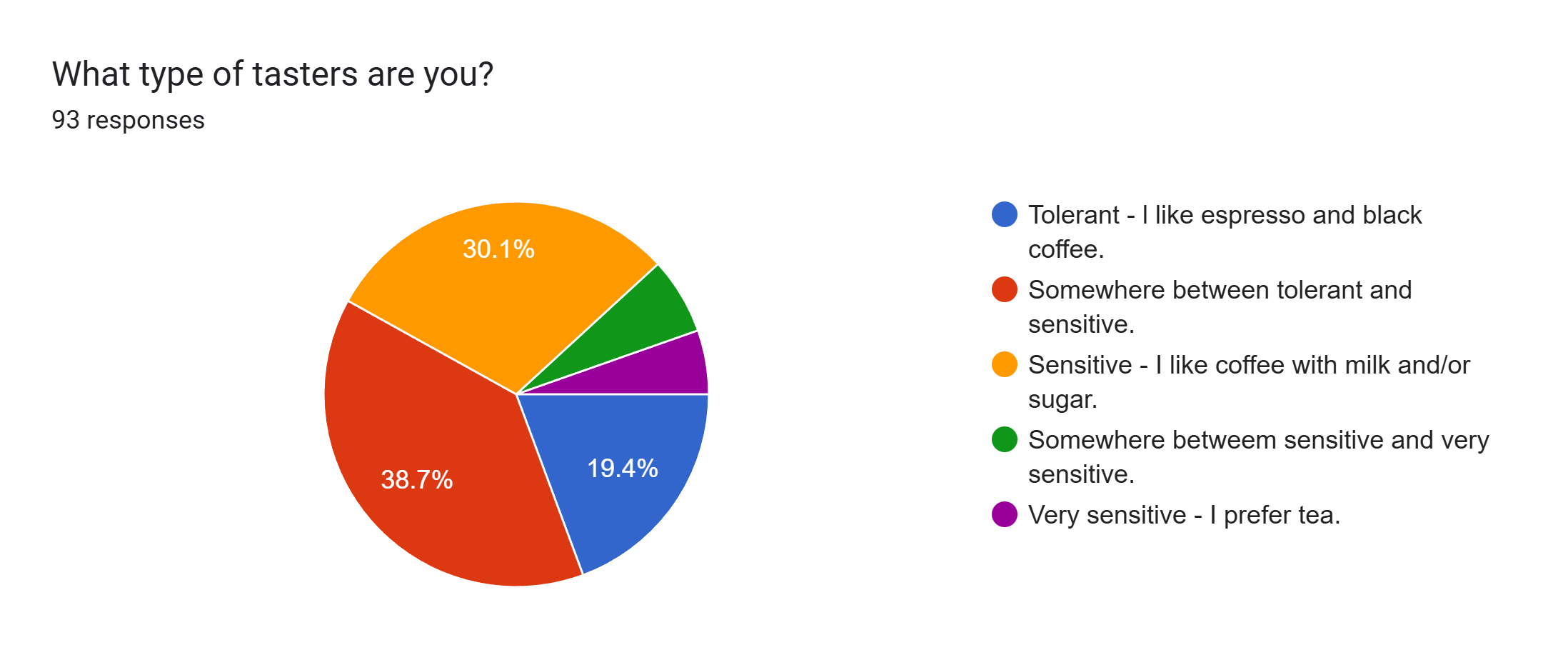
The taster categories of tolerant, sensitive and very sensitive are those defined by the Wine and Spririt Education Trust but the survey question was expanded to reveal more nuance regarding the tasters’ perceptions after 18 weeks of wine evaluation training. With the majority of tasters being tolerant or somewhere between tolerant and sensitive, this indicates a greater tolerance for bitterness and complex, robust flavors found in both sweet and dry wine styles. In the below wine style by preference chart you’ll find that students state by name their preferences for a broad range of sweet and sweet fortified styles that they tasted during the class.
Preferences for dry styles naturally evolve more quickly for some types of tasters than others. Once students discover wine styles they enjoy that evolution seems to speed up as their curiosity and interest are peeked by exploring a broad range of production styles and aging regimes.
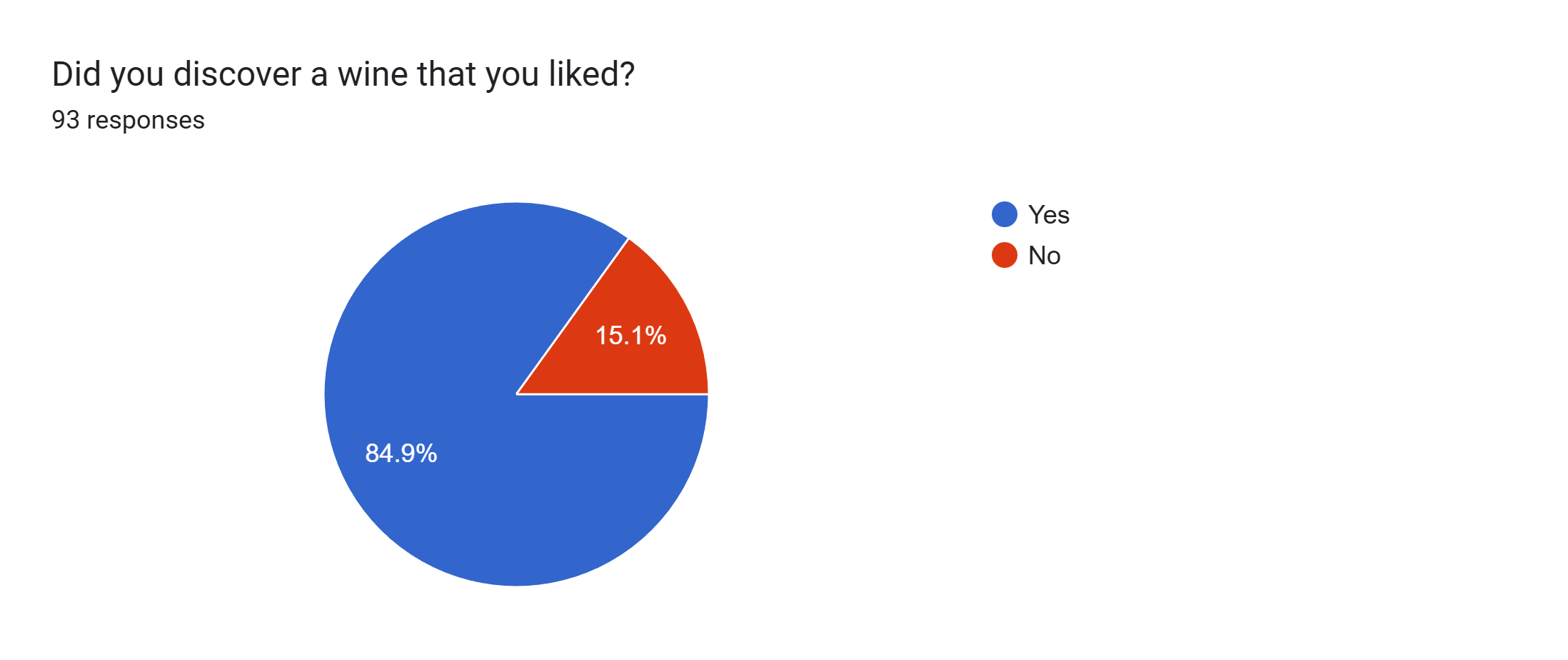
Despite being exposed to a pantheon of the world’s historic sweet and off dry wine styles, many of which novice tasters would rarely encounter independently, and classic dry wines, at the end of the 18-week class a surprising number of students – 16 percent of those surveyed – reported they did not discover a gateway wine defined as a wine they “liked.” This could be interpretted as they simply prefer other types of beverage alcohol over wine. The remaining 84 percent can be described as “wine likers.”
Students’ engagement in the course is evidenced by their responses to short answer questions like the one above in which they could recall and correctly state the specific wine or wine style they preferred. Specific wines i.e. the Quady Essencia and spatlese Riesling emerged as favorite white wines with Brachetto leading the pack for favorite red. Surprisingly, esoteric wines including Mavrodaphne of Patras, Vin Santo and Pedro Ximenez sherry were called out by name by tolerant tasters.
Despite 16 percent of tasters not finding a gateway wine, 99 percent of students felt the class enhanced their enjoyment of alcoholic beverages in general.
Hundreds of wine curious Gen Z students enroll in my Wine Appreciation class at San Jose State University each year. The majority are novice consumers of all beverage alcohol types and many have never tasted wine or profess they only like sweet wine when signing up for 18 weeks of wine immersion.
They are a strikingly diverse group hailing from a dozen different nations and speaking just as many different languages. The one thing 85 percent of this cohort has in common, they enjoy and appreciate the world’s historic sweet wines.
The semester-long curriculum for this course follows a slow build towards introducing the world’s wine regions. Students first learn the mechanics of their own physiology by studying olfaction, gustation and the sensations of texture and temperature all of which comprise flavor. They achieve working mastery of the Wine and Spirit Education Trust Systematic Approach to Tasting (SAT) within a few weeks and, by working with it begin to understand their own thresholds and preferences.
This foundational training prepares them for studying the wines of the U.S., France, Italy, Spain, Germany, Australia, New Zealand, Chile and Argentina. Given that 85 percent of the students indicate they prefer off dry and sweet wines, there’s a wealth of delicious, historic wines to show them.
Sweet wines of the world
France is a treasure trove of sweet and fortified historic styles. Students respond with enthusiasm to the botrytized Chenin Blancs of the middle Loire Valley that include everything from demi-sec and moelleux Vouvray to Quarts de Chaume, the Vendanges Tardives and Sélection de Grains Nobles of Alasce, the vins doux naturels of Beaumes de Venise and Roussillon, Sauternes and the ethereal sweet wines of the Premières Côtes de Bordeaux.
The wines of Italy’s Prosecco, Asti and Brachetto regions are widely enjoyed and led to discoveries of Recioto della Valpolicella and Recioto di Soave, the joys of Lambrusco, the complexity of vin Santo, the rarified passito wines of Pantelleria and Liguria’s Cinque Terre.
In a discussion assignment asking students to rank three sweet wines from Northern Italy, Brachetto d’Aqui edged out Prosecco with a Lambrusco trailing in distant third. The makers of Brachetto know full well novice consumers enjoy their wines and students only need an introduction to the wine to start seeking it out on the shelves of Eataly or Total Wine & More.
Germany’s Pradikat wine styles serve as an ideal training ground for dialing in students’ thresholds for the perception of residual sugar. In a blind tasting exercise with Kabinett, Spatlese and Auslese wines made the the same producer from the same Mosel vineyard and vintage, they learn to gauge the increasing levels of sweetness and to discover the electric tension between acidity and residual sugar that are the hallmarks of these styles.
Rare and complex historic wines like Mavrodaphne of Patras resonate with students who enjoy Pedro Ximenez sherry and more complex vins doux naturels.
In a recent survey of 93 students, sweet wines of all styles outperform dry styles.
Gen Z survey says
When asked about their taste tolerance levels, 58 percent of students are either tolerant or between tolerant and sensitive tasters (WSET).
The good news for producers of dry wines. By the end of the semester, over 20 percent of students are enjoying dry wines and almost half of the students who began the semester with little or no interest in dry wine styles are more interested in exploring.
The most sobering data point from the survey reveals that despite being exposed to a plethora of wine styles, 15 percent of students indicate that they did not find a wine they enjoyed which I refer to as a gateway wine. One student commented, “Before [this class], I thought I hated all wines and that they all tasted the same. But after this course, I’ve learned that there are so many types of wine with different styles of taste. Although I don’t love it, I can appreciate it much more.”
When wine curious Gen Z consumers are shown high quality sweet wines and given some basic information about the origins of the wine and the methods used to make them, their appreciation and liking for those wines increases. As these wine styles cost more due to their production methods, the biggest hurdle for their adoption is price.
The message my students are sending to the makers of the world’s historic sweet wines amounts to a love letter. My passion for these historic wines can only be described as a love affair.
The University of California, Davis,has a long history of groundbreaking research that has significantly impacted the global wine industry.
Standing on the shoulders of giants
With the retirement of several key academics whose research in the areas of grapevine genetics, fermentation science, and sensory science has played a crucial role in the development and advancement of the modern American wineindustry, the Department of Viticulture and Enology now has new leadership. In January 2024, Benjamen Montpetit began his tenure as the Marvin Sands Endowed Chair in the department, succeeding David Block, who spent nearly 13 years in the role.
Montpetit’s journey
Montpetit’s journey from studying biochemistry to assuming leadership of the world’s top wine-science department was a natural progression. After earning a Ph.D. from the University of British Columbia, he made his way to the University of California, Berkeley, for postdoctoral research in gene expression regulation using yeast species Saccharomyces cerevisiae.
As a self-described foodie, Montpetit had already formed a deep personal connection to Vancouver’s multicultural restaurant scene, but it was a memorable glass of Navarro Riesling during a celebratory lunch with his wife at Chez Panisse that connected him to California’s wine culture.
Benjamen Montpetit is the Marvin Sands Endowed Chair in the Department of Viticulture and Enology at the University of California, Davis.
Though he soon went back to Canada to spend the next four years at the University of Alberta in Edmonton exploring human disease mechanisms using yeast, Montpetit found the perfect opportunity to return to the Bay Area and join UC Davis as profes sor of yeast biology when renowned researcher Linda Bisson retired in 2016. He then served as vice chair of the department from 2021 to 2023 and was appointed the Richard M. Kunde Endowed Chair in Viticulture & Enology in late 2024 (a title he holds in addition to his other chairmanship).
Currently, Montpetit’s lab has two major areas of focus. One is the study of the genetics and origins of yeast in spontaneous fermentations in an attempt to create more efficient and site-driven wines using yeast strains that are unique to California. And the other is an examination of yeast as a model organism to inform biomedical sciences and human biology-research that according to Montpetit is funded by both the National Institutes of Health and the National Science Foundation.
During Montpetit’s tenure, the department has also focused on launching two new minors: a viticul ture and enology minor for STEM students and a wine business and science minor in partnership with the Department of Agricultural and Resource Economics.
His role as a professor includes instructing both undergraduate and graduate-level courses spanning topics from wine microbiology to production as well as the ever-popular spring seminar that brings industry guest speakers and alumni together with students. He also supports the student led Davis Enology & Viticulture Organization, which organizes free wine tastings and trips.
Following the passage of Senate Bill 918, a state law that UC Davis successfully championed, the university recently began selling wine to the public through Hilgard631, a 501(c)(3) nonprofit that makes it possible for the Department of Viticulture and Enology to sell student-made wine, with proceeds funding student scholars. The inaugural winesmade by Montpetit’s students include a 2020 Cabernet Sauvignon and a 2024 Sauvignon Blanc made with grapes from Oakville Station, UC Davis’ research and teaching vineyard in the heart of Napa Valley.
Find Hildegard631
The winery sells Sauvignon Blanc, Albarino, Chardonnay, Petit Syrah and Cabernet Sauvignon blends. The Hildegard631 Cabernet Sauvignon, a blend of 85% Cabernet Sauvignon, 8.5 % Cabernet Franc, 6 % Merlot, and 0.5% Petite Sirah is sourced from the Oakville AVA in Napa Valley. Described as a bold, classic expression of Oakville, the 2020 Cabernet Sauvignon is powerful yet refined, with depth and aromatic complexity.
Aromas of blackberry, black cherry, and boysenberry are interwoven with notes of fresh roses, cassis, vanilla, and black pepper. Hints of dark chocolate, tobacco, and baking spices enrich and complete the bouquet. On the palate, dark fruits take center stage: plum, black currant, and black raspberry framed by silky tannins. Notes of bittersweet chocolate, espresso, and anise unfold alongside mocha, toasted cedar, and clove, revealing the influence of 22 months in medium toast French oak barrels. The finish is long and structured, with lingering spice, leather, and a touch of oak that speaks to its age worthiness and balance.
The wine sells for $125 a bottle and can be purchased from the Teaching and Research Winery, details at Hilgard631 – Wine
The term aphantasia has been around since 2015. It was coined by Adam Zeman, a professor of cognitive and behavioral neurology at the University of Exeter in the United Kingdom, based on the classical Greek term for imagination, phantasia, defined by Aristotle as the “faculty/power by which a phantasma [image or mental representation] is presented to us.’”
In his lastest book, Message in the Bottle: A Guide to Tasting Wine, Master Sommelier Tim Gaiser writes about a technique for manipulating mental images in order to deconstruct the flavor profile of wine. It’s a visualization technique that he’s perfected and that can be used by anyone who can see with their mind’s eye. But for the small percentage of individuals with aphantasia, or the inability to generate mental images, the exercise can be replicated with verbal clues in lieu of visual clues.
Zeman’s work is based on a famous “breakfast table” experiment conducted in 1880 by Sir Francis Galton, who studied the vividness of mental imagery. Galton asked participants to recall and describe their breakfast table, focusing on brightness and color, definition, and scale. His experiments revealed that some individuals had strong mental imagery, while others struggled to visualize anything or saw nothing at all, illustrating the phenomenon now known as aphantasia.
Anywhere from 1% to 4% of the population is affected by aphantasia, meaning their mind’s eye is effectively blind. This condition can be congenital or occur as the result of an injury, as in the case of the patient that Zeman studied, who suffered aphantasia following heart surgery. Researchers attribute it to a disruption of the brain’s visuospatial sketchpad, a component of working memory that reduces the vividness of mental images when information is being retrieved from long-term storage.
Stages of aphantasia, left to right: aphantasia, hypophantasia, hyperphantasia. Image credit: Deborah Parker Wong
Aphantasia definitions
In addition to full aphantasia, there are several stages attributed to the perception of visual imagery including hypophantasia, or a limited ability to see imagery and hyperphantasia, a photographic-quality visual image. Multisensory aphantasia extends to the other senses as well. Aphanatics may experience:
Auditory prevents the mental recreation of sounds, voices, or music.
Olfactory involves the inability to mentally recreate or imagine smells.
Gustatory affects the ability to mentally recreate or imagine tastes.
Motor presents as the inability to mentally rehearse or imagine movements or actions.
Tactile involves the inability to mentally recreate or imagine sensations of touch or texture.
In an article for Nautilus, “My Brain Doesn’t Picture Things,” author Marco Giancotti explains that the only thing he sees when prompted to visualize everyday objects is “the dark underside of my eyelids.” With roughly one out of every 25 people experiencing aphantasia, it’s common enough to require alternatives to traditional visualization techniques often used in behavior modification and psychotherapy.
According to Giancotti, confusion about aphantasia comes primarily from the assumption that “imagination” and “forming mental images” are the same thing. He can form spatial thoughts, but without any accompanying imagery, “I’m fully aphantasic, including sight, smell, taste, and sound, unlike others who have low levels of imagery [yet] do dream in images,” he said.
The consensus among researchers is that aphantasia is a normal variation in human cognition. It doesn’t meet the criteria to be called a disability largely because aphantasics use different, less direct or alternative cognitive strategies for recall of visual memories and, unlike Giancotti, typically have the ability to imagine sounds, flavors, or other nonvisual sensations.
The good news for aphanatics is that there are alternative cognitive strategies for tasks that involve mental imagery that lead to equally successful results. “While many tasters use internal imaging to recognize and remember aromas and flavors in a glass of wine, other modalities such as auditory and kinesthetic can also be effective and useful,” says Gaiser.
Anatylical models shed light on the inner workings of wine competition scoring
In 2021, The prestigious Concours Mondial de Bruxelles (CMB) wine competition began using artificial intelligence (AI) developed by Winespace, a Bordeaux-based firm founded by Sylvain Thibaud and Julian Laithier in 2015, as part of its judging protocol as a value added feedback mechanism for producers. (CMB also collaborates with UC Louvain in Louvain-la-Neuve, Belgium, on further analysis that evaluates the performance of its juries and judges.)
Winespace’s aroma wheels for two entries in the Concours Mondial des Bruxelles competition—one white wine (above) and one red (below).
I first experienced Winespace’s rubric for sensory analysis when judging the México Selection by CMB, held in Guanajuato, Mexico, in 2021. At the time, its technology was a promising prototype, and the collaboration with CMB helped Thibaud and Laithier to commercialize what is now a robust platform called Tastee AI that has since been adopted by CMB and others.
In April 2024, I used the tasting grid again during the Sauvignon Selection by CMB held in Leibnitz in the Austrian state of Styria, where a panel of judges recorded tasting notes in as many as eight different languages. The technology seamlessly translated and analyzed those notes and compiled a sensory analysis for each wine.
According to Thibaud, the resulting reports, which have been shared with producers for the past two years, offer a collective picture of the wine’s quality and style in the form of summarized tasting notes, an aroma wheel, a list of specific strengths and weaknesses, and comments for improvement.
“From the CMB’s point of view, this approach also reflects a desire for transparency in the wine assessment process, thereby reinforcing the industry’s confidence in the seriousness and value of the medals wine competitions award,” he observes.
Deeper analysis of performance by wine competition judges
In the future, Winespace plans to provide feedback to each judge on their taste preferences, scoring style, and other criteria. “One of the aims of analyzing comments is to identify the preferences and writing habits of each taster and to better understand the frequency of the concepts and descriptive vocabulary they use,” explains Thibaud.
“We can also identify the criteria they seem less sensitive to and areas where they are less expressive.” This type of rigorous analysis soundly debunks the commonly held belief that wine sensory evaluation is purely subjective. For example, analysis of my five-person jury for the 2024 Sauvignon Selection competition (provided by CMB and prepared by Christian Ritter of Ritter and Danielson Consultingalong with UC Louv revealed a highly correlated panel working with astounding consistency.
This eggshell plot illustrates
the performance of a coherent jury,
one that arrived at a consensus in their
scoring when evaluating wines of the same
or similar quality (namely Sauvignon Blancs
from world-class regions).
The eggshell plot shown here illustrates the performance of a coherent wine competition jury, one that arrived at a consensus in their scoring when evaluating wines of the same or similar quality (namely Sauvignon Blancs from world-class regions). The panelists’ close alignment is represented by the cluster of jagged curves just above the smooth curve, which is the control metric for a theoretical jury with identical scores.
This is one of half-a-dozen metrics reported by Ritter, all of which are immensely useful in understanding my performance and the performance of my colleagues over the course of the competition. Metrics of this caliber could help the industry address valid concerns about inconsistency in scoring caused by the different models and scoring systems used by commercial wine competitions.
In a further exploration of Tasteee.ai in practice, I conducted a study on sensory training methods for novice wine consumers which was presented at the American Society of Enology and Viticulture on May 18, 2025. The three-phase study determined that despite consumer and marketing research pointing to preferences for gamification and hedonic learning experiences, a Gen Z cohort showed no preference for gamification over the traditional rubric/lexicon models used by the Wine & Spirit Education Trust or the Court of Master Sommeliers.
Paul Carayas, GM/Wine Director of San Francisco’s Saison Cellar & Wine Bar, is an arbiter of affordable luxury
With close to 30 years of industry experience, Paul Carayas, general manager and wine director of San Francisco’s Saison Cellar & Wine Bar, exemplifies leadership and hospitality, defying the stereotypes of snobbery that are often associated with the sommelier profession.
Although he has studied with the Court of Master Sommeliers, Carayas credits astute mentorship and self education as the driving forces behind his obsession with wine. His success, however, could also be attributed in part to values he acquired early in life.
Wine director Paul Carayas credits astute mentorship and self education as the driving force behind his obsession with wine.
Early leardership roles
By the age of 15—when most teenagers would be relegated to jobs like bussing tables and washing dishes—he was working as a host in the small town of Surprise, Arizona. He credits the fact that he had the maturity and people skills to succeed in that role to the years he spent participating in the Boy Scouts of America. “I became an Eagle Scout when I was 13”—just 5–7% of Scouts earn that rank by age 18—“and by that time, I already had leadership and public speaking experience through scouting.” It’s clear the earnestness and grace that radiate through his professional comportment began there.
After attending Arizona State University to study business management, Carayas went to the University of California, Santa Barbara, where he credits the release of the movie Sideways in 2004 for sparking his interest in the Pinot Noirs of Santa Ynez. “
At the time, all my friends were getting into wine, and it was then that I began tasting on regular basis,” he recalls. It was his move to San Francisco in 2008 that cemented his career in wine. There, he joined Jesse Ziff Cool at Flea Street Café. “Jesse has been a part of the Slow Food movement for decades, and she puts a lot of emphasis on place and producers,” he notes.
He was mentored by Flea Street’s wine buyer, who taught him how to taste with sales representatives and to sell wine, and eventually became the restaurant’s wine and beverage director.
Not long after, he began a leadership role managing the wine program at the one-MICHELIN-starred Chez TJ in Mountain View where he increased profitability by curating pairings of older vintages, adding Coravin pours, and building a full bar program.
When his nine-year tenure at Chez TJ came to a close, Carayas spent a month in Bourgogne, where he attended the annual Grands Jours de Bourgogne. There, he spent time tasting with restaurateur Mark Bright and returned last August to open Saison Cellar & Wine Bar in the former Les Clos and Petit Marlowe spaces under Bright’s leadership.
For the newest concept in the portfolio of Saison Hospitality, which operates the MICHELIN-starred Saison and Angler restaurants as well as Saison Winery, Carayas expertly oversees the by-the-glass and bottle lists, designed to complement a light menu offered at prices he describes as “affordable luxury.” As he puts it, “We’re a taste of the MICHELIN experience without the MICHELIN bill.
Bubbles are the hallmark of all sparkling wines, and they play a significant role in the cachet that surrounds this category. Even the terms “bubbles,” “mousse,” and “Champagne” elicit a pleasurable response in expert and novice consumers alike.
Image (a) depicts bubbles ascending in a laser-etched glass containing 100 milliliters of Champagne; (b) shows a network of convective cells revealed through 3D computational fluid dynamics modeling; and (c) shows the corresponding velocity field along the axis of symmetry of the glass.
Though sparkling wine has been around for centuries—it first appeared in the early 16th century at the St. Hilaire Abbey in the Limoux region of Languedoc, France— its physicochemical properties properties have been studied only for the past two decades. At the Université de Reims Champagne-Ardenne, professor Gérard Liger-Belair’s group, Equipe Effervescence, Champagne et Applications, has compiled an overview of more than 20 years of research.
From a sensory standpoint, sparkling wines are in a class by themselves. The olfactory experience is one of continuous change as bubbles ascend and burst, releasing both CO2 and volatile compounds in the headspace of the glass. Surprisingly, they activate the same pain receptors in the brain that are triggered by spicy food in what is known as the “carbonic bite.” As we take a sip, they excite our mechanoreceptors, creating a tingling sensation in our mouths.
Once the cork or crown cap on a bottle of sparkling wine has been popped, the key to maximizing the duration of the bubbles comes down to 1) how the wine is poured and 2) your choice of glassware. Infrared imaging has revealed that pouring sparkling wine down the side of a tilted glass (as you would for beer) is a gentler method that preserves more of the dissolved CO2 that creates or nucleates the bubbles.
Natural and Artificial Bubbles
Bubbles themselves are categorized as “natural” and “artificial.” Natural bubbles are those that originate directly from dissolved CO2, while artificial bubbles are produced by unseen forces like microscopic cloth fibers or tap water tartrates that get into the glass during cleaning or by laser-etched glassware; in the latter case, the intentional imperfections in the glass trap tiny pockets of ambient air and trigger CO2 bubble nucleation or effervescence.
Snapshots performed through infrared imaging showing the massive losses of dissolved CO2 during the pouring of champagne in a vertically oriented flute (a), and in a tilted flute (b). (Université de Reims Champagne-Ardenne).
Higher activity in the glass, whether from natural or artificial bubbles, is subjectively perceived to be associated with higher quality, so the technical evaluation of sparkling wine should be conducted in unetched glassware.
Along with their activity, bubbles are also evaluated for their size. CO2 bubbles in sparkling wine rise in a line in the form of characteristic “bubble trains,” and they grow larger as they ascend to the surface of the glass. In a narrow flute, bubbles will appear about three times larger than in a standard glass or coupe. Due to the loss of CO2, older wines will have smaller bubbles (which are a well-known marker of older Champagne).
Distribution of the size of the bubbles floating on the surface of a Champagne wine, 30 s after the service, depending on whether champagne was served in a coupe (left), or in a flute (right) (scale bar = 1 cm). (Gérard Liger-Belair).
For the final say on glassware, gas chromatography reveals that you’re more apt to experience carbonic bite from a flute. Researchers agree that a tulip-shaped glass, shorter than a flute and narrowed at the top, delivers the optimal sensory experience. Either way, tasters are cautioned to pause before sniffing a freshly poured glass, allowing the liquid’s calmer flow patterns to reveal a truer sense of the wine’s aromas.
. Gaseous CO2 escaping from a flute (left) or from a coupe (right), revealed by infrared imaging, around ten seconds after the two glasses were served with 100 mL of champagne; The gas mixture above glasses is all the darker as it is concentrated with gaseous CO2 (scale bar = 1 cm). (Université de Reims Champagne-Ardenne).
According to neuroscientistCamilla Arndal Andersen, how consumers describe the taste of foods that include vanilla can be misleading largely due to inherent biases. Among the most problematic is the “courtesy bias,” which comes into play when people respond with what they see as a socially acceptable opinion that doesn’t accurately reflect how they feel. There’s also the “bias blind spot,” in which we think we’re less biased than others. In short, we’re biased about our biases.
We see the courtesy bias at work in the wine industry when consumers say they prefer dry wines but, when given a choice, favor wines that are off dry or have much higher levels of residual sugar. Arndal Andersen points out that even trained tasters aren’t immune to bias; for example, foods that contain vanilla are rated sweeter by professionals even if they lack sugar. This can be explained by our long association between the two ingredients, which is based on a lifetime of exposure to their use in baked goods and desserts.
A ripened Madagascar vanilla bean, typically called Bourbon vanilla.
Vanilla aroma wheel
Hidden compounds: the secret to aromatic complexityAs one of the few low-threshold odors we still find pleasant even past the point of overexposure, vanilla—aka 4-hydroxy-3-methoxybenzaldehyde—is known to have 170 volatile compounds, of which vanillin is dominant. The vanilla flavor wheel used by the flavoring company FONA International specifies 29 distinct flavor characteristics for natural vanilla that it groups into ten main categories: smoky, spicy, botanical, sulfury, sweet, creamy, medicinal, cooked, fatty, and floral.
The vanilla flavor wheel
Like wine grapes, natural vanilla grows in different places—among them Madagascar; Mexico, where it originated; or Tahiti—and has different taste profiles and potency. For example, Madagascar vanilla, typically called Bourbon vanilla, is highly sought after for its rummy taste and sweet aroma.
Vanilla production
Typically, vanilla goes through a ten to 16 month process from blossom to being ready for shipment. Scientific American notes that it takes 600 hand-pollinated blossoms to produce 1 kg of cured beans.
While still green, beans are picked and then sold to fermentation locations. There, the beans get sorted, blanched, steamed and dried in the sun. Afterwards, they are sorted again, dried again and fermented. All the while, beans are checked by workers for aroma and quality.
Often, one season is being dried, sorted and conditioned while another is blossoming and being pollinated. It’s a labor-intensive process and a time-sensitive one: the window to hand pollinate the beans is only one to two days.
Adding to this: vanilla orchids take a long time to blossom. It takes three to four years for a new plant to produce flowers (which turn into beans). So an orchid planted today won’t even be pollinated for several years.
The demand for vanilla flavoring, however, has long exceeded the supply of beans. Natural and synthesized vanillin are used to create the impression of sweetness in foods, as seen in the mass-market chocolate industry’s practice of adding synthetic vanillin to products to counter the bitterness of cocoa. With the growth and popularity of the sweet red blend category, it’s no surprise to find that vanilla/vanillin is a dominant flavor descriptor for this style, as it undoubtedly helps mask bitterness imparted by tannins.
When tasting across a commercial-quality range of single-varietal, and blended red wines from California for a recent sensory project, the use of vanillin-flavored oak alternatives left a ubiquitous stamp across all brands and varieties tasted. While the organic polymers known as lignins that are present in oak serve as one source of vanillin, few consumers know that an estimated 85% of the world’s supply of synthetic vanillin is derived from petroleum or crude oil. (The other 15% comes from the manufacture of cellulose.)
As for the perception of sweetness that vanillin can contribute to red wines, while we may be aware of unconscious biases, there’s little scientific evidence that supports the idea that heightened awareness will reduce the occurrence of bias in general. In other words, it’s very likely that we’ll still perceive vanillin-dominant red wines as tasting sweeter.
Laguna Ridge rises between Green Valley and the Santa Rosa Plains
Laguna Ridge is the smallest of the six neighborhoods of the Russian River Valley (RRV). Lying at the geographic heart of the region, this well-defined and expressive terroir is located between the Laguna de Santa Rosa wetland complex of the Santa Rosa Plains to the east and Highway 116 on the border of Green Valley to the west; it’s bordered to the north and south by River Road and Highway 12, respectively.
The landscape marks a clear transition from the plains as it unfolds in a series of gently rolling hills that reach 400 feet in altitude. The eastern and western exposures of the hills benefit from a marked downslope of air that flows out toward the east and west. Elevation is key here, as it helps drive the wideranging diurnal shift that can swing by as much as 40 degrees during the growing season and results in warmer winters than Sebastopol Hills experiences to the south. Spring temperatures are also higher, which means that Laguna Ridge tends to experience earlier budbreak, while summer temperatures are cooler than they are in neighboring Santa Rosa Plains and Middle Reach to the north.
Map of the neigborhoods of Russian River Valley AVA.
Despite the presence of the outer Northern Coast Ranges that define the Sonoma coastline to the west, a marked coastal influence is felt here. During the mornings, the hills are shrouded in fog, a curious ribbon of which clings to the ridge line until it’s burned off by the afternoon sun.
The soils that comprise these hills originate from the parent materials of the Wilson Grove Formation and the underlying, deeply eroded Franciscan Complex: The Gold Ridge–Sebastopol series is a deep sandy loam soil from weathered sandstone, while Altamont is reddish soil weathered from fine-grained sandstone and shale. Octagon soils that contain layers of clay can be found on the hilltops.
It’s common to find layers of volcanic ash and pumice interspersed with these sandstone-based soils. They were deposited when volcanic vents spewed ash over the seabed at a time when the ridge from which the neighborhood takes its name, running from Forestville to Sebastopol (and further south to Cotati), was a shallow ocean floor.
All of these soils, in combination with highly adapted clones, are credited with contributing to the tannin structure that has earned Laguna Ridge Pinot Noir its reputation for longevity. Described as having bright yet deep red fruit; lively acidity; earthy spice; and fine, resolved tannins, it exhibits the lush mouthfeel that is characteristically associated with the RRV.
Sonoma-Cutrer’s Vine Hill Vineyard in the Laguna Ridge neighborhood.
“Laguna Ridge Pinots are rounder and fuller in the midpalate,” says Rod Berglund of Joseph Swan Vineyards. “They’re markedly different from the ‘laserbeam’ character of Green Valley.” Pioneering winemaker Joseph Swan was the first to grow Pinot Noir in the neighborhood, specifically in the Trenton Estate Vineyard, located in the northeast corner.
The site was originally home to cherry and apple orchards, followed by Zinfandel and Colombard vines; it was replanted by Swan to Pinot Noir and Chardonnay in 1969 and replanted again to Dijon and Swan clones in 1996.
The Nurmi Vineyard atAncient Oak Cellars sits at the northern end of the neighborhood, and it too was once an apple orchard. Winemaker Greg La Follette says that the patience required to establish a more robust microbiome by addressing deficiencies in the alluvial soils of this low-yielding site—which is planted to Pinot Noir on the east and south slopes and Chardonnay on the north slopes—has been rewarded.
Winemaker Adrian Jewell Manspeaker sources the fruit for his Jewell 2019 Martini Clone Old Girls Pinot Noir from the Starscape Vineyard. Located on Laguna Ridge’s northern border with Middle Reach, the site is home to some of the oldest Pinot Noir vines in all of Sonoma County; planted in 1971, they yield just 1 ton of fruit per acre.
Lying just east of Forestville, Vine Hill Vineyard spans 400 acres that reach 400 feet in altitude. It belongs toSonoma-Cutrer, which was founded in 1973 and is owned by Brown-Forman. The producer’s Pinot Noir winemaker, Zidanelia Arcidiacono, describes the site as “a powerful, robust terroir” that has historically been planted to Chardonnay. The Dijon clone Pinot Noir she works with was planted in 2015 and is gaining finesse with each passing vintage.
Laguna Ridge Tasting Notes
Ancient Oak Cellars 2018 Alcman Pinot Noir, Russian River Valley ($58) From the alluvial soils of a steep northeast-facing slope in Nurmi Vineyard that doesn’t see much direct sun, this wine offers bright red-cherry and dusty cinnamon aromas that radiate from the glass. Flavors deepen to ripe cranberry and darker berries while silky, resolved tannins frame notes of cedar and nutmeg.
Joseph Swan 2018 Pinot Noir, Russian River Valley ($72) Planted in 1969, the dry-farmed Trenton Estate Vineyard is home to a combination of Dijon and Swan clones grown in shallow soils across several aspects. It yields a dark-fruited, savory, umami-driven wine with cola, dried leaves, and a distinctly saline mineral finish. Intended for release in 2024.
Jewell 2019 Martini Clone Old Girls Pinot Noir, Russian River Valley ($75) This single-vineyard, single-clone wine leads with intense aromas of strawberry, cherry, pomegranate, and thyme laced with hints of sassafras and leather. Wild berries reappear on the spice-tinged palate, meshing with mouthwatering acidity before a finish of citrus zest.
Sonoma-Cutrer 2019 Pinot Noir, Russian River Valley ($50) The deep soils of the sunny Vine Hill Vineyard were planted to Dijon clones in 2015. The vines are maturing, and a complex picking regimen results in waves of black cherry, cocoa nibs, and savory leather.
In 2021, the prestigious Concours Mondial de Bruxelles (CMB) wine competition began using artificial intelligence (AI) developed by Winespace, a Bordeaux-based firm founded by Sylvain Thibaud and Julian Laithier in 2015. This AI was integrated into the judging protocol as a value-added feedback mechanism for producers, allowing for a more comprehensive understanding of wine assessments. CMB also collaborates with UC Louvain in Louvain-la-Neuve, Belgium, on further analysis, which evaluates the performance of its juries and judges, enhancing the reliability of the results.
I first experienced Winespace’s rubric for sensory analysis when judging the México Selection by CMB, held in Guanajuato, Mexico, in 2021. At the time, its technology was a promising prototype, and the collaboration with CMB helped Thibaud and Laithier to commercialize what is now a robust platform called Tastee AI that has since been adopted by CMB and others.
Winespace’ Sylvain Thibaud (left) and Julian Laithier.
In April 2024, I used the tasting grid again during the Sauvignon Selection by CMB, one of CMB’s five annual wine competitions, held in Leibnitz in the Austrian state of Styria. This time, a panel of judges recorded tasting notes in as many as eight different languages, showcasing the international nature of the competition. The technology seamlessly translated and analyzed those notes, compiling an at-a-glance sensory analysis for each wine.
Wine competitions generate analysis for producers
According to Thibaud, the resulting reports, which have been shared with producers for the past two years, offer a collective picture of the wine’s quality and style. This is presented in the form of summarized tasting notes, an aroma wheel that visually represents the wine’saromatic profile, a list of specific strengths and weaknesses, and constructive comments for improvement.
Winespace’s aroma wheels for two entries in the Concours Mondial des Bruxelles competition—one white wine (left) and one red, illustrating the complexity and diversity of the wines evaluated.
“From the CMB’s point of view, this approach also reflects a desire for transparency in the wine assessment process,” Thibaud observes. This transparency not only reinforces the industry’s confidence in the seriousness and value of the medals awarded but also educates consumers about the evaluation process, making the results more meaningful and trustworthy.
In the future, Winespace plans to provide feedback to each judge on their taste preferences, scoring style, and other criteria. “One of the aims of analyzing comments is to identify the preferences and writing habits of each taster,” explains Thibaud. “This insight will help professionals who judge wine competitions refine their evaluation skills and become more consistent in their assessments. We can also identify the criteria they seem less sensitive to and areas where they are less expressive,” allowing for targeted training and improvement.
This type of rigorous analysis soundly debunks the commonly held belief that wine sensory evaluation is purely subjective. For example, analysis of my five-person jury for the 2024 Sauvignon Selection competition revealed a highly correlated panel working with astounding consistency. The data showed that even with differing personal preferences, judges could arrive at similar conclusions about wine quality, demonstrating a shared understanding of the evaluation criteria.
The eggshell plot depicted to the right illustrates the performance of a coherent jury, one that arrived at a consensus in their scoring when evaluating wines of the same or similar quality (namely Sauvignon Blancs from world-class regions). The panelists’ close alignment is represented by the cluster of jagged curves just above the smooth curve, which is the control metric for a theoretical jury with identical scores. This data provides critical insights for improving future competitions and refining the judging process.
Metrics of this caliber could help the industry address valid concerns about inconsistency in scoring caused by the different models and scoring systems used by commercial wine competitions. By implementing a standardized approach, competitions can enhance their credibility and provide more reliable results, ultimately benefiting producers and consumers alike.
The integration of advanced analytical models and AI technologies in wine competitions marks a significant shift towards transparency, consistency, and education in the wine industry. As these methods continue to evolve, both producers and consumers stand to benefit from a more nuanced understanding of wine quality and preferences, ultimately leading to an enriched wine culture.
Moreover, the role of education cannot be underestimated in this process. Educating judges and producers alike about the importance of consistent, objective scoring will help maintain high standards across competitions. Workshops, seminars, and training sessions can foster a culture of excellence and ensure that all parties involved are equipped with the necessary skills and knowledge.
Additionally, as wine competitions evolve, the integration of technology will likely lead to a more sophisticated understanding of consumer preferences. By analyzing trends in tasting notes and scores over time, competitions can help producers align their offerings with market demands and changing tastes. This proactive approach will not only elevate the quality of wines but also enhance the overall consumer experience.
Of the more than 1,000 compounds that make up wine’s aromatic profile, desirable aromas are represented by a combination of 82 different volatile compounds, only some of which are detectable when present above threshold.
These aromatic molecules, which act alone or synergistically, are responsible for the majority of our olfactory perceptions of wine; 28 of them are considered major aroma compounds and 54 are trace compounds. Of the latter, methional (which has a scent often likened to that of boiled potatoes) is among the most difficult to detect, as it’s highly volatile and synergistic.
Deborah Parker Wong
Using sophisticated detection methods, researchers at the University of Zaragoza in Spain grouped the 82 organic compounds into ten different classes, of which esters, phenols, terpenes, lactones, alcohols, acids, and carbonyls are the most significant.
Aromatic classes
Esters in wine are formed during fermentation through the reaction between an alcohol and an acid in a process called esterification. Warmer fermentations, like those common in red winemaking, pro duce more esters, while cooler temperatures help retain esters during and after fermentation.
The primary esters of ethyl acetate (which smells like pear drops), ethyl 3-methylbutyrate (whose odor is vinous and reminiscent of pineapple), and ethyl 2-methylpropanoate (which has an apple peel-like scent) contribute fruity aromas, while ethyl cinnamate adds com plexing notes of balsamic and cinnamon.
Phenolic compounds originate in grapes and develop during fermentation and aging. The most common phenols in wine are anthocyanins and tannins that originate in the skins, seeds, and stems of grapes. As they are not volatile, you can’t smell them in isolation, but they act as precursors that contribute to and synergistically enhance the perception of volatile aromas.
As with esters, higher fermentation temperatures result in the extraction of more phenolic compounds. At low levels, 4-ethylguaiacol (woody, vanilla, barbecue), 4-ethylphenol (spicy, smoky), and 4-vinylphenol (clove, medicinal) are complexing phenols, though they quickly become off-aromas when present above threshold.
Terpenes are the origins of the floral and citrus as well as some herbal aromas found in wines. They vary greatly among grape varieties but are found in significant amounts in Muscat, Riesling, and Gewurz traminer. In the white Spanish wine analyzed by the Zaragoza researchers, geraniol (sweet, floral, specifically rose-like with a hint of citrus) was the only terpene found above threshold. Linalool and citronellol were present below threshold and contributed synergistically to the wine’s floral aromas.
Lactones are byproducts of malolactic fermentation and thus naturally present in most red wineslike the young, unoaked Spanish red used in the aforementioned study. Of the eight lactones identified by researchers, none are detectable. However; whiskey lactones that result from oak aging are readily identifiable.
Volatile acids in wine are produced during winemaking. All seven identified are detectable, with the most abundant being acetic acid. At low levels, acetic acid adds brightness and complexity to aromas, becoming problematic only at higher concentrations, when it smells like vinegar.
Most volatile compounds in wine are not detectable because they are present in miniscule, sub-threshold amounts, yet they work in conjunction with dominant aromas to further complexity. By identifying and quantifying these hidden aromatic compounds, researchers are better able to gauge the contributions they make to our perception of wine aroma.
Consorzi Vini e Olio Classico tapped some of the industry’s best and brightest for its new education initiative
If familiarizing yourself with the updates that have recently come into effect in the Chianti Classico AOP is not on your list of New Year’s resolutions, the Consorzi Vini e Olio Classico has just handed you an incentive; a free, online training program – Mooc Chianti Classico.
Developed for industry and tourism professionals, journalists, educators and students as well as for all wine and olive oil enthusiasts, the new courses explore the rich history, regional characteristics, production techniques and the growing diversity within Chianti Classico DOP wine and oil.
The courses, currently only one, are available on demand and presented in five modules consisting of short videos led by some of our favorite communicators from the food and wine world, including Michaela Morris, Michael Godel, Alessandro Masnaghetti, Jeff Porter, Gabriele Gorelli MW and Leonardo Romanelli.
You’ll study in English, with optional subtitles in Italian, French and German and upon completion receive an official certificate from the Consorzi Vino e Olio Chianti Classico.
As a vetern of trade association education courses, many of which like Valpolicella’s VEP have catapulted my understanding to new heights, I have not yet explored the Chianti Classico program but I’ll be doing that during the holiday break. What I can say it that very few things in life are truly free, this being one.
Meet Chianti Classico
The first available course – Meet Chianti Classico – guides you through the centuries-old history and unique terroir of one of the world’s most renowned wine and olive growing regions.
Over the course of five modules, you’ll explore every aspect of this Tuscan treasure, from its ancient history to modern-day challenges, from the source of production to the latest UGAs, from grape and olive varieties to production techniques for the two Black Rooster Denomination di Origine Protetta (DOP) products.
The course is aimed at food and wine writers, sommeliers, importers and distributors as well as wine lovers, at anyone who wants to enhance their professional skills or otherwise deepen their knowledge of the multi-faceted world of Chianti Classico.
Wine director at Napa Valley’s PRESS restaurant in St. Helena, Ca, unearths Napa Valley gems
In his recent TEXSOM master class “Napa Valley ‘Classics’ (Redefined),” Master Sommelier Vincent Morrow emphasized small-lot wines made with a range of varieties sourced from treasured old-vine sites in the Napa Valley AVA.
Vincent Morrow is wine director at PRESS in Napa Valley.
He’s taken the same approach with the wines he selects for the tasting menus at PRESS. “Napa Valley Cabernet Sauvignon represents a large chunk of wine sales at PRESS,” said Morrow. “But with the menu allowing more of a conversation with guests about other varieties and older vintages, there’s definitely a healthier mix on our list.”
The one-MICHELIN-starred PRESS opened in St. Helena in 2005 and is now under the leadership of Samantha Rudd and chef Philip Tessier, who offer seven-and four-course tasting menus with wine pairings. Morrow, who received MICHELIN’s California Sommelier Award in 2022, oversees the wine cellar, which houses the largest collection of Napa Valley wines in the world and is focused on library wines. When adding a new bottling to the list, he looks for winemakers who have worked their way up at acclaimed producers and then started their own labels.
Take the Newfound 2018 Grenache made by industry veterans Audra and Matt Naumann, a wine he describes as having a spritzy lift and a floral, white-peppery quality that complements charcoal-grilled lobster in a crema of charred avocado, tomatillo, and cucumber. Matt, who spent a decade at Failla, and Audra started the Newfound label in 2016. Or take BXT, which Morrow calls “a cool grower sparkling wine project that is destined for the [cult] Ultramarine category.” Made by Aussie founder Tom Sherwood (who is married to talented Heitz winemaker Brittany Sherwood), theBXT Blanc de Blancs is paired on PRESS’ menu with fruits de mer and the signature caviar pretzel.
As knowledgeable as he is, Morrow has more questions than answers when looking ahead, the biggest of which is the fate of Napa Valley Cabernet Sauvignon. According to Morrow, it’s getting harder to source older vintages of the wine, so he’s beginning to look outside the AVA. “The focus for us is like an extended family,” he says. “We want to support Napa Valley producers, although at times the fruit may not hail from the Valley.”
As for future vintages, there are valid concerns that Cabernet won’t be viable from a water, climate, and quality perspective, and the same may be true for Chardonnay. Morrow features the HDV 2017 Chardonnay, a stunning library vintage noted for its texture, style, and ability to work with very different dishes, from ricottagnudi to a corn-pudding raviolo. “Is HDV going to be able to make the same wines in 40 years?” he asks. “If we fast-forward, what will be considered a classic white wine for the Valley? Possibly Chenin Blanc.”
Morrow’s penchant for and appreciation of older vintages is commendable—and not surprising, given that he began his career at Ridge Vineyards in Sonoma County’s Dry Creek Valley, where Zinfandel is known to age for decades.
Tasting Notes Here are Vincent Morrow’s notes from Ridge Vineyards’ recent 50th anniversary tasting.
Ridge 1996 Lytton Estate Syrah, Dry Creek Valley: Elegant representation of sanguine and five-spice. More direct and focused tannins on the palate. More Hermitage-adjacent than Cöte-Rötie.
Ridge 2009 Lytton Springs, Dry Creek Valley: More fruit and more primary than the 2013 despite being older. Still very dark-fruited and structured. There is a warmth and depth of spice and toast notes. Spice box and star anise tannins.
Ridge 1999 Lytton Springs, Dry Creek Valley: Nose of an old, perfectly mature Right Bank. Plump, juicy, red-dominant fruit with hints of red pepper and sandalwood.
Ridge 1974 Lytton Springs, Dry Creek Valley: John Olney brought this to dinner with Paul Draper at The French Laundry while I was a cellar sommelier there! Old leatherbound book, mint, red fig, and savory spices. Could easily be mistaken for old Bordeaux, but the core is still ripe, [with the] sunshine of California.
You’ll find Ridge Vineyards and Newfound Wines listed in the 2025 edition of the Slow Wine Guide USA.
Enter the Winescape: an immersive sensory experience
SENSES at Ink Grade combines an immersive multisensory experience with wines from the Howell Mountain estate.
There’s no question the pandemic has amplified the influence of the experience economy, which gives businesses a potentially lucrative channel for success in an unpredictable market while enhancing their level of direct engagement with consumers.
The experience economy that has long existed in the wine industry is evolving as seated tastings are now de rigueur, replacing the once-ubiquitous tasting bar. Research has shown wine marketers that the sensory experience provided by a wine-tourism destination is one of the most powerful tools available to help consumers identify its unique characteristics.
While we create positive memories about a destination mostly through visual sensory stimuli, when we are engaged in an experience through the five senses, an emotional response is triggered and a distinct identity for the destination can be formed.
One such experience, SENSES by Ink Grade, transports visitors to the remote Ink Grade Vineyard on Napa Valley’s Howell Mountain, where the namesake winery’s estate fruit is grown. Developed by former brand manager Julie Gilles and introduced last February at the Pavilion by Ink Grade tasting room in St. Helena, SENSES is a guided tasting of four wines held in a soundproof room whose walls become the canvas for a dramatic 360-degree video montage of the lifecycle of the vineyard, accompanied by a soundscape of recordings made onsite.
Gilles, who joined Ink Grade owner Lawrence Wine Estates in 2020 and has since moved to New Frontier Wine Co., worked with the London-based firm Igloo Vision to create the installation, which is the first of its kind in Napa Valley. (In 2016, Igloo created a similar immersive experience for Scotch distillery Lagavulin on the island of Islay.) The 90-minute SENSES experience is offered daily from 10:30 a.m. to 3:30 p.m. for $195 per guest.
The SENSES by Ink Grade tasting transports visitors to the remote Ink Grade Vineyard on Napa Valley’s Howell Mountain through an accompanying video montage and soundscape.
Considering that the relationship between wine and music has been credibly researched (though the effects of music on wine aging in barrel cellars have been hotly debated), it’s no wonder that sound is playing a larger role in multisensory wine experiences.
In January 2022, Medlock Ames in Healdsburg introduced the Immersive Sound Experience, a 90-minute, self-guided audio tour of the winery’s 340-acre Bell Mountain Ranch, which is followed by a guided tasting of six current-release wines paired with local, organic cheeses.
Local composer and sound artist Hugh Livingston spent months recording the soundscape, which is narrated by co-founder Ames Morison, winemaker Abby Watt, and a handful of winery staff. The experience is offered on weekends for $75 per guest.
Ames Morison leading a walking tour of the Bell Mountain estate.
November 2023, Medlock Ames received Regenerative Organic Certification which recognizes their efforts to go far beyond being merely organic to incorporating the concepts of soil health and worker fairness. They are just one of a handful of wineries globally to be certified.
Recent developments in neuroscience and psychology have confirmed what many artists have long intuited: that our senses are connected and that wine possesses a complexity that activates an intricate network of sensory and aesthetic relationships. Research into cross-modal correspondence—the universal tendency of sensory functions to connect with one another and create synergies—has highlighted the strong connections between flavor and sound that we have only just begun to explore.
AI-generated podcast summarizes four recent articles
Podcasters may be headed for the endangered species list.
With advances in artificial intelligence (AI) making huge strides, podcasters look to be on the endangered species list. NotebookLM has cranked out a realistic – if not completely accurate – ten-minute discussion of four of my recent wine related articles exploring Champagne production techniques, accountable sustainability, lower-alcohol Cabernet Sauvignon, and novice wine education.
It was fascinating to see how the algorithem selected four topics from my archive, sussed out the key points of each article, and wove them together into a podcast that I found no more or less compelling than many I have listened to.
For the record, I don’t find podcasts a particularly good use of my listening time. While there are exceptions, I prefer reading to listening to other people audbily processing content.
That said, I encourage you read these brief articles –
Solera wines are the secret sauce in Champagne producer’s blending process. In a tribute to the rare practice of aging reserve wines via the solera system, Champagne Palmer’s nonvintage Brut Reserve is now labeled La Reserve. The wine spends a minimum of four years on the lees, and the current release is defined by a structured backbone composed of 51% Chardonnay, 30% Pinot Noir, 19% Meunier, and up to 35% reserve wine.
As the labyrinth of wine industry certifications continues to expand, consumers often find themselves without a compass. Nearly half of American adult drinkers of beverage alcohol (48%) say they are “positively influenced” to buy brands that have demonstrable environmental or sustainability credentials, according to IWSR’s 2021 research. As U.S. wineries rush to embrace sustainable business practices in response to the increasing value of sustainability in the marketplace, farming practices are often their lowest priority.
Novice consumers learn to love wine by starting with sweet wine styles. After more than two decades of teaching Wine & Spirit Education Trust certification courses and academic wine classes, a new assignment at San Jose State University has provided the impetus for a sea change in my approach to educating wine-curious consumers.
In 2019, Jordan Vineyard & Winery published a tasting map that listed almost 40 Napa and Sonoma wineries known for making elegant, lower-alcohol wines with less than 14% abv. Among them were producers of Cabernet Sauvignon, such as Corison and Nalle as well as Jordan itself, that have remained steadfast in their dedication to a house style more influenced by the wines of Bordeaux than by the über-ripe, higher-alcohol Cabs that emerged from Napa Valley in the 1980s.
And then spend ten minutes listening to what AI thinks is the relevant take away from all four at DPW’s first AI-generated podcast. Other than the lack of introductions by the hosts, if you didn’t know it was AI, do you think you could tell?
Another example of an AI-generated podcast was posted by a colleague Felicity Carter who used NoteBookLM to generate a seven-minute overview of her archive site. Carter describes the segment as “cringy” but validating as it can be challenging for most of us to see the bigger picture impact of our daily work. As her body of work covers a myriad of topics often in great depth, the AI took an overview approach that lauded her accumen and insights. If you didn’t know Carter, the content would be, in effect, a compelling sales pitch.
Comments on her social media post to Facebook were generally positive with a friend who knows her saying, “The weird part is how scarily accurate it is while being full of things you would never say yourself. It’s actually a pretty good assessment. I’m low-key pleased there are a few tells in the podcast that it’s AI, but they’re pretty subtle.”
Champagne Palmer has sourced from the same Premier Cru and Grand Cru vineyards in the Montagne de Reims region of Champagne for 50 years.
Solera wines are the secret sauce in Champagne producer’s blending process
In a tribute to the rare practice of aging reserve wines via the solera system, Champagne Palmer’s nonvintage Brut Reserve is now labeled La Reserve. The wine spends a minimum of four years on the lees, and the current release is defined by a structured backbone composed of 51% Chardonnay, 30% Pinot Noir, 19% Meunier, and up to 35% reserve wine.
The 2019 vintage constitutes the base of La Reserve, which points to its source in the Montagne de Reims. “The Chardonnay here is comparable to Mersault,” observed Remi Vervier, managing director and enologist at Champagne Palmer, during an inspired dinner recently hosted at The Morris in San Francisco. “The power, however, comes from artful blending.”
Remi Vervier is managing director and enologist at Champagne Palmer.
Palmer’s perpetual reserve system includes three different soleras: one devoted to Chardonnay, one to a blend of Pinot Noir and Meunier, and one to Pinot Noir-each of which plays an important role in the producer’s reserve wines. In La Reserve Nature, a grippy, gastronomic zero-dosage wine with a dense mousse that spends six years on the lees, spice from the Chardonnay solera is further enhanced by extended aging to produce a memorable style.
The Rose Solera Brut, which spends up to three years on the lees, is blended with reserve wines from the red wine solera, which is replenished with fruit from the best exposures in the Cote des Bar. Showing raspberry, currant, warm spices, and bright acidity, it made a sublime pairing with the main course of hickory-smoked duck. Wine from the Pinot Noir solera, meanwhile, is used in the blending of Palmer’s Blanc de Noirs.
According to Vervier, solera reserve wines have been part of Champagne Palmer’s blending program for 50 years. There are two stages to the solera system: The young wines-used notjust in the reserve wines but also for dosage liqueur-age in oak casks and are then used to refresh the perpetual reserve, which ages in stainless steel.
Champagne Palmer’s style is best expressed in Grands Terroirs, only released in exceptional vintages. The current release’s vintage, 2015, showed riper fruit characteristic of a warm year; it was further defined by a spicy citrus note best compared to makrut lime, also known as combava, which has a complex flavor described as a combination of lemongrass, yuzu, ginger, and coriander. Referred to by Vervier as “the big brother of the La Reserve,” it reaches a level of tertiary complexity and intensity that sets it apart.
Beyond the soleras and the enviable Montagne de Reims terroir, the wines of Champagne Palmer’s Vintage Collection reveal a third strength: The cooperative of seven producers has not altered its vineyard sourcing since its founding in 1947, forming what Vervier calls the “DNA of the brand.” A 1997 Blanc de Blancs served during the dinner revealed a rose-gold color; a whiff of petrol, caramel, truffle, and toast; and a nuttiness buoyed by succulent, precise acidity.
The Blanc de Blancs is seen as a benchmark in its category, blending 80-85% fruit from the Montagne de Reims, which imparts elegance and freshness, with 10-15% grapes from the Cote de Sezanne, which brings roundness and fruitiness.
Tasting in the company of Vervier was particularly insightful, providing a far better understanding of how the winemaking team at Palmer collaborates to blend the wines and how the house style of Champagne Palmer can be differentiated from its competitors in the category.
Champagne Palmer La Reserve Nature, France ($96) Though it contains zero dosage, this blend of 57% Chardonnay, 19% Pinot Noir, and 24% Meunier (with 34% reserve wine) aged for six years on the lees maintains a classic style. On the nose, super-fresh green apple, white cherry, and tangerine are rounded out by hints of sweet brioche and toasted almond; the palate, meanwhile, is surprisingly silky if not ethereal, even as mint-sprinkled citrus highlights its chalky, salty edge. A dash of anise delights on the finish. 94 – Ruth Tobias
A group of professional palates recently gathered for dinner at Auro, the one-Michelin-starred restaurant at the Four Seasons Resort and Residences Napa Valley in Calistoga, California, for a tasting hosted by Clos de los Siete founder Michel Rolland and managing director Ramiro Barrios to commemorate the 20th anniversary of the estate, located in Argentina’s Uco Valley.
In a surprise twist, six vintages of its flagship wine—2006, 2009, 2012, 2015, 2018, and 2021—were presented blind, and we were invited to guess which was which by placing printed hang tags on the glasses.
Clos de los Siete is a Bordeaux-style blend of Malbec with Merlot, Cabernet Sauvignon, Syrah, Petit Verdot, and Cabernet Franc, the percentages of which vary by vintage. The wine is assembled by Rolland from a portion of the production of four bodegas— Monteviejo, Cuvelier los Andes, DiamAndes, and Bodega Rolland, each of which also produces its own wines— using fruit from a 2,100-acre vineyard that sits at 3,800 feet in the foothills of the Andes Mountains.
Clos de Los Siete founder Michel Rolland.
First released in 2002, the wine is notable for its quality to-price ratio, typically retailing for $20. For myself, navigating this tasting with some degree of success was possible thanks a similar event I attended six years earlier that, fortunately, included a few of the same vintages.
Clues from the past
Out of curiosity as to how the wines had evolved in the interim, I brought along my notes from the 2018 tasting with Rolland of vintages 2006, 2009, 2010, 2011, 2014, and 2015. Blind tasting blended wines presents a number of challenges: Blending masks varietal characteristics and creates synergistic effects that can’t be attributed to one variety.
Malbec, meanwhile, presents its own challenges as a variety that is known to evolve quite rapidly during its first five years in the bottle but then tends to plateau and develop slowly over the subsequent 30 years. This lull in maturation can leave tasters with few clues as to its age; understanding vintage conditions for the years in question can therefore be helpful.
Managing director Ramiro Barrios.
The 2021 vintage was the only wine in the flight younger than five years old, making it the easiest to identify given its expressive primary fruit and spices. The remaining vintages showed more red than black fruit with the exception of 2012, which stood out as the most dark-fruited and extracted wine of the lineup.
Vintages 2015 and 2018 were similar, with lean profiles and tighter, granular tannins—although the former showed far less intensity than it had when I tasted it six years ago. Containing 57% Malbec, the 2009 vintage hadn’t budged much since 2018, showing marked freshness, leaner red fruits, and notes of camphor; it was the only older wine of the flight that I was confident about identifying.
The oldest wine, the 2006 with 45% Malbec, was still quite fresh and floral with receding red fruit, layers of umami, and a drying finish. Approaching two decades in the bottle, it didn’t resemble its former self, which showed darker fruit, but was still holding up well.
Rolland, for his part, expressed contentment with the way the wines were showing that evening as well as with the parade of impressive dishes that Auro chef Rogelio Garcia paired with them.
As the labyrinth of wine industry certifications continues to expand, consumers often find themselves without a compass.
Nearly half of American adult drinkers of beverage alcohol (48%) say they are “positively influenced” to buy brands that have demonstrable environmental or sustainability credentials, according to IWSR’s 2021 research. As U.S. wineries rush to embrace sustainable business practices in response to the increasing value of sustainability in the marketplace, farming practices are often their lowest priority.
Lulie Halstead, Wine Intelligence
“Younger consumers (millennials and Gen Z of legal drinking age) are significantly more engaged with sustainability; they view it as increasingly important to protect the future, and have a strong affinity towards sustainable wine certifications,” says Lulie Halstead, CEO of Wine Intelligence, speaking about consumer perceptions of sustainable wine during an online seminar hosted by the California Sustainable Winegrowing Alliance.
A key driver from her talk points to consumers seeking easy ways to find and identify sustainable wine. According to Halstead, sustainability certifications for wine provide these buyers with transparency and reassurance. But do they?
Unclear definitions
Beyond the wine industry’s most transparent certifications, which include the CCOF (California Certified Organic Farmers) and USDA organic programs and the Demeter Biodynamic certification there is not a single certification governing sustainable winegrowing in the United States that prohibits the use of synthetic herbicides. When it comes to farming practices, it’s far from easy to substantiate a winery’s claims of environmental sustainability.
While logos give the impression that a standard is being adhered to, they don’t spell out the trade-offs that make it possible for a winery to use herbicides and pesticides while prioritizing other aspects of the certification. Winegrowers in Napa Valley take a myriad approach to prioritizing their practices.
Even the most contentious consumers, three in five of whom say they look for information about a brand’s sustainability practices at least somewhat often — and, of those, one in five checks frequently — are extending their trust to brand claims. For wineries that are not certified organic or biodynamic, the only way for a consumer to validate claims about winegrowing practices is to ask the right person the right questions or to track down the winery’s pesticide use report (PUR), which in California is public record.
Unclear priorities
When young adults studying viticulture and enology were assigned to read an article discussing the Slow Wine Guide USA, the nation’s only eco-curated guide to wineries that farm transparently, then asked if eliminating synthetic herbicides is essential if a winery claims to farm sustainably, their answers revealed a profound lack of understanding about the complex tradeoffs associated with claims of sustainability.
As illustrated by one student’s response, “Customers or critics should be considering waste management or solar units before looking at something as small a business as weed control techniques.”
Sustainability is a priority at Spottswoode. Photo courtesy Spottswoode Winery
The recurring theme of prioritizing recycling, solar power, water and carbon footprint reductions at the expense of the health of the soil and, in turn, the people to work and live on the land points to the success of the wine industry’s obfuscation and the catch-all term of “sustainability.”
In a recent survey on sustainability conducted by Morning Consult, protecting local ecosystems, minimizing plastic waste, and reducing carbon emissions are seen as the most important environmental priorities by U.S. consumers aged 18 to 55. A majority of those consumers picked a new brand or product specifically because of the company’s stated sustainability practices.
What consumers say they believe about sustainability and the choices they make when acting on those beliefs are known to underperform. How has the protection of the ecosystem fallen so far down the list of priorities for consumers defined as those who are the most concerned?
Unclear sustainability
Weed control is, in fact, big business for the corporations that manufacture and sell synthetic herbicides. While lawsuits and trials play out in courts across the nation in an effort to hold manufacturers accountable for the toxicity of their products, the wine industry is complicit in burying the use of synthetic herbicides behind a logo touting sustainability.
It’s common to see wineries pick and choose initiatives that are easiest for them to adopt and implement or those that return the most cost savings and then communicate their efforts using a blanket approach that leads consumers to believe those sustainability efforts extend to their farming practices.
Photo courtesy Ridge Vineyards
Blissfully unaware of the deception, consumers seem content to prioritize initiatives like recycling and solar power, the most familiar to them, in lieu of land stewardship.
While still opaque to consumers, the future of sustainability will likely to be more transparent as the wine industry begins to adopt ecoperformance-based loans that require a publicly disclosed sustainability report and stated environmental, social and governance (ESG) goals.
Planted to just over 1,230 hectares, AOP Gigondas devotes a scant 16 hectares to white varieties such as Clairette Blanche, which is the starring grape in the region’s newly approved white wines.
These expressions must either be made with a single variety or feature Clairette as at least 70% of a blend alongside white grapes traditionally grown in the appellation— Bourboulenc, Clairette Rose, Grenache, Marsanne, Piquepoul, and Roussanne—with Viognier and Ugni Blanc limited to just 5% of the total.
A view of Gigondas from the old vines in Château St. Cosme’s Hominis Fides vineyard.
Gigondas joins Languedoc’s oldest white-wine AOP, Clairette du Languedoc, established in 1948, and Clairette de Bellegarde, a tiny Southern Rhône AOP in the Costières de Nîmes, in showcasing Clairette, which often serves as the base in Southern Rhône and Languedoc blends. Typically high in alcohol and low in acidity with the tendency to oxidize, the grape is also the preferred base for vermouth.
Altitude lends elegance to Gigondas
Situated at the base and on the slopes of the Dentelles de Montmirail foothills, Gigondas has some vineyards that reach elevations of over 400 meters. The altitude, Mediterranean climate, and mistral winds create conditions considered ideal for winegrowing, while the high percentage of limestone in the soils is credited with preserving acidity and lending elegance to the wines.
However, climate change is creating problems for Syrah: Rising temperatures and drought during the growing season are increasing alcohol, driving down acidity, and diminishing the variety’s characteristic peppery notes.
With the newly approved AOP, winegrowers now have an increased incentive to plant more Clairette. Many of the region’s top producers can be found within walking distance from the center of the village of Gigondas against the ever-present backdrop of the Dentelles de Montmirail.
Domaine La Bouïssière’s terraced hillside vineyard, La Grande Bouïssière, faces northwest and rises from 300 to 500 feet; it’s the source for a fresh and textured 2023 Gigondas Blanc that includes just 2% Grenache Blanc.
During a recent stay at Domaine de Piéblanc—which is located 2 kilometers west of the village and is home to 6 hectares of Gigondas Blanc grapes—I walked to nearby Château de Saint Cosme; the producer has released a 2023 monovarietal Clairette, the Hominis Fides Gigondas Blanc, that shows delicate typicity and the finesse of its oldest vineyard, which has shallow sandy and limestone soils.
Just steps away is Domaine du Pesquier, which is releasing its first white wine, a 2023 Gigondas Blanc made with 10% Piquepoul for some added freshness. The approval of a Gigondas white wine didn’t happen overnight. According to its website, the AOP began talks with the Institut National de l’Origine et de la Qualité in 2011 and conducted experiments until it settled on Clairette in 2018. Approval was granted in 2022 for the 2023 vintage wines, which are just beginning to appear on the market.
My host at Domaine de Piéblanc was winemaker Matthieu Ponson who established the winery in 2014 and began welcoming visitors at a new cellar in May 2022.
Harvest at Domaine de Piéblanc in Gigondas.
The winery farms two impeccable, higher altitude vineyards: 10 hectares in AOC Ventoux terraced across an ampitheater that sits at the foot of the Mont Ventoux and 15 hectares of AOC Beaumes de Venise vines a few kilometers away in Suzette. Six hectares of AOC Gigondas vinesand 7 hectares of AOC Côtes-du-Rhône vines surround the winery.
Ponson converted his total combined hectares under vine to organic production and the winery’s 2020 vintage is certified organic with the « AB » label (organic agriculture). In addition to wine, the estate has hundreds of olive trees and produces oil.
Why “vinous” is the catchall term for what we can’t describe
A wine’s scent is one of the best indications of its quality. The hedonic effects of wine are influenced by hundreds of volatile aroma compounds, making it one of the most complex of food and beverage products.
While those aromas derived from fermentation are the most important contributors to the overall aroma of a wine, the parts-per-billion (ppb) levels of many aroma compounds make understanding their sensory relevance a difficult task.
Deborah Parker Wong appreciating the scent of wine.
Of the several hundred volatile aroma compounds that have been identified in wine and classified into different chemical families based on their roles in the wine matrix, the most important are higher alcohols, esters, and fatty acids that create the general aroma profile of a wine often described as “vinous.”
This profile isn’t significantly altered by changes in the concentrations of single aroma molecules. Even when a diverse group of these compounds have concentrations above their perception thresholds, they are integrated components of the wine matrix, making it difficult to perceive or differentiate them using individual aroma descriptors. Despite not making an individual contribution to the scent of a particular wine, they are critical for enhancing or depressing the perception of other aromas.
This complex non-aromatic matrix in which aroma compounds are dissolved varies greatly among different types of wines with different predominant aromas, contributing a specific typicity to each. Recently, the effects of non-aroma compounds present in the wine matrix have been shown to be important for the perception and release of wine aroma; the compounds we can’t differentiate interact with those we can to directly influence the scent of wine.
In general, wine aromas can be classified into varietal, fermentative, and aging aromas. Most wine aroma compounds, including those present only as non-aromatic or bound precursors, are produced or released during fermentation due to microbial activity.
Among them are three families that contribute to the distinct varietal characteristics of wines: terpenes, methoxypyrazines, and pleasant-odor thiols. Terpenes, which include linalool, (E)- hotrienol, citronellol, geraniol, nerol, (−)-cisrose oxide, and a-terpineol, are the most important aromatic monoterpenoids and contribute floral, fruity, and citrus aromas to wine, while their non-aromatic monoterpene precursors are the most significant among many grape varieties.
Varietal thiols have strong effects on the sensorial properties of wines because of their very low detection thresholds; they comprise approximately 10% of the volatile components detected in foods and beverages and are prevalent in many white wine varieties, including Sauvignon Blanc, Macabeo, Gewürztraminer, Riesling, and Verdejo.
Low-volatility compounds like thiols enhance wine aroma, while high-volatility compounds are most associated with defects including rotten egg aromas and secondary reductive odors such as cooked vegetables, onion, and cabbage. They only exist in trace amounts in berries and are formed during fermentation as a byproduct of yeast.
Given the deceptively complex nature of wine aromas, generic-sounding descriptors like “vinous” and even “grapey” can both be considered accurate indicators of quality.
Jordan Winery has a track record of producing lower-alcohol Cabernet Sauvignon from Alexander Valley.
In 2019, Jordan Vineyard & Winery published a tasting map that listed almost 40 Napa and Sonoma wineries known for making elegant, lower-alcohol wines with less than 14% abv. Among them were producers of Cabernet Sauvignon, such as Corison and Nalle as well as Jordan itself, that have remained steadfast in their dedication to a house style more influenced by the wines of Bordeaux than by the über-ripe, higher-alcohol Cabs that emerged from Napa Valley in the 1980s.
Jordan’s style was established from the moment founders and Francophiles Tom and Sally Jordan planted vines in 1972 and undertook their first harvest in 1976; that inaugural vintage weighed in at 12.8% alcohol, setting the precedent for the winery’s Cabernets.
When newly elected President Ronald Reagan served Jordan’s wines at state dinners in 1980, they became synonymous with the quality, style, and potential of Sonoma’s Alexander Valley. “Consumers seem to think Cabernet Sauvignon–based wines are all the same,” second-generation owner John Jordan notes. “[But] Cabernet is grown in very different climates around the world that result in a broad range of styles. Alexander Valley Cabs are noted for being more red-fruited and lighter-drinking.”
Committment to lower-alcohol
One notable example of the winery’s commitment to restraint is its 1999 Cabernet Sauvignon, the first to be made from the estate’s hillside vineyards, which I had the opportunity to try at aretrospective tasting of wines from producers celebrating their 50th anniversary in 2022. At 12.8% alcohol, the blend of 76.8% Cabernet Sauvignon and 23.2% Merlot was the product of a “rebound” vintage after the notoriously cool 1998; showing a marvelously deep garnet core moving to a narrow garnet rim, it opened with aromas of lighter red fruits and black olives that progressed to a nuanced palate of black cherry, tobacco, and vanilla.
Throughout the 1990s and early 2000s, when Napa Valley was most famous for high-octane fruit bombs, “Jordan wasn’t trendy,” John admits. “We never chased the big-wine trend. Ours has always been a leaner style and one Author Deborah Parker Wong considers the 1999 vintage a notable example of Jordan’s commitment to restraint. One that’s true to the terroir.”
But with interest in lower-alcohol wines growing among consumers, producers like Jordan are back in the limelight. “Our Bordeaux-style Cabernet and Burgundy-style Chardonnay wines range between 12.6% and 13.8% [alcohol], compared to the California average of 14.5%,” says Jordan winemaker Maggie Kruse. “This represents far more than numbers; lower-alcohol wines have a more balanced flavor profile.”
Jordan Winery & Vineyard in Alexander Valley, California.
Kruse cites advancing harvest dates and rising sugar levels as key challenges. “Over the last five to ten years, the leading fine wine regions throughout Europe, including Bordeaux and Tuscany, have experienced slight increases in alcohol levels . . . due to changing weather and climate factors,” she notes.
At Jordan, vineyard selection plays a crucial role in achieving the house style. “Alexander Valley benefits from the cooling and intricate influences of the Pacific Ocean that move through the Petaluma Gap and Russian River Valley, reaching various elevations,” explains Kruse. “This allows the grapes to reach optimal maturity without excessive sugar accumulation.”
The result: wines with lower alcohol content. But making a world-class Cabernet Sauvignon depends on skill as much as terroir. Historically, when grown in cooler climates, Cabernet Sauvignon has often yielded green and underripe wines. Thanks to technological advances as well as the warming climate, what were once marginal growing areas for the variety can now produce wines that are physiologically ripe and free of overt pyrazines—though they still pale in comparison to the wines of vibrancy and intensity produced in superlative Cabernet growing regions like Alexander Valley.
The current release of Jordan Cabernet Sauvignon, 2019, represents the first official vintage for Kruse. Although challenging, it was nevertheless a great vintage for restrained Cabernet Sauvignon. According to Kruse, cool spring and average summer temperatures set the stage for slow and steady fruit development, keeping sugars in check. At the point of veraison, managing yields for optimal quality became a priority, and any unevenly ripening clusters were dropped, resulting in a smaller, higher-quality crop that was harvested in September.
Second generation vintner John Jordan and Jordan winemaker Maggie Kruse.
Kruse describes the resulting blend of 80% Cabernet Sauvignon, 10% Merlot, 8% Petit Verdot, and 2% Malbec as structured, balanced, and elegant at just 13.8% alcohol, a combination that will ensure its evolution for years to come.
One of the key attributes of lower alcohol Cabernet Sauvignon wines is their flexibility at the table. Jordan’s executive chef, Jesse Mallgren, advocates for pairing the 2019 with lighter fare like miso-glazed salmon and vegetable dishes, including mushroom risotto and ratatouille. Mallgren draws inspiration from the estate’s potager while also foraging for wild ingredients on the 1,200-acre property, where he interacts with guests of Jordan’s bespoke culinary experiences—which naturally celebrate the house style.
As chairperson of the Napa Valley Vintners’ Environmental Stewardship committee, she’s looking to the future.
As chairperson of Napa Valley Vintners’ Environmental Stewardship Committee, Sarah Vandendriessche leads a group of winery owners, executives, and production team managers who meet every two months to grapple with the sea changes in farming practices that are washing over Napa Valley and the relevance of those changes to today’s eco-conscious marketplace. “The committee acts as a beacon of improving practices for the organization,” she says. “And by continuously growing our knowledge base and seeking outside perspectives, we’re better able to guide our stewardship efforts within the industry.”
Her efforts in guiding theenvironmental stewardship committee naturally inform Vandendriessche’s role as winemaker at Elizabeth Spencer Winery, one that she stepped into in 2010. As is the case for many winemakers, her career journey began with a stint in hospitality, when she was working in the restaurant industry in New Orleans. But it was the sound advice from the restaurant’s owners to experience an internship with Abe Schoener’s Scholium Project that would parlay her interest in wine to knowledge. The upside to being displaced by Hurricane Katrina and unable to return home in 2005, was that she landed under the protective wing of John and Maggie Kongsgaard.
“This is the source of stylistic integrity without homogeneity, largely because there are no herbicides to suppress the markers of the fruit or the vintage,” surmises Vandendriessche.
Vandendriessche cites Nigel Kinsman, who hired her to work with Jan Krupp at Stagecoach Vineyard, and Abe Schoener of Scholium Project as her tutors and mentors. She went on to work at Robert Sinskey Vineyards and at White Rock Vineyards, where she met her husband, winemaker Christopher Vandendriessche.
Vandendriessche’s role at Elizabeth Spencer extends well beyond winemaking: She oversees all aspects of production, from vineyard management to bottling. Tracing her interest in environmental stewardship and viticulture to the fact that she majored in biology at North Carolina State University, she has since gained expertise in showcasing California’s most sought-after terroirs, from the sprawling aforementioned Stagecoach Vineyard on Atlas Peak in Napa Valley to working with Robbie Meyer for sites in Russian River Valley.
Elizabeth Spencer winemaker Sarah Vandendriessche (left) with consulting winemaker Heidi Barrett. Photo credit: Alex Rubin
Elizabeth Spencer was founded in 1998 by Spencer Graham with his wife, Elizabeth Pressler, who opened a tasting room in a picturesque former post office in Rutherford in 2006. When the Boisset Collection purchased the winery in 2021, founder Jean-Charles Boisset described the iconic building, built in 1872, as “a gem of Napa’s history that we intend to continue as its steward.” Boisset now owns commercial property in all of Napa Valley’s major towns: Napa, Yountville, Oakville, Rutherford, St. Helena, and Calistoga.
Today, Elizabeth Spencer’s wide-ranging portfolio is sourced from vineyards in Napa Valley as well as Sonoma, Mendocino, and Lake counties to include a parade of appellated bottlings sold both on-and off premise and directly to consumers. “We buy from a handful of premier grape growers with whom we work from vintage to vintage,” Vandendriessche says. “It’s a challenge to be relevant in the wholesale market, and the goal is always to overdeliver. When it comes to the consumer, it’s about styles that appeal to them and prices that are accessible.” That she achieves with an organic Mendocino Cabernet Sauvignon, a wine that is sold only in distribution and export and retails for about $30.
At last count, Sarah crafts wines from 14 different appellations, employing 11 grape varieties in both monovarietal wines and blends. Among them are a stalwart lineup of precisely balanced Cabernet Sauvignon, Pinot Noir, and Sauvignon Blanc and a clutch of less common white varieties that are compelling: a layered Rutherford Sémillon, an alluring Napa Valley Riesling, and a North Coast Roussanne that shines with honeyed notes of acacia and ginger. The Meyer lemon trees that flourish around the Rutherford tasting room even inspired her to create Elizabeth Spencer’s signature aromatized wine based on Grenache brandy, Meyer lemon, and ginger.
When asked what differentiates her many wines, Vandendriessche doesn’t skip a beat in citing a move toward cleaner farming that elicits more typicity from the fruit, which then gives a better snapshot of a time and place. “This is the source of stylistic integrity without homogeneity, largely because there are no herbicides to suppress the markers of the fruit or the vintage,” she surmises. “Our winemaking philosophy adheres to a classical tradition: The model for all our wines is intensity without excess weight, purity, persistence, and length.”
Throughout her career, Vandendriessche has had the privilege of collaborating with such extraordinarily talented individuals including the aforementioned fifth-generation Napan John Kongsgaard, who “gave me a seat at the table” while he was consulting winemaker for the custom-crush wines being made at White Rock, and Abe Schoener, who had made his first vintage under Kongsgaard at Luna Vineyards. Today she collaborates with Heidi Peterson Barrett, who joined Elizabeth Spencer as consulting winemaker in 2022. Vandendriessche’s star-studded winemaking journey recalls the metaphor popularized by English scientist Sir Isaac Newton: “If I have seen further, it is by standing on the shoulders of giants.”
Novice consumers learn to love wine by starting with sweet wine styles
After more than two decades of teaching Wine & Spirit Education Trust certification courses and academic wine classes, a new assignment at San Jose State University has provided the impetus for a sea change in my approach to educating wine-curious consumers.
My first in-person session with 45 young adults—many of whom are taking my wine-appreciation class as an elective in their final semester prior to graduation—has upended my plans for what the rest of their semester is going to look like. These students are not wine lovers yet, and if I pursued the curriculum that I had planned for them, it’s likely they never would be.
Fortunately, I laid the groundwork for the class carefully, which has given me the opportunity to adapt. Based on the weekly assignments they’ve responded to, I have insights into their preferences, including which aromas and flavors they prefer based on their limited experience with wine. But the direction I’m now taking these students didn’t stem from those insights.
It was only after a food-and-wine pairing exercise that included several high-quality dry wines across a range of varieties and styles—Champagne, Sauvignon Blanc, Barolo, and a particularly delicious sweet Vietti Moscato d’Asti—that I saw the light.
These students are still learning what wine is and what it can be. They reminded me of my earliest experiences with fine wine and how it was that I came to love it. It began with an intriguing whiff of petrol from a glass of Riesling and the sheer delight I felt in discerning the tension between acid and sweetness in the form of residual sugar that is the hallmark of the German Prädikat system.
The significance of that early experience was rapidly overshadowed by what I’ll call “the rush to dry.” From the moment I embarked upon my formal wine education onward, the emphasis has overwhelmingly been placed on dry wines. Iconic sweet wine styles like Sauternes, Tokaji, and Trockenbeerenauslese entered the picture early on, but it was only after a few years of study that I gained any exposure to the moelleux wines of Vouvray, Austrian Rust, or Hungarian Spätburgunder Ausbruch.
What I have in store for my students is to begin their wine-appreciation journey by showing them wines with varying levels of residual sugar as a bridge to dry versions made from the same grape varieties. They’ll still be learning about, say, dry styles made from the Bordeaux varieties and indigenous reds, but those will be wines they can explore further as they continue to broaden their preferences through experimentation and travel.
For now, I can’t wait to introduce them to Riesling, Gewürztraminer, Chenin Blanc, Grenache, Muscat, Malvasia, Lambrusco, Spätburgunder, and dozens of other glorious grapes produced in a range of styles.
With the creation of a new Tawny Port and White Port categories in March 2022, bottles sporting a 50-year age statement on their labels began to make their debut in January 2023. Prior to the new ruling, cask-matured Tawny and White Ports were categorized as ten, 20, 30, or over 40 years of age; at 50 years, the wines were simply categorized as Very Old.
Kopke Port master blender Carla Tiago with author Deborah Parker Wong.
Fifty is the average age of the rare wood-aged Ports from several vintages comprising these blends. In the case of Tawny, one key sensory aspect is the absence of aromas and flavors associated with new oak, which it is never aged in.
Kopke, the oldest of Portugal’s Port houses, was established in 1638 and possesses one of the deepest inventories of aged Tawnies in the Douro Valley. Along with a handful of other producers, including Messias, Sandeman, Taylor, Quinta do Mourão, and Quinta do Vallado, it has now released a 50-year-old bottling. In honor of the launch, Kopke master blender Carla Tiago led a blending exercise hosted by Skurnik Wines & Spirits at San Francisco’s Press Club last October that was unlike any I have experienced to date.
Kopke’s inspiring Carla Tiago.
The session began with a tasting of the extraordinary wine we were challenged to recreate, which was described by Tiago as having layered aromas of cinnamon-scented roasted almond, dried apricot, orange zest, bergamot, and toffee tinged with salinity. “Synergy is very important in Port blending,” said Tiago. “We don’t rely on numbers [like residual sugar] when creating a blend. In the 50-year expression, the whole is far greater than the sum of the parts.”
For this sensory scientist, the contents of the Kopke blending kit amounted to an adult chemistry set: a graduated cylinder for measuring the components of the blend, a beaker for blending, and six different Port expressions to work with.
The kit at a recent blending session for Kopke at San Francisco’s Press Club.
Lot A, at 20 years old, was the freshest expression, with sweet aromas of caramel, grapefruit, and citrus zest; Lot B (44 years old) was rich and weighty yet harmonious, with ethereal, high-toned notes of dried fruit and spice; Lot C (49 years old) was confected, with notes of dried fruit, coffee, and brown sugar; Lot D (50 years old) was refined, with subtle notes of wood, tobacco, dried fruit, curry spice, and hints of smoke; and Lot E (53 years old) was exuberant and persistent, with dried orange peel, mocha, balsamic, and salinity.
The exercise was far from easy, even for the most experienced tasters. “I found the subtle differences in the Ports challenging to blend compared to similar blending exercises with Scotch whisky and other spirits,” said noted spirits writer Camper English, “possibly because of the lower alcohol by volume or the residual sugar. But I very much enjoyed the challenge.”
At $267 retail, Kopke’s 50-year-old Tawny represents the apex of quality; it’s a wine that has collectively improved during aerobic aging for five decades. According to Tiago, “It’s not only about making a wine you are going to bottle that year; you have to blend according to the profile of the house and to ensure that the new blend is similar to the last.”
Kopke’s newly-codified 50 year age category release.
Visit Sacramento and Slow Food International will host Terra Madre Americas, the American version of the internationally acclaimed Terra Madre Salone del Gusto food conference May 17th – 19th at the Sacramento Convention Center. Programming focuses on three key Slow Food themes – wine, coffee and biocultural territories of Latin America and the Caribbean.
The event is free to the public and brings together wineries, food producers, scientists, cooks, and researchers from the United States and Latin America for educational and interactive experiences for all ages. Additional ticketed event opportunities including Slow Wine USA masterclasses programmed by Slow Wine USA editors Deborah Parker Wong and Pam Strayer with producers from the 2024 Slow Wine USA guide.
Saturday, 5/18
1:00 PM – 2:00 PM
Slow Wine: Take Your Time, Everyday Wines: Wines Priced $30 and Under, $50
Speakers: Deborah Parker Wong, journalist and Slow Wine USA director, and Pam Strayer, journalist and Slow Wine USA co-director.
Little known fact: Lodi and the Sierra Foothills offer affordable, artisanal wines (priced below $30). Explore California wines from lesser-known varieties originally from France, Italy, Portugal and Spain that have taken root here. Discover a Portuguese white, a lightly sparkling Mourvedre from El Dorado, a red blend from Amador County, Sangiovese from biodynamic vines in Lodi, a low alcohol Italian red blend, and heritage Cinsault from historic vines in this masterclass.
Sunday, 5/19
1:00 PM – 2:00 PM
Slow Wine goes Local
Speakers: Deborah Parker Wong and Pam Strayer The region of “Superior California” encompassing Lodi, the Sierra Nevada Foothills, the California Delta and Yolo County is home to a wealth of old vine vineyards and the Slow Wine producers who cherish them. We’ve selected wines that tell the story of these terroirs and showcase the talents of the makers whose efforts have preserved their heritage. The region favors heat-loving varieties including Cinsault, Syrah and Zinfandel but there are surprises like Albarino around every corner.
3:00 PM -4:00 PM
Growing Great Grapes: Amador County’s Legendary Shake Ridge Ranch
Speakers: Deborah Parker Wong and Pam Strayer
California’s best winemakers and emerging vintners alike come to Sutter Creek to get great grapes. Since 2005, winemakers–from Napa’s top tiers to fledgling natural vintners–have coveted the 14 varieties legendary vineyardist Anne Kraemer meticulously grows in Amador County in the Sierra foothills from Barbera, Grenache and Syrah to Tempranillo and Zinfandel. See why in this sampling of terroir-driven wines with Kraemer and selected winemakers.
For more information contact: Deborah Parker Wong, deborahparkerwong@gmail.com.
Pictured from left to right at SOStain Sicilia’s second International Symposium on Sustainable Interactions are moderator Anna Favella and panelists Maurizio Cellura, Marco Pistocchini, Attilio Carapezza, Paolo Fontana, Gianluca Sarà, Gaetano Benedetto, and Francesco Picciotto.
Sustainability of biodiversity equal stability was the key message at Sicily’s second international SOStain symposium.
It isn’t well known that the Italian island of Sicily is home to the greatest biodiversity in the European Union, stemming from the fact that that the island is a bridge between Europe and Africa, according to Gaetano Benedetto, president of the World Wildlife Foundation Italy Study Center.
The drive to protect its flora and fauna is evident in the rapid adoption of organic certification by its winegrowers. With a dry Mediterranean climate and windy conditions that allow for fewer inputs in the vineyards, the island is naturally suited to organic production and has the most certified-organic land under vine of any region in Italy: over 37,000 hectares, which account for 35% of the country’s total.
There are several factors driving sustainability efforts both in Sicily and on the mainland of Italy, many of which were discussed at SOStain Sicilia’s second International Symposium on Sustainable Interactions, held on October 5, 2023, in Torre del Barone di Sciacca.
SOStain Sicilia is led by president Alberto Tasca d’Almerita and a board of directors composed of five producers who represent a cross-section of the industry: Giuseppe Bursi sits on behalf of cooperatives, Letizia Russo of large companies, Arianna Occhipinti of smallcompanies practicing organic agriculture and biodynamics, and Alberto Tasca and Alessio Planeta of family businesses. SOStain was jointly established by the Consorzio di Tutela Vini DOC Sicilia and winemakers’ association Assovini Sicilia in 2020.
The agency, which does not allow members of its program to use synthetic herbicides, is based on the specifications of VIVA, a program developed by the Italian Ministry of the Environment and Energy Security in 2011 to promote sustainability within the Italian wine sector.
Sicly’s sustainability goals
SOStain’s main goals are promoting inclusivity, as producers do not have to be certified to participate in certain aspects of its program, and fostering the involvement of all players in the wine supply chain, making it one of the most progressive sustainabilitycertification programs to date.
The symposium was organized into three sections—Nature, Economy, and Society—with talks by 13 academic presenters (myself among them), followed by four partner presentations that demonstrated the agency of SOStain Sicilia in putting action behind its initiatives.
Ernesto Ghigna, European marketing director for O-I, introduced a wine bottle composed of 100% Sicilian glass; weighing 410 grams, it has a 90% recycle rate. Given the difficulty of achieving carbon neutrality in glass production, O-I relied on existing infrastructure in Marsala and a nearby cullet supplier to create a one-of-a-kind “closed-loop economy” in which glass bottles are produced, sold, and eventually recycled into cullet, fromwhich more bottles are produced. The initiative produced its first bottles in May.
In her opening remarks, Lucrezia Lamastra, president of SOStain’s scientific committee and professor at the Catholic University of Piacenza, noted that the annual carbon savings of the program are equal to 1,000 flights around the globe.
Among the compelling presentations on the natural world, “Biodiversity as a Keystone in a Changing World” was riveting in its clarity. Gianluca Sarà, professor and coordinator of ecology laboratory at Palermo University, stated in no uncertain terms: “Biodiversity is the basic layer of the foundation upon which sustainability is built. Any loss of biodiversity undermines the entire ecosystem, and it jeopardizes the flexibility and the resilience of our planet.”
Sarà, who coordinates marine biology studies, described the need for a paradigm shift in which we see ourselves as protectors rather than exploiters of the ecosystem. The takeaway: biodiversity equals stability.
Sarà’s talk served as the connective tissue for discussions by Paolo Fontana, entomologist at Fondazione Edmund Mach in Trento, about the impact of synthetic inputs on bees and the species’ viability as an indicator of environmental health and by Attilio Carapezza, entomologist and president of the Sicilian FonSociety of Natural Sciences, about the unprecedented decline of insects.
Carapezza noted, for instance, that Germany recorded an overall biomass loss of 78%. “We cannot live without insects; they first emerged in the Devonian era, and their disappearance would shatter our existence,” he remarked. “A world without insects means a world without chocolate.
The cacao plant is pollinated by a very tiny insect that has evolved for this purpose.” He pointed to the increasing threat of invasive species, which could result in the loss of palm trees and palm beetles.
Speaking on the topic of energy transition, Maurizio Cellura, director of the Center for Sustainability and Ecological Transition at the University of Palermo, began with citing the need for a universal language or “grammar” of sustainability, proposing a course to train educators in metrics and the skills needed for the transition to a sustainable economy.
He pointed to the “tough choices” facing us as the raw materials critical to producing fuel cells, i.e. solar panels, decline. “We need to stretch our practice areas and to seek new renewable sources—those that will transfer us to a circular economy,” Cellura said. “To do that, we must develop synergies that connect the sourcing of raw materials and the supply chain to climate justice.”
In addition to moderator Anna Favella and Lamastra, who presented an overview of SOStain’s results to date, I was the only other woman and the only English speaker to present as part of a panel that day. My talk, titled “The Sustainability Certification Landscape in California and US Market Trends,” provided a snapshot of where the California wine industry currently stands in terms of adoption and compliance with sustainable mandates.
Author and SOMM Journal global wine editor Deborah Parker Wong was invited to discuss the sustainability-certification landscape in California and the market value of organic-, biodynamic-, and regenerative-certified wines.
“The evolution of the wine industry certification landscape in California has resulted in a dizzying array of regional and national certifying organizations that stand under the sustainability umbrella,” I explained.
“And while these efforts have positioned California as a leader in sustainable practices in the United States, ours is a complex landscape that is constantly evolving and . . . particularly challenging for consumers to navigate in an informed and empowered way.”
This scenario stands in stark contrast to the streamlined and transparent certification system being championed by SOStain in Sicily. Drinks Business editor-in chief Patrick Schmitt, MW, remarked that the talk had the effect of an “exposé” in pulling back the curtain on what passes as sustainably certified in California.
There’s more than alcohol at work when we pour a glass of grassy Sauvignon Blanc and feel a deep sense of relief. For varietal wines like Sauvignon Blanc and Grüner Veltliner, grassiness is a positive aroma descriptor with which many consumers can readily identify. In a 2021 survey of 2,000 consumers commissioned by Swiss decongestant brand Olbas, the smell of fresh-cut grass ranked number one among 20 different aromas (not all of which were pleasant) in terms of its ability to recall childhood memories. Researchers have found that odor-evoked memories like those connected to the smell of grass are linked with the first decade of life and tend to be highly emotional, vivid, and specific.
Olfactory nostalgia can be triggered by wine aromas.
The distinct smell of newly mown grass is the result of a volatile chemical cocktail known as green leaf volatiles (GLVs). GLVs are a combination of aldehydes (including hexanal and hexenal), terpenes, and pheromones that are released by plants in great quantities to act as a warning signal to other plants and insects when they are being damaged.
Plants also emit GLVs to attract predatory insects when they are being attacked by pests and use them as protection against fungi and frost damage, as GLVs have antifungal properties that can inhibit the growth and development of certain fungal pathogens and also contribute to the overall stress tolerance of plants, making them better equipped to withstand environmental stresses.
Scientists believe that GLVs smell good to humans because they remind us of food: Vegetables release them when chopped and fruit releases them as it matures. In effect, we are genetically programmed to react positively to this smell, but the positive associations that many people have with these compounds can also be linked to childhood memories.
Known anecdotally as the Proust Phenomenon—so named for the French novelist Marcel Proust, “who was particularly interested in understanding the mechanics of his own being and the role memory played within it,” according to the book Smell, Memory, and Literature in the Black Country, edited by Sebastian Groes and R.M. Francis—this is what researchers refer to as olfactory nostalgia. Odors that evoke nostalgia have a positive impact on self-esteem, self-continuity, optimism, social connectedness, and a sense of meaning.
Odors that evoke nostalgia have a positive impact on self-esteem, self-continuity, optimism, social connectedness, and a sense of meaning.
Sauvignon Blanc’s wine aromas
Interestingly, the aldehydes hexanal and hexenal contribute to the aromas of freshly cut grass and tomato leaf found in Sauvignon Blanc, particularly that produced in New Zealand and the Loire Valley. The factors that contribute to making New Zealand Sauvignon Blanc so distinctly grassy are many, but one is its location in the Southern Hemisphere, where growing regions receive 30%–40% more ultraviolet (UV) light than do their counterparts in the Northern Hemisphere at similar latitudes.
In New Zealand, most of this UV is felt in the summer, but higher levels are present in the fall as well; meanwhile, cool coastal nights allow for long ripening while maintaining acidity. When combined with the approach of harvesting fruit at varying levels of ripeness, a production method that is now widely used in California, these factors can yield a blend with the level of grassiness and wine aromas desired for a particular style or brand.
According to Groes and Tom Mercer, with whom Groes cowrote a chapter on the Proust Phenomenon in the aforementioned book, the phenomenon’s wider significance lies in triggering strong, emotive childhood memories that we may have forgotten, in a sense reconnecting us with our former selves. This olfactory nostalgia is considered beneficial because it affords us the possibility of perspective and contemplation. The next time you’re swirling a glass of Sauvignon Blanc and appreciating its grassy aromas, take a moment to imagine your younger self and reflect upon what life choices, motives, and desires have brought you to today.
Sustainability is a catch-all term that’s tossed around casually to refer to just about anything even remotely related to climate action, resource conservation, and land stewardship. But for Martin Reyes, MW, and the panel of winemakers that joined him for the “Napa Valley’s Green Scene” session at SommCon in San Diego in September, achieving sustainability requires taking concrete steps with the intention of ensuring the viability of the planet, the broader community, and the wines that are grown and produced in Napa Valley well into the future.
A man of many talents and founder of his own consultancy, the Reyes Wine Group, Reyes is an industry leader. In addition to his professional accomplishments and the many hats he wears, which include joining importer WineWise as partner in 2022, he’s a passionate advocate for climate action and the cofounder of the Napa RISE event series, which has elevated the discussion around sustainability initiatives in Napa Valley to new heights.
Martin Reyes MW
The session opened with an impassioned plea by Reyes to budding activists: “Start a study group so you can relearn together and climb on the shoulders of those like our panelists, who are leading the charge.” From there, each panelist spoke about their work while reinforcing their message through the wines they presented.
Trois Noix
First up was Jaime Araujo; the founder of Trois Noix, whose name means “Three Nuts” in French and newly-elected board member of Napa Valley Vintners, she views wine as a catalyst for social change. Trois Noix is a Certified B Corp, which means that its practices have been assessed across five categories: governance (which concerns accountability and transparency); worker welfare; community welfare; environmental stewardship; and customer impact.
“Being small makes it easier to track the requirements for B Corp, and we work on it every single day,” she said. “We query vendors about what they are doing; we’ve moved to cotton instead of tree paper labels; and [we’ve] addressed bottle weights and other aspects of packaging.” For instance, she recently packaged a Sauvignon Blanc in recycled bottles from Conscious Container. Such efforts are key when it comes to “being proactive for the future of our planet and . . . prioritizing what matters most in our climate-action efforts,” she told Reyes.
Jaime Araujo, Trois Noix
The Trois Noix 2021 Muir-Hanna Vineyard Chardonnay, hailing from Napa’s Oak Knoll District, was powerful, with tropical-fruit intensity. Grower Bill Hanna, a direct descendant of naturalist John Muir, is currently working to introduce regenerative farming to the historic designated vineyard.
Jackson Family Wines
As the man responsible for “turning the ship” of farming at Jackson Family Wines in Napa Valley, winemaker (and Slow Food activist) Chris Carpenter oversaw the certification of hundreds of estate acres by California Certified Organic Farming (CCOF) in 2022. He spoke passionately about the failure of chemical fertilizers, which have merely served as a Band-Aid on depleted soils: “Chemical inputs end up in the groundwater, the lakes, and the oceans,” he pointed out. “The results are pollution, pests, and vine diseases.”
Chris Carpenter, Jackson Family Wines
He believes that vineyard health can be restored by keeping the soil in a vegetative state with plants that feed it: “The job of the farmer is to harvest energy, which is the symbiosis of plants and microbes.” Carpenter presented the producer’s 2019 Mt. Brave Cabernet Franc. Made from Mount Veeder fruit grown above the fog line, it exuded lavender and violets; bright, focused notes of mulberry and black tea; and restrained tannins. “Quality has gotten better since the conversion,” he said. “It’s got to make economic sense to convert and follow the regenerative path.”
Grgich Hills Estate
Ivo Jeramez’s stewardship of his family’s Grgich Hills Estate, where he is vice president and winemaker, has made him one of Napa Valley’s most trusted sources for insight into organic practices and regenerative organic certification, which the winery achieved in 2023.
Ivo Jeramez, Grgich Hills Estate
Grgich Hills is a veritable case study in the economic benefits of organic farming: “The current yearly cost of farming a single acre of vineyard in the Napa Valley is $15,000 on average, while our costs are $11,000 per acre,” Jeramez said, resulting in savings of more than $1 million every year. “On top of that, our yields are above average as well”—depending on the variety, he can produce 0.5–1 ton more fruit than is standard in the region. Of course, the resulting wines are also far above average: The Grgich Hills 2018 Yountville Cabernet Sauvignon was fresh and red-fruited, with a sublime balance between umami and oak.
Elizabeth Spencer Winery
Cabernet Sauvignon from a block adjacent to the Grgich vineyard in Yountville was presented by Sarah Vandendriessche, winemaker for Elizabeth Spencer, which is owned by the Boisset Collection.
Vandendriessche, who has been with the winery since 2010, works with consulting winemaker Heidi Peterson Barrett in the cellar while coordinating all the sustainability initiatives for Boisset’s California estates. She has a committed relationship with their farmers: “We’re working with growers that are increasingly becoming certified. In terms of agriculture, the wine industry is small, but we’re highly visible. We are a bullhorn of the green message, and we should be putting our money behind our messaging,” she said.
Sarah Vandendriessche, Elizabeth Spencer
The Elizabeth Spencer 2018 Yountville Cabernet Sauvignon represents a major milestone for the brand, which was established 20 years prior to the vintage in 1988. Though built to age, it uses a relatively high percentage of neutral oak, which has long been a marker of the winery’s house style. After five years in the bottle, it was still deeply saturated, showing wellknit, muscular tannins and varietal typicity, including dried herbs and a savory finish.
In his closing comments, Reyes left the room with an upbeat and hopeful attitude. “We are making a great product in Napa Valley, and we can [make it even better] by including more people who have agency in our discussions, by focusing on climate action, and by calling for action,” he said.
“We can do more by asking where our food comes from and by making diversity a priority. These are the ingredients for action. We need to focus on that power and ride the groundswell of momentum that brought us together here today.”
Due to their reputation as vectors for Brettanomyces and their unwelcome presence when discovered swimming in one’s glass, fruit flies have long been viewed as annoying pests by wine drinkers. But as research subjects, they’re surprisingly beneficial: Their brains are teaching us more about how we humans learn to differentiate aromas.
Working in collaboration with the Salk Institute for Biological Studies in La Jolla, California, researchers studying fruit flies at Cold Spring Harbor Laboratory (CSHL) in Cold Spring Harbor, New York, have discovered two different types of olfactory neurons attached to the business end of our odor receptor cells: reliable olfactory neurons, which consistently identify odors, and unreliable neurons, which respond to odors unpredictably over time and “learn” to distinguish nuanced odors through experience.
Of our sensory systems (vision, olfaction, taste, hearing, and balance), olfaction is one of the oldest. Our olfactory neurons, which our bodies have the capacity to regenerate, are directly connected to the olfactory bulb, which relays impulses to other brain regions like the somatosensory cortex. The random way unreliable neurons respond originates from circuits deep within the brain—a scenario that, according to researchers, suggests they serve a significant purpose.
The study, conducted by CSHL associate professor Saket Navlakha and Salk Institute researcher Shyam Srinivasan, is based on research that was done years ago by former CSHL assistant professor Glenn Turner, who noticed during trials that some of the olfactory neurons of fruit flies fired consistently while others varied. At the time, those differences were dismissed as background noise and didn’t warrant further investigation.
The humble fruit fly is teaching researchers how our neurons learn to differentiate aromas.
In 2022, Navlakha and Srinivasan decided to take another look, and their research, which also employed fruit flies, identified the origin and purpose of the variability. As part of the study, the team isolated a small group of reliable neurons that responded the same to similar odors and, as a result, help the fruit flies quickly discern different smells. They also isolated a much larger group of unreliable neurons that respond less predictably when detecting similar smells.
These are the neurons that help flies—and us, for that matter—to identify nuanced aromas in, for example, wine as well as to discern novel odors and group them together. The flies’ aversion to unfamiliar odors can be predicted based on the activity of the neurons those odors induce. (You might question how research done on fruit flies could apply to humans. While the humannose of course differs from that of a fruit fly, not to mention those of other mammals, at the microanatomical level our olfactory systems are essentially the same.)
While these neurons are useful, the researchers point out that they require many repeated exposures to take full advantage of their ability to “learn.” This news won’t come as a surprise to those students of wine whose mantra is “taste, taste, taste” when it comes to mastering sensory analysis.
The results of this study could help explain how, through our unreliable neurons, we learn to differentiate between similarities detected by other senses such as taste, sight, and hearing and how we respond based on those sensory inputs—much like the process of transduction, in which our neurons convert aroma and taste compounds into electrochemical signals that our brains can perceive.
In May, Cyril Delarue, a sixth-generation pro- prietor of Champagne Bollinger who oversees the producer’s U.S. interests, celebrated the release of the Bollinger 2008 R.D. Extra Brut ($360) at San Francisco restaurant The Progress.
Sixth-generation Champagne Bollinger proprietor Cyril Delarue presented the 2008 R.D. Extra Brut and eight additional wines at The Progress in San Francisco, CA.
Delarue collaborated with The Progress chef-owner Stewart Brioza in creating a six-course menu that was paired with nine wines ranging in age from the nonvintage Special Cuvée Brut ($150) in magnum to the oldest wine of the evening, the 2002 La Grande Année ($250). The wines were ordered such that the 2002 and 2008 La Grande Année—the cuvée that is selected in superior vintages to become R.D., which stands for “recently disgorged”—were tasted first.
The first vintage of the R.D. Extra Brut was made in 1952 and released in 1967; today, it continues to be highly sought after by collectors for its longevity. The 2008 R.D. Extra Brut is a blend of 71% Pinot Noir and 29% Chardonnay from 18 crus and simultaneously shows exuberant freshness and development withtoasty aromas, dried stone fruits, and distinct truffle notes that were mirrored in a course of roasted Wolfe Ranch quail with morels and cherry sauce.
Debbie Zachareas, owner/partner of Ferry Plaza Wine Merchant, had this to say about the tasting: “Special Cuvée is and has always been the ‘basic’ wine that feels like luxury every time you open a bottle. The 2008 R.D. had just enough baby fat to balance the structure and focus of the wine, which has just a hint of brioche. All the wines give you a perspective of the quality of the house.”
The first vintage of the R.D. cuvée was made in 1952 and released in 1967.
Three nonvintage wines—the aforementioned Special Cuvée Brut as well as the Brut Rosé and the PNVZ16 Blanc de Noirs—were poured from magnums, which, as the preferred format for optimum bottle aging, showed them to their best advantage. The 2008 R.D. was also poured from magnum as well as from a 750-milliliter bottle to provide further proof that the larger format slows the wines’ development.
The final wine of the evening, the 2014 La Grand Année Rosé, was playfully paired with a dessert course of yogurt-elderflower floating island with rhubarb sorbet and strawberries.
Champagne Bollinger, nicknamed “Bolly” by fans worldwide, is unique in several ways: It relies on its 403-acre estate for the lion’s share of its grapes and its iconic style is defined by Pinot Noir, which forms the backbone of all of its blends.
Bollinger is also known for sponsoring the Ferrari Challenge North America, a single-make race in which every driver competes in a Ferrari 488 Challenge Evo. In July, more than 80 amateur drivers from across the country competed in the five-day event, held at the Sonoma Raceway in California.
The 2024 Ferrari Roma.
My visit to spectate the fifth round of the Challenge included a leisurely test drive of a 2024 Ferrari Roma—just the second V-8-powered front-engine coupe by the maker—that was both exhilarating and demanding. After spending time behind the wheel of a car called a “rolling sculpture” by Car and Driver, what better way to wind down than with a visit to the Champagne Bollinger Lounge for a glass of NV Special Cuvée?
I spoke with Émilien Boutillat, chef de cave at Champagne Piper Heidsieck, this week from New York for an update on the maison’s sustainability initiatives and the launch of Essentiel in the U.S. Find the video here.
Boutillat took the reins from Régis Camus, who now oversees Rare, in October 2018. He’s a native of Champagne where his father is a grower and has worked in winegrowing regions – including for Peter Michael in Sonoma – around the world.
The interview touches on several topics with an emphasis on the company’s sustainability efforts which include being the first Champagne house to achieve B Corp certification (2022) in addition to holding HVE3 (Haut Valeur Environmentale Level 3) and VDC (Viticulture Durable en Champagne) since 2015. As of 2020 they no longer farm using herbicides and are working with their growers to acheive the same level of stewardship.
What’s new at Piper Heidsieck
Meet Bacchus, the Vitibot, and learn more about Piper Heidsieck’s goals to reduce their and the Champagne AOP’s carbon footprint by reducing bottle weights and with longer term measures through 2050.
Watch for the release of Essentiel, extra brut non-vintage Blanc de Noirs and Blanc de Blanc wines that are aged for six years on the lees, in the U.S. The wines have been available in France and the U.K. but a recent increase in production means they will soon be available here.
The aromas of fig in must and young wine can be attributed to (Z)-1,5-octadien-3-one, a fig-like aldehyde.
If you detected familiar the aroma of coconut in a young Merlot wine, you might surmise that it was derived from barrel aging and characterize it as one of the secondary wine aromas. Likewise, if you perceive dried-fruit aromas of figs or prunes, you might conclude that those tertiary aromas indicate the wine had considerable bottle age.
Yet the wine aromas of coconut and dried fruit that we typically associate with secondary and tertiary development can also be found in must and young wine. In a July 2023 study by Alexandre Pons, a research scientist at the University of Bordeaux and Seguin Moreau France, the compounds responsible for those aromas in must and young red wines were identified as furaneol and homofuraneol.
The concentration of these compounds as well as that of γ-nonalactone, which is reminiscent of coconut and cooked peach, depends on vintage conditions and the amount of sunlight grapes receive during ripening, with the highest levels of γ-nonalactone being found in Merlot and Cabernet Sauvignon.
When grapevines are stressed by heat or by Uncinula necator, a fungus that causes powdery mildew, the metabolism of the berry is affected such that during fermentation yeasts can produce large amounts of γ-nonalactone.
A demonstration of that connection can be seen in Merlot and Cabernet Sauvignon wines from the 2007 and 2010 vintages in Napa Valley, which yielded higher levels of γ-nonalactone in the wines due to heat spikes close to the harvests.
Winemakers have a particular interest in understanding the origin of coconut and dried-fruit aromas in must, as they can point to premature oxidation. Researchers at the University of Bordeaux have identified both another lactone, massoia lactone, which smells like coconut and dried figs, and (Z)-1,5-octadien-3-one, a fig-like aldehyde, that contribute cooked and dried-fruit aromas in red grape must.
In a previous column titled “The Trilema of Primary, Secondary and Tertiary Aromas,” for the August/ September 2017 issue of The SOMM Journal, I discussed the paradox of grape-derived compounds like 1, 1, 6, -trimethyl-1,2-dihydronaphthalene (TDN) being categorized as a tertiary aroma when TDN is also found in must and detectable in young wine.
According to research by Vicente Ferreira, head of the Laboratory of Aroma Analysis and Enology at the University of Zaragoza in Spain, tasting rubrics like the Wine & Spirit Education Trust’s Systematic Approach to Tasting and the tasting grid preferred by the Court of Master Sommeliers for codifying wine aromas were state of the art when developed, but recent advances have allowed researchers to expand the wine-aroma universe by linking the seven aroma-precursor systems in grapes to potential aromas.
Ferreira’s research pushes beyond the boundaries that have been the standards by which the wine industry has trained wine professionals for the past 50 years. Even though the grape genome was decoded more than ten years ago, we still don’t have an understanding of all the grape metabolites that ultimately contribute to the aromas of wine.
California State University Fresno’s Dr. Miguel Pedroza talks with Matthew Malcom from California Ag Network about his smoke taint research. Pedroza is my graduate advisor and the principle investigator for the study which is the basis of my thesis.
California Ag Network’s Matthew Malcom interviews Dr. Miguel Pedroza who is conducting research at California State University Fresno.
Destemming or separating the fruit from the grape stalk—also known as the rachis, to which each berry is connected through smaller stalks called pedicels— prior to fermentation is standard practice in modern winemaking, but the discovery of new compounds in wine grape stems has prompted researchers in Bordeaux to re-evaluate the benefits of including stems during this crucial stage of production.
Whole-cluster winemaking has long been associated with the nouveau wine style of Beaujolais, which relies on carbonic maceration for its juicy, primary flavors; stems are also traditionally employed in Burgundy, Côtes du Rhône, Corsica, and Barolo, but as destemming technology evolved, the practice fell out of favor in regions like Bordeaux.
Stem compounds can decrease alcohol and add freshness to wine.
The decision to include stems in a fermentation is often made with the intention of bolstering the tannin expression in wine, as phenolic compounds abound in stems. But as researchers at the Laboratoire Excell biochemistry lab in Floirac, France, have learned, there is far more to wine grape stem compounds than previously thought: It’s been discovered that they contain the salicylate family of molecules and Astilbin, which is shedding more light on how the inclusion of stems during fermentation impacts wine beyond the contribution of tannins.
Astilbin is a well-known compound in Chinese herbal medicine typically extracted from the flower Astilbe thunbergii (false goat’s beard). Studies have shown that it has anti-inflammatory and antioxidant benefits and shows potential in the treatment of kidney disease and obesity.
Stem compounds reduce alcohol
Astilbe thunbergii, False Goat’s Beard.
According to one of the researchers, Frédéric Massie, a technical consultant for wine-consulting firm Derenoncourt Consultants near Vienne, France, the addition of stems can decrease actual alcohol levels in wine: The stems can not only dilute the wine by releasing water but also absorb alcohol. Astilbin, meanwhile, reduces the perception of alcohol, as its presence contributes to the impression of sweetness, density, and texture.
Frédéric Massie, a technical consultant for wine-consulting firm Derenoncourt Consultants.
“The perception of alcohol is the balance between the level of alcohol and the density of the wine. [When compared to another wine with] the same level of alcohol, a wine with more density will appear [more] balanced,” he says. Of the Merlot, Cabernet Sauvignon, and Cabernet Franc wines evaluated by the researchers, Merlot showed the highest concentrations of Astilbin by a significant margin.
The salicylate family of compounds, meanwhile, are of particular interest to perfumer and winemaker Cédric Alfenore of Biolandes, a flavor and aroma manufacturer in Le Sen, France, who also participated in the research study. He explains that ethyl and methyl salicylates contribute nuances of freshness to wine with aromas that include juniper needles; wintergreen-dominant medicinal aromas like camphor; vegetal notes of green pepper and tomato leaf; and cut grass, herbs, and white flowers.
Cédric Alfenore of Biolandes, a flavor and aroma manufacturer in Le Sen, France.
These characteristics will be more or less perceptible depending on the concentration of salicylates: Higher levels mean more freshness. In addition to the salicylates, Alfenore notes that there are floral terpenes (citronellol, geraniol, oxy rose); benzaldehyde (a compound that contributes notes of almond and cherry); and fatty acids such as myristic found in stems. While they are present in very small amounts and their concentrations vary depending on soil type, grape variety, and vintage, their presence results in a bouquet of aromas and incredible flavors.
Seize every opportunity to meet and taste with the makers
No matter one’s knowledge of wine, there is simply no substitute for tasting. For those of us who keep an eye on the world’s ever-evolving wine regions, that means seizing an opportunity to taste as well as to meet the makers.
Daniel Carvajal Pérez, Responsable Patrimoine Œnologie chez Dom Pérignon. Credit Leif Carlsson
Raising a glass of the current 2013 vintage release of Dom Perignon after more than a few years of neglect on my part left me almost speechless. In March, I met briefly with self-described “curious guy” Daniel Carvajal Pérez, a Columbian-born bioprocess engineer who joined the Champagne house as Responsable Patrimoine Œnologie in 2019. In his role, he has focused on developing processes that eliminate distracting molecules from the base wines, designing innovative gastronomic experiences, and codifying the winery’s historical best practices.
I was surprised to learn that the base wines for the cuvee completed malolactic conversion at the peak of fermentation. “As early as 2000, we moved to increase the intensity of the wines,” said Carvajal Perez who works with Chef du Cave Vincent Chaperon on the assemblage. 2013 was a warmer vintage, reflecting a trend as been working in favor of the Champenoise. The 51%/49% blend of Pinot Noir and Chardonnay shows plenty of ripe fruit but it’s sleek and saline with a density and texture that I can only attribute to increased amounts of dry extract and seven years of autolysis.
Looking south to Priorat, I met with Clos Mogador’s René Barbier IV for breakfast at San Francisco hotel Citizen M before he headed to Napa. As of 2017, the producer’s namesake wine, Clos Mogador, is one of only four Vinya Classificada (Premier Cru) wines recognized by the Priorat Denominació d’Origen Qualificada (DOQ) and is the first wine in Spain to also be designated Vi de Finca (estate wine). The winery’s Manyetes is a Vi de la Vila (village wine) for Gratallops and its white wine, Nelin – a blend of Grenache blanc and Macabeu – is Priorat DOQ. The winery also produces Com Tu, a monovarietal Garnacha from the Montsant D.O., and Barbier alluded to Clos Mogador’s first-ever rosé, which is as yet unnamed but scheduled for release this year.
Clos Mogador’s René Barbier IV. Credit: Clos Mogador
Barbier spoke passionately about the gains Clos Mogador has made in the vineyards, which are certified organic and have been farmed regeneratively over the last five years. “When everything is in balance, the wines are far more stable,” he said, a fact that allows for the use of native yeast and low amounts of sulfur at bottling. That said, water continues to be a concern for Barbier, who noted ongoing tensions over rights to the river water that goes to the city of Barcelona. “The older vines are at risk and we’re focusing on higher elevations for new plantings,”
Weeks after our meeting, I received the 2020 Clos Mogador Gratallops, a blend of 49% Garnacha, 29% Cariñena, 16% Syrah and 10% Cabernet Sauvignon, and tasted it with my students. We marveled at its approachability and balance in spite of the 15% ABV and the potential it conveys for lengthy aging. Protected from the cierzo winds by the Montsant mountains that cradle it, Priorat’s Mediterranean climate and the carboniferous llicorella (a soil with different stages of evolution composed of shale, slate and eventually schist) can be felt in the wine.
Where so many fictional movies that explore wine have failed, Drops of God which is an eight-part series inspired by the New York Times bestselling Japanese graphic novel (manga) series has set the bar for its depiction of wine culture and sensorial appreciation.
Originally created and written by Tadashi Agi and illustrated by Shu Okimoto, the manga series was adapted for Apple TV by Quoc Dang Tran and executive produced by Klaus Zimmermann with the collaboration of Sébastien Pradal, a career sommelier whose depth of experience defined the role wine plays in this tense family drama.
Wine pro Sébastien Pradal defined the role wine plays in the Apple TV+ series Drops of God.
Pradal is general manager and owner of a handful of companies that import and distribute fine French wines to the trade in Paris, France, and Mexico, and the restaurant La Petite Régalade and sister bistronomie La Pascade which offer a wine list reflective of both his access and focus on smaller organic and biodynamic producers. Add vigneron to his many roles as he is a partner in Domaine Montrozier which lies directly north of Narbonne in the Côtes de Millau AOP.
As wine consultant to the fictional series which was four years in the making, Pradal’s experience gave him what amounts to a no nonsense-approach to determining how the lead characters – Camille who is played by Fleur Geffrier and Issei played by Tomohisa Yamashita – would interact with wine as the series unfolds.
Wine is just one of the many themes being explored in the tri-lingual storyline told in French, Japanese, and English which pits Camille against Issei in a competition like no other. Camille had not seen her father the iconic Alexandre Léger, author of the famous Léger Wine Guide, since her parents separated when she was nine years old.
Upon his death, she is unceremoniously thrust into his world when she flies to Tokyo for the reading of his will which will determine the fate of Léger’s 87,000-bottle wine collection reputedly the finest in the world and valued at $148,000,000. To claim the inheritance, Camille must compete with Issei, Léger’s star pupil, in a winner take all duel that challenges their senses and their wits in three tests involving wine.
In a phone interview conducted mid-way through the airing of the Apple TV series, I asked Pradal about his approach to the monumental task of making fiction both believable and enjoyable given the inevitable scrutiny of the wine trade.
DPW: How did you arrive at the valuation of the Léger cellar at $148,000,000?
SP: First, let’s establish that the story is fiction but at the onset of the project we began by averaging the prices of the bottles depicted in the cellar at about $2,000 per bottle. Léger had been collecting for 40 years and his collection included bottles easily valued at $30,000 to $40,000. Five years ago, one bottle of the DRC Romanee Conti 1945 (only 600 bottles were produced) was auctioned for over $500,000 [1] so this is very possible.
DPW: As she is Léger’s daughter, Camille could benefit from having his genes whereas Issei is presented as a product of academic wine study under his tutelage. When it comes to their ability to decode the aromas and tastes of the wines, is this a case of nature versus nurture?
SB: I can’t speak to genetics but of all the people I know who excel in this area, it boils down to a lot of hard work. In real life, you have to work to be good; there is no substitute for training but it’s more about directing a part of the brain. In doing so, you can sometimes identify a wine. It’s like when you meet someone and you have a visceral reaction to them, to their pheromones. We don’t understand it but there is something deep inside us, some part of our reptilian brain that we don’t consciously exploit.
DPW: When it comes to the language of wine, do you think early exposure to wine provides an advantage versus coming to wine through academic study as an adult?
SB: Absolutely, I do think it helps. I teach wine occasionally and I ask my team to image what they smell. If it’s strawberry it’s a fuzzy memory of the aroma of strawberry that may remind you of your grandmother’s strawberry jam. It’s a combination of all the things you learn over the course of your life with all the smells you can memorize. Together they help you recall aromas.
DPW: We learn early on that Camille suffers from post-traumatic stress disorder (PTSD) related to her early experiences with wine. This seems like a tremendous handicap as she prepares to compete with Issei.
SB: Yes, initially she suffers from PTSD but it’s helping her later in the competition. This state is what takes her to synesthesia and enables her to perceive a flavor as a color. When she finally comes to terms with it, she finds another level of perception. Both Quoc and Klaus wanted her to have superpowers, and this is her path.
DPW: Most viewers will be attracted to the show because it’s a dramatic story of love, deception, and competition but what are a few examples of how the characters interact with wine?
SP: A close observer will see the moments when the characters do what professionals actually do in real life. A winemaker may not bother to cut the capsule from the neck of the bottle as a sommelier would, they will twist the capsule intact from the bottle. You can see Fleur’s behavior evolve as she gains more confidence; she learns to hold the glass properly, to practice a consistent technique for tasting, and her visualization of the wine evolves as well. Tomo’s character Issei is a robot.
DPW: Fleur’s visualization process reminded me of the method of loci or memory palace, an ancient visualization technique developed by the Greeks and Romans. Was this used as a model for her character’s behavior?
SB: That material came from the writers after observing me taste wine. They saw that my eyes move around as if I’m searching. They decided the library was the best way of illustrating the process of her searching for and locating her memories.
DPW: As a wine pro, what is it that you liked best about this project?
SB: I saw this as the perfect opportunity to demonstrate to the audience what wine is, what it can be; a link to our humanity, to the earth, our history, and to the economy. I began in food and wine as a cook, and then a waiter, and eventually a sommelier. This project presented itself to me as a crazy gift when I was asked to coach Tomo, Luca and Fleur whose father was a cook from Aveyron where my winery is located. Now that it’s completed, I’m content with the work that we did together, and I hope that people enjoy it.
In preparation for a vertical tasting of older vintages of Bertani Amarone della Valpolicella Classico presented by Bertani COO Andrea Lonardi last November, I revisited my notes for several of the wines, which I’d also tasted in a vertical flight in 2018.
Upon sampling them again, I was struck by their subtle evolution after an additional five years of bottle age; many of them seemed to have barely budged in terms of development, with the exception of a few very particular compounds.
Bertani Amarone, which ages for seven years prior to release, was characterized by Lonardi as having three stages. At seven to ten years old, it shows primarily cherry, plum, and orange; at ten to 20 years, it reveals sour cherry, chocolate, and fig; after 15 years of bottle age, it’s dominated by tertiary flavors of tobacco, truffle, and earth. The vintages I tasted in 2018 (’67, 75, ’81, ’98, ’05, and ’08) and the ones I tried recently (’67, ’75, ’87, ’98, ’00, ’05, ’11, and ’12) showed those characteristics and much more.
Bertani COO Andrea Lonardi brought an eight-wine vertical to San Francisco’s One Market Restaurant.
For Lonardi, the drying process known as appassimento that’s used to make Amarone produces wines that are expressive of terroir. Researchers studying the compounds found in Corvina—the indigenous grape that is the foundation of the wine’s blend—agree. Typical markers for Corvina include balsamic and tobacco notes that increase during appassimento, and the presence of these markers in aged wines points to specific vintage conditions.
Tabanones, compounds that contribute tobacco notes, are directly derived from the grape and are generally increased by oak aging. There’s a direct connection between levels of tabanones and vintage conditions; vines that have been subject to severe water stress in warm weather produce wines with higher levels of tabanones after several years of bottle aging.
These compounds can also be used as markers to identify vineyards that have a greater capacity to produce wines with tobacco aromas. I found tobacco notes to be more apparent in Bertani Amarones from warmer vintages.
Cineol, a eucalyptus note; p-cymene, which is minty; and the elusive vitispirane, with its camphoraceous aromas and earthy-woody undertones, all help to form the balsamic character of aged Corvina wines. They are generated from precursors that unlock over time, and they accumulate progressively as the wine ages. In the 1975 Bertani—a wine that shows orange zest, star anise, and bittersweet chocolate—they present as beautiful herbal notes reminiscent of Ricola lozenges.
Lonardi’s first vintage at Bertani was 2012, which was warm, with low rainfall. From that vintage onward, he revealed, he has eschewed malolactic conversion. Given his penchant for freshness in Amarone, which he describes as a “nervous profile,” this shouldn’t come as a surprise, but it’s a rare exception in red winemaking—one that is clearly working in his favor. The 2012 Bertani is characterized by its purity of red fruit, savory resinous herbs, complex bitterness, and characteristic freshness.
Bertani is not resting on its laurels. In 2023, Lonardi will introduce a new line of Valpolicella wines that he referred to as “an evolution of style,” one that captures the region’s earlier, warmer harvests, made from grapes that are crushed after just 60 days of drying.
An abundance of beauty ushered in the new year in Northern California
The closing moments of 2022 were, for me, marked by wine-centric experiences that were not only pleasurable but succeeded in exalting the mind and spirit. Although we rarely talk about beauty in relation to wine, both tend to rely on intersubjective judgments for valid standards, and they are inextricably linked by their connection to pleasure.
A dazzling floral display set the stage for Perrier-Jouët’s “1 With Nature,” an immersive tasting experience celebrating the 120th anniversary of the iconic painting of Japanese anemones by Art Nouveau leader Émile Gallé that has graced this Champagne house’s bottles since 1902. The al fresco event in San Francisco was the last in a multicity tour that paired the cuisine of Los Angeles–based chef Sophia Roe with Perrier-Jouët Champagnes selected by Séverine Frerson, who was appointed the eighth cellar master of the estate in 2020.
Guests were treated to a dramatic view of the Bay Bridge from the table staged on the terrace of 1 Hotel and outfitted in decorations and glassware inspired by the Belle Époque era. Each of three courses was accompanied by hands-on sensory exercises guided by Elise Cordell, manager–Champagne trade engagement and events at Pernod Ricard USA, that explored specific themes— Terroir, Awakening, and Florality —in ways that were both whimsical and visually engaging. The most alluring scents of the evening, however, were those of the Perrier- Jouët 2010 Belle Époque Rosé.
A Belle Époque–inspired evening with Perrier-Jouët, guest Teresa Barajas, and author Deborah Parker Wong. PHOTO: MONICA LAMTHREAD
SingleThread Farm-Restaurant-Inn, Sonoma’s only three-Michelin-starred restaurant, hosted a sold-out event celebrating the release of IWA 5 Junmai Daiginjo Saké #3 ($180/720-mL bottle). Using ingredients grown by his wife, Katina, chef Kyle Connaughton paired kaiseki-inspired cuisine with three IWA 5 sakés, Dom Pérignon 2008 from magnum, and a Château Yquem 2005 for a sublimely hedonistic experience. While the food was orchestrated to play second chair to the saké, the symphony that resulted was nothing less than perfect.
IWA 5 Saké.
With the release of IWA 5 #3, founder and creator Richard Geoffroy, best known as the chef de cave for Dom Pérignon, has realized a rich, medium-dry style that is unlike any in this taster’s experience. Beyond nuanced floral and tropical fruit aromas (that I’m told will become more integrated and refined over time), it displayed a focused freshness and a pronounced mineral expression on the palate that persisted through a seemingly endless finish, making it a standout in the ultra-premium category.
The evolution and refinement of the IWA 5 #3 was demonstrated by a side-by-side tasting of the first, second, Geoffroy attributes the brand’s success to the use of a blend of three rice varieties, Yamada Nishiki, Omachi, and Gohyakumangoku; no fewer than five different saké and wine yeasts that include Kimoto and experimental varieties; and reserve sakés in the final blend.
Geoffroy chose the town of Tateyama, in the lesser-known Toyama Prefecture, as the home for the IWA brewery, which opened in 2021. Arnaud Brachet of ABCK Corp. is IWA 5’s U.S. repre- sentative and importer.
Southern Italy’s native varieties were on parade at the annual wine competition
After a seven year absence, I returned to Sannicandro, Italy, last June to serve as a member of the international jury of Radici del Sud—otherwise known as the world’s only competition for wines made with native grapes from the Southern Italian regions of Abruzzo, Calabria, Campania, Molise, Puglia, Sardinia, and Sicilia.
Before 2015, when I first juried the competition, my exposure to many of Southern Italy’s native varieties—and the DOCs/DOCGs they come from—had been limited to my WSET studies and the occasional trade tasting. Radici del Sud provided my first immersion into the region’s wealth of grapes and wine styles. It was a defining experience, one that initiated years of study and tasting.
The winning wines at this year’s competition are memorable for several reasons: The whites were fresher, the rosés crisper, and the red wines seemingly more elegant than I recall them being in 2015. Granted, my impressions are surely influenced by the fact that I am now far more familiar with these varieties and their terroirs.
Scores determined the first- and second-place wines for both juries, and the results revealed a marked difference in palates: Not one wine received awards from both. If, like me, you’re passionate about na- tive grape varieties and their regions of origin—or even if you’re just curious—I’m providing a list of the wines awarded first place by the international jury for handy reference. Consider it a shopping list for the next time you’re looking for something off the beaten path.
All of these wines have the potential for enjoyment and represent good value.
Merlot has been synonymous with Markham Vineyards since its first vintage in Napa Valley in 1980, and the charm of the variety has never been more apparent thanks to winemaker Kimberlee Nicholls. As the 2022 harvest wound its way to a close, she told The Tasting Panel that “it has been a fast-paced vintage—one that has allowed me to take lessons learned from prior vintages and make critical decisions at the right time.” With perspective derived from her longevity at the winery, Nicholls is well equipped to guide the portfolio’s style while mentoring her all-female winemaking team on best practices as they deal with the increasing unpredictability of Mother Nature.
Farming for the Future
When it comes to sustainability, the trajectory of Markham’s star-studded collection of estate vineyards—now under the direction of viticulturist Taylor Abudi, who joined the team early in the 2022 growing season—is impressive. Twelve acres of the winery’s Hopper House Vineyard in Yountville, which are serving as a trial space for various sustainability practices, have seen no synthetic inputs since 2021. Named after the family home on Hopper Creek, whose habitat has been restored by neighboring Dominus Estate, this gently sloping benchland at the foot of the Mayacamas was one of first terroirs in the Valley to be planted to vines in the early 19th century.
“Our Hopper House Vineyard is a truly significant place in terms of viticulture in Napa Valley,” said Abudi. “It’s been farmed conventionally for decades, and now we’re pursuing sustainability practices to help replenish our natural resources, improve air and water quality, and protect our ecosystems and wildlife habitats.” To that end, farming practices continue to evolve at all the winery’s 260 acres of estate vineyards—Yountville’s Hopper House Vineyard, Yountville Ranch Vineyard, and Bryan’s Block at the Yountville Ranch Vineyard; Little Cannon Vineyard in the Oak Knoll District; Markham in St. Helena; and Rockerbox Vineyard in Calistoga—with a long-term focus on better vineyard and soil health. Among other things, the wineryy is marking its fifth year of drill planting a rotating cover crop of clover mix, brassicas, and insectary rows and is now moving to no-till farming for all of its sites.
The vineyards are certified through the California Sustainable Winegrowing Alliance, which ensures sustainable winegrowing practices that benefit the environment, the community, and the development of high-quality grapes and wine. But sustainability involves more than the adoption of innovative technology and setting a timeline for achieving environmental and climate goals: The “people factor” is also an essential part of Markham’s ethos.
A Dream Team
In her role as head winemaker, Nicholls directs an all-female winemaking team that includes assistant winemaker Abigail Horstman and enologist Patricia Sciacca. The collaborative culture that thrives at Markham is a direct result of how she prioritizes the professional growth of her team.
During a technical tasting of the portfolio, the value of empowerment was demonstrated by the fact that everyone had a seat at the table and had an opportunity to offer insights into the winemaking process and the sensory characteristics of the wines. This scenario, which is rarer than you might think, ensures a high level of communication particularly but not only during the hectic months of harvest—it’s woven into the fabric of Markham’s operations.
As role models go, Nicholls is impressive for reasons well beyond her winemaking talent. In 1989, she was among the first women to enter the Napa Valley wine industry, accepting a position in the laboratory—a place where many women did (and still do) get their start—at Stag’s Leap Wine Cellars. She joined Markham’s founding general manager, Bryan Del Bondio, in 1993 and became one of the first women in Napa Valley to serve as a head winemaker in 2001.
Next year will represent a particularly significant milestone not only for Nicholls—who will celebrate 30 years of an impressive career that has made her synonymous both with Markham and with the heritage of Merlot in Napa Valley—but also for the winery, which will celebrate its 45th year in operation.
The Return of the Cannoneer
Leading up to the anniversary, Nicholls and her team have been revamping Markham’s portfolio with an emphasis on Merlot and Cabernet. It now includes four tiers that made their debut in 2021: the Napa Valley Series, the District Series, Marked Parcels, and the winery’s Bordeaux-style icon, The Character. The winery’s label artwork was also redesigned in a tribute to Markham’s historic cannoneer (who first appeared on the label in 1980): Winery founder and U.S. veteran Bruce Markham used to signal the start of harvest by firing a miniature cannon.
For The Character’s second vintage, 2018 ($135), only seven barrels were sourced from Markham’s Yountville estate vineyards. The wine is framed around Merlot (65%) and Cabernet Sauvignon (21%), with Malbec, Petit Verdot, and Cabernet Franc completing the blend. Nicholls and her team fermented the wine in stainless steel, allowing it a generous amount of time on the skins, after which it spent 30 months in 100% new French oak. Prior to release, it showed a seductive and generous depth of flavor and freshness along with secondary notes of coffee and black pepper.
At the other end of the pricing spectrum is the Napa Valley Series, among them a 2019 Merlot ($29) that punched far above its weight with cherry blossoms, sapid red plums and cherries, black tea, star anise, and vanilla as well as a fresh, savory finish.
In between, you’ll find the District Series, including wines from select Napa Valley sub-AVAs such as the 2019 Yountville Cabernet Sauvignon ($65), a cool, floral expression of lavender-scented red and black currants; blackberries; and lush, resolved tannins. The Marked Parcels series, meanwhile, represents Nicholls’ selections from each estate vineyard, of which the 2019 Yountville Ranch Merlot ($65) was a standout with cherries and raspberries, notes of dark chocolate, caramelized toast, and the chalky tannins so often cited as a marker of benchland terroirs.
An Anniversary Makeover
While Markham’s vineyards and stone cellar—which was built by Bordeaux immigrant Jean Laurent in 1879—together represent the soul of its estate, the property has recently been renovated with an eye toward the future. Investments in the winery include the addition of modernized crush equipment, new presses, and smaller tanks. Nicholls explains the latter amount to a “a winery within a winery” for special projects that explore prized small lots to develop unique wine expressions.
The tasting room has also undergone a major renovation that showcases the talents of the winemaking team and their Merlot-centric identity. The space has been artfully upcycled, building on existing materials to give it and the surrounding courtyard and patios a warm, contemporary vibe. The interior design leans toward the mid-century modern and Bauhaus styles, featuring soothing neutral colors and statement artwork under soaring ceilings. Against this backdrop, flights of Markham’s District Series and Marked Parcels wines can be customized according to guest preference and optionally paired with cheese. Meanwhile, the adjacent historic barrel cellar can accommodate private functions for up to 175 people; it has been redesigned to provide a front-row view into where all the magic happens.
The winery’s generous grounds have also undergone a makeover to create intimate outdoor seating areas with soothing water features and water-efficient plantings, while outdoor fire tables invite visitors to linger even in cooler weather.
Between the portfolio revamp and the winery renovation, Markham has been polished to perfection for its 45th vintage and for decades to come.
Pu-erh tea is one of the most obsessed-over teas in the world – and one of the few that can improve with age.
Over the last decade, rapid modernization and rising incomes in China have made the production of labor-intensive artisanal teas like pu-erh far more costly. The quality of Chinese tea is also being impacted: by climate change, industrial farming practices and changes in production methods that favor quantity over quality.
For San Francisco-based tea master Roy Fong whose 45 metric tons of tea are slowly ageing in an atmospherically controlled warehouse, this means selling the pu-erh tea he bought in the 1990s back into the Chinese market.
Tea master Roy Fong
The history of Pu-erh
From its beginnings, pu-erh tea has been esteemed. The very first book on tea, The Classic of Tea, written in the eighth century by Lu Yu who the Chinese sometimes call the “father of tea”, extols this tea’s virtue above all other varieties. Pu-erh gets its name from a city in the remote southern mountains of China’s Yunnan Province, but it can come from anywhere in those mountains where for two millennia tea has been grown and produced. Pu-erh-style teas have also been produced for centuries in the neighboring provinces of Guangdong, Guangxi, Sichuan, Hunan and in the border areas of North Vietnam, but in 2003 the Chinese government defined authentic pu-erh as coming solely from Yunnan. Tea plantations and wild groves are cultivated at altitudes of more than 1,500m/5,000ft and flourish in Yunnan’s warm, humid climate.
While the term “wild” is common in labelling, older tea trees are cultivated trees that were left unmanaged for years and now grow naturally. One of Yunnan’s largest ancient tea plantations covers more than 4,050ha/10,000 acres in the forests of the Jing Mai and Man Jung Mountains. Yunnan’s oldest tea trees are treasured as living fossils: one of the oldest trees on record, discovered in 1961 growing on the Great Black Mountain of Bada San, is 1,700 years old.
The cultivation of pu-erh tea in China dates back as far as the first century. As trade routes developed throughout Central Asia, tea was one of the first things to travel along them. As a Chinese proverb puts it: “Better to be deprived of food for three days than tea for one.” To make their tea easier to transport – it could take a year for a horse-drawn caravan to reach Tibet – the Yunnanese began compressing it into bricks, cakes, bowls and, later, into more fanciful shapes.These long treks to market also led to the discovery that the broad, tough leaves of pu-erh trees had a singular ability to improve over time, becoming earthier and more complex.
Aged bings or cakes can command $5,000 USD.
Eventually, the finest teas were intentionally aged to increase their value. By the 17th century, aged pu-erh was being sent as tribute to the Chinese emperors. Production and styles Pu-erh comes in two basic styles: raw, known as sheng, and cooked, known as shou. All tea starts as sheng, when green tea leaves are wilted, dry fried, rolled and sun-dried. Then, there’s the option of “cooking” the tea into shou, a process invented in the 1950s but popularised in the 1970s to imitate the long ageing process of raw tea. Today, cooked pu-erh is more popular than raw in Hong Kong.
The tea ferments in a warm, humid environment for up to one year, in a process that deepens and mellows the flavors and adds increasing amounts of complexity. Whether raw or cooked, at this point, the pu-erh – which has a distinctively astringent and tannic character – can be sold loose. Normally, however, it is compressed into cakes – or into bamboo stalks or even hollowed-out citrus fruit – and allowed to sit for years for what is essentially an extended microbial fermentation. Just as a wine can evolve over time, pu-erh flavors can change dramatically as the compressed tea and the beneficial fungi it harbors continue to interact.
Complex microbiome
Researchers have identified 390 fungal and 600 bacterial organisms in the microbiomes of raw and cooked pu-erh teas. The most commonly observed fungal taxa belong to Ascomycota and the most commonly observed bacterial taxa belong to Firmicutes, Actinobacteria, and Proteobacteria. Interestingly, fungal diversity drops and bacterial diversity rises as a result of raw or cooked fermentation. The composition of microbial populations changes significantly among fresh leaves, and raw and cooked pu-erh.
Microbiome of raw, fresh and ripened pu-erh tea.
The most sought-after tea, aged raw pu-erh, has a fungal population more like cooked than young raw pu-erh. This indicates that the accelerated microbial fermentation of cooked puerh results in a microbial community composition similar to that found in much older, raw pu-erh. It also provides an explanation for the rapid acceptance and widespread use of the cooked pu-erh process. Contrary to the beliefs of many collectors, ageing does not significantly affect the communities of cooked tea, suggesting that ageing cooked tea is unnecessary.
Traditionally, ageing took place in mountain caves, but today most tea merchants use temperature- and humidity-controlled warehouses. It can take up to 30 years for a pu-erh to be considered fully mature – though some tea pros think it should not age for more than 15 years. When it reaches that point, the resulting brew tastes pungent and earthy, but also clean and smooth, reminiscent of the smell of rich garden soil or an autumn leaf pile and often with roasted or sweet undertones.
Despite its low profile, pu-erh is not a newcomer to the West; it most likely made its first appearance in America in the late 19th century with the wave of immigrants who arrived from China’s Canton province to build the railroads. Fong, who owns the Imperial Tea Court and operates tearooms in San Francisco and Berkeley, California, calls pu-erh the birthright of every Cantonese. “During my childhood years in Hong Kong, whenever tea was served, pu-erh was the automatic choice,” he says. “I think there would be violence if cooked [pu-erh] were ever banned in Hong Kong or southern China.”
Growing market
Fong, who markets his own brand of pu-erh as part of his San Francisco-based business, believes good-quality cooked pu-erh peaks at 20 years. “There is something magical that happens with shou after 20 years,” he says. “It becomes soft, smooth, silky and rich. Some teas can have delicate plummy and almond notes. They are still youthful and retain their floral qualities, but they are highly concentrated, with distinct layers of flavor.” However, pu-erh spent decades mostly confined to Chinese restaurants. But in 1993, when Fong opened his first San Francisco tea-house assuming that it would mainly attract Chinese expats, he was surprised to find most of his clientele was Caucasian.
Not only that, many were interested in pu-erh, and willing to pay market price for aged varieties. Most Westerners, if they’ve tried pu-erh at all, have only sampled poor-quality pu-erh. The tea’s pungent earthiness can be jarring for people who expect a delicate brew. Fong likens it to strong cheeses, or tannic wines. Those who appreciate complex flavours, however, have ensured that interest in pu-erh has increased over the past decade.
Pairing Pu-erh
Pu-erh has also finally broken out of the dim sum houses. Alice Cravens, a former tea buyer for Chez Panisse restaurant in Berkeley, California, and other fine-dining restaurants, says pu-erh has pairing potential far beyond Chinese food – she likes to suggest it to restaurants that offer lots of wood-fired dishes, like grilled lamb. “Red-wine drinkers gravitate to the robust flavors and wine-like tannins of these rich, intense teas,” she says. “Pu-erh teas exhibit aromas and flavors that are found in wines like Pinot Noir: earth, forest floor, mushroom and even barnyard.”
Pu-erh has also made its way onto bar menus. The tea is a principal ingredient in drinks at New York hotspots like Pegu Club and the Flatiron Lounge. Brooklyn’s Marlow & Sons has offered various tea cocktails, including the Hot Iced Tea, made with pu-erh, orange bitters and whiskey that was infused with Himalayan long peppers. “The pu-erh tea really grounded the drink and gave it a smokiness that helped mellow the spiciness of the peppers,” says bartender Johnny Edlund. “It worked out really well.”
There is a downside to this new popularity: as pu-erh’s profile has risen, so have prices. Vintage teas from the 1960s, known as “Masterpiece Pu-erh”, can command as much as $3,000 to $5,000 per cake. Then there are the people who, while honest, have come to appreciate pu-erh only as an investment, buying up choice cakes to age and sell for a profit later. “This scenario happened all over China,” says Fong. No matter what happens to prices, Chinese consumers seem thirstier than ever for pu-erh. More and more westerners are immersing themselves, drawn by the mystique, the ritual, the prestige and, above all, the flavor – that nuanced, earthy complexity that makes pu-erh unlike any other tea.
The prevailing impression of Chile’s wine industry as one based on international varieties and conventional winemaking practices leaves little to the imagination. Yet all along, its ancestral wine culture has been hiding in plain sight.
Following a chain of valleys that runs from north to south, the Itata Valley denominación de origen (DO) is located south of the Maule Valley DO. It spans 60 miles of rolling hills and native forests, extending east from the Pacific Ocean to the foothills of the Andes Mountains, where the Cerro Blanco, peaking at 10,500 feet, dominates the landscape.
Wine culture here in the northernmost of Chile’s three southern wine regions exemplifies what is known as “evolution in isolation.” Experiencing no phylloxera and only a modest incursion of international grape varieties, this isolated region has held on to its heritage grapes and ancestral winemaking practices seldom found beyond its borders.
The Itata Valley DO is centered on Ñuble, which became Chile’s 16th political region in 2018. Like the Ñuble River, which flows west from the Andes to join the Itata River as it winds its way north to the Pacific Ocean, the region takes its name from an indigenous Mapudungún word meaning “narrow river” or “stony river.”
While 97% of Ñuble’s vineyards lie within the province of Itata, the 13 communes comprising the Itata Valley DO extend beyond its borders and dip into the neighboring provinces of Diguillín and Punilla as well as the sunny coastal region of Bío Bío to the south. Here, the Mediterranean climate is like that of Maule and is cooled by the Humboldt Current that runs the length of Chile’s coastline, although any similarities to the northern valleys end there.
In contrast to the larger estates to the north, wineries in the Itata Valley are typically small and family-owned, with a production capacity averaging 60,000 liters per year. The average vineyard size here is just over 5 acres; plots are traditionally measured by the number of vines. Usually planted to old vines, organically farmed, plowed by horses, and handpicked, this rare patchwork of small estates has been instrumental in preserving the region’s culture and its distinctive wines.
Ancestral Varieties
The Itata Valley encompasses an extensive mix of head-trained, dry-farmed vineyards that are home to some of the oldest vines in Chile. The majority are ancient País (Listán Prieto), Muscat of Alexandria, and Torontel—varieties that arrived during the country’s colonial era. In the 1940s they were joined by Cinsault, Carignan, and Chasselas, which were introduced to improve the market price of the region’s wines, as well as by lesser plantings of the international varieties ubiquitous in many other areas of Chile.
Muscat of Alexandria and Cinsault form the backbone of Ñuble vineyards, especially in the Itata Valley, where they represent two-thirds of the grapes grown. Plantings of País, which came to Chile from Peru during the colonial era, are second only to those of Maule; Torontel, a natural cross of Muscat of Alexandria and País that originated in Mendoza, is considered indigenous. The heritage of these and other varieties is cataloged in Chile’s old-vine register; of the 22 producers from Itata listed there, ten care for vines 100 years or older, including Le Leona, which harbors a País vine dating back to 1798.
What’s Old Is New Again One of the first major wine regions of Chile, the Itata Valley was initially planted by the Spanish in the mid-16th century. Wine culture flourished under the Jesuits during the colonial period, and viticulture became an integral part of the local economy.
Winemakers used the high-quality clay found in the region to make tinajas, or clay amphorae, and made barrels and vats from a native beech tree called raulí in which to ferment and age their wine. While these centuries-old practices were never fully abandoned, they are enjoying a renaissance today.
Producers to Know Under his own name as well as the Rawüll and Kilaco brands, Gustavo Martínez is championing the use of ancestral varieties and production methods at his small winery in the Itata Province, where he ages País, Carignan, Cinsault, and Muscat of Alexandria in 20-year-old barrels.
Since 1992, the Pandolfi Price family has been making wines in Chillan Viejo, the easternmost commune in the Diguillín planted to vine. There, they produce Sauvignon Blanc, Chardonnay, Pinot Noir, Syrah, and Riesling under their Larkün and Los Patricios brands.
Juan José Ledesma, who works with Malbec from Bío Bío and Cabernet Sauvignon from Itata, explores the connection between music and wine at Terroir Sonoro, developing musical composition for each expression as part of his creative winemaking process.
Enologist Leonardo Erazo employs a combination of experimental and ancestral techniques at A Los Viñateros Bravos in the Itata Province to produce both modern and traditional wine styles. He works with aromatic white varieties planted on slate in the commune of Cobquecura as well as with fruit from Guarilihue, a cold coastal site in the Coelemu commune, where he recently completed a soil map.
Since 1983, Joel Neira and his family have tended Cinsault, Cabernet Sauvignon, Carménère, and Muscat of Alexandria vines at Viña Piedras del Encanto in the commune of Ránquil. They produce both still and sparkling wines under the Kürüf, Quartz Rouges, and Piedras del Encanto labels.
Built-in Sustainability In a region that is home to a chain of 12 volcanoes, many of which are active, it’s a given that the parent soil is primarily granite. Its decomposed forms, including maicillo, or gravel rich in quartz, and rusty-colored, iron-rich clay, are found in the Cordillera de la Costa, the coastal mountain range. Further inland, there are pockets of sedimentary deposits along the rivers and caches of slate on the eastern slopes of the Andes.
The key to the Itata Valley’s natural sustainability lies in the location of the vineyards, which determines how much rainfall they receive, and the water-retention capacity of these soils. With approximately 33–43 inches of rain each year, the Itata Valley is one of the few regions in Chile that can be completely dry farmed. (Despite the presence of snowmelt from the Andes and many rivers, Chile does experience droughts, and water resources are increasingly scarce.)
With approximately 300 wineries, of which 26 export to 23 different markets and 38 are potential exporters, the future looks auspicious for the Itata Valley.
Chateau Montelena winemaker Matt Crafton presents the producer’s 1990 Chardonnay during a retrospective tasting in St. Helena, CA.
Of the California wineries celebrating their 50th birth year in 2022, six gathered to mark the occasion with a retrospective tasting at The Culinary Institute of America at Greystone in St. Helena. Each dazzled us with three wines while reflecting on five decades of harvests and providing a snapshot of their current vintages.
In his 2002Decanter story on the 30th anniversary of the Class of ’72—as the Napa Valley and Sonoma wineries that either were founded in or presented their inaugural releases that year have come to be known—Paul Franson noted that it was a glowing report about the future of the wine business by Bank of America that emboldened many to make the leap of faith required to live their dream.
And yet 1972 wasn’t an easy vintage; on its 25th anniversary in 1997, Wine Spectator’s James Laube wrote that “if you turned back the clock to 1972, you’d find one of the—if not the—worst [Napa Valley] vintages in modern history.” His observation is a testament to the passion and determination that kept these post-Prohibition winegrowers, who were known for their camaraderie, going strong.
Pouring the 1972 Stag’s Leap Wine Cellars S.L.V. Cabernet Sauvignon.
In fact, the vintage was a dry one, with intense summer heat spikes and rain during harvest, yet quality for Stag’s Leap Wine Cellars remained excellent. Stag’s Leap assistant winemaker Luis Contreras and vineyard manager Kirk Grace presented the 1972 Stag’s Leap Wine Cellars S.L.V. Cabernet Sauvignon. Representing the second harvest from vines planted by Warren Winiarski, the wine was showing well, having moved to fully tertiary flavors of umami, loam, clove, and black pepper, while its aromas pointed to evidence of bright red fruit and even citrus in its youth.
Made by founding winemaker Bill Sorenson, the Burgess Cellars 1989 Cabernet Sauvignon was presented by current winemaker Meghan Zobeck. With a deep ruby-garnet core and a fully garnet rim, the wine was very much alive, offering complex leathery notes courtesy of Brettanomyces, deep brown spice, earth, black tea, and, eventually, coffee. Like the mythical phoenix, Burgess has risen from the ashes after being destroyed in the Glass Fire in 2020 thanks to its new owners, Lawrence Wine Estates, and the arrival of Zobeck, now in her second vintage.
California conquers France
Chateau Montelena’s fame will forever be entwined with that of Stag’s Leap Wine Cellars, as together they conquered the Judgment of Paris tasting in 1976, which succeeded in shining a spotlight on Napa Valley. Presented by winemaker Matt Crafton, Montelena’s 1990 Chardonnay was made by Bo Barrett with destemmed fruit from the Oak Knoll AVA; vinified without malolactic conversion, the wine was both fresh and lush, with delicate notes of petrol and ripe pineapple (a classic marker of the Old Wente clone) and a dusting of nutmeg.
Diamond Creek’s 1993 Red Rock Terrace, made by Al and Boots Brounstein, was the product of a cool, wet vintage. Made from dry-farmed vines planted in 1968, the deeply extracted expression showed layers of dark, spicy fruit, including blackberry and cassis, and earth with resolved, dusty tannins. The winery was acquired by Maison Louis Roederer in 2020 and is under the guidance of president Nicole Carter, who presented the wine.
A partial lineup of the 18 wines poured at the tasting.
Dry Creek Vineyard’s Dave Stare was one of the only winemakers in the Class of ’72 to study at the University of California, Davis, prior to founding a winery—in fact the first winery in Dry Creek Valley since Prohibition. Winemaker Tim Bell presented the 1994 Fumé Blanc, renowned for its provenance as one of the first Fumé Blancs besides Robert Mondavi’s. Bright, beautifully golden, and vibrant, the wine was redolent of toasted hazelnut, golden apple, and aromatic dried herbs.
The retrospective tasting was organized by Lisa Mattson, creative director for Jordan Vineyard & Winery, who was not about to let the 50th anniversary of the Class of ’72 go unacknowledged. Founders Tom and Sally Jordan were already Francophiles when Tom read a Wall Street Journal article citing Bank of America’s aforementioned report on the bright future of the California wine industry. He planted vines in 1972,and Jordan’s first harvest was in 1976.
In 1980, when newly elected President Ronald Reagan chose the wines that would be served at state dinners, Jordan was among them, helping to make a name for Sonoma’s Alexander Valley. The 1999 Jordan Cabernet Sauvignon was presented by grower relations manager Dana Grande, who pointed out that 1999 was a “rebound” vintage after the notoriously cool 1998 and that it was the first vintage made from Jordan’s hillside estate vineyards. With a deep garnet core moving to a narrow garnet rim, the wine opened with lighter red-fruit and black olive aromas that deepened to a rich, nuanced palate of black cherry, tobacco, and vanilla.
For tasters with an appreciation for older vintages, it will be a dream to revisit these and the spectacular 12 wines that followed them in 2044, on the 72nd anniversary of the Class of ’72.
Perception beyond our five senses—smell, taste, touch, hearing, and sight—involves other sensations from temperature (or thermoception), which is part of flavor; pain (nociception); the passage of time (chronoception); and our body’s movement and orientation in space (proprioception).
In an effort to expand my perception beyond my daily work with beverage alcohol, I tackle the evaluation of chocolate and fragrance a few times each year by judging hundreds of products as part of a anonymous panel. We can make the case that judging wine and chocolate using a common language tips the scale in favor of the idea that tasting is based in objectivity: The rubric for evaluating the sensory characteristics, quality, and style of chocolate is similar to that of wine, and we can achieve consensus on that quality and style according to our analysis.
Perception of aromas can stimulate memories and feelings of well being.
The exercise is demanding but doesn’t require me to stretch too far beyond my comfort zone into uncharted territory while offering sheer gustatory pleasure.
Altered perceptions
However, evaluating fragrance, even using industry standard guidelines, is considered by many to be almost entirely subjective. Natural perfumer Mandy Aftel, who judges an industry award that bears her name, prioritizes the quality of ingredients and factors other than analytical evaluation. “My priority is what’s going into the bottle and whether a perfume is well made and evolves well,” she says. In her view, longevity or “dry down,” which refers to how long a scent lasts, doesn’t speak to anything other than the presence of chemicals.
Have you entered an empty elevator only to find it filled with fragrance worn by the previous passenger? In the perfume world, the trail a scent leaves in the wearer’s wake is known as sillage. Aftel says it’s the most immediate way to identify a synthetic fragrance: “Natural perfume doesn’t billow off the wearer leaving a trail; you must be very close to the person to smell it.”
When judging fragrance, I like to collaborate with fellow wine professional and perfume lover Mary Orlin, who has judged the Taste TV Artisan Fragrances of the Year Awards since its inception in 2012. While we can easily achieve a consensus for a description of the scents in question, we have very different emotional responses to them. Researchers have found that people inherently choose perfumes that interact well with their own chemistry, which provides at least one explanation for the highly individual nature of perfume choice.
“Perfume helped me decipher scent notes in wine,” says Orlin, “and my wine sensory training has helped me be a better evaluator of fragrance. I find them similar in the way that perfumes have a top, middle, and base note, [while] wine has aroma, a mid-palate, and finish.”
Guidelines for evaluating scent include two different aspects of quality: preference and emotional response being one and the quality of the ingredients and the accord or “soul” of the fragrance (which are key for Aftel) being the second. Other criteria include originality, power (also referred to as “projection”), radiance, longevity, and versatility.
The language of fragrance evaluation may be different, but I agree with Orlin that there are structural parallels to the analysis of wine. “An individual’s connection to perfume is profound,” said Aftel. “One of the most important factors we consider is beauty.”
In wine, biogenic amines are a byproduct of fermentation and malolactic conversion. They’re produced by yeasts and lactic acid bacteria during the process of amino acid decarboxylation, which lowers acidity and creates a more hospitable environment for the growth and survival of the bacteria.
Of the several different amines that result, tyramine and histamine are the most frequent and problematic; together, they can cause a synergistic reaction known as biogenic amine toxicity, characterized by headaches, migraines, nausea, vomiting, and hypertension.
While not all no- and low-sulfur wines contain elevated levels of biogenic amines (and some contain none), their presence is related in part to winemaking that involves malolactic conversion. In cellars where biogenic amine levels are high, higher-pH musts, native ferments, and the addition of no or low sulfur at the end of malolactic conversion are the key contributing factors.
The resulting wines allow lactic acid bacteria to remain metabolically active and produce increasing amounts of amines during aging. Casey Graybehl, R&D winemaker and production director for the Sonoma-based Obsidian Wine Co., makes three excellent low-sulfur wines for the brand’s Rabbit Hole label: Máslás, a piquette; Pezsgö, a pétillant naturel; and Pear Blanc, a sparkling grape-and-pear wine.
Curious about amine production, he had the 2021 vintages tested. “Our winemaking practices for the Rabbit Hole wines, which are typically wines bottled immediately after harvest, include native yeasts, low-pH musts with only a small amount of sulfur added pre-bottling to inhibit malolactic fermentation, and zero filtration or fining,” he says.
“While this would seem like a scenario for biogenic amines to be produced, upon testing we did not see increased levels over our more standard winemaking practices. It’s very likely that our low-pH musts are inhibiting amine production.”
José Luis Ordóñez, Ana Maria Troncoso, Maria Del Carmen García-Parrilla, Raquel Maria Callejón, Recent trends in the determination of biogenic amines in fermented beverages – A review, Analytica Chimica Acta
Wines with normal levels of biogenic amines alone aren’t likely to tip the scales. But sensitive consumers who unwittingly pair wines that have elevated levels with foods that are rich in amines, including aged cheese and charcuterie, are at far greater risk for adverse reactions (alcohol itself also increases their toxic effect).
Studies have shown that a mere 10 milligrams of tyramine can trigger the onset of migraines and that, given foods with different levels of histamine, symptoms of biogenic amine toxicity can occur at levels between 75 and 300 milligrams in both histamine-intolerant and healthy consumers.
Because the consumption of biogenic amines can pose a threat to human health, the Food and Drug Administration has set a legal limit of 35 parts per million of histamine in seafood products, but no specific regulations exist for it or other biogenic amines in wine.
In a comprehensive research paper for the Institute of Masters of Wine on the use of sulfur dioxide as related to biogenic amine levels in wine, Sophie Parker-Thomson, MW, concludes, “If SO2 additions are unconscionable for the Natural Wine movement, perhaps zero-added SO2 wines should carry a mandatory high-BA warning unless they can prove otherwise.”
Early humans are known to have altered their consciousness with practices that some scientists believe sparked the dawn of modern human cognition. The controversial “Stoned Ape” hypothesis suggests that our ancestors may have “eaten their way to consciousness” when they ingested the naturally occurring psychedelic known as psilocybin.
As a species, we’ve been eating and drinking to intentionally alter our states of perception ever since. For generations, the indigenous peoples of the Congo, Nigeria, and Ghana have used the fruit (and leaves) of Synsepalum dulcificum, a shrub indigenous to West and Central Africa, in ethnomedicine. The taste-altering properties of this flavorless, bright-red berry—dubbed “the miracle fruit,” it’s about the size of a coffee bean—make for a fascinating sensory experience.
Asaba or Miracle berry
Ghanaians call the berries asaba and have eaten them throughout history, but the first documentation of the fruit in Western society wasn’t made until the early 18th century, when the Chevalier Reynaud des Marchais—a French cartographer, navigator, and slave ship captain who traveled extensively along the west coast of Africa—witnessed the berries being consumed by natives before eating a meal.
In Ghana, they are traditionally used to eliminate the need for sugar or any sweeteners in items like koko (a sour, spicy porridge), kenkey (fermented white cornmeal), and palm wine. During the past few decades, Ghanaian farmers have produced asaba commercially and sold it through fair trade agreements.
Asaba contains miraculin, a taste-modifying glycoprotein composed of glucosamine (31%), mannose (30%), fucose (22%), xylose (10%), and galactose (7%) that chemically is roughly 400,000 times sweeter than table sugar. When we eat asaba, the miraculin binds to specific sweet receptor cells in our taste buds, making them easily activated by acidic foods like vinegar, lemons, pickles, and mustard and enabling us to perceive these items as sweeter for about two hours. (Miraculin doesn’t, however, affect our perception of foods with a neutral pH.) For this taster, miraculin makes lemons taste like lemonade, goat cheese taste like cheesecake, and mild red wine vinegar taste like off-dry natural wine.
Beyond tricking our palates, the potential uses for miraculin, which was first synthesized in 1989, are many; it’s currently being studied by Japanese researchers to improve the flavor of less sour foods like tomatoes and strawberries.
Its applications in sensory therapy include aiding cancer patients whose taste perception is skewed by chemotherapy, and there are anecdotal accounts that it has helped people suffering from parosmia as a result of contracting COVID-19.
Asaba currently has “novel food” status in the EU, a classification that means a given food does not have a history of widespread consumption in the region and therefore requires a safety assessment before it can be used in food products.
And while it’s technically legal in the U.S. to buy whole or powdered asaba berries and to sell them in a restaurant or cafe, distributing items that contain miraculin is still prohibited. In a questionable ruling in the 1970s, the FDA classified the miracle berry as a food additive, meaning it would need extensive testing to gain approval for its use in manufactured food products; decades later, that testing has yet to be completed.
Why winetasters can’t always see the forest for the trees
Professional wine evaluation is a fundamental example of perceptual learning, a process that relies on prior experience to improve our abilities, which results in long-lasting changes to our perceptual system.
For example, when an expert taster evaluates a wine made from Sémillon, their perceptual state includes not only the wine they are tasting but also previous wines they have tasted and their perceptions of those wines. In short, it involves far more than the immediate impressions the wine delivers to our senses; it is intrinsically bound to our prior experiences.
While perceptual learning plays an important role in evaluating wine, there’s another phenomenon related to perception that arises from the wine itself: perceptual interaction. When our olfactory system is confronted with complex aromas, we often perceive them as a single aroma due to odor blending in a process known as configural perception (our perception of the smell of coffee as a single aroma is just one of many examples).
We often perceive complex aromas as a single aroma due to odor blending in a process known as configural perception (our perception of the smell of coffee as a single aroma is just one of many examples).
At the same time, we are able to isolate individual odors within complex mixtures, as in the case of detecting a fault in wine, through what is known as an elemental perception process. The rules that govern these processes are poorly understood, but the contradiction they present raises the question: How do these types of perception facilitate or complicate matters for wine tasters?
While the wines were characteristically complex, they didn’t exhibit the classic markers of orange marmalade, candied orange zest, or overripe orange that are characteristic of the style and indicate the grapes were subject to noble rot.
Researchers identified two lactones responsible in this case: One is a compound that’s associated with oak aging (3-methyl4-octanolide, a whiskey lactone that has coconut, celery, and fresh wood aromas), the other with Botrytis cinerea development (2-nonen-4-olide, a newly discovered lactone that’s oily, coconut-like, and rancid).
While it was evident that noble rot had contributed to the sweetness of the young wines I was evaluating, the two specific lactones that result in the perception of candied-orange aromas weren’t detectable in them. Yet it’s very likely they would emerge with age.
Configural perception can present a dilemma for olfactory experts of all kinds, as specific training and repeated exposure to odors mean that we are better at elemental perception of odor mixtures; we can be better at detecting the parts than we are at perceiving the whole.
This is where perceptual learning comes into play. Sensory experts are keenly aware of this adaptation and develop the ability to move fluidly back and forth between perceiving the individual elements of an aroma and perceiving the blend.
After tasting the Piper-Heidsieck Hors-Série 1971 ($499), a rare, late disgorged Champagne that spent 49 years resting peacefully on its lees, I was inspired to delve deeper into the role yeast autolysis plays in the flavor development of sparkling wine.
The wine, which is the first release of the new Hors-Série range, was made by then-cellarmaster Claude Demiere; an equal blend of Chardonnay and Pinot Noir that was sourced from 12 different Grand Cru villages and did not undergo malolactic conversion, it is characterized by concentrated aromas and flavors attributed to the low-yielding vintage.
Émilien Boutillat, who was appointed chief winemaker in 2019, disgorged the wine in February 2021, selecting a 2019 Chardonnay for the Brut dosage of 10 grams per liter. Describing autolytic characteristics in wine that has undergone lengthy periods of aging on the lees can be tricky, largely because these aromas and flavors aren’t part of a routine sensory experience and are inherently more challenging to pin down as a result.
Because Boutillat and I were tasting different bottles that showed slight variations, we compared notes during our Zoom session to compile a summary of descriptors for the wine: delicate yet complex aromas of honeysuckle, golden hay, dry garrigue, hazelnut, quince paste, and caramel; beautifully balanced and intense flavors of toast, baked apple, nutmeg, orange zest, and prune; and chalky minerality with lemon pith that persists through an incredibly lengthy finish. For this taster, it was the epitome of mineral expression.
In addition to the Hors-Série 1971, I also tasted the Telmont 2006 Blanc de Blancs Vinothèque ($209) with Telmont president and shareholder Ludovic du Plessis. In a joint partnership with Rémy Cointreau, du Plessis is reviving a house he describes as “a sleeping beauty” by reducing the winery’s carbon footprint and converting the estate to organic viticulture by 2025.
The 2006 Vinothèque, which spent a minimum of three years on the lees and another 12 in the cellar, is a vinous wine with miniscule bubbles and notes of marzipan, brioche, young pineapple, and lip-smacking Granny Smith apple that culminate in a toasty, savory, umami-driven finish.
While du Plessis is planning comparative tastings to zero in on the sweet spot for lees aging at Telmont, which he believes is highly dependent upon vintage, this wine is a prime example of what researchers in Tasmania and South Africa have discovered about lees aging post–secondary fermentation: namely, that the base wine plays the dominant role in determining the complexity of a late-disgorged sparkling wine and that overall wine age has a much greater impact on the development of the characteristic flavors most commonly associated with sur lie aging.
While lengthy aging on the lees contributes to sensorial changes, enhanced foaming properties, and the development of the characteristics that winemakers refer to as autolytic, these researchers found that aging base wine on or off the lees produced similar aroma profiles irrespective of grape variety.
To better understand the impact of lees aging on flavor development, expert tasters participating in the trial were asked to evaluate base wines and tiraged wines for six sensory characteristics: autolytic, spicy, toasty, honeyed, nutty, and earthy.
Chardonnay base wine aged without lees showed significantly more intense nutty and honeyed flavors and, after 24 months of aging, its concentrations of compounds associated with malty, cooked, potato-like, honeyed, and floral aromas were more than 99% higher than those in the base wine aged on the lees.
While Pinot Noir aged on the lees had intense honeyed character and positive aromas of nuts and vanilla, it didn’t fare as well over time, showing increased levels of sweaty, cheesy, and rancid notes after 24 months. Having focused only on yeast-derived volatiles, researchers are now calling for further study on the effects of fruit-derived volatiles on the perception of flavor in sparkling wine.
Our sense of smell is based on two delivery pathways, orthonasal and retronasal; that makes it the only “dual sense modality” we possess, one that provides information about things both external and internal to the body.
When it comes to evaluating as well as marketing wines, the duality of smell has important consequences for perception. Not surprisingly, there are differences in the odors resulting from orthonasal and retronasal olfaction, even though they are processed in the same way.
While both pathways deliver volatile aroma compounds to the same receptors, the quality of those odors and our thresholds for detecting them differ due largely to the airflow patterns that the molecules follow, the temperature differences of the air traveling through each pathway, and the different enzymes found in our saliva and the membranes of our mouth and throat.
The Nasothek, a museum of statuary noses, in Copenhagen, Denmark takes its name from the Latin for “nose” and Greek for smell “container.”
Researchers at Ohio State University have determined that food odors elicit similar responses through orthonasal and retronasal olfaction—but that’s not the case with non-food odors such as floral aromas. Participants in the study were asked to match an identified scent, such as rose, with one of four unknown scents using two methods: by drinking a solution to activate the retronasal sense of smell through the internal nares, or nostrils, at the back of the throat and by sniffing from a vial to activate the orthonasal sense of smell through the nose.
Participants were presented with the reference aromas of honeysuckle, lavender, rose, and jasmine labeled in three different ways: with their common names, with their Latin or species name, and with a letter. When the routes of delivery differed, for example by smelling one sample and tasting another, participants made more mistakes, which were attributed to the differences in those delivery systems affecting their ability to match the scents.
Smell is complex. Non-food odors such as floral aromas elicit different responses through orthonasal and retronasal olfaction.
Regardless of how the samples were labeled, the best results were achieved when aromas were introduced in the same way, either through sniffing them in a vial or drinking them in a solution.
However, researchers were surprised to find that the less participants knew about the reference aromas—that is, when they were labeled with their species name or a letter—the better their chances of correctly identifying a match when using different routes of delivery. The unexpected finding suggests that aroma detection (and thus perception) involves learning, memory, and cognitive strategy.
Researchers point to cues provided by familiar labels as the cause of cognitive interference from the brain’s language centers, which has a negative impact on our ability to identify aromas: Even when the same aromas are activating the same receptors, albeit through different pathways, we still can’t make a match.
Their conclusion: Sensory descriptors are likely intimidating to inexperienced consumers, who get frustrated when they can’t identify the aromas and flavors used to describe the wine. The consumers studied had a better tasting experience and purchased more wine when they had less information about the sensory attributes of the wines they were tasting.
Wine professionals use markers like the peppery notes in Syrah that differentiate grape varieties as guideposts when assessing quality and style and/or when blind tasting. Wine enthusiasts relish the complexity of their favorite expressions, a factor that contributes significantly to their enjoyment.
Wine is one of the foods richest in volatile aroma compounds, linked to as many as 1,000 of them. That said, only 80 or so—including the monoterpenols responsible for the floral notes in Muscat (among other varieties) or the thiols that impart passion fruit and grapefruit aromas to Sauvignon Blanc—have been widely studied.
Rotundone, the compound that gives Syrah its peppery characteristics, is becoming a victim of climate change.
“Now the days of comparing a glass of Northern Rhône Syrah to a strip of peppered bacon appear to be coming to an end.”
In fact, the molecule responsible for the pronounced peppery notes found in several French grapes—including Syrah from the Northern Rhône; Gamay from Beaujolais; and Duras, Fer, Négrette, and Prunelard, grown in the southwest—was only recently discovered.
Until 2008, knowledge of the aromatic compounds that account for the varietal character of red wines, especially free compounds directly extracted from grapes,was limited to methoxypyrazines, the culprit responsible for undesirable green notes in Bordeaux varieties. The discovery in an Australian Syrah of rotundone, a sesquiterpene responsible for those peppery notes, shed new light on its sensory significance.
Rotundone had been hiding in plain sight; it had remained undetected by researchers in not only wine but food products such as Piper nigrum, or black pepper, which has more than 50 volatile compounds. These researchers speculate that several factors complicated its detection, including the fact that 1) the molecule appears late during sensory evaluation sessions, when judges no longer expect to encounter any molecules of interest and therefore may be less attentive, and 2) there is a specific anosmia for it, with 30% of tasters unable to detect it.
But now the days of comparing a glass of Northern Rhône Syrah to a strip of peppered bacon appear to be coming to an end: Researchers at the École d’Ingénieurs de PURPAN in Toulouse, France, anticipate that the peppery notes attributed to rotundone in Syrah grown in warmer climates will be lost due to increased temperatures and less precipitation during the ripening stage.
Unlike other aroma compounds in grapes that are derived from odorless precursors released during production or formed during fermentation, rotundone is directly extracted from berry skins during winemaking. In the context of climate change, strategies are being proposed in both the vineyard and the winery to help produce wines with consistent rotundone levels.
In addition to developing drought-tolerant rootstocks, the Toulouse researchers have identified specific clones that produce higher concentrations of rotundone, including Duras clones 554 and 654; they are also focusing on later-ripening clones of varieties like Tardiff, because later picking dates appear to be another significant factor in maximizing rotundone in wines (as do extended macerations in the cellar).
If we lose the peppery notes that we know and love in Syrah and Gamay wines, producers will have the option of recreating those characteristics by blending with wines made from varieties such as Duras and Tardiff.
Loss of complexity is just one indicator of the impact that climate change is having on the characteristics that we associate with benchmark wine styles. And this unfortunate scenario isn’t confined to the warmest growing regions of France. It’s hard to imagine tasting Grüner Veltliner without its characteristic notes of white pepper or losing the fragrant green peppercorn that is found in Cabernet Franc. Without them, differentiating between grape varieties will become increasingly more difficult, and consumers will be forced to look elsewhere for their favorite complex flavors.
Get US Market Ready host Steve Raye talks with Slow Wine Guide USA National Editor Deborah Parker Wong about her journey and work as an educator, journalist and much more. The 2023 Slow Wine Guide USA is available through Slow Food USA.
Despite its close proximity to the Atlantic Ocean and the Minho River, the Monção e Melgaço subregion of Portugal’s Vinho Verde DOC has a Mediterranean climate, with hot summers and mild, rainy winters. The horseshoe-shaped Gerês Mountains, home to Portugal’s oldest and largest national park, encompass the area in a natural amphitheater that opens northeast to the Minho River and the border with Spain.
The mesoclimate created by those mountains, which reach elevations of up to 1,550 meters, is utterly unique within the Vinho Verde region and is a defining factor in the character of the Alvarinho wines produced there. The peaks protect the vineyards from the cool maritime influence of the Atlantic coast and create a rain shadow that delivers 1,178 millimeters of rain during the winter months—less than half of the annual precipitation received by other Vinho Verde sub regions.
Average temperatures during the growing season in Monção e Melgaço are also warmer, resulting in an ideal climate for producing a range of styles of Alvarinho. The area’s soils—a combination of shallow, weathered granite and coarse sand from colluvial runoff and aeolian erosion—don’t have much water-holding capacity and are naturally high in acidity, with low levels of phosphorus. Winegrowers use terraces and natural fertilizers to enrich the soil, but the low vigor ultimately works in their favor.
The Minho River valley in the region of Monção e Melgaço
Above 500 meters, the terrain is notoriously rugged and inhospitable, so vineyards around the towns of Monção and Melgaço are typically sited below 300 meters—Soalheiro, for instance, produces its aptly named Alvarinho Granit from sites above 200 meters. Alvarinho, which originated in the Minho River valley, dominates the plantings here, producing wines with extraordinary minerality and physiologically ripe fruit character but without searing levels of acidity.
The range of styles includes both light, fresh wines like the Adega de Monção 2020 Deu la Deu—offering lime and tangerine flavors and a suggestion of pétillance—and richer expressions that show marked intensity and purity of fruit as well as minerality, such as the Valados de Melgaço 2019 Alvarinho Reserva laden with peach, apricot, and just-ripe tropical fruits; these can age gracefully for several years.
Winemaking techniques also play a role in the range of styles characteristic of the region. While most fermentation takes place in stainless-steel tanks, winemakers do allow higher-temperature fermentations that result in less overtly floral wines and greater focus of flavors on the palate.
The reserve wines typically undergo bâtonnage and aging on the fine lees to help build body and add complexity. Alvarinho produced in its native terroir is incomparable to expressions of the variety grown elsewhere. But it may ultimately prove to be on a trajectory similar to that of Pinot Gris, which is renowned for producing light, delicately floral wines in Italy’s Collio region and wines of great mineral intensity and fruit purity in Alsace. Time will tell.
When Japan hosted its first Summer Olympic Games in 1964, saké was served freely on opening day as part of a festive ceremony known as kagami biraki. This ancient tradition, which dates to the 17th century, is an integral part of Japanese culture, taking place at celebrations throughout the year.
Japan has since played host to two Winter Olympics—1972 in Sapporo and 1998 in Nagano, where saké and shochu were the drinks of choice—but it will make history this year as the only Asian nation to host a second Summer Games. Because Americans won’t be able to attend in person, they’ll be seeking ways to experience the tournament from afar—and, surely, raising their own toasts to the occasion.
Official logo of the 2020 Summer Games
In fact, they already are. According to a market research report from Kalsec, a leading producer of natural spice and herb flavor extracts, pandemic travel restrictions are fueling dining and drinking trends that emphasize cultural authenticity.
Interest in Japanese cuisine in particular is growing; take, for example, the newfound popularity of “sandos,” or katsu sandwiches, and sudachi, a Japanese citrus fruit from Tokushima Prefecture that’s being touted as the new yuzu.
As these foods grow in recognition, saké and shochu are also gaining traction in the U.S. market—and for consumers who are increasingly drawn to the stories behind the products they purchase, iichiko, Japan’s most popular shochu brand, has what they’re looking for in spades.
The Spirit of Umami
While saké is a fixture at all of life’s important moments in Japan, the similarly lengthy history and traditions of shochu have made it the nation’s distilled spirit of choice—and iichiko its most notable producer.
With a name that translates as “it’s good,” iichiko conveys a level of complexity that few white spirits can rival thanks to its barley base and koji backbone. It’s distilled on the island of Kyushu in O¯ita Prefecture, but because the area lacks the cold winters that were once so essential to fermentation, shochu became the key alcoholic beverage, as warmer weather wasn’t a factor in the distillation process.
The shochu capital of Japan, Kagoshima
That said, the two-row barley used to produce iichiko is treated very similarly to saké rice in that it’s polished, steeped, and steamed in soft, iron-free water, preparing it for the addition of barley koji. The koji initiates the fermentation process, releasing the rich flavor of the grain and creating citric acid, which protects the shochu from bacteria that causes spoilage.
To produce its two expressions, iichiko uses a mix of low- and high-pressure distillation techniques at different temperatures, resulting in raw shochus with different characteristics. These are then blended to create Silhouette—which, at 25% ABV, offers notes of melon, grapefruit, and herbs with a smooth, elegant flavor profile and nutty finish—and Saiten, a 43% ABV shochu that shows aromas of honeydew melon, white grape, pickled watermelon rind, Kabosu citrus, and umami notes of soy and barley as well as flavors of jasmine tea, white peach, minerals, and earth.
Saiten was developed specifically for mixology, while Silhouette is frequently mixed with oolong or matcha tea, showcased in a classic Highball with soda or fruit juice, or served on the rocks. Together, they reinforce shochu’s undeniable versatility.
As an ambassador of Japanese culture, iichiko has a unique story to tell. From its heritage grains and traditional production methods to its affinity for pairing with umami-rich foods, iichiko is a metaphor for Japan itself: a place where the enduring past sets the stage for the future.
The discovery of more naturally-occurring compounds found both in soil and in wine prompts winegrowers to abandon their geologic metaphor and take credit for winemaking choices that reflect their terroir.
In addition to water and alcohol, wine is composed of fewer than 4% of minor components, many of which are only present in miniscule amounts. The dozen or so minerals that are present as nutrient elements—typically metallic cations (positively charged ions)—such as potassium, phosphorus, and calcium are only distantly related to geological minerals found in vineyards, which are complex crystalline compounds.
Although there is no single term for the source of mineral expression in wine, one thing wine professionals and consumers do agree upon is the use of certain words to describe such characteristics.
Careful study of the lexeme for the word “mineral” has produced a list of relevant descriptors, including: flint, matchstick, smoke, kerosene, petrol, rubber eraser, slate, granite, limestone, earthy, tar, charcoal, graphite, rock dust, wet stones, salty, metallic, steely, and ferrous.
Despite the widespread use of the term “flinty” to describe them, the odors of these sulfanes had previously never been studied in the context of food products—largely because the sulfanes are highly volatile and unstable, making them challenging to work with—until researchers who were studying toilet malodors realized they were on to something.
Flint is formed from sediments rich in hydrogen compounds as a result of the bacterial reduction of sulfates in an anaerobic environment. When it’s scraped or struck against another rock, the presence of iron from clay minerals releases those compounds as iron sulfides and other sulfur forms.
This is the source of the easily detectable gunflint odor that the winegrowers of Sancerre metaphorically assign to the aromas found in the wine that comes from the area’s silex soils. Flinty aromas in Sauvignon Blanc are attributed to benzene methanethiol (or reduction), but hydrogen disulfane can also play a role.
The abovementioned researchers confirmed the presence of hydrogen disulfane in two dry white Chasselas wines that were described by wine professionals as the most mineral from among 80 samples.
When tested, in addition to containing this polysulfide, these wines were found to have higher concentrations of malic and lactic acid. While hydrogen sulfide is present to some degree in all wines, the compound hydrogen disulfane is more abundant in wines defined as mineral.
Given its presence in both them and the soils they hailed from, the intrepid winegrowers of Sancerre can now revise their metaphor and take credit for winemaking choices that reflect their terroir
Bringing together like-minded stakeholders for its second global conference addressing sustainability, Sustainable Wine UK will host the Future of Wine Americas Conference, 1 – 3 June. This no-cost, online conference will connect peers for information sharing, debate and best practices aimed at tackling pressing topics such as water conservation, the benefits of organic versus low-intervention wine, sustainable management of pest and disease outbreaks, and the role of social fairness in the green movement.
Sustainability is a vast and complex topic that many winegrowers and winemakers need help navigating. “That cannot be done in isolation, as we must confront myriad issues to reach sustainability objectives,” said Toby Webb, co-founder of Sustainable Wine. “With the COP26 negotiations coming up in November and the USA coming back in to the Paris Agreement, it’s clear policymakers, consumers and the wine industry itself want to tackle climate change,” he noted.
With its comprehensive approach to the three components of sustainability (people, planet, profit) and insightful looks at real issues affecting the wine industry, the Future of Wine Americas Conference mirrors the priorities of the growing Slow Wine USA movement. And indeed, a significant contingent of Slow Wine guide participating wineries are among the 60 speakers Webb has brought together for the one-day workshop and two-day conference.
Matthiasson Wines plans to have two staff speak at the virtual conference. “Our winery was founded on the same principles as Slow Food and Slow Wine, including getting back to the basics of growing great food sustainably,” said Owner and Winemaker Steve Matthiasson. The vineyard is certified organic and uses regenerative practices, including no-till agriculture, cover crops and compost to build soil health, and raising several crops to increase biodiversity.
In a session on polyculture, Vineyard Manager Caleb Mosley plans to discuss how the vineyard’s fruit trees attract beneficial animals and insects and supply the raw material for jams that are made available to wine club members, farmers market shoppers and local restaurants.
Matthiasson will touch on the hot topic of labor and how the company is able to keep its 15 employees year-round. He sees such tremendous benefit from this that he can’t imagine running his business any other way. “We have a reciprocal relationship—we take good care of them and they take good care of the vines,” he said. “That’s one of the things that makes our work really fun, is that we’re finding that we can take good care of our people and take care of the land and make really good wine.”
Sustainability is a complex topic, and there isn’t a “one size fits all” approach. At the Future of Wine Americas Conference, Laura Diaz Munoz with Ehlers Estate will participate on a panel to discuss where organic practices are the most impactful: in the vineyard or in the cellar. “It depends on the size of the winery and how impactful the winemaking practices in the cellar are,” she emphasized. Her winery is relatively small, and she’s found that her biggest impact comes from activities such as minimizing water usage in the cellar and making packaging more lightweight so that shippers don’t need to use as much fuel to deliver it.
Some of this is also place-based; since she lives in drought-stricken California, limiting water use is essential, both from an ecological and cost perspective. And that other aspect of sustainability—the need for economic sustainability—isn’t lost on her. “At the end of the day, our business needs to be sustainable in that regard,” she said. The greenest business can’t have any impact on the planet if it ceases to exist.
Peter Work with Ampelos Cellars will speak on the leadership panel and share his many years of experience with sustainable farming practices. He has worked to develop a comprehensive set of best practices that looks at all aspects of farming. “It’s not just soil and plant focused, but it also including other key areas like energy, employees, water, social equity and financial sustainability,” he said. “It is an all-encompassing way to approach farming where the grape grower can use these best-practices in an ongoing way to improve the operation.”
Work will emphasize that while winegrowers need to implement and improve their own sustainable practices, they also have an important role in educating everyone in the supply chain about the importance of sustainable farming. “We need to make sure that this is understood by the winemakers, distributers, sommeliers and wine buyers, media and especially the end consumers,” he said. “We need to not just create awareness around our practices but to create a demand from the consumer and trade side.”
Beth Novak Milliken, president and CEO of Spottswoode Vineyard and a long-time leader in the sustainability movement, will also speak during the leadership panel. She hopes the winery’s many sustainable practices will serve as an inspiration for others. In addition to being certified organic and biodynamic, the brand is pursing zero waste certification. It is powered by solar energy and contributes generously to nonprofits such as 1% for the Planet, the CarbonFree Fund and the Lane Trust of Napa County.
“Not only are we deep environmentalists, but the reality is that our ability to continue to grow grapes of the very highest quality (and) produce exceptional wines relies upon a relatively stable climate—which we do not now have,” she said. “And so we must act now. We must all care and work collectively as people, as a nation and as a global community.”
Slow Wine USA’s Senior Editor Pamela Strayer will lend her expertise to a panel titled “How can retailers turn sustainability into an opportunity for the wine industry in the Americas?” while National Editor Deborah Parker Wong will moderate panels addressing social fairness and migrant labor issues. Also participating are Diana Seysses of Domaine Dujac and Snowden Vineyards, David Gates of Ridge Vineyards, Neil Collins from Tablas Creek and John Williams from Frog’s Leap Winery all of which are listed in the 2021 Slow Wine Guide USA.
The legacy of the man who made Insignia, the iconic Bordeaux-style red blend created in 1974 that propelled Joseph Phelps to fame, is defined by Pinot Noir.
Walter Schug departed this world in 2015 but his passion for Pinot Noir lives on at Schug Carneros Estate which is celebrating 41 years of devotion to the variety. Axel and Claudia Schug, third generation winegrowers, were joined by chef Kristine Schug and winemaker Johannes Scheid as they presented a retrospective tasting that spanned the past, present and future of the Carneros estate winery.
Schug Winemaker Johannes Scheid (l), Claudia, Kristine and Axel Schug.
The tasting began with the wine that started it all, the Schug Cellars 1980 Heinemann Vineyard Pinot Noir, Napa Valley, which was the first wine made by Walter Schug for his own label.
Schug had Pinot Noir in his blood. He grew up in the family winery – Staatsweingut Assmannshausen – founded by his father, a Spatburgunder specialist who was surrounded by Riesling in the heart of Germany’s Mosel region.
The inaugural Schug vintage was described by Jonathan Cristaldi, editor ar large for SOMM Journal, as “…lively and energetic, showing no signs of slowing down. Packed with brown spices, earth, and black truffle notes it is a marvel at 41 years old.” He went on to characterize the following wines, “The ‘83 Heinemann vineyard was surprisingly robust and tannic, the ‘86 literally opulent and the ‘92 Cab a throwback to those California yesteryear reds that make us fall in love all over again with that unmistakable California “style” which may or may not be lost for good.”
The original Schug label
The complete list of wines tasted included:
2020 Rose of Pinot Noir, Sonoma Coast
2017 Rouge de Noirs Brut, Pinot Noir Sparkling Wine, Carneros – fragrant with raspberries and crisp acidity.
For the first time the Slow Wine Guide USA 2021 edition is available in print. As the only US guide that lists eco-friendly wineries, myself and the 20 coordinators who help write the guide can only continue this work with your support. The purchase of even one guide will make that possible. It’s really easy to buy from us directly:
Slow Wine debuts its first stand-alone guide which has been expanded to cover the wineries and wines from the United States’ major wine growing regions of California, Oregon and Washington and New York states.
As the only U.S. wine guide that includes eco-friendly criteria for inclusion, the 2021 edition profiles 285 producers and more than 850 wines all of which celebrate and demonstrate the Slow Food ethos of “good, clean and fair” that forms the foundation of our work.
Now in its fourth year of publication, producers from Washington and New York states are making their debut in the 2021 edition alongside producers from California and Oregon who made participating in the guide a priority during this unprecedented year. Although the coveted Snail award was withheld in 2021, Slow Wine has recognized wines with exemplary sensory qualities as “Top” wines.
Want to support us? Purchase guides directly from Slow Wine and Slow Wine wineries!
Slow Wine Editor-in-chief Giancarlo Gariglio and Fabio Giavedoni, founding partner, decided to expand the guide to include the states of New York and Washington, which was an ambitious goal, even before the pandemic impacted daily life and wine sales.
Our immensely talented team of field coordinators across four states were quick to put their writing skills to work and conduct virtual winery visits in place of the in-person visits which are one of the many things that make the Slow Wine guide so unique. Interested in seeing those videos? You can watch and listen to some of the visits by scanning the QR code of an entry which will take you to the Slow Wine YouTube channel video for that producer.
The guide continues to grow through the efforts of our field coordinators including Senior Editor Pamela Strayer whose subject matter expertise in conventional, organic and biodynamic winegrowing has been a guiding light for several years. We have also welcomed several new coordinators to our editorial family including Catherine Fallis, MS who reviewed wineries in California and Oregon, Eric Degerman who wrote our first exploratory entries for Washington state, and the dynamic duo of Courtney Schiessl and Katherine Wilcox who have contributed the first entries for New York state.
I’d like to acknowledge and extend heartfelt thanks to the Italian Slow Wine editorial team led by Jonathan Gebser for their editorial guidance and expert production of the digital and print editions of the guide.
Exciting initiatives lie ahead for the Slow Wine guide USA in 2021. We will be working closely with wineries in all four states to speed the adoption of the newly-introduced Slow Food Manifesto for good, clean and fair wine, a ten-point pledge that establishes a code of practice beyond the vineyard and winery to the community at large.
What Argentina’s savvy winemakers have known for many decades—that certain vineyards reliably produce superlative wines despite vintage variations—is now scientific fact.
Researchers at the Catena Institute of Wine in Mendoza used a combination of chemometric data and sensory analysis to group a selection of Malbec wines into distinctive regions and identify the specific vineyard site, or parcela, they hailed from with a high degree of certainty.
The study, which is the first of its kind, took its cue from smaller-scale research done in Burgundy and Valpolicella. But it went a step further in analyzing the phenolic profiles of renowned Malbec wines from 23 parcels distributed across 12 geographic indications in the Uco Valley and Luján de Cuyo—located at the foothills of the Andes Mountains at elevations of 900–1,600 meters—that were made under the same winemaking conditions over a period of three vintages: 2016, 2017, and 2018.
By using chemical data and statistical tools to avoid the vintage effect, researchers were able to clearly separate the wines by location and identify distinct terroir signatures—something that wouldn’t be possible using the sensory data alone.
Dr. Laura Catena Photo credit: DPW
Not only did they predict the vintage of each wine, 48% of the parcelas studied could be identified by chemical analysis with 100% certainty and the remaining 52% could be identified with up to 83% certainty.
To reach their conclusions, the researchers developed fingerprints by matching the individual subregions and parcelas with 27 phenolic compounds in the wines, which included a dozen red pigments, yellow co-pigments, seed tannins, wood tannins, several antioxidants including resveratrol, and different floral aroma compounds.
The most interesting results were observed in the Uco Valley and the high-elevation subregion of Gualtallary in Tupungato, where the parcelas analyzed produced higher concentrations of key anthocyanins and seed tannin.
About 50% of the parcelas in the study belong to Bodega Catena Zapata and the remainder to its contract growers. “Winemakers around the world can tell you that there are differences in their terroirs,” says Dr. Laura Catena, managing director of the family estate, who founded the Catena Institute in 1995 to advance wine quality in Argentina.
Catena Zapata was the first winery to plant in Gualtallary in 1992; its high-altitude Adrianna vineyard sits at 1,450 meters, which is the limit for ripening Malbec. By 2002, Adrianna was the source of its finest fruit, and the winery now has 100 hectares under vine in the subregion.
“Adrianna is Winkler Zone I and sometimes Zone II,” says Catena, “but with more sunlight hours and a longer growing season, we can ripen Malbec.” Pointing out that the study is a culmination of 20 years of research largely inspired by winemaking director Alejandro Vigil, who came to Catena in 2007 as a soil scientist, she adds, “Until now, we really didn’t know if Malbec could transmit terroir to this degree.”
A NEW LAW HELPS PROTECT BIODIVERSITY IN THE FRENCH COUNTRYSIDE
An infamous rooster named Maurice and a gaggle of contented geese have helped ensure biodiversity in France. In the face of complaints about the noises and smells typical of the countryside, the French Parliament passed a law on January 21, 2021, protecting what it calls the “sensory heritage” of its rural areas.
While the primary intention of the ruling is to help local officials tasked with mediating disputes between vacationers and local residents (more on that later), it introduces sounds and smells into the French environmental code as recognized characteristics of natural spaces. In doing so, it’s able to protect them the same way it does the land, the quality of the air, and the biodiversity of plant and animal species.
French Minister for Rural Affairs Joël Giraud celebrated the adoption of the law, which he said aims to “define and protect the sensory heritage of the French countryside”— be that in reference to livestock manure, church bells, the raucous buzz of cicadas, or the growl of diesel tractors.
As residents of the nation where the loosely defined concept of terroir originated, winegrowers in France are increasingly choosing to promote biodiversity in their vineyards. Over the last two decades a plethora of national and regional certification programs—all of which prioritize biodiversity among their initiatives—have been introduced and are being widely adopted. As such, the new ruling represents an unexpected win for them as well.
That includes producers on the small island of Oléron off the Atlantic coast of western France. There, vineyards surround the village of Saint-Pierre-d’Oléron, where Maurice was put on trial in 2019 for disturbing the peace. The rooster has come to symbolize the growing polarization between rural and urban France, and the pandemic has only fueled tensions as city dwellers seek refuge in the countryside during prolonged lockdowns.
Vignoble Vincent Tour on the island of Oléron.
Winegrowers in Oléron and the surrounding department of Charente- Maritime produce Cognac, Pineau, and dry wines from Ugni Blanc, Folle Blanche, Colombard, Sémillon, Sauvignon Blanc, and Montils as well as Cabernet Franc, Cabernet Sauvignon, and Merlot.
Their websites promote enotourism and the rich biodiversity of their estates. Tourism is the region’s largest industry; vacationers flock to the Atlantic coast to enjoy the beaches and the local seafood, including the highly prized oysters cultivated in Marennes-Oléron, which account for 45 percent of the nation’s oyster production.
Cited by Christophe Sueur, mayor of Saint-Pierre-d’Oléron, as “common sense,” the sensory heritage ruling is not without its caveats. It also entrusts regional heritage inventory services formed to implement the requirements of the 2003 UNESCO Convention for the Safeguarding of the Intangible Cultural Heritage—in this case the L’Inventaire Général du Patrimoine Culturel for Poitou-Charentes—with the task of identifying and qualifying the cultural identity of rural areas, including their sounds and olfactory elements, to help protect them through heritage professional training programs, funding, public-education initiatives, and the like.
The French government has been given a six month-deadline to present the court with a definition of “abnormal neighborhood disturbances” that may include environmental factors; local elected officials will then be able to use these guidelines to resolve neighborhood conflicts while preserving the terroir.
From the host of functional beverages marketed toward the wellness minded consumer, none are so closely associated with relaxation as spa water. Some believe that the word “spa” is an acronym for “salude per aqua,” a phrase meaning “health or healing through water” that was found on the marble walls of Roman baths known as thermae (though it’s unlikely that the Romans flavored their drinking water with slices of cucumber and citrus or fresh herbs like mint or lavender, as modern-day spas are known to do).
Thanks to those increasingly looking for ways to incorporate healthy choices into their lifestyle, sparkling water is one of the fastest-growing segments of the beverage market, and functionality continues to be a major trend within it. Sparkling waters containing water-soluble, broad-spectrum cannabidiol (CBD) represent the newest sector of a category that encompasses everything from sports and energy drinks to ready-to-drink teas, plant milks, and neurotrophic “smart” drinks.
As companies experiment with new ways to improve water’s hydrating ability while incorporating additional health benefits, they’ve embraced the use of CBD derived from hemp. Its biphasic properties are similar to those of alcohol in that small doses are uplifting, while larger doses suppress mood and energy.
Water-soluble CBD has significant advantages over oils and extracts, as it ensures more accurate dosing. Of the three CBD-enhanced functional waters I evaluated for flavor, all of which source their water-soluble CBD emulsions from Seattle, Washington–based manufacturer SoRSE Technology, Aprch Mint + Cucumber with 30 milligrams of broad-spectrum hemp extract (10 milligrams of active CBD) could well be the standard for functional spa water.
It’s lightly sparkling, with a refreshing and pronounced cucumber flavor that’s subtly laced with mint. With zero calories and zero sugar, it also includes L-theanine (amino acid), vitamin C, and organic, natural flavors. A four-pack of 12-ounce cans sells for $13.
CBD-enhanced functional beverages from makers Kleer Water, Aprch and Mad Tasty.
Flavorists at SoRSE have succeeded in using botanicals to mask CBD’s trademark bitterness in the current generation of functional beverages containing broad-spectrum CBD. “Our approach has been to mirror the active ingredients in broad-spectrum CBD with botanical flavors that work,” says expert flavorist Donna Wamsley, SoRSE’s director of research and analytics.
Kleer Water, a Woodinville, Washington-based manufacturer, has a botanical gin–inspired Cucumber Lime sparkling water with 25 milligrams of SoRSE broad-spectrum CBD, 15 calories, and no sugar. Brimming with floral, terpenic aromas of fresh herbs like tarragon and cilantro, it offers a veritable farmers market of flavor and a slight bitterness on the finish. Kleer also offers Passion Orange Guava and Berry Blast flavors at $55 for a dozen 12-ounce cans.
Finally, Santa Monica, California-based beverage company Mad Tasty is the maker of Unicorn Tears, a sparkling water with zero sugar and 5 calories per 12-ounce serving; its ingredient list consists of purified water, 20 milligrams of CBD (labeled as hemp extract), natural flavors of passion fruit and citrus, and citric acid.
“We consider the flavor profile of Unicorn Tears to be the baseline for what consumers like,” says Wamsley, noting its Sauvignon Blanc–like profile and almost IPA-like finish. In addition to Unicorn Tears, Mad Tasty also makes Grapefruit and Watermelon Kiwi expressions for $60 per six-pack.
SoRSE’s success in developing emulsions and flavor profiles that make it convenient for manufacturers to incorporate broad-spectrum CBD into their products is paving the way for more functional foods across a variety of categories. Specifically, says Michelle Sundquist, the company’s director of product management and development, “We see more opportunity in non-alcoholic beverages, confectionery, oral care, and the health and beauty categories.”
The sequence of 400 or so genes that control human olfaction is considered by geneticists to be unusually diverse among animal species. Until recently, researchers thought that any deviations resulting from that diversity led to a reduction in perception, but the results of a new sensory study have revealed otherwise.
Researchers from biopharmaceutical company deCODE Genetics conducted a two-year study on the olfactory genes of almost 12,000 people in Iceland—the largest of its kind. Based on the Sniffin’ Sticks test they administered, which involved identifying everyday smells, they found that genetic diversity does allow for enhanced olfactory ability—specifically increased odor perception and identification.
Participants in the study smelled six odors, five of which are commonly associated with wine: licorice, cinnamon, lemon, peppermint, and banana. They were asked to name what they smelled and to rate the intensity and pleasantness of the odors; overall, peppermint was the odorant most often correctly identified, indicating that it was the strongest odor with the lowest threshold. Crucially, the study found gene variations in participants associated with the perception of licorice, cinnamon, and fish.
People with an increased sensitivity to trans-anethole—a compound found in black-licorice products as well as botanicals such as anise seed, star anise, and fennel—carry a gene that makes licorice odors more intense, more pleasant, and easier to name accurately. (Other studies have found this predisposition to be much more common in East Asians than it is in Europeans.) The genetic variation for cinnamon, meanwhile, influences the perception of trans-cinnamaldehyde, the major ingredient in both Chinese and Ceylon cinnamon.
Tasters with that predisposition find cinnamon more intense and have lower identification thresholds, meaning they can name the odor more accurately. Fish was the sixth odor that subjects were asked to smell but the compounds responsible for salty or shellfish aromas and flavors in wine—umami, salinity, minerality, and oyster shell—can hardly be described as fishy.
For many people, however, the smell of fish can be powerful and unpleasant. Iceland’s national dish of fermented shark, known as kæstur hákar, is considered to be one of the most offensive-smelling foods consumed by humans; its fishy, blue cheese–like flavor has an ammonia-rich aftertaste that can only be described as that of urine.
This pungency is largely due to the presence of trimethylamine, a bacterial metabolite also found in animal and human secretions including semen. The synthetic version used in the study was a molecular compound of trimethylamine with the addition of small amounts of two volatile sulfur compounds. Participants who could not recognize or accurately identify it as kæstur hákar have a gene variant that results in a neutral or pleasing perception of what they may describe as rose, potato, ketchup, or caramel.
It’s safe to say that these individuals would not be able to detect high levels of volatile acidity in wine. Researchers noted that the inability to detect trimethylamine varies by population, occurring in 2.2% of Icelanders, 1.7% of Swedes, 0.8% of Southern Europeans, and 0.2% of Africans. This sheds light on one of the many reasons why fermented shark is well tolerated by many Icelanders. The enhanced perception of cinnamon and licorice also varies by population, leading researchers to believe that the human sense of smell may still be undergoing natural selection.
Written by Guest Contributor Laurie Love, WSET Level 3, FWS
Best known as an easy-drinking sparkling wine that’s also easy on the wallet, Cava and the expanding Spanish sparkling wine category are undergoing a transition that aims to improve both the quality and the image of this largely underrated wine.
The Cava wine category is evolving from its origins as a Denominación de Origen (DO) to the inception of five sparkling wine designations that are in use today: Conca del Riu Anoia, Clàssic Penedès, Corpinnat, Cava de Paraje Calificado, and Espumoso de Calidad de Rioja. These designations seek to improve the overall quality and global image of Spanish sparkling wine by focusing more on terroir and establishing higher standards—for aging, for production, for winegrowing, and more—than the original Cava DO traditionally has.
Original Cava DO (1986)
Cava was established as an official DO in 1986, shortly after Spain joined the European Union. Prior to that, sparkling wine made in Spain was simply called Cava, which means “cave” or “cellar.” The term refers to the traditional method of sparkling wine production used by Cava where secondary fermentation happens in the bottle while it rests in the production cellar or cave. This is the same method used in Champagne. The first traditional method sparkling wine made Spain was crafted in 1872 by Josep Raventós of the Cordoníu family in Catalonia after he had spent some time in the Champagne region of France. Raventós is considered the founder of the Cava industry .
Cava DO wines must be made in the traditional method with a minimum of 9 months on the lees (basic Cava), 15 months on lees (Reserva, 18 months beginning with 2021 harvest), and 30 months (Gran Reserva). Sweetness levels are the same as for champagne; however, Gran Reserva may only be Brut or drier. Authorized grapes include both indigenous (Xarel-lo, Macabeu, and Parellada) and international varieties (Pinot Noir and Chardonnay). The heart of Cava production is the Penedès region of Catalonia. However, Cava grapes can be from any of eight non-contiguous Cava growing regions throughout Spain (including Catalonia), and producers are allowed to buy base wines from other regions.
It is precisely this laxity of sourcing that prompted several quality-focused Cava producers to question the DO’s commitment to terroir specificity and geographic indication of origin. From that arose five new Spanish sparkling wine designations in use today: Conca del Riu Anoia, Clàssic Penedès, Corpinnat, Cava de Paraje Calificado, and Espumoso de Calidad de Rioja.
Conca del Riu Anoia (2012)
A new generation of Raventós, Pepe Raventós of Raventós i Blanc, broke away from the Cava DO in 2012 and established Conca del Riu Anoia (Anoia River Basin) as a potentially separate DO. Pepe felt that Cava DO had become too volume-oriented without focus on geographic origin and terroir. Among other things, Conca del Riu Anoia defines a small geographic area in the Penedès region between the Anoia and Foix rivers. It stipulates grapes must be indigenous, can only come from vineyards that are organically farmed, and are minimum 10 years old with set yields, and wines must age on the lees for 18 months minimum. So far, Raventós i Blanc Winery is the only producer following this designation, which has no legal recognition. However, Raventós is an historic name in Spanish sparkling wine production, so this designation carries quite a bit of clout.
Clàssic Penedès (2013)
At the same time that Raventós was breaking from Cava, 18 Cava producers left the Cava DO and formed a subclassification of the Penedès DO called Clàssic Penedès in 2013. Unlike Conca del Riu Anoia, Clàssic Penedès is a legal designation for Spanish sparkling wine recognized by the Consejo Regulador and the EU, the first such designation outside of the Cava DO. The primary goal of Clàssic Penedès was to establish a premium sparkling wine category from a specific region within the classic growing and production area of Cava in Catalonia.
The rules for Clàssic Penedès require that grapes come from certified organic vineyards, notably the first sparkling wine designation in the world to do so. There are strict regulations against buying base wines from outside the region; all production must take place within the producer’s own premises with the Penedès DO.
Furthermore, Clàssic Penedès wines may be made in the traditional method or the ancestral method, the only Spanish sparkling wine designation with regulations for ancestral sparklers. Traditional method wines require minimum 15 months lees aging (equivalent to the current classic Reserva level of Cava), and all wines must be vintage and include the date of disgorgement. Ancestral method wines may be released after four years on lees, and label with the term “No Degorjat” (or “No Degollat”), indicating it has not been disgorged.
Clàssic Penedès went a long way toward terroir specificity and promoting organic production. But several issues remained: to use the Clàssic Penedès designation, producers had to leave the well-recognized Cava DO. Also, the rules allow for a laundry-list of grape varieties, including international varieties (such as Gewurztraminer and Riesling!) alongside the traditional indigenous varieties, and the designated growing region is still considered too large. For these reasons, in addition to the fact that the name may seem too generic, several premium producers opted to remain in the Cava DO while they worked independently on forming yet another more stringent sparkling wine designation: Corpinnat.
Corpinnat (2018)
Photo credit: Julia Bernet
Simultaneously, a band of independently-minded premium producers worked to form Corpinnat. Corpinnat, which means “heart of Penedès,” was formed in 2015 and authorized by the European Union in 2017. Corpinnat was officially launched in April 2018 as a terroir-driven, premium quality-focused collective. It is not a separate DO, but rather a brand and collective of winemakers and growers. Corpinnat wines are certified under the Vino Espumoso de Calidad category, its guidelines are enforced and audited by the European Bureau Veritas, and Corpinnat is an EU trademark.
The rules shine a bright light on grape sourcing: all vineyards must be certified organic, grapes must be hand harvested and grown and sourced from the strictly defined Corpinnat region, a 997 square kilometer area that encompasses approximately 23,000 hectares of vineyards. Additionally, grapes must be minimum 90% indigenous varieties, and there are minimum pricing standards for grapes, protecting growers. Corpinnat producers are required to make their own base wine on their own premises and undergo traditional method secondary fermentation in the bottle for a minimum of 18 months lees aging.
Intentionally, all of these rules effectively exclude large-scale producers. As of December 2020, there are 10 Corpinnat-authorized producers who left the Cava DO in order to use the Corpinnat brand.
Cava de Paraje Calificado (2017)
Meanwhile, in response to the movement started by Raventós as well as Clàssic Penedès and Corpinnat producers away from Cava DO, the Cava DO Consejo Regulador created a new subclassification called Cave de Paraje Calificado (CPC) in 2017. CPC addresses the terroir issue by requiring single estate bottlings from single vintage certified organic vineyards. International varieties are still allowed, but the vines must be minimum 10 years old and owned and controlled by the producer. Minimum 36 months lees aging is required and wines must be Brut or drier.
The downsides are that large-scale producers can still qualify, and participating wineries’ overall production are not taken into consideration.
To complicate things even more, the Cava DO Consejo further changed the rules in July 2020 forming two new “super classifications”: Cava de Guarda and Cave de Guarda Superior. In the Cava de Guarda bucket is basic Cava with minimum 9 months lees aging. The Cava de Guarda Superior category encompasses all of these: Reserva, Gran Reserva (minimum 30 months and only Brut or drier), and the new Cava de Paraje Calificado. At the same time, the Cava DO also increased the minimum required aging time for Cava Reserva from 15 to 18 months, thereby aligning it with Corpinnat.
Espumoso de Calidad de Rioja (2017)
Meanwhile, Rioja DOCa has gotten into the act. Rioja, arguably the most well-known Spanish wine region, is one of the eight regions in Spain authorized for Cava production. As further evidence that quality-focused producers are moving away from the Cava designation, in 2017 the Rioja DOCa Consejo Regulador authorized a new sparkling wine category, Vino Espumoso de Calidad de Rioja, with wines so designated being first released in 2019. The designation is for traditional method sparkling wines only. Aging requirements exceed those for generic and Reserva Cava (15 and 24 months, respectively), while wines aged 36 months or more are labeled Gran Añada. Grapes must be hand harvested and can be any of varieties authorized in Rioja DOCa. These wines are part of the Rioja DOCa, so are not labeled Cava DO.
Throughout the wine industry, consumers worldwide are demanding more terroir-focused wines, with a movement away from mega producers to micro producers with a more personal, hands-on approach. The growth of sales in the grower-Champagne category is a good example of this. The thinking is that smaller production from a more specific geographical area yields better quality wines.
Moreover, savvy consumers are looking for premium wines sourced from certified organic vineyards, and producers are responding by stipulating organic production methods. Organic production requirements are a key and growing trend. These things are becoming more and more important to wine drinkers. On the whole, the changes that have taken place in the Spanish sparkling wine category go a long way towards meeting these market demands.
However, producers opting out of the Cava DO to follow these more stringent terroir-focused categories face an uphill climb to establish these as top-quality sparkling wines. They risk losing market share without the well-known and heavily-marketed Cava designation. Clàssic Penedès, Corpinnat, and Conca del Riu Anoia, are not well-known nor easy to find outside of Catalonia. In addition, the flurry of activity in this category (new designations and subclassifications, changing terminology, zones and subzones, etc.) all but certainly will create confusion in the market. And retailers will need to be educated and prepared to educate consumers on the differences between these designations.
“As a retailer, it’s not necessarily an explanation or conversation I want to get into with every customer who’s looking for a ‘Cava,’” said retailer Andy Booth, co-owner of California-based The Spanish Table. But with time, exposure, and word of mouth, these pioneering sparkling wine producers will reap the benefits of adhering to strict production rules while supporting the all-important and on-trend organic vineyard certifications. In the future, they will be seen as trailblazers that improved the quality and image of Cava.
A compact, smart, electric tractor has been on the wish list of sustainably-minded winegrowers the world over. With no significant advances in tractor technology for more than a decade, the arrival of the Monarch tractor represents the missing link needed to fast track the integration of precision agriculture and address the growing labor challenges confronting the wine industry.
After spending five long years in development at Motivo Engineering and almost two years in trials in Northern California, the Monarch electric tractor (e-tractor) which takes its name from Carlo Mondavi’s sustainability initiative the Monarch Challenge, made a quiet debut at the Unified Symposium in early 2020.
Mondavi is chief farming officer and co-founder with CEO Praveen Penmetsa, founder and CEO of Motivo, and CTO Zachary Omohundro, a robotics expert from the mining industry, of Monarch Tractors. “At a time when we’re pushing for sustainability which requires spending more time in the vineyard, we’re being confronted with a labor shortage,” said Penmesta. “Our technology is a bridge to sustainability.”
Left to right: Mark Schwager, president, Carlo Mondavi, chief farming officer, Praveen Penmesta, CEO, Zachary Omohundro, CTO
With OSHA stepping down the agricultural work week to 40 hours by 2022, there’s an even greater incentive to manage and automate vineyard tasks. The need to do more with less time and manpower is a reoccurring theme for anyone on the front lines of managing a vineyard.
At a base price of $50,000, the driver-optional Monarch e-tractor delivers 70 horse power (at peak performance) in comparison to the standard 25 horse power of most compact conventional tractors. The e-tractor’s low torque gives it the ability to pull large loads at slow speeds. According to Penmetsa, the Monarch’s low-torque electric engine delivers 200 Newton-meters (N⋅m) of torque compared to the 90 – 120 (N⋅m) of a diesel engine.
For winemaker Steve Matthiasson, who talked with the Monarch development team over the course of a few years providing input on functionality, said the realization of an e-tractor nullifies the most commonly levied argument against organic farming. Namely, objections to the carbon footprint generated by mechanical weed control.
The Monarch is equipped with a single universal, three-point hitch that can accept any implement meeting the tractor’s horsepower requirements. Matthiasson uses several different under-vine implements – Clemens weed knife, Pellenc Under-the-Vine weeder known as the “sunflower,” and Gearmore Spedo in-row cultivators – all of which he’ll be able to use with greater precision and without a drop of diesel. “With the sensing capabilities that built in to the Monarch, we’ll be using all of our implements in a more precise way,” he said. “This moves us one step further along on the continuum of sustainability.”
“The bar for sustainability has been set so low,” said Mondavi. “We absolutely need to get rid of diesel and by going electric, you’ll save $45 a day on diesel and maintenance.”
Jesus Hernandez, vineyard manager and grower relations at Artesa Winery, first saw the Monarch at Unified and has since attended several demonstrations to see the Monarch in action and working autonomously for 30 minutes at a time.
Completing the redevelopment of the estate vineyards at Artesa the majority of which are planted to rolling foot hills at the base of Mount Veeder is a priority for Hernandez. With or without a driver, the Monarch helps insure safety through artificial intelligence, roll and collision prevention, 360° cameras and a full sensor suite designed to protect both workers and the vineyard.
Hernandez sees the Monarch etractor as key to applying precision agriculture. “Using data from the Monarch’s sensors we’ll be able to spot treat for outbreaks of mildew, pests and nutrient deficiencies,” he said. Artesa is planning to take delivery of a Monarch next fall and Hernandez sees adding additional vehicles over the next few years as his existing conventional fleet ages out. Artesa is still in the early stages of planning and considering both solar and wind turbines. “For now, we’ll be using the grid to power the Monarch.”
Penmetsa and Mondavi have spent the last year trialing the Monarch at one of Wente Vineyard’s fallow sites in Livermore. According to viticulture manager Niki Wente, the winery was in the right place at the right time. They worked with the Monarch team to submit a grant proposal to the Bay Area Air Quality District for zero-emission farm equipment and were awarded two Monarch e-tractors. “This fits right in with our sustainability goals,” said Wente. “Reducing emissions is ideal for us; it’s ideal for everyone.” The winery anticipates receiving delivery of their Monarchs in March 2021 and initially plans to use the e-tractor’s automation for mowing, vineyard installation and removal.
The wind turbine at Scheid Family Wines in Monterey, Calif. generates two megawatts of power, some of which is soon going to be charging a Monarch. “With the addition of an e-tractor, we’ll be able to complete the story of generating our own power,” said Greg Gonzalez, director of vineyard operations at Scheid, who knew about the R & D but also got his first look at the Monarch during Unified. “One of the true aspects of sustainability is creating higher value for your workers,” said Gonzales. “By transitioning workers from direct management of the vines to managing precision agriculture systems, we’re upskilling and redefining our labor force.”
Gonzalez is already looking to the near future. “In the best-case scenario, we’ll have two implements working simultaneously with the Monarch and get two vineyard tasks done in one pass.”
Producers in the Portuguese winegrowing region of Alentejo— whose vineyards encompass about 18,000 hectares, or almost a third of the country—have made significant gains in sustainability under the guidance of the Wines of Alentejo Sustainability Program (WASP).
Launched as a membership program in 2015 by the Comissão Vitivinicola Regional Alentejana (CVRA), WASP offers a certification path that aims to tackle environmental and societal challenges while reducing operational costs and improving the economic health of its members.
“In developing WASP, we benchmarked the most relevant international schemes on sustainability, being strongly inspired by the OIV [International Organisation of Vine and Wine] guidelines as well as [those established by] the California Sustainable Winegrowing Alliance and Wines of Chile, due to the similar characteristics of these [three] regions,” says João Barroso, sustainability manager at the Alentejo Regional Winegrowing Commission, which works with the CVRA to implement the program.
João Barroso, sustainability manager at the Alentejo Regional Winegrowing Commission, works with the CVRA to implement the WASP program.
“We also received input from the University of Évora and the Alentejo Winegrowers Technical Association as well as individual Alentejo grape growers and wineries.” Since the program’s inception, its membership has grown steadily and currently comprises 411 wineries and vineyard owners representing approximately 45% of Alentejo’s considerable vineyard area.
Much of that growth can be credited to the support and incentives WASP offers free of cost: In addition to consultancy and assistance with implementing and monitoring sustainability-related practices in the field, the program provides training led by Barroso that’s focused on water, energy, and waste management in both the vineyard and cellar, representing a key value-add for the hundreds of members that have participated.
WASP in Action
The program’s impressive gains over the past five years are indicative of an organization that is striving to build a big membership through inclusion. While the majority of members are already certified organic, it’s not required; others are also part of the Integrated Production of Wine—a separate sustainability program launched in South Africa in 1998—which allows for the limited application of synthetic inputs in the vineyard.
Instead of excluding them, WASP opts to focus on reducing the use of herbicides and pesticides by providing education about alternatives such as cover crops to increase organic matter in the soil and the application of natural nitrates.
In addition, the use of sheep, geese, and bats is encouraged for both managing insect populations and pruning vines. “We are mostly focused on promoting biodiversity in the vineyards with auxiliary insects and cover crops,” Barroso explains. “By establishing ecological corridors and buffer zones around our [members’] vineyards, we have increased the number of insect-eating mammals and birds and have significantly reduced the use of pesticides and spraying.”
WASP participants have also decreased their dependence on pesticides by using equipment that captures and recycles spray drift, reducing chemical use by up to 50%. Another top priority is water conservation, as the production of just 1 liter of wine requires 14 liters of water on average. Producers are reducing their consumption by installing water meters, closely monitoring use, and implementing water-management plans while improving maintenance on their irrigation systems; as a result, some are now using as little as 1.2–5 liters of water to produce 1 liter of wine.
For WASP members, an indirect effect of adhering to these sustainability-driven practices has been better wine quality, according to Barroso, who notes that “savings as a result of conservation can be used to invest in better equipment and next-generation technology.”
Among the producers looking to the future is Herdade do Esporão, which has developed a 9-hectare vineyard to test 180 grape varieties (about 150 of which are indigenous to Portugal) in order to identify those best adapted to the warming climate. “Alentejo consistently has the highest average summertime temperatures in all of Europe,” says Barroso. “We are not planning for climate change; we’re living it.”
The Path to Certification
In order to officially verify its members, WASP launched its third-party certification in July 2020. Producers can work with one of four certifying bodies: SGS, Bureau Veritas, Certis, and Sativa. After conducting the first certification audits in late November, Borroso says that “we anticipate having our first certified producer by the end of the year and at least five producers certified by the first quarter of 2021.”
WASP logo
To become certified, producers must reach what’s known as the “developed” level for each of the requirements defined in the program’s 18 chapters; they also must source at least 60% of their grapes from vineyard areas also registered in the WASP program.
WASP’s success hasn’t gone unnoticed: It was recognized by the European Commission with the 2019 European Rural Innovation Award and is now one of the EU’s Rural Innovation Ambassadors for 2020. The program’s initiatives have drawn the attention of researchers and sustainability groups from the University of California, Davis; Wines of Chile; Italy’s Viva la Sostenibilità nella Vitivinicoltura in Italia (VIVA); and many others hoping to draw inspiration from its progress to improve their own practices.
Over the next five years, Barroso expects WASP to continue making gains toward its overall goals as a result of promoting the use of ecosystem-management services specifically designed to make vineyards and organizations more resilient and adaptable to climate change.
“Climate change is not a one-region or one-country fight,” says Barroso. “Alentejo and Portugal have benefited from learning from other world regions, and we are now proud to also be looked at as a sustainability frontrunner.”
Tasting Notes from WASP-member Producers:
Herdade do Rocim 2017 Olho de Mocho Reserva Branco This monovarietal Antão Vaz shows crisp, mineral citrus and a touch of vanilla; the lush body reflects five months of daily lees stirring.
2019 Peceguina Antão Vaz Exotic floral and tropical-fruit aromas point to a ripe style on the palate, with lemon and grapefruit flavors and a saline, mineral finish.
Luis Duarte 2019 Rubrica Branco This blend of Antão Vaz with Verdelho and Viognier offers delicate aromas of white blossom and a creamy body with notes of white peach and young pineapple.
Herdade do Esporão 2012 Vinha das Palmeiras Alicante Bouschet Scents of violets, sweet tobacco, and dark berries announce flavors of red and black plums as well as dark spices in a structured medium body.
Carmin 2017 Monsaraz Alicante Bouschet Bright aromas of black plum, mulberry, and dark earth lead to a medium-bodied wine showing cedar and black pepper as well as tasty, still-youthful tannins.
This tasting kit is survival gear for pros and enthusiasts alike.
Studying wine without the experience of tasting it in real-world settings such as trade events and seminars is frustrating at best. One elegant solution, developed by author and educator Evan Goldstein, MS, and his business partner, Full Circle Wine Solutions CEO Limeng Stroh, has quickly become the gold standard of study tools for professionals and consumer enthusiasts.
I first learned of the Master the World (MTW) tasting kits in late 2018, when Goldstein and Stroh mounted a successful Indiegogo campaign to launch their company. The kits contain six screw capped, 187-milliliter bottles of wine selected by a panel of Master Sommeliers and access to both a proprietary online-tasting platform and live webinars led by Goldstein and his colleagues.
“While we had planned for a soft launch once we went live in January 2020, the pandemic accelerated that launch to hang on and grow,” says Goldstein. “[In] the new normal of structured tastings being relegated to the confines of your dining room table or living-room couch, we have seen an enthusiastic response from the trade and consumers alike.”
With travel severely restricted during the lockdown—limiting access to field research—keeping our tasting skills sharp has proven challenging. Here’s how three industry professionals are using their MTW kits to broaden their horizons.
Santa Cruz native Scott Thomasen is vice president of sales Mountain West, air, seas, and export markets for Vino del Sol, a regional importer of Argentine wine. “With a portfolio of 12 wineries, the kits help me understand other regions; they also keep me from becoming myopic and developing cellar palate,” he says, noting that two wines from the Vino del Sol portfolio are included in the kits for Argentina (as they were designed for blind tasting, we can’t disclose the labels here). “Most consumers aren’t aware of these wines, and it’s a great way to introduce them to these regions and producers.”
Wine Enthusiast’s Wine Star Awards 2020 Person of the Year Heidi Scheid can’t wait for her kit to arrive each month. Scheid, who is also the executive vice president of Scheid Vineyards in Monterey County, participates in a tasting group with friends and family members, but she says that it’s not structured enough for someone who wants to constantly keep learning about wine: “When you’re on your own, it can be very hit-or-miss, [but] these kits work on so many different levels.”
Scheid adds that she gets the most out of her kits when she’s tasting along with the live webinar: “The presenters are such gifted speakers, and they make the information very accessible.” Then, when she and her partner taste together, he gets to enjoy the wines and she gets to exercise what she’s learned by acting as his guide. She also has high praise for the kits’ slick design and packaging developed by Goldstein and Stroh.
Photo credit: Master the World
Kat Thomas, yoga instructor and former wine education and training manager at The Hakkasan Group in Las Vegas, Nevada, is preparing for the Master Sommelier exam and using the MTW kits to replicate the conditions of sitting for the tasting portion. She points to the webinars and online tools—including a “Full Workout” blind-tasting mode for sensory evaluation and a “Quick Picks” mode that encourages tasters to try to guess what’s in their glass—that Goldstein offers with each kit as the biggest value-add: “You have an opportunity to self-check against the tasting notes of the presenters during the live webinar and use the online tool.”
Thomas is also using the kits to lead a private class of eager consumers through blind-tasting sessions, the objective of which is enjoyment. As she explains, “The kits are perfect for exploring on your own, but many consumers genuinely enjoy having a guide.”
No one needs a reason to drink Champagne but ringing out 2020 is certainly a good opportunity to reach for something beyond your sentimental favorite. In an effort to learn more about Billecart-Salmon’s Brut Sous Bois, I asked Mathieu Roland-Billecart for the inside scoop on this particular cuvée.
Mathieu Roland-Billecart is the seventh-generation of his family to oversee Billecart-Salmon. He took over the management of the family holding company and joined the supervisory board in 2013 and became CEO of the Group in 2019. He now manages all the activities of Champagne Billecart-Salmon, including the tasting committee that shapes and validates all the house’s vintages.
Billecart-Salmon CEO Mathieu Roland-Billecart
DPW – Brut Sous Bois which was first introduced to the U.S. market in 2011 has been compared to Burgundy on several occasions. What do you think of the comparison?
MRB – If people mean it as a compliment then great! There are similarities in terms of grape varieties and terroirs to a certain extent with Champagne when you look from afar, but the two regions are quite distinct when you look at them closely in my opinion. I think where the comparison might come from is that the Brut Sous Bois is vinified in 15 year old Burgundian oak barrels, which give it additional structure and depth to a typical base NV Champagne. It is also the non-vintage we age the most on lees before release (c. nine years on lees for the current release) hence there is a richness to it that make it more of a gastronomy wine than a lighter champagne for an easy aperitif.
DPW – Brut Sous Bois has settled nicely into its very specific style niche and is competing easily with wines that are triple and more of its price. Would you say the wine represents the best quality for its style on the market?
MRB – I am biased perhaps but I certainly agree it is right up there and it is a must try for all wine lovers! With Brut Sous Bois, you have a non-vintage wine that is older than the majority of vintage champagne on the market, including in the prestige category. The blend also includes a majority of grand cru and premier cru so you have amazing quality for the price for those that are looking at a richer style of Champagne. It is also particularly well suited to be paired with food like poultry, mushrooms, (hard) cheeses, etc.
DPW – Although it’s not a direct comparison of style, there are oak-aged Blanc de Blancs receiving very high scores. Is it complexity from the composition of the blend that sets Brut Sous Bois apart or are there other points of differentiation that are more significant?
Brut Sous Bois
MRB – It is really a combination of factors that makes the Brut Sous Bois blend unique. It, of course, includes the three mains grapes which makes it different from a Blanc de Blancs but there are more technical differences that set it apart:
The selection of some of our best parcels are vinified in our oak barrels across Pinot Noir, Meunier and Chardonnay with a significant proportion of grand crus and premiers crus.
The fact we use barrels that are 15 years old on average give richness to the wine through the micro oxidation without making the wine overly marked by the taste of the barrels (that you can get with new barrels).
The very long ageing on lees (six/seven years minimum and c. nine years in the last release) allow the wine to gain additional complexity.
A balanced dosage – always decided by blind tasting with our tasting committee – to be able to have a balanced and harmonious tasting experience.
DPW – Given the percentages of Pinot noir and Meunier in the blend, are there any plans for a rosé?
MRB – No plans of that nature currently. Our Brut Rosé has a very distinct identity and we already have a very wide range with 12 cuvées, but never say never.
DPW – What vintage is the base wine for the current release of Brut Sous Bois?
MRB – Base year 2010 with c. 1/3 of reserve wine
DPW – Reviewers have commented that the oak influence has been dialed back from earlier vintages, please elaborate on that observation.
MRB – That’s correct, we have indeed ‘refined’ the style since the very first releases… the oak barrels are getting older, we have aged the wine more on lees, and adapted our selection of parcels to have more finesse. We constantly challenge ourselves to make better wines and we are not scared to adapt/change if we feel it delivers better quality. Whilst it is 100% vinified in barrels it is important this cuvée shares the full Billecart DNA: Finesse, elegance and balance.
DPW – I’ve read that this style relies on partial ML but the house is known for often blocking ML. If partial, why does this work better with the oak fermentation and aging regime?
MRB – For the house as a whole, there is nothing systematic about ML at Billecart-Salmon, we taste every tank after alcoholic fermentation and decide whether to do the ML based on the year, parcels, grape variety etc. hence the vast majority of the blends are partial ML.
Now if we are more specific about Brut Sous Bois, you are correct that because the chai of barrels tend to get more of the top parcels (that typically have greater power and depth), we tend to block (almost) all ML. This is to preserve the tension and freshness with a vinification method (barrels) that tend to bring more oxidation and we also know that the wines from the chai are very likely to end up in cuvées that we age more (Brut Sous Bois, Nicolas Francois, Louis Salmon etc.)
DPW – Is Billecart Salmon’s hallmark technique of double cold settling of particular importance to this style?
MRB – It is across the board, but I would not say this is more important for Brut Sous Bois than the other cuvées. The double cold settling combined with our cold fermentation is one of the main reasons our wines tend to have the finesse and elegance that is the signature of Billecart-Salmon.
A tipping point for the appreciation of smoky wines
Wildfire is certainly a factor of terroir. This unwelcome truth is bringing about a shift in the U.S. wine industry’s attitude toward the flavor of wine made from grapes that have been exposed to smoke.
After historic fires in 2017, many winemakers in Oregon and Washington decided to embrace the volatile compounds associated with smoke exposure in grapes such as guaiacol and 4-methylguaiacol, which are released during fermentation.
While using techniques like whole-bunch pressing to minimize smokiness, they didn’t try to hide it entirely. Because these volatile phenols reside in grape skins, whites and rosés that are pressed off of the skins immediately after harvest carry less risk for taint.
Oregon producers take a new approach
Winemaker Darryl Joannides of Viola Wine Cellars in Portland made a lightly smoked Dolcetto rosé that was a hit at local wine bars. “We focused on making younger, fresher styles that we could get to market quickly,” he says. “If I’m faced with that situation again, I’m planning on making as much rosé as I possibly can.”
Teutonic Wine Company’s Barnaby Tuttle, meanwhile, produced a skin-contact Riesling that tested for high levels of guaiacol in a style he dubbed Rauchwein (a play on Rauchbier, or “smoked beer” in German). The resulting wine had a subtle smoky aroma, more texture than the average Riesling, and a mezcal-like finish.
In his 2019 book Flawless: Understanding Faults in Wine, Jamie Goode characterizes smoke taint as an automatic fault. But it’s one winemakers are going to have to contend with, given the fourfold increase in forest fires in the Western U.S. since 1986 and the fact that, according to a recent article in The Lancet, the number of days per year of high bushfire risk in Australia is expected to increase as much as 70% by 2050.
Consumers enjoy smoked flavors
Consumers enjoy the flavor of smoke in many food and beverage products, including wine: When derived from the process of aging in toasted oak barrels, low levels of guaiacol and 4-methylguaiacol are described positively as toast, smoke, char, and even camphor. But when they overwhelm a wine’s varietal character, they’re treated as a fault.
In the extreme, smoke-tainted wines are often described as smelling and tasting like a wet ashtray, medicine, or burnt bacon (which some of us admittedly enjoy). Sensory testing at the Australian Wine Research Institute (AWRI) has shown that up to 20% of people cannot taste smoke flavors in wines that others find unpalatable. For the remaining 80%, the smoky phenols can go undetected until the wine comes in contact with the enzymes in their mouths, which break them down and release them.
To mirror or mitigate
It’s not possible for winemakers to eliminate the risk of producing a red wine that’s faulted by offensive phenols, but they can mitigate it through carbon filtering, reverse osmosis, and manufactured yeast strains. According to researchers at AWRI, oak treatments and tannin additions can also mask some of the effects of mild smoke exposure by amplifying the same compounds that are found in wood smoke, including lactones, eugenol, and guaiacol. Some of these also exist in certain grape varieties, like Syrah.
What can we expect as winegrowers in Australia, Chile, France, and the United States are increasingly forced to adapt their winemaking practices and styles to account for devastating fire seasons?
Anticipate more rosés, early-drinking reds, and even skin-contact whites as they seek to get the most out of high-quality fruit that might otherwise be destined for the bulk market due to smoke exposure.
The 2020 Wine Media Conference, August 20 – 23, may have been virtual this year but it was as robust as ever. My talk explored vodcasting, a catch-all term for prerecorded video segments that feature a host/s and guest/s designed to be published across several online outlets and social media platforms.
Vodcasting is where podcasting is headed. In July, Spotify announced that it added video content creation for its podcasters. Viola, they are now vodcasters. One of my favorite wine industry podcasts is Levi Dalton’s “I’ll Drink to That” but watching Levi record a podcast would be like watching paint dry. A vodcast needs to be visually compelling.
Superb vodcasting relies on the quality and reliability of your recording software and internet connection. By adopting a format for your vodcast that works towards the goal of ‘one and done’ and requires little or no editing, you can create media assets that have value and be prolific.
In my talk I covered basic technology and best practices however, I didn’t address looking your best on camera. You’ll find tons of tips out there on how to do that with the simplest being “Use the fix up my appearance-setting when you’re recording a vodcast on Zoom.”
The final questions is what to do with your content once you’ve created it. The 2020 Wine Media Conference offers plenty of guidance. There are sessions like those by Phil Pallen who breaks down Instagram, Scott Fish from 32 Digital dishing up straight talk about SEO strategies and Kelly Wagner offering social media savvy.
Optimizing the video and audio quality of your vodast
Wifi for all its splendid convenience can be unstable. When you’re recording a vodcast using your preferred video conferencing platform, use a wired Ethernet connection. If WiFi is your only option, work within 20 – 30 feet of your router which is referred to as the “overpowered” zone. Range extenders are handy but they don’t make your signal stronger, they simply extend it.
Bandwidth requirements for recording using video conferencing tools are a minimum of 6 Megabits per second (Mbps) to 10Mbps. If there are other users sharing your network, you’ll need 10Mbps to 20Mbps which provides enough ‘headroom’ for everyone’s traffic. For optimal video and audio quality, minimize the load on your network when recording a vodcast.
Clear the Decks
I’ve adopted a simple housekeeping routine for my computer prior to recording a vodcast or video conferencing which includes closing any applications that may be running in the background, closing open browser tabs and turning off notifications. I’ll usually have Powerpoint running to share slides but if the presentations are overly large and tend to lag, I’ll use a correctly-displayed pdf instead.
Low battery power will cause performance problems so always plug in. Typically, when battery power starts getting low, your laptop will prioritize processing and powering the screen over powering devices like webcams. If your CPU can’t keep power to your microphone and camera stable, the quality of your vodcast will suffer.
Audio and video conferencing via VOIP software requires a lot of processing power from your computer. It has to both encode and upload audio and video to the service you’re using in real time. This is heavy lifting for your machine so expect battery life to be brief.
The single most helpful tool I’ve added to my system is an externally- powered Universal Serial Bus (USB) hub. Every external device I own is connected to my computer by USB and my laptop just couldn’t power them all resulting in an unstable system that caused audio latency and frozen video. With the addition of an externally-powered hub, my set up is now very stable and my computer is freed up for running and recording using my video conferencing software of choice.
The Allure of High Definition
80% of US households have a High Definition television set and consumers are used to seeing High Definition video. As such, I consider this a priority for optimizing the quality of your vodcast.
My Logitech HD webcam C920 is mounted on my monitor at eye level and the dual microphones deliver clear stereo sound. The 16:9 aspect ratio means I can’t switch to standard format in some video conferencing platforms. The 16:9 aspect ratio requires a rather large green screen; mine is eight feet by seven feet to be exact. I’ve made a green screen that I can put up and take down in less than a minute and it’s been key to the polished, higher production value of the Planet Grape Wine Review vodcasts I produce and host.
The author hosting a vodcast in her home office.
Improving Audio Quality
When vodcasting I don’t want a visible microphone in the shot so getting the quality sound I need from my webcam is a bonus. If there’s unavoidable background noise, I’ll resort to earbuds that have a microphone. A low-profile desktop speaker like a Jabra is another option as well.
One of the easiest ways to get good audio is to record in a furnished room. My small office has a carpet and some soft furnishings but it’s my fleece green screen that works as an acoustic panel. If you have a space with a lot of hard surfaces, you can strategically position stand alone-acoustic panels to improve your sound quality.
Lighting 101
As the host of a vodcast it’s absolutely key to get lighting right but it’s a lot harder when it comes to your guests. Even celebrities are frequently seen in video segments with less than ideal and truly unflattering lighting. My goal is consistency and I like the look of warm LED bulbs (3000K – 3400K) the best against lighter backgrounds. You can adjust the warmth of your adjustable but cool LEDs using a standard photography gel filter; Rosco Sun comes highly recommended.
Vodcasting Formats for Success
When you’re presenting virtually you lose any advantage you might otherwise have from being in person with your audience. Your content and the quality of your video recording must carry the day. As a writer, I’d rather spend my time writing a script than editing poor-quality video. In fact, the format that I enjoy using the most requires little or no editing. Most video conferencing platforms have some simple editing tools but the InShot video editing application comes in handy for on the fly-editing.
What: 15 to 30-minute hosted segments where winemakers describe the three wines that are being listed in the 2021 Slow Wine Guide.
Why: We could not make winery visits this year for the guide due to shelter in place restrictions and recording virtual visits was the ideal way to help promote the wineries participating in the guide now and in 2021. The recorded segments are a high-quality media asset that are currently being vodcast on several websites and social media platforms and will continue to be used through 2021.
How: The information gathering portion of the interview and any housekeeping is done upfront before I begin recording. I’m only recording the last 10 minutes of the Zoom conference call. By that time I’ve established a level of comfort with my guest and they’ve had a chance to rehearse some of their talking points.
I typically taste along in the background while the winemakers talk which gives me something to do and keeps them doing most of the talking. Using a consistent format means little or no editing on my part and allows me to produce more content. The recordings are uploaded to social media within minutes and archived both on the cloud and an external hard drive.
Vodcast Format#2 – Planet Grape Wine Review Vodcast Series
What: Two to 20-minute segments on seasonal wine and food topics targeted at the hospitality industry.
Why: We saw a demand for video content for the hospitality industry which looks underserved.
How: Segments are closely scripted for time management and to prioritize messaging. We typically record two or three at a time and use a green screen to help provide context for the topics and to add visual impact and a higher level of production value to the segments.
Our Premiere Napa vodcast has about 140 views which is very similar to Wine.com’s recorded segment featuring Frog’s Leap, Grgich Hills and Tablas Creek wineries. There’s plenty of opportunity to expand the online reach for these segments.
I’ve shown you two possible formats to use as a model for your own vodcast and offered some ideas about low-cost gear that performs well and will help insure that the quality of your recordings. The vodcasts that I’m producing and hosting are successful in terms of production value and a return on the investment in the amount of time required to produce and publish a valuable media asset. The sky’s the limit as to what you can do with your vodcast content once you’ve created it. Happy vodcasting.
In the search for alternative ways to control grape vine diseases while reducing the use of synthetic herbicides and pesticides, a cadre of modern hybrids—second- and third-generation interspecific varieties— are demonstrating considerable promise in both the vineyard and the glass.
A team of researchers from universities in Trento and Udine in Italy and Geisenheim in Germany recently published a groundbreaking study of the 2013, 2015, and 2016 vintages of 16 disease-tolerant hybrids. It analyzed their lipids, volatile compounds (low-sulfur compounds and esters derived from fermentation), and non-volatile compounds (grape tannins, anthocyanins, and minerals) and compared the data to that of Vitis vinifera varieties.
Chemically, disease-tolerant and vinifera varieties are identical in terms of the types of compounds they contain, though the levels of some of those compounds vary. Hybrids have higher amounts of polyphenols and their tannins are typically lower (though more evident in some hybrids than in others).
Lower levels of anthocyanins (color pigments) were found to be the biggest differentiator between the hybrids and vinifera varieties, while vintage variability was identified as a significant factor in overall wine quality. Interestingly, low-volatile sulfur compounds contribute complex aromas like quince, truffles, and flint in disease-tolerant varieties but present as off-flavors in vinifera wines.
Among the white varieties studied were Muscaris and Souvignier Gris, created in 1987 and 1983, respectively, by German scientist Dr. Norbert Becker. Souvignier Gris, a cross between Cabernet Sauvignon and Bronner, is a cultivar with a loose canopy and robust red-tinged skin that is compared to Pinot Gris; Muscaris, a Solaris and Yellow Muscatel hybrid, resists both mildew and frost to produce acidic white wines with intense nutmeg notes. Muscaris was approved in Austria as a Quality Wine Grape Variety in 2018.
Souvignier Gris, a cross between Cabernet Sauvignon and Bronner.
Christof Winkler-Hermaden, who runs his family’s eponymous winery in the Vulkanland Steiermark region of Styria, started trialing Muscaris and Souvignier Gris ten years ago.
“Both are easy to cultivate,” he says. “We are spraying 85–100% less and seeing much better soil structure in these vineyards.”
Having vinified both varieties, Winkler-Hermaden notes that Souvignier Gris shows more complex aromatics than its reputation for being neutral suggests, evoking “a blend of Sauvignon Blanc (gooseberry, passion fruit); Riesling (apricot); and Pinot Gris (pear, classic Pinot Gris mist)”; it also boasts fresh, lively acidity that exhibits minerality very well. Depending on the climate, soil, and ripening potential of the vineyard, it can deliver a high-quality expression.
Muscaris, a Solaris and Yellow Muscatel hybrid.
Winkler-Hermaden’s Muscaris vines are now in their 11th year, producing full-bodied wines that are similar to Pinot Blanc on the palate. “If picked at the right time, it exhibits aromatics of honeydew melon, lemons, grapefruit, and nutmeg,” he says. “We’ll be able to produce a Riedenwein [single-vineyard designate] with this variety in the future.”
Although he hasn’t vinified them, Winkler-Hermaden has tasted wines produced from two of the red varieties featured in the study, Carbernet Cortis (a cross between Cabernet Sauvignon, Merzling, Zarya Severa, and Muscat Ottonel) and Carbernet Carbon (a Cabernet Sauvignon–Bronner hybrid). He compares them to Cabernet Franc, though he notes that “they are typically made with a lot of wood and the addition of tannins, which obscures their varietal character.”
Winkler-Hermaden—who is a member of the quality-obsessed producer consortium Steirische Terroir & Klassik Weingüter (STK)—adds that several of his colleagues in Styria are also trialing disease-resistant varieties, including fellow STK member Weingut Frauwallner, Kobatl, BIO-Weinbau Thünauer, and Ploder-Rosenberg.
When I first tasted the Valpolicella wines produced by Valentina Cubi in January of 2011, I was captivated. After visiting the organic estate a few times over the last decade and tasting the wines during the annual Amarone Anteprima events that are held every February in Verona, my appreciation has only deepened. This year the winery which is located in the Valpolicella Classica region of Fumane marks a key milestone celebrating a decade of organic certification.
The level of quality and beauty achieved in Cubi’s flagship Amarone Biologico Morar DOCG which was first released in 2016 represents far more than a return on an investment in organic certification. According to Valentina, “The first organic wine we bottled was Iperico, organic Valpolicella DOC, and that wine has traced our way.”
Morar, one of the very few Amarone made from organic grapes.
Winegrowing practices at the estate which was certified organic in 2010 include the use of vegetable compost or green manure that contains herbs to balance soil vitality and fertility while preventing imbalances. Cubi also incorporates biodynamic vineyard management practices as well with applications of 500P and 501 preparations to promote optimal vine health.
The ten-hectare estate is in Fumane, the northwestern-most region of Valpolicella Classica, and gets a moderating influence from Lake Garda just a few kilometers away. Vineyards are south and southeast-facing and planted on terraces from 170 to 350 metres on the slopes of the Lessini Mountains. Rocky, sandy, clay-based soils enable the estate to be farmed without irrigation.
Vintner and organic winegrower Valentina Cubi (center) with her daughter Paola and son Albano.
Cubi began converting the estate to organic viticulture in 2007 and conducted her initial trials in the Ca ‘di Cozzi vineyard, near Verona. After which she converted the lower-elevation estate vineyards including Casterna, the vineyard behind the winery. This vineyard is Guyot trained and planted to permanent cover crops.
Prior to the initial conversion to organic which has occurred in two phases, the estate had been farmed conventionally in a way that Cubi describes as being “environmentally friendly.” She credits this with significantly reducing the stress on the vineyards during conversion something that has enabled them to preserve even their oldest vines planted in 1973 in the higher-elevation Monte Tenda cru.
The Monte Tenda Cru
According to Cubi, the second phase of organic conversion began in 2010 to bring the oldest vineyards which are planted to the estate’s highest elevations in to certified organic production by 2014.
Today the estate produces a portfolio of wines that range from the easy-drinking Iperico, the estate’s first organic release; Italbarro, a Valpolicella Superiore that spends one year in Slavonian oak; and Arusantico, a Ripasso named for the indigenous people who inhabited the Valpolicella region prior to Roman occupation.
The winery’s flagship, Morar, is an elegant, dry Amarone that is only released when deemed ready. Melioto, a Recioto, and Sin Cero, a sulfite-free natural wine, are only produced when the vintage conditions dictate. The estate produces between 45,000 and 70,000 bottles annually.
Cubi has been an advocate for organic farming in Valpolicella for more than a decade and her convictions have resulted in a marked improvement in the expression and vitality that I find in the wines. When I was visiting the region in 2018 for the Valpolicella Educators Program sponsored by the Consorzio Tutela Vini Valpolicella, her wine Morar was among those presented in the blind tasting examination. It was like greeting a good friend after an absence and picking up immediately where you left off. Only better.
Congratulations, Valentina Cubi, and tanti auguri for another delicious vintage.
It’s Sauvignon Blanc—not Grüner Veltliner—that’s the star of the show in Austria’s Südsteiermark DAC, a historic winegrowing region in the country’s southern state of Styria that has evolved rapidly over the last thirty years. The variety is grown at high elevation in all five of Südsteiermark’s sub regions and on steep slopes that rival those of the Mosel.
Of them, Kitzeck-Sausal has the highest and steepest. With its elevation exceeding 2,100 feet and more than 100% slope, it is also the highest-steepest Sauvignon Blanc winegrowing region in the world. (The world’s steepest vineyard is the Bremmer Calmont located on the Mosel which has a 210% slope and sits at 950 feet.)
Sauvignon Blanc grows in a variety of terroirs around the world: the deep gravels next to the Napa River, the silex and calliottes-riddled soils of Sancerre, the oceanic clime of Bordeaux, the banks of Marlborough’s Awatere River and Chile’s Casablanca Valley to cite just a few. But nowhere in the world will you find Sauvignon Blanc grown at the altitude, slope and in the soils like those found in Austria’s Südsteiermark DAC and Vulkanland Steiermark.
Südsteiermark’s transition from producing sweet, classically-styled wines to incredibly high-quality dry wines from Sauvignon Blanc began more than 30 years ago with winegrowers Erich Polz, Willi Sattler, and Manfred Tement. In 1993 the wineries Sattlerhof, Tement, Polz, Prünte, Winkler-Hermaden, Lackner-Tinnacher and Gross established the Steirische Klassik, a precursor of the producer group now known as Steirische Terroirs & Klassik Weinguter aka the STK.
Similar in many respects to Germany’s VDP, the STK in 2006 established guidelines for further classifying the region’s Rieden (registered single vineyards). In doing so they relied on historic vineyard names taken from the oldest maps of Styria many of which have been noted on labels since the 1980s. The work of the 12 producer members who now form the STK was instrumental in the recent elevation of Südsteiermark to a Controlled District of Austria (DAC) region in 2018.
STK producers Gross, Lackner-Tinnacher, Wolfgang Maitz, Polz, Erwin Sabathi, Hannes Sabathi, Sattlerhof, Tement, and Wohlmuth are located in Südsteiermark DAC. Producers Frauwallner, Winkler-Hermaden and Neumeister are located to the east of Südsteiermark in the neighboring region of Vulkandland Steiermark where Sauvignon Blanc is grown in all three subregions.
The producers of Steirische Terroirs & Klassik Weinguter aka the STK.
In addition to the regional, village and riede wines produced in Südsteiermark and Vulkanland, the STK has further designated single-vineyard sites as Erste STK for the production of STK Premier Cru wines and Grosse STK for STK Grand Cru-designated wines. The criteria that define Erste and Grosse sites and wines relies on both vineyard and winemaking factors. Most notably, the requirement for hand harvesting which given the extremely sloped vineyards is practically a given. Sites must be sloped – many exceed 45% and approach 90% – and run from east to west with a favorable mesoclimate.
Alpine-Mediterranean Winegrowing
Styria can be roughly divided into a northern mountain region, which is not suited for wine growing, an the southern region which has a mixed Alpine-Mediterranean climate in the higher-elevation western regions and a Pannonian-Continental climate in the lower eastern region. Südsteiermark DAC is defined as having a humid Alpine (also referred to as Illyrian)-Mediterranean climate with marked diurnal shift (~25-30°C during the day and 8-20°C at night) and warm, amphitheater-like sites that sit above the fog line where they are protected from overnight frost that occurs in the spring. Cool rain moderates summer temperatures but hail poses a risk during the long growing season that is ideally suited for achieving balanced ripeness in Sauvignon Blanc.
Although winegrowing practices are not universal, there are a number of best practices like the use of mechanization that has been specialized over the last decade to manage ground cover. For example, permanent in-row ground covers are often rolled instead of mowed to preserve habitat. Austria recently passed a law prohibiting the use of the synthetic herbicide Glyphosate in vineyards and winegrowing in harmony with nature is emphasized.
Netting is used to protect the vines from hail and to restrict the canopy. Stony soils also help manage the requirement for low yields of this typically high-yielding variety. Clonal selection in the vineyards is more or less homogenous as massal selection has been the primary source of plant material since Sauvignon Blanc was introduced to Südsteiermark by Archduke Johann in the early 1800s. Vines are quite healthy with Eutypa being the only common virus.
Made with the Intention to Age
In addition to their unique terroirs, specified minimums for vine age and extremely low yields, STK Premier Cru and Grand Cru wines are subject to lengthy bottle conditioning and aging requirements. STK Premier Cru wines are released no earlier than September twelve months post-harvest and must demonstrate five years aging potential while Grosse STK Grand Cru wines are cellared for eighteen months and must have the ability to age gracefully for ten years. The resulting quality and style of these elegant wines makes them some the longest-lived of their kind.
Within the STK there’s been an intentional effort by producers to move beyond fruit forward-styles toward smokier, flinty wines showing complex fruit, spices like ginger and more evolved fruit like grilled pineapple.
As they rely on pristine fruit—typically with no evidence of Botrytis—winemaking practices include malolactic conversion, native yeast fermentation, extended lees aging and very low amounts of sulfur. Fermenting and aging typically takes place in large-format 600-liter Slavonian oak foudre known as a “startin.” Screwcap and glass closures are commonplace although some producers including Polz have returned to using natural cork.
NAVIGATING THE SUBREGIONS Given this general consensus with regard to winemaking practices, wines that hail from the STK Erste and Grosse-designate single vineyards are differentiated more by subregion than by winemaking. We’ll navigate the region beginning in the north then move south and finally east to Vulkanland.
KITZEC-SAUSAL Kitzeck-Sausal is the northern-most subregion where single-vineyards sites were on record as early as 1322. Vines are planted to elevations of 1,250 to 2,130 feet on slopes that can exceed 90%. Soils are very low vigor, weathered slate and schist that retain heat.
WeingutGerhard Wohlmuth is a 20-hectare estate just outside of Kitzeck where the Wohlmuth family has five single vineyards (Riedes) planted to Sauvignon Blanc, Riesling, Pinot Blanc, Pinot Gris and Chardonnay known as Morillon. Gerhard J. Wohlmuth is a second-generation winemaker.
Ried Edelschuh Grosse STK Grand Cru Sauvignon Blanc 2017 A monopole of red and blue-black slate and schist on a 90% slope that tops out at 1740 ft. Showing spiciness from white pepper and elegant white peach while brimming with acidity. “This single vineyard produces wines with both warm and cool characteristics that are attributed to the long growing cycle and the distinctive slate soils,” said Gerhard J. Wohlmuth.
Ried Hochsteinriegl Grosse STK Grand Cru Sauvignon Blanc 2017 A site with black and red slate that reaches an altitude of 1670 ft. and has a 78% slope. Spicy ginger, apricot and stone fruit slaked with cool mineral-drive acidity.
Weingut Gerhard Wohlmuth is a 20-hectare estate just outside of Kitzeck where the Wohlmuth family has five single vineyards (Riedes).
GAMLITZ The name of this village stems from the Slavic term gom, meaning hill. Vineyards here are planted at 1,800 feet on well-drained, sandy soils mixed with mica interspersed with orchards and Illyrian deciduous forests of spruce, fir, pine, and oak trees.
Weingut Hannes Sabathi is a 30-hectare organic estate is located southeast of Wohlmuth on the western side of the Kranach Gorge.
Ried Kranachberg Grosse STK Grand Cru Sauvignon Blanc 2015 From a basin site at 1,500 feet with chalky, sandy, gravelly soils. Apparent floral aromas with optimally ripe tropical fruit and mandarin in a light-handed minerally, fumé style.
Weingut Hannes Sabathi is a 30-hectare organic estate is located southeast of Wohlmuth on the western side of the Kranach Gorge.
Weingut Sattlerhof is a 40-hectare estate run by Hannes Sattler on the western side of the Steinbach Gorge which runs parallel to Kranach.
Ried Kranachberg Grosse STK Grand Cru Sauvignon Blanc 2016 Soils here are tertiary sand with shell limestone and white mica. Extraordinarily complexity savory aromas, pear, green tea, and red pepper with a weighty texture.
Ried Kranachberg Grosse STK Grand Cru Sauvignon Blanc 2012 Apples and asparagus, chamomile, saline mineral with aging potential to 2026.
Ried Sernauberg Erste STK Premier Cru Sauvignon Blanc 2017 From a site with sandy soils showing vibrant orange zest, fresh fennel and superb balance.
Winery Lackner-Tinnacher is a 27-hectare organic estate that lies further south and on the eastern side of Steinbach Gorge. The Tinnacher Family have been winemakers from 1770.
“Quality is not only a matter of having quality soils and vines, it’s a matter of manual work in the vineyards.”
Katharina Tinnacher
Ried Flamberg Grosse STK Grand Cru Sauvignon Blanc 2017 This site is in Kitzek-Sausal with limestone soils considered by some to be the Holy Grail for long-lived Sauvignon Blanc. Showing orange zest aromas with savory, spicy, and stony mineral avors.
Ried Welles Grosse STK Grand Cru Sauvignon Blanc 2017 Sandy gravel site at 1,700 feet in Gamlitz. Sublime and focused with a whisper of smoke, tea leaves, green apple, white peach, and lemon pith on the finish.
Opok, the region’s distinctive chalky, limestone marl soil.
Weingut Gross is a 47-hectare estate in Ratsch where Johannes Gross is the winemaker, and his brother Michael is the director, of the family’s estate Vino Gross in Gorca, Slovenia.
Ried Nussberg Grosse STK Grand Cru Sauvignon Blanc 2017 This bowl-shaped basin reaches 1,500 feet with slopes that reach 85%. Tremendous fruit purity showing salty lemon and white peaches, resinous herbs, and a ripe, structured palate
Ried Sulz Erste STK Premier Cru Sauvignon Blanc 2017Touch of fennel, citrus and pith, lean with intensity and length.
Weingut Wolfgang Maitz is a 15-hectare estate in Ratsch where the family operates a superb hotel and restaurant and Wolfgang Maitz is the third-generation winemaker. The Maitz family were very kind hosts during the long days of this intense research visit.
Weingut Wolfgang Maitz is a 15-hectare estate in Ratsch where the family operates a superb hotel and restaurant and Wolfgang Maitz is the third-generation winemaker.
Ried Hochstermetzberg Grosse STK Grand Cru Sauvignon Blanc 2017 This site has distinct gravelly marl soils known as opok. Fennel, spice notes and creamy texture and weight from aging in 300-liter French oak barrels. The 2013 showed ripe peach and lovely fruit purity illustrating the evolution forward from fruit forward to more austere wine styles.
Reid Schusterberg Erste STK Premier Cru Sauvignon Blanc 2017 Lean and precise with lemon zest and pleasing intensity.
Weingut Tement combines 20-hectares in Ehrenhausen and another 30 hectares in Slovenia. Brothers Armin and Stefan are third-generation winemakers.
“Village wines are the bright future for Südsteiermark. We release them later and they can age for ten years.”
Armin Tement
Ried Zieregg Grosse STK Grand Cru Sauvignon Blanc 2017 A very protected site of limestone and opok. Extraordinary intensity, flinty with lemon thyme, young pineapple and saline mineral. The 2012 was riper, honeyed and earthier with oolong tea and white tree fruits.
Armin Tement of Weingut Tement an estate that combines 20-hectares in Ehrenhausen and another 30 hectares in Slovenia.
Weingut Polz is a 35-hectare family estate in Grassnitzberg run by fourth-generation winemaker Christoph Polz and family members. Polz’ ready smile and outgoing character played a significant role in conveying the nuances of the region as he patiently answered technical questions and provided insights.
Ried Hochgrassnitzberg Grosse STK Grand Cru Sauvignon Blanc 2017 Coral reef limestone soils inform the texture of this light-bodied, fumé style from neutral oak with marked citrus zest intensity and wet, white chalk on the finish. He said of the 2015 which was very intense on the mid palate that they “pop” with some age.
Ried Theresienhöhe Erste STK Premier Cru Sauvignon Blanc 2017 This site has slate soils. Lean with melon, fresh herbs, saline minerality and a bright push of acid on the finish, Riesling-like.
LEUTSCHACH Südsteiermark’s southern-most subregion of Leutschach lies below Gamlitz and Ehernhausern and shares its southern border with Slovenia.
Weingut Erwin Sabathi is a 51-hectare family estate with a winegrowing history fr 1650. Winemaker Erwin is the tenth generation to work the estate with his two younger brothers.
Ried Possnitzberg Grosse STK Grand Cru Sauvignon Blanc 2017This site is the southern-most vineyard in Styria, is comprised of opok, and sits on a 75% slope. White blossom and white tree fruit, ripe citrus, linear acidity, lean bodied with stony mineral. The 2015 showed ripe peaches, vanilla custard, golden apple lovely balance.
Ried Poharnig Erste STK Premier Cru Sauvignon Blanc 2017 A monopole site with weathered sandstone and gravel. More pyrazine evident as fresh green herbs, lime, and leaner overall with a saline mineral finish.
Winemaker Erwin Sabathi is the tenth generation to work the Sabathi estate with his two younger brothers.
VULKANLAND STEIERMARK
Vulkandland Steiermark lies to the east of Südsteiermark on Styria’s eastern border. There are eight villages: Oststeiermark, Riegersburg, Gleichenberg, Kapfenstein, St. Anna, Straden, St. Peter, Tieschen and Klöch, three of which are home to STK wineries. The villages of Kapfenstein in the north, Straden in the central area and Klöch in the south totaling about 1300 hectares of vineyards much of which are Sauvignon Blanc. Vineyards are sited on the slopes and aprons of extinct volcanos and the soils that include tuff stone studded with Peridot (Olivine) that produce wines of power and structure. The region is often compared to Sicily’s Mount Etna.
Winkler-Hermaden is a 40-hectare family estate run by Georg Winkler-Hermaden and his three sons Christof, Thomas, and Wolfgang. The geologist Arthur Winkler-Hermaden researched the region and the 11-century castle Schoss Kapfenstein is the family property.
Ried Kirchleiten Grosse STK Grand Cru Sauvignon Blanc 2017 A site with fine sand a volcanic tuffs. Riper white peach, balanced acidity. The 2013 showed grapefruit and peach with a nutty, peach pit development.
Ried Klöcher Hochwarth 2017 A red clay site with basalt and volcanic tuffs. Pronounced aromas of peaches, white pepper and petrol with a firm mineral finish.
Gebietswein Sauvignon Blanc 2017 International in style with lime, tropical fruit, gooseberries, saline and a lemony finish.
Christof Winkler-Hermaden checking the health of the vines at the 40-hectare family estate.
Weingut Frauwallner a 30-hectare estate run by third-generation vintner Walter Frauwallner. The winery joined the STK in 2018.
Ried Buch Grosse STK Grand Cru Sauvignon Blanc 2017 Defined by weathered basalt soils and 1100 ft. Fresh herbs, lime, green apple, salty peach, passion fruit, silky finish from small oak barrel fermentation.
Ried Buch Sauvignon Blanc TBA 2017 Rose petals, grilled pineapple, orange zest, oolong tea, mineral with perfect balance.
Volcanic tuff stone studded with peridot (olivine) in
Vulkanland.
Weingut Neumeister is a 40-hectare family estate managed by Christoph Neumeister. The family owns and operates the Saziani Stub’n in Straden which is famous for is regional and experimental cuisine.
Ried Moarfeilt Grosse STK Grand Cru Sauvignon Blanc 2017 Silt over Sarmat gravel. Good mid-palate density, mineral and citrus on a lengthy
Buchberg Alte Reben Sauvignon Blanc 2015 Limestone and sandstone site in excess of 45% planted to Austria’s oldest Sauvignon Blanc vines. Fermented in neutral casks and bottled after three years. Ripe stone fruit, beeswax and autolytic notes with a tight, bright texture.
A view from the 11th-century castle Schoss Kapfenstein.
Anosmia, or the loss of one’s sense of smell, has previously been identified as an early warning sign of the mild cognitive impairment that can lead to Alzheimer’s disease. Now, along with ageuisa—the loss of taste—it’s been cited as one of the most common symptoms experienced by those who have contracted COVID-19.
While they weren’t commonly reported in Wuhan, China, during the early stages of the pandemic, these conditions are often the only symptoms experienced by people with mild cases. However, they can develop after other symptoms appear and remain after most signs of illness are gone.
In the United Kingdom, anosmia and ageuisa have been stronger predictors of COVID-19 than fever. As of April 1 out of 400,000 people reporting one or more symptoms on a mobile tracking app developed at King’s College London, 18% had lost their sense of smell or taste and 10.5% were experiencing fever.
Dr. Zara Patel, a Stanford associate professor who researches olfactory disorders, explains that COVID-19 is just one of a variety of viruses that can attack the trigeminal and olfactory nerves and their surrounding tissue. This type of inflammation, either occurring directly around the nerve in the nasal lining or within the nerve itself, is what causes the complete or partial loss of smell.
According to Patel, people who have a family history of neurological diseases are more vulnerable to damage from viral-induced inflammation and may be less capable of recovering from anosmia, ageusia, or hyposmia, the decreased ability to taste certain types of foods. For this reason, Patel urges seeking treatment, which could include olfactory training as well as medication, as early as possible for symptoms that persist after recovery.
Anyone who has experienced loss of smell or has recently recovered from an upper respiratory infection is encouraged to participate in the Global Consortium for Chemosensory Research survey at gcchemosensr.org. A joint effort between 500 clinicians, neurobiologists, data scientists, cognitive scientists, sensory researchers, and technicians from 38 countries, the survey aims to help uncover how the virus is transmitted—and how to prevent its spread—by asking participants to rate their ability to smell and taste before, during, and after their illness.
A similar survey called SmellTracker has been developed in neurobiologist Noam Sobel’s laboratory at the Weizmann Institute of Science in Israel. Participants are asked to pick five household items from a list that includes vanilla, peanut butter, mustard, garlic, and toothpaste and rate the intensity of their odor and taste over time.
The algorithm then creates an “olfactory fingerprint” that measures olfactory perception and mirrors an individual’s unique genome. Such fingerprints predict genetic features linked to the olfactory system, such as aspects of immune regulation.
Scientists estimate that there are currently eight active strains of COVID-19, and Sobel and his colleagues believe that anosmia may be a differentiating symptom. While the specter of losing our senses of smell and taste, even for a short time, is anxiety-inducing for any wine professional, keep in mind that those who have experienced these symptoms report recovery times spanning ten days to several weeks, with two-thirds of surveyed patients at King’s College London reporting improvement in three weeks.
Much of the California vineyard land that is so prized today was established on tracts granted by the Mexican government to its military leaders, who became the state’s earliest settlers. Among them was Tomas Olivera, who was granted the 9,000-acre Rancho Tepusquet in what is now Santa Maria Valley in 1837.
Olivera later sold the property—which took its name from the Chumash word for “fishing for trout”—to his son-in-law, Juan Pacifico Ontiveros. The first record of grapes being planted there dates to 1857, the year Ontiveros completed the adobe that still stands on the land.
Rancho Tepusquet had been reduced to about 2,800 acres by the time the Miller family purchased it in 1969. But from that seminal moment forward, the ranch and its owners began to play an instrumental role in the evolution of the California wine industry, serving as protagonists in a story that continues to unfold today.
While wine lovers the world over know the iconic Bien Nacido Vineyard, the Millers’ legacy in California agriculture began long before the family planted it on the Tepusquet site. They trace their heritage to Yorkshire native William Richard Broome, who settled in Santa Barbara.
In 1871, Broome purchased the vast Rancho Guadalasca, eventually bequeathing a large portion in what is now southern Ventura County to one of his three children, Thornhill Frances Broome. Thornhill was a talented businessman with diversified holdings, and his heirs have followed suit in forming Thornhill Companies, of which his daughter Elizabeth’s son, Stephen Thornhill Broome Miller, is CEO and President.
Miller’s sons Marshall and Nicholas represent the fifth generation to farm the property now known as Thornhill Ranches, cultivating blueberries as well as the lemons and avocados their forebears grew. (The name Rancho Guadalasca survives as a popular trail at Point Mugu State Park, where Thornhill Broome Beach commemorates the family’s ancestor.)
The Birth of Bien Nacido
Despite their long history of farming, the Millers are relatively new to grapes. When Stephen Miller and his brother Robert sought to diversify their crops to include wine grapes, they settled on the site at Rancho Tepusquet, which was thought by many at the time to be unsuited to viticulture.
Inspired by its striking maritime climate—attributable to the juxtaposition of the San Rafael Mountain and Transverse Ranges to the Pacific coast as well as to its chalky, sandy loam soils—they named it Bien Nacido, which means “well born” in Spanish, and planted it in 1973.
Image courtesy of the Thornhill Companies
For 30 years, Bien Nacido held the distinction of being a major nursery for varietal budwood as part of the California Grapevine Registration & Certification Program. Most of its original plantings were cool-climate varieties from stock grown by the University of California, Davis, including Santa Barbara County’s first Gewürztraminer and three Pinot Noir clones: Dijon, Martini, and Wädenswil.
Though the Millers no longer grow budwood, according to Nicholas, “there’s now a Syrah clone that is referred to as Bien Nacido.” Beyond that, the vineyard’s initial fame was won by Central Coast winemakers, including Qupé’s Bob Lindquist and Au Bon Climat’s Jim Clendenen.
They produced single-vineyard designates of such high caliber that, for some time, the Miller family was content to work behind the scenes as growers, supporting the nascent industry that was emerging in the region.
In 1988, they opened Wine Services in Santa Maria, offering a consolidated warehousing, bottling, and barrel aging facility; California Certified Organic Farmer (CCOF) certified, it now has an impressive 10,000-ton crush capacity. Seeing the rapid emergence of the industry in Paso Robles, they next opened Paso Robles Wine Services in 2005, and their presence there has contributed to the region’s status as the fastest growing in the state.
“We’ve been gratified by the success of the wineries we’ve worked with over the years,” Stephen says. “They’ve entrusted us by putting Bien Nacido and our other single-vineyard names on their labels.” He attributes the company’s success to its ability to build strategic relationships with the winemakers, characterizing it as an “interactive process” that led him to a watershed moment: “We received a letter from a consumer about how much they enjoyed wines made from Bien Nacido grapes; it was then we realized that consumers were trusting in our vineyard.”
From Growers to Vintners
When Stephen’s sons Marshall (who handles operations for Thornhill Companies) and Nicholas (who spearheads marketing and sales) joined their father in the business in 2006, they knew that it was the right time to put their name on a label. “I applaud the next generation’s effort to lead the company forward,” says Stephen. “Becoming vintners has opened the aperture of what we do as a business.”
Image courtesy of the Thornhill Companies
In 2007, the Miller family began bottling their own vineyard-designate wines from Bien Nacido as well as Solomon Hills Vineyard, the westernmost site in Santa Maria Valley, which they acquired in 1999. Notable Bien Nacido bottlings include The Captain Pinot Noir, Old Vine Pinot Noir, and XO Syrah, all of which are among the Central Coast’s highest-scoring wines.
Marshall, meanwhile, is keenly aware of the myriad factors that are forcing changes in the wine industry. “Labor costs and the availability of labor, combined with rising minimum wage, is an ongoing concern,” he says, adding that he’s made huge strides with respect to vineyard mechanization at the company’s French Camp Vineyard in the Paso Robles Highlands, about one-third of which is CCOFcertified.
“We’re highly automated at French Camp, and we have a good understanding of what works well and what doesn’t,” he explains. “But mechanized farming is a bit like using a PC from the 1980s; 20 years from now, we’ll be seeing the hybridization of mechanization and optical recognition applied across the board. The goal is to find the places where automation can be used most effectively to assist hand labor.”
Future in the Making
Like son, like father: Stephen is similarly focused on the what’s next for the family enterprise. “Now more than ever,” he says, “we are looking at all aspects of the business and applying creativity with the goal of reaching beyond solving immediate problems to advancing the industry.”
Sustainability measures are a key example: Bien Nacido is certified by both the California Sustainable Winegrowing Alliance and SIP to ensure the preservation of the terroir so beautifully reflected in the wines of the Miller family—whose long-held dream of a winemaking legacy looks to be in good hands, thanks
A plethora of stylistic expression has helped Chardonnay maintain its prominence.
California Chardonnay has had its ups and downs over the last 60 years but it had clearly been a cash cow for many producers whose styles have evolved while remaining a hallmark for others whose style hasn’t changed significantly for decades. Excerpt from the Wine Analytics Report May 2020 by Deborah Parker Wong available as pdf download.
Accurately capturing a snapshot of the Penfolds Bin 389 Cabernet Shiraz – fondly known as “Baby Grange” – involves revisiting a vital moment in the company’s history. The year 2002 marked the beginning of a new era for Penfolds in several respects: Winemaking had once again returned to its Magill Estate after a 29-year hiatus as the winery bid farewell to winemaker John Duval, appointing enologist Peter Gago as chief winemaker.
Credited with reinventing the role, Gago bolstered research and product development while building a rapport with members of the industry and consumers alike. Despite changes weathered by the company, the winemaking team has remained quite consistent.
Gago himself began making sparkling wine for Penfolds in 1989 and moved to red-wine production in 1993, but several of his colleagues in the lab and cellar have had even longer tenures at Penfolds: Red winemaker Andrew Baldwin, for example, has helped produce Bin 389 for more than 30 years.
To say that Gago’s star rose quickly post-appointment would be an understatement. Within three short years the Bin 389 Cabernet Shiraz was recognized as “Outstanding” and the Bin 95 Grange as “Exceptional” by the Langton’s Classification, an independent guide to fine Australian wines that’s been compiled since 1990.
Gago was also named Winemaker of the Year by Wine Enthusiast in 2005 and was recently awarded an Order of Australia – the country’s highest honor- for his contributions to the Australian wine industry.
A retrospective tasting with Penfolds’ Chief Winemaker Peter Gago celebrates the 60th anniversary of BIN 389.
Sixty Years in the Making
Bin 389, a claret-style blend of Cabernet Sauvignon and Shiraz, was first released in 1960, predating by eight years the release of another iconic Cabernet blend, Sassicaia. Inspired by the experimental St. Henri Clarets – Cabernet and Mataro blends that evolved toward the use of Shiraz – Bin 389 relies on warm-climate Cabernet for its perfumed intensity and chocolaty tannins; the Shiraz, meanwhile, contributes a dynamic presence of opulent fruit.
While several techniques have proved instrumental over the years in evolving the style of Bin 389 (among them partial barrel fermentation in American oak and aging stainless steel-fermented components in seasoned ex-Grange and Bin 707 hogheads), what Gago referes to as the wine’s “original blueprint” remains intact.
Regarding himself as a custodian of that style, he’s set about refining this multidistrict blend – vineyard sources include the Barossa Valley, Coonawarra, Padthaway, Robe, McLaren Vale, Langhorne Creek and Clare Valley regions – through adaptive vineyard management practices that are better suited to modern winemaking techniques.
In a panel review of Bin 389 from seventh edition of Andrew Caillard MWs’ Penfolds:The Rewards of Patience, the vintages of the 1990s are noted as relatively tannic, with beautiful fruit, richness and power; ’91, ’94, ’96 and ’98 as highlights. The early 2000s produced wines with softer textures , a shift attributed to older vines and better tannin management. Vintage highlights were ’02, ’04, ’06, ’08, ’09 and ’10.
The aforementioned Bin 95 Grange (aka Grange), which made its commercial debut in 1952, has long served as Penfolds’ calling card: A Shiraz-dominant, multiregional blend, it usually comprises less than 8% percent Cabernet Sauvignon.
In keeping with Gago’s practice of tasting verticals of older Penfolds vintages alongside panels of expert tasters, I’ve amended my tasting notes to include the historical perspective documented in Penfolds:The Rewards of Patience. This consummate guide to all things Penfolds provides invaluable hindsight through the lens of the world’s most highly-regarded palates.
Penfolds 1990 Bin 389 Cabernet Shiraz, South Australia
A banner year for Bin 389 that was lauded for its rich fruit, chocolatly tannins and balance. Aromas of Cassis underscored by tobacco and earthy minerals. Minty, evolved black fruit akin to mulberry on the palate with vanilla bean and earthy, tarry flavors. Almost powdery tannins and an umami-laden finish. The wine held up well for the first 30 minutes and changed considerably over the course of an hour in the glass. This vintage proceeds Gago who begun working with the red wines in 1993.
Penfolds 1990 Bin 95 Grange, South Australia
Upon its release in 1995, Grange 1990 was named Wine of the Year on Wine Spectator’s Top 100 list. Declared viable through 2045, it shows evolved black fruit akin to mulberry on the palate with minty, vanilla bean and earthy, tarry flavors mid palate that give way to vanilla through the finish. The wine held up well for the first 30 minutes and changed considerably over the course of an hour in the glass. 5% Cabernet Sauvignon.
Penfolds 1996 Bin 389 Cabernet Shiraz, South Australia
Dominated by secondary aromas of earth, umami and eucalyptus. Milk chocolate coats a core of mildly grippy tannins that persist through a lengthy finish of darker fruits. Upon release the 1996 showed classic Cabernet Sauvignon markers of savory red currant and mint with gravelly tannins. Noted as an earlier drinking vintage through 2016, the drinking window has held on longer than anticipated.
Penfolds 1996 Grange, South Australia
Lauded as a “classic” vintage, with star anise and complexing, high-toned varietal aromas. The blue plum and blackberry that defined its youth are supported by still-firm tannins. In 1996, the aging of Grange and Bin wines was discontinued at Magill. 6% Cabernet Sauvignon.
Penfolds 2004 Bin 389 Cabernet Shiraz, South Australia
Comprising 53% Shiraz, this expression and has a dark, compact and refined structure. Medium intensity flavors of black pepper and savory black fruit show a linear progression from its youth. It showed particularly well upon release with brambly fruit and herb/leafy notes earning it a “special wine” designation and a lifespan to 2035. (Gago recommends patience).
Penfolds 2004 Bin 95 Grange, South Australia
Still opulent with aromas of tobacco and dry forest floor aromas as well as a flourish of black raspberry on the palate. Notes of camphor and vanilla cloak a refined tannin structure, with cedar and mocha defining the finish. Largely due to that structure, it was initially given a drinking window to 2050. 4% Cabernet Sauvignon.
Penfolds 2010 Bin 389 Cabernet Shiraz, South Australia
The nose leads with secondary notes of cinnamon and exotic wood spice akin to sandalwood, showing an evolution of more overt vanilla and marzipan aromas of the wine’s youth. The palate is precise, with enervating flavors in the mouth of black fruits moving to darker spice, mocha, bittersweet dark chocolate and, on the finish, a flourish of saffron-infused minerality. Described by Gago as “no wimp” upon release, the vintage was noted as hold until to 2050. It’s still developing, promising even more complexity as tertiary notes begin to emerge. With 51 percent Cabernet Sauvignon.
Penfolds 2016 Bin 389 Cabernet Shiraz, South Australia
“The 1990s [are] antecedents to this vintage,” observed Gago noting that the 2016 has progressed in the same manner. Scheduled for release in August, the wine shows primary notes of red and black fruit, precise varietal expression, and a lithe body that, according to Gago will “fatten up” [with time] in the bottle.
Penfolds 2015 Bin 95 Grange, South Australia
Also scheduled for release in August, this wine is comparable to the ‘10 Grange in character (Gago is emphatic that “absolutely nothing” has changed with respect to winemaking in the last six years). It shows very peppery dark fruit, with a tight, firm core and almost seamless intensity from start to finish.
Now in its 176th year, Penfolds has learned the hard way that imitation is not the highest form of flattery. Over the last decade, its sought-after wines have increasingly been the target of counterfeiters. Fortunately, efforts to curtail fakes have been successful, and while the Penfolds portfolio has expanded and contracted over the years in response to the market, the impact of Gago’s tenure has undoubtedly helped the company sustain its lengthy track record of success.
As one of the first American wine writers to conduct modern field research in the Utiel-Requena DO, an extreme winegrowing region in central Spain, I found a treasure there that has been hiding in plain sight. Other than having tasted the region’s indigenous grape—Bobal—on rare occasions, I was in the dark about the region’s ancient winegrowing history.
Guided by Nora Favalukus who had visited Utiel-Requena five years earlier, and presented a master class tasting on the region for the Society of Wine Educators, we embarked on a three-day immersion designed to demonstrate the modern range of style afforded by Bobal and the region’s extreme terroir.
Right time for old vines
As the region lies is 45 minutes northwest of Valencia, Utiel-Requena’s primary agricultural crops are oranges and almonds with one wine only recently being recognized as a value-added source of revenue for a winegrowing region that is Spain’s third-largest.
You begin to see vineyards as you approach the city of Requena with the majority of wineries located here while much of the land under vine stretches towards the town of Utiel to the north.
Ancient, head-trained Bobal in ferrous red clay soils.
As a late-ripening variety, Bobal is ideally adapted to the region’s extraordinary climate, one that’s distinctly continental but bears a Mediterranean influence most evident in the landscape’s flora, a scrubland known as matorral or tomillares.
Utiel-Requena’s climate is marked by a severe diurnal shift during the hottest summer months when daytime high temperatures can reach 40 C and an increasingly short growing season that is being attributed to climate change.
With its winged, tapered bunches, Bobal is said to be named for a bull’s head. Its berries tend to be uneven in size and it can ripen unevenly not unlike Zinfandel. Unlike Tempranillo, the variety isn’t oxidative and it was historically used to top up Rioja barrels that had lost volume during transport to the port of Valencia.
Where vineyard elevations reach heights of 940 meters in the region’s Campo Robles Alta, both altitude and increased exposure to UV help the late-budding Bobal variety retain high levels of acidity and produce thick skins dense with anthocyanin and tannin.
Winds—some hailing from the Mediterranean that lies to the south and the mountains that protect the region from the heat of La Mancha to the north—result in far healthier vineyards enabling growers to achieve organic certifcation. Many of the vineyards here have been farmed for generations without chemical inputs and producers see the value add of certifying those practices.
Bobal was traditionally vinifed as rustic bulk wine and almost exclusively exported to France. Over the last decade it has undergone a transformation, one that takes full advantage of the grape’s versatility and modern winemaking techniques that respect both its varietal character the region’s terroir.
It thrives in two primary soil types—ferrous red clay with limestone and Albar, chalky and limestone rich, and stony alluvial soils. The former producing richer, fruitier wines and the later wines that are floral and less structured.
Old-vine Bobal planted to chalky, limestone-rich Albar soils in the foreground.
With less than 400 mm of rain annually, Utiel-Requena is one of Spain’s driest and coldest DOs. But due to the water-holding capacity of the soils, dry-farmed, head trained or trellised Bobal vines have survived for centuries with the oldest vines at 80 years and the majority of plantings averaging 40years. As such, yields are generally around 1.5 kilograms per vine or one vine per bottle.
“The answer to success with Bobal lies in the old vines,” said Vicente García alongside his daughter Rebecca at Pago de Tharsys. This predominance of old vine material is working in favor of the winemakers who are vinifying the variety across a broad range of styles all of which are successful. Garcia is well known as the father of Bobal-based sparkling from the Utiel Requena DO.
The father of Bobal Spumante, Vicente García alongside his daughter winemaker Rebecca at Pago de Tharsys.
While Bobal isn’t a sugar factory like Garnacha and it’s abundance of anthocyanins often result in darker rosés that perform well on the domestic market, it’s a variety ideally suited to rosé produced by direct press method.
Bobal was first planted at Bodega Sierra Norte in 1914 and according to winemaker Manolo Olmo the winery was among the first in the region to work organically. The winery produces a Bobal rosé from the winery’s Ladera Fuenteseca vineyard at 900 meters, the highest vineyard plots in the Camporobles. This wine is bright and lively with cherries and strawberries, and utterly pleasing.
Grupo Covinas’ tropically-fruited Aula Rosé shows watermelon and banana and is one of anexpansive portfolio of wines produced by the largest co-operative winery in Utiel-Requena.
Grupo Covinas’ Export Director, Manolo Pardo pouring “A” Reserva Cava from the Utiel-Requena DO.
In contrast, the Veterum-Vitium which means “old vine” in Latin, is an old vine Bobal that spends about six months in oak showing refined black fruit and savory secondary notes of tobacco and spice.
Superb examples of oak-aged Bobal were shown at several wineries. At Dominio de la Vega, a vertical of Paraje 2016, 2014 and 2006 sourced from the stony hills of the La Moella, a vineyard revered by winemaker Daniele Exposito as a very old site for Bobal, showed opaque black wines with mulberry, blackberry and plum evolving with bottle age to smokier, leaner aromas of prune, cedar, umami, earth, thyme and ferrous, licorice notes.
Winemaker Daniel Exposito of Domaine de la Vega produces long-lived Bobal wine from 100- year old vines.
At Marqués del Atrio, a Bobal–dominant blend with Tempranillo from the La Guardia vineyard spends 15 months in new French oak for a savory, sapid wine that over-delivers on its modest price while the 2013 Reserva showed dark spices and meaty, chewy tannins. Older vintages including a 2010 were focused and rich with compelling notes of orange zest.
French and American oak aging of the Ladrón de Lunas Exclusive LDL at Bodegas & Viñedos Ladrón de Lunas results in a wine with exotic spice notes, vanilla and red-fruited Bobal from sixth-generation winemaker Fernando Martinez.
An opulent 2017 barrel-fermented Bobal from Bodegas Vibe winemaker Juan Carlos Garcia showed more apparent blue fruit, graphite, star anise, and mocha as a result of battonage during malolactic conversion in barrel. The winery also works with the native white variety Tardana which has plenty of dry extra, beeswax and pear drop notes.
2014 Clos de San Juan is a richly-developed, old vine Bobal from Bodega Cherubino Valsangiacomo with mulberry, plum, leather, earth, and geosmin. Marta Valsangiacomo, fifth-generation family member led our tour.
Iron Age wineries tamed the wild vine of Utiel-Requena
The presence of Bobal in Utiel-Requena was documented in the 15th century in “Espill o llibre de les dones” by Jaume Roig, but evidence that a thriving wine industry existed in Spain’s Utiel-Requena region as early as the fifth century BCE points to the ancient origins of this thoroughly modern region that’s staking its claim with the indigenous grape – Bobal.
Having walked among the well preserved Iron Age ruins of Las Pilillas de Requena, a massive stone winery carved into a remote hillside 80 kilometers due west from Valencia, it’s thrilling to realize the connection between the region’s ancient winemaking heritage and the indigenous Bobal grape. Las Pilillas dates from the sixth century BCE and is considered the oldest industrial winery in the Iberian Peninsula.
Although we rarely hear of their contributions, the Phoenicians are credited with introducing the tradition of wine consumption to the native pre-Roman inhabitants of the Iberian coast. The amphorae used to transport wine by sea arrived in the region in the seventh century at a time when wine was an exotic and prestigious, imported good very likely used for the worship of Dionysus or Bacchus.
The presence of Phoenician amphorae shards which line the modern-day trail leading to Las Pilillas and other sites also points to early commerce between Phoenician settlements in the south and these ancient wineries. By the sixth century, local wine production was established and Phoenician amphorae were used to store wine. During the fifth century, local amphorae were being produced at pottery kilns or workshops at or nearby the winery sites.
A granite basin at Las Pilillas de Requena which dates to the sixth century BCE.
While the Phoenicians brought viticulture and winemaking technology to the native Iberians, DNA evidence suggests[i] that they didn’t introduce cultivated grape varieties but instead relied on local, wild rootstock for their cultivars . The rise in cultivation of indigenous vines which were very likely the precursors of Bobal across the region coincides with the construction of the Phoenician wineries.
So it seems, ancient winemaking flourished in Utiel-Requena as the result of an abundant natural resource and imported technology. In addition to vines, olives which can still be seen growing near the ancient wineries, almonds, figs, and pomegranates were commercial crops in the Iberian economy from about the fifth century onwards.
As many as ten Iron Age wineries some dating to the seventh century have been discovered in the region once known as Kelin, the capital of a 10-hectare site covering much of the sub meseta de Utiel- Requena. The earliest was excavated at Edeta/Tossal de Sant Miquel (Llíria, València) in 1934 and indigenous wine production was finally confirmed in 1989 with the discovery of various presses and associated amphorae and grape seeds at the site of L’Alt de Benimaquia (Dénia, Alacant) dating to the end of the seventh century.
The sites for these wineries were selected along the La Alcantarilla and Los Morenos watercourses (Requena, València), where Las Pilillas de Requena is located. They provided fresh water for irrigation, wine production and possibly a means of transport. The ravines formed by these rivers resulted in a growing region that was warmer and protected from frost creating ideal conditions for ripening grapes.
The wineries themselves were ingenious adaptations of the terroir and the use of gravity. They are sited on the higher slopes of the ravines and comprised of one or two upper terraces that were used for foot crushing of grapes and pressing of the skins.
Small channels fed must into lower basins where it was collected in wells carved directly into the rock. Fermentation occurred either in the basins or in amphorae. Once finished, the wine was transported to the head water of the ravine in wine skins or amphorae and sold within the region. The floor plans of the wineries and some local houses include storage areas and dedicated cellars for wine amphorae.
These ancient wineries flourished for centuries and the Iberian merchants who controlled wine production which is estimated at about 40,000 liters annually per site were certainly affluent.
Not long after Valencia was founded in 138 BCE by retired Roman soldiers, Romanization ensued and imported wine in Campanian amphorae flooded the Kelin region. During that time, the hillside wineries were abandoned as the Romans absorbed the local industry into their broader production and trade networks.
Today, the curious can walk about one kilometer off the main road to reach Las Pilillas de Requena and explore it unsupervised. The region has applied for Unesco heritage status which would help secure the resources necessary to protect and preserve its fascinating heritage.
Bobal’s characteristics defined
Low in alcohol, generous in tannins and chock full of antioxidants, this perfect combination of characteristics makes Bobal a wine for modern times.
A sensory snapshot of the variety reveals that it has far more complexity than the simple, commercial wines of the past have alluded to. Highly dependent upon the mesoclimate where it’s grown, Bobal shows red fruits like plum, pomegranate, cherry, blueberry, damson plum and darker black fruits like mulberry, blackberry, and black currant.
After Airen and Tempranillo, the indigenous vitis vinifera grape Bobal, from bovale in reference to the shape of a bull’s head, is the third most-planted grape variety in Spain. Grown predominantly in nine towns in the Utiel-Requena DO, Bobal is also farmed in significant quantities in nearby Valencia, Cuenca and Albacete.
Like many of Spain’s treasured high-altitude winegrowing regions, Utiel-Requena, located at 70 kilometres (50 miles) from the Mediterranean coast, sits at an altitude of between 700 and 950 meters (1960 and 2950 ft) above sea level where a mixture of Mediterranean and continental climates result in long, cold winters.
Late frosts in April and May are a hazard for winegrowers here but Bobal is well adapted and protects itself from the frosts by budding late. An extreme diurnal shift, the difference between daytime high and nighttime low temperature variations during the growing season, helps preserve acidity in the grape which benefit from a long growing season and late ripening.
This vigorous variety prefers loose, sandy soils from the region’s alluvial river beds and has to be rigorously pruned to limit canopy and yields for high-quality wine. Typically grown head trained in gobelet (en vaso) and less often on trellises (en espaldera), Bobal is very tolerant of drought and resists both downy and pests including birds possibly due to its low sugar accumulation.
However, it can be susceptible to odium and botrytis and, when grafted to Rupestris root stock, coulure. In the vineyard, Bobal can be recognized by long, loppy shoots, large, juicy blue-black, thick-skinned berries, and light red leaves after harvest.
In the winery, Bobal doesn’t tend towards oxidation but without precaution acidity can be lost during fermentation. Naturally low in alcohol and pH with plenty of natural acidity (5.5 to 6.5 g.l), the wines have remarkably high levels of resveratrol and generous amounts of anthocyanin, polyphenols, and terpenes.
The modern organic vineyards of Chozas Carrascal are planted to several varieties including Monastrell, Garnacha, Tempranillo, Syrah, Cabernet Sauvignon, Cabernet Franc, and Merlot.
Ranging from dark cherry to deep crimson in color, Bobal has notes of violet, high-toned florals, spices, resinous herbs, and cherry, raspberry and dark fruits. It’s typically medium to full in body with complex layers and high levels of tannins that range in style.
Considered an ideal blending partner with Monastrell, it develops additional complexity and gains in quality from barrel aging. Old vine Bobal wines gain a specific designation in the DO as “Bobal Alta Expression.”
These are mono-varietal wines that may or may not be oak aged produced from dry-farmed vineyards 35 years old or older that are held to lower yields. Rosé wines and all styles of 100% Bobal can be designated “Bobal With Specific Mention” of Utiel-Requena.
There is no better time to gauge the quality and stylistic range of Sauvignon Blanc than during the only international wine competition devoted solely to the variety: the Concours Mondial du Sauvignon, which unfolded in Touraine, France, in early March.
While the lion’s share of the wines hail from France, Austria, and Italy, 21 other countries are also represented at the Concours, making it a one-stop shop for Sauvignon Blanc from lesser-known regions as well as world-famous ones.
For example, California made a strong showing, as did Central and Eastern Europe made a showing with wines from Bulgaria, Croatia, Romania, Slovakia, and Slovenia—a small number of which received awards. All in all, entries from 15 countries merited recognition from myself and 73 fellow jury members.
Successfully identifying the origin of a Sauvignon Blanc requires relying on a full arsenal of sensory information related to aroma, flavor, texture, temperature, structure. The terpenes and thiols that the grape contains as a result of picking decisions and winemaking choices make for very distinct, pronounced aromas. But as Nick Jackson, MW, points out in his recently released reference guide Beyond Flavour: The Indispensable Handbook to Blind Wine Tasting, a blind taster must look beyond the obvious to succeed in making the right call.
Jackson characterizes Sauvignon Blanc by its acidity, describing it as spiky or jagged so as to seemingly prick the inside of the mouth. He makes one exception for high-quality Loire Valley wines, which represented almost 40% of the 1,110 wines that appeared at the Concours. “Top-quality Sancerre and Pouilly-Fumé with limited yields tend to smooth out the rough edges of this rather aggressive acidity and make the wine more mellow,” he writes.
In addressing the wines of the Loire Valley, Bordeaux, New Zealand, Chile, and the U.S., Jackson notes that it’s becoming increasingly difficult to generalize about style; climate change and copycat winemaking are blurring the distinctions of what were once regional benchmarks, forcing bodied like the Institute of Masters of Wine to re-evaluate their blind-tasting exams.
That said, wines from the Loire receive praise for being chalky and flinty, while Bordeaux is described as “becoming a little ‘sweaty’-smelling quite easily.” His characterization of Chilean Sauvignon Blanc was plainly demonstrated in a flight I tasted during the competition: The wines showed hard acids, overt pyrazines, and restrained citrus.
At the top of my own list of Sauvignon Blanc–producing regions, meanwhile, is Südsteiermark, Austria. With luscious ripe fruit, mineral expressiveness, and finesse, its wines are not to be missed.
In northeastern Spain, Garnacha Blanca can predominately be found in the regions of Calatayud, Campo de Borja, Cariñena and Somontano but the Terra Alta PDO has the treasure trove with 1400 hectares of old vine Garnacha Blanca under vine. That amounts to one-third of the vines grown worldwide and growing as new plantings are on the rise.
Throughout these European regions it’s not uncommon to find wines made from extremely low-yielding, sixty-year old vines thriving in what amounts to fossilized sand dunes. Recently designated as the Terra Alta 100% Garnatxa Blanca PDO classification, these wines hold up well to oak aging and deliver orchard fruit, herbs and spices with plenty of texture and creamy mouthfeel.
Garnacha blanca just prior to flowering in Terra Alta.
White and gris Garnacha/Grenache are varieties native to Spain that dwell happily in Roussillon where they are blended to make both dry and sweet wine styles. When designated expressly for the dry wines of PDO Côtes du Roussillon and Collioure, they are picked early to retain aromas and freshness that would otherwise be lost to the sun.
In the dry white wines of Côtes du Roussillon, Grenache Blanc often shares the limelight with Macabeu or Tourbat in a blend where the dominant grape cannot exceed 80%. Grenache Blanc contributes alcohol and plushness to the wines with sweet floral aromas and flavors of white tree fruits like apple and pear, green citrus, stone fruit and dried green herbs. Macabeu contributes acidity and Tourbat which looks quite like Grenache Gris in color offers distinctive smoky and secondary aromas.
In Collioure, Grenache Gris which has been referred to Grenache Blanc’s “pink-skinned cousin” small amounts of mono-varietal wine are produced from old vines that grow on schist soils within sight of the Mediterranean Sea. The resulting wines have volume, good minerality, the coolness of fennel and dryness that doesn’t exceed 4 g/l residual sugar.
The role of these varieties has traditionally been as the star players in the white and ambré vins doux naturel wines of Rivesaltes AOP. Ambré wines mature in open wooden vats for two years and achieve the color of liquid amber with aromas and flavors characterized by roasted nuts, candied citrus zest, raisins and toffee. With an additional three years of aging that often extends to decades, the wines take on Hors d’Age and Rancio designations for their evolved oxidative characters. AOP Maury and tawny-colored Banyuls known as “traditionnels” can also be designated this way.
Geographic Indications (GI), Protected Designation of Origins (PDO) and Protected Geographical Indications (PGI) protect the name of a product, which is from a specific region and follow a particular traditional production process. Product names registered as PDO are those that have the strongest links to the place in which they are made. PGI emphasizes the relationship between the specific geographic region and the name of the product, where a particular quality, reputation or other characteristic is essentially attributable to its geographical origin.
The Roussillon region of Southern Franceis home to five AOPS that produce fortified vins doux naturel wines.
As the Tet River makes its way east towards the Mediterranean Sea, it bisects the combined AOPs of Rivesaltes and Muscat de Rivesaltes. The northern half of this AOP is divided once again by the Agly River and here, on Roussillon’s northern-most border, is the AOP Maury. A third river, the Tech, flows through the southern half of the AOP where perched above the Mediterranean Sea on region’s southern border with Spain is the AOP Collioure.
While they are diverse in size and geography, all of the wines produced here require 21.5% abv after fortification and rely largely on the same family of grape varieties.
Rivesaltes and Muscat de Rivesaltes combined comprise the largest of the AOPs (6,180 hectares). Rivesaltes is primarily made of Grenache with Macabeu as secondary grape in the blend. It produces four vin doux naturel wine styles from rosé, and red to tuilé and ambré. Rivesaltes requires a minimum of 100 g/l natural residual sugar although they can be far sweeter.
The vin doux naturel wines of Mas Amiel.
A combination of Grenache Noir, Blanc and Gris, Macabeu and Malvoisie du Roussillon (locally known as Tourbat) are used for the Rivesaltes where levels of residual sugar can and do vary. The white, rosé and red fortified wines rely on shorter periods of reductive aging while tuilé and ambré wines are defined by longer periods of oxidative aging.
In AOP Maury we find the same primary white and red grape varieties with the added bonus of Carignan Noir, Cinsault and Syrah. The region’s 300 hectares produce white, ambré, multiple red styles and tuilé wines. As is typical, the white and red wines are aged reductively and ambré and tuilé wine styles rely on exposure to oxygen during aging. As in Rivesaltes, levels of residual sugar in the finished wines are determined by the producers.
While AOP Banyuls (938 hectares)grows the same varieties as Maury, the use of reductive, reducing and oxidative aging regimes produces a broader range of wine styles. White Banyuls ages with limited exposure to oxygen, rosé, rimage and rimage mise tardive red wines are aged reductively and the tawny “traditionnels” enjoy a fully-aerobic aging regime.
As with Maury and Rivesaltes, the finished levels of residual sugar in the wines will vary. Banyuls is further distinguished by a Grand Cru designation for tuilé wines that can be designated dry, sec or brut if natural residual sugars are 54 g/l or greater.
EU quality policy protects the names of these specific wines to promote their unique characteristics, keep them linked to their geographical origin as well as preserving traditional know-how. Wines with a ‘geographical indication’ (GI) must have a specific link to the place where they are made.
The GI recognition enables consumers to trust and distinguish European Quality Wines while also helping producers to market their products better. According to the EU definition, PDO products are “produced, processed and prepared in a given geographical area, using recognized know-how”. Their quality and properties are significantly or exclusively determined by their environment, in both natural and human factors. The category is also referred to as Appellation d’Origine Protégée (AOP) in French.
Appearing in the March 2020 edition of Wine Business Monthly
The oxygen transmission rate (OTR) of a wine closure is just one of several factors that contribute to the total package oxygen (TPO) in a bottle of wine. According to Dr. Paulo Lopes who conducts research and development at Santa Maria da Fiera-based Amorim & Irmãos, S.A. and has extensively studied the OTR of natural corks, closures are the least variable aspect when considering TPO. “We know precisely how much oxygen a closure will provide to the wine but only by accurately measuring oxygen during the bottling process are we able to make precision additions during winemaking.”
Lopes’ current research illustrates the oxygen release of natural cork over time, a measurement that is particularly relevant in the context of an oxygen audit designed to measure total package oxygen – the combination of the oxygen contained within the closure combined with the presence of atmospheric and headspace oxygen during bottling and the dissolved oxygen in the wine.
Oxygen
Dynamics of Natural Cork
Not surprisingly, different grades of cork contain different amounts of oxygen; a longer, higher-quality Grade A cork with fewer lenticels will release less oxygen. “Longer corks are much more homogeneous in oxygen release,” said Lopes. “Also, due to the [sloping] shape of the bottle neck, the cork is less compressed and thus releases less oxygen.” To that effect, Amorim has created an online application which makes the OTR rates of it closures readily available.
Lopes is also researching the contribution of cork phenolics to wine. “Phenols from cork in low amounts can help shape the oxygen reduction potential of a wine by polymerizing some compounds to reduce astringency and bitterness,” he said. In effect, they provide extra protection against oxidation. “We’re working to understand the relationship between cork length and different kinds of wine. By using the same approach as the barrel industry we’ll be able to identify the optimal pairing between wine and cork.”
On average, a natural cork will release up to one mg of oxygen during the first six months in bottle and then continuously micro-oxygenate at just over one mg from its cellular structure over a period of 60 months of storage. Although it’s impermeable to atmospheric oxygen, oxygen from the cell structures of the cork travels through the plasmodems and lenticels in to the wine.
Corks used to seal wine bottles have a lifespan of about 25 years, after which they begin to lose elasticity and can start to let atmospheric air into the bottle along their sides. “After ten years, a cork will lose only one to two percent of its elasticity,” said Lopes. “And if stored in contact with the wine, it will absorb about three millimeters of wine. “
Join more than 80 producers from Italy, Slovenia, California and Oregon in San Francisco on Tuesday, February 18th at Pier 27, The Embarcadero for the Slow Wine 2020 USA Tour. Register to attend here.
The Slow Wine Guide evaluates over 400 different wineries and treats each with the utmost respect and attention. The Slow Wine team prides itself on the human contact it has with all producers, which is essential to the guide’s evaluations.
While other guides limit their relationship to a blind tasting and brief write up, Slow Wine takes the time to get personal with each winery in order to create a well-informed, detailed review of the wines themselves and the people behind the production.
Slow Wine selects wineries that respect and reflect their local terroir and practice sustainable methods that benefit the environment. And for the first time ever, those wineries that receive the snail or the official Slow Wine seal are 100% free of chemical herbicides, a quality that the Slow Wine Guide continues to passionately support.
Brief History
The first edition of the Slow Wine Guide to the Wines of Italy, published in 2010 by Slow Food Editiore (Bra, Italy), marked a watershed moment in the contemporary history of Italian wine writing. With its publication, the editors-in-chief Giancarlo Gariglio and Fabio Giavedoni not only abandoned the score-based formula that had dominated the field for more than 20 years but they also adopted a wholly new and innovative set of criteria.
For the first time, the pioneering Italian wine critics looked not just to the quality of the wines: They also took into consideration the wineries’ sustainable farming practices and the winemakers’ “Slow philosophy,” as Gariglio has put it, “which continues to be increasingly important to consumers in wine and food globally.”
Where a previous generation of Italian wine writers based their evaluations solely on subjective (and often modern-leaning) tasting notes, Gariglio and Giavedoni had their contributors base their selections on the wines’ relationship to the places where they are made and the people who produce them.
It was the first time that the Slow Food ethos had been applied so broadly to the world of Italian wine and it was the beginning in a new era of how Italian wines would be perceived throughout the world — and not just in Italy. In Gariglio’s words, they “wanted to tell the wineries’ stories.”
With the 2019 guide, the editors have continued their expansion into the US that started in 2017 with California to include Oregon.
When Sonoma’s La Crema Winery turned 40 last year, it celebrated the milestone with a unique exercise: Led by Dr. Henry “Hoby” Wedler, it was easily one of my top sensory experiences of 2019.
Wedler, who has been blind since birth, studied chemistry at the University of California, Davis, and serves as Sensory Innovation Director at Senspoint, a consulting practice he co-founded with several partners.
A
native of Petaluma, Wedler has long explored the geology of the Sonoma County and
has worked extensively with local clients in viticulture and winemaking—including
Jackson Family Wines, which acquired La Crema from founder Rob Berglund in
1993.
After conducting a brief overview of the winery’s history and the terroir-related factors that influence the quality and style of wines grown on the Sonoma Coast, Wedler led a small group of professional tasters through six Russian River Valley AVA wines made by La Crema winemaker Craig McAllister.
While Wedler designed the experience to improve sensory literacy, he also described it as a “thought-provoking way of telling the story of a great growing region like the Sonoma Coast.”
To begin, the 2017 Kelli Ann’s Vineyard Chardonnay and the 2016 Bellflower Vineyard Pinot Noir were analyzed using all five senses. To help us connect aromas readily apparent in the wines with the aromas of microbial terroir from each expression’s respective vineyard, Wedler asked the group to moisten two vials containing soil samples with a small amount of water.
As grape varieties go, it’s fair to say that Alicante Bouschet (Ahlee-KANT Boo-SHAY) is flashy in the vineyard. It’s one of the few—along with Chile’s Carménère and Campania’s Piedirosso— whose leaves turn a deep, brilliant shade as the growing cycle winds down.
The resplendent, purple-hued robe of the variety’s canopy emerges when anthocyanins, the same pigments responsible for its red pulp and dark skin, are activated as the vine approaches dormancy.
A relative newcomer to the teinturier family of grapes, which are so named for their red pulp, Alicante has a unique anthocyanin fingerprint. It was bred as an improvement over its grandparent grape, Teinturier du Cher, a variety hybridized by renowned French viticulturalist Louis-Marie Bouschet with Aramon to create Petit Bouschet.
Henri Bouschet continued the experiments of his father in 1866 when he crossed Petit Bouschet with Grenache Noir (known as Alicante in southern France), resulting in Alicante Bouschet and several biotypes.
Alentejo, which covers almost a third of Portugal by area, encompasses roughly 18,000 hectares of vineyards. Last year, the region ranked third behind the Douro and Lisboa (formerly Estremadura) in total wine production, and although Alicante Bouschet is not among the country’s top ten varieties under vine, Alentejo is second only to Spain (where the grape is known as Garnacha Tintorera) in plantings of the variety.
In addition to vineyards, the region’s gently rolling landscape has historically been dotted with cereal crops, olive trees, and cork forests. In this continental climate with very low rainfall, the winters are cold and an ever-present risk of frost extends to the spring season; the hot, dry summers, meanwhile, necessitate irrigation.
A mix of heterogeneous soil types abounds, with outcrops of clay schist, granite, gravel, rañas deposits of sandy, clay loam, and ferrous limestone. The region’s natural landmarks have helped producers define mesoclimates ideal for producing monovarietal Alicante Bouschet.
The Vidigueira fault, which marks the border between the Alto Alentejo and Baixo Alentejo provinces, is a long, east-west-facing escarpment that tempers the warmer southern climate. It’s here that Herdade do Rocim, an estate sited between the municipalities of Vidigueira and Cuba with 60 hectares under vine, produces an Alicante Bouschet expression from vines planted in the 1970s. Traditional foot treading and barrel aging produced a 2016 vintage laden with deep plum and velvety tannins framed by sandalwood and dark spice.
South of the fault lies the 1,700-acre Herdade dos Grous estate; its 70 acres under vine share the schist soils of the nearby hills of Monte dos Magros. The 2016 Moon Harvested Alicante Bouschet, aged in French oak, illustrates how young Alicante Bouschet tends to show fewer primary aromas. Instead, there’s the promise of tertiary aromas that will develop and even predominate during aging, with bittersweet chocolate, espresso, char, and mulberry on the palate. Moderate acidity helps counterbalance the wine’s grip, and decanting will help release any reined-in aromas.
Alicante Bouschet’s adaption to this terroir has been helped along by its drought tolerant-nature and producers’ shared understanding that this thick-skinned, high yielding variety performs best when it’s planted in low-vigor soils and aggressively pruned.
Traditionally reserved for blending with Aragonez, Castelão, and Touriga Nacional as well as Cabernet Sauvignon and Syrah, Alicante Bouschet–dominant wines can be labeled either Alentejo DOC or Alentejano Vinho Regional (IGP). With a total approved vineyard area of 11,763 hectares, DOC wine production exceeds the IGP’s production of 6,233 hectares.
Another producer, Dona Maria Vinhos, bottles an Alicante Bouschet–dominant (50%) DOC Grand Reserva: a classic blend that sees the addition of 20% Syrah, 20% Petit Verdot, and 10% Touriga Nacional. Produced from old, dry-farmed vines planted in iron-rich clay-limestone soils at an elevation of 400 meters, the grapes for the 2012 vintage were foot tread before the wine aged one year in new oak. The firm and lithe result positively vibrates with crisp dark fruit, mocha, and uncured tobacco.
Because of its heritage, Alicante Bouschet contains a higher proportion of anthocyanins than all of the other international varieties planted in Alentejo and in Portugal at large. With a total phenol index over 60, it ranks among the grapes— including Portugal’s native Tinta Barca and Borraçal, Italy’s Barbera and Corvina, and France’s Tannat—with the highest levels of antioxidant stilbenes known as resveratrol.
The presence of high phenol levels is readily apparent in the mouth coating texture of the 2015 Alicante Bouschet from Herdade São Miguel, whose clay- and schist-based vineyards are surrounded by the cork forests of Redondo. Lighter and more medium-bodied than the wines of southern Alentejo, the wine spends one year in oak and shows a combination of red and black fruit with lavender, nutmeg, and some white pepper.
The SOMM Journal’s Global Wine Editor, Deborah Parker Wong, DWSET (’09), recently hosted three professional mixers marking the 50th anniversary of the London-based Wine & Spirit Education Trust (WSET).
Parker Wong teamed up with three Sonoma wineries—Balletto Vineyards, Sangiacomo Wines, and McEvoy Ranch—in welcoming WSET alumni and students as well as members of the trade to taste and network during Wine Education Week, held September 9–15. Three lucky attendees were awarded access to a Level 2 online certification course.
The world’s largest wine educator, WSET has more than 700 approved program providers that deliver its wine, spirits, and saké certification programs in 70 countries and 15 languages.
Parker Wong offers both instructor-led and online Level 2 and Level 3 certification courses and specializes in bringing WSET training to winery staff on site.
Raffle winner Suzanne Martin with winegrower and vintner Steve Sangiacomo and Meghan Delzell, Director of Sales and Hospitality for Sangiacomo Wines. The
Sangiacomo family celebrates 50 years of
winegrowing this year.Raffle winner Regina Baker (left) accepts
her Level 2 study pack from McEvoy Ranch
Event Manager Shannon Frances, who
earned her Level 2 certification this year.Pictured from left to right at Balletto Vineyards are vintner Jacqueline Balletto and
winemaker Anthony Beckman with raffle winner Julie Pedroncelli St. John, herself a
third-generation vintner.
Even knowing full well that geological minerals (with the exception of halite, aka sodium chloride, and iron or ferrous oxide) have no smell, we’ve inherited a liking for the smell of petrichor from our ancestors, who relied on rain for their day-to-day survival.
The term, derived from the Greek words petra (stone) and ichor (the blood of the gods), was coined by researchers Isabel Joy Bear and Richard Thomas in their 1964 paper “Nature of Argillaceous Odour” to describe the scent of rain.
At the time, the source of this particular smell was still unknown to scientists, but it had already been successfully captured in sandalwood oil by an Indian perfumer who called it matti ka attar, or “earth perfume.”
Bear and Thomas, who were working in the Division of Mineral Chemistry at Australia’s Commonwealth Scientific and Industrial Research Organisation (CSIRO), mimicked the humid conditions experienced prior to a rainstorm by steam-distilling rocks that had been exposed to warm, dry conditions.
The experiment produced an aromatic, yellowish oil that shared the same distinctive smell, which the researchers promptly named petrichor—the blood of the stone.
Petrichor is a combination of several fragrant chemical compounds, and while some have yet to be identified, one is 2-isopropyl-3-methoxy-pyrazine (IPMP). Also found in Cabernet Sauvignon and Sauvignon Blanc grapes, it has a very “rain-like”smell.
Beyond plant oils, the primary contributors to petrichor’s complex aromatics are actinobacteria, a genus of soil-dwelling bacteria that are classified in a unique group since they lie between true fungi and bacteria. Actinobacteria decompose dead and decaying organic matter into simple chemical compounds, and a byproduct of that activity is the organic compound geosmin.
When the air becomes more humid and moistens the ground prior to a rainstorm, actinobacteria speed up their activity and produce more geosmin, which is the dominant aromatic compound in petrichor. Also found in beets, it can be considered a flaw or fault when readily apparent in wine and has a very low threshold for human detection at 5 parts per trillion.
Another compound associated with the smell of rain is ozone, created when lightning or ultraviolet light in the atmosphere splits oxygen molecules that then reform to create trioxygen.
The average human nose can pick out the distinctive smell of ozone—often described as the “clean” smell after a rainstorm—at a concentration as little as 10 parts per billion; due to this higher detection threshold, ozone can be masked when geosmin is present.
In a subsequent paper, “The Genesis of Petrichor,” Bear and Thomas elaborated on the process by which rocks, clay, and soil absorb organic compounds. Silica absorbs more atmospheric contaminants—compounds like lipids, terpenes, carotenoids, and other volatile decomposition products— when humidity is low. Those compounds are increasingly oxidized and transformed when it’s hot, and their volatile aroma compounds combine to produce petrichor when humidity increases before and during a rainstorm.
It’s not common knowledge that rye whiskey production originated in Pennsylvania and Maryland, where it reached its zenith in the late 19th century. Historically, each state produced a different style: Pennsylvania rye was spicy and bold, while Maryland rye traditionally presented more well balanced flavors.
After Prohibition, rye whiskey almost disappeared altogether. The production of a few surviving brands moved to Kentucky, where an early 2000s revival largely favored the Pennsylvania style. But in 2013, trading on Maryland’s distinct rye pedigree, Sagamore Spirit launched a renaissance of its own.
The name Sagamore—and the brand’s three-diamond emblem—pay homage to Sagamore Farm, an active thoroughbred-racing and -training facility in northern Baltimore County once owned by the Vanderbilt family. The team uses spring-fed water from the farm’s Spring House to proof every bottle of Sagamore at their waterfront distillery in Baltimore’s Port Covington neighborhood.
Corn plays a supporting role to rye in the Maryland-style mash bill. According to company president Brian Treacy, Sagamore relies on two mash bills: One is “high rye,” while the other is “low rye,” a rye-dominant blend that includes corn. The whiskeys are aged separately, blended, and brought to proof with the aforementioned spring water.
Imitation is called the sincerest form of flattery; in the case of Sydney, Australia-based company Lyre’s, which makes a range of alcohol alternative products that mimic classic spirits, it’s an artful homage.
After three years of obsessive research and development by founder and CEO Mark Livings, Lyre’s will make its debut in California, where— under the guidance of Global Brand Ambassador Jeremy Shipley—it’s bound to find a receptive audience. Shipley and Christian Butler, Lyre’s VP of North America, brought the portfolio to San Francisco for a tasting and to shed some light on the ingredients behind these doppelgänger spirits.
“The team at Lyre’s collaborated with Australian sommelier David Murphy to craft and refine the 12 flavor profiles that make up the portfolio,” said Butler, who describes Murphy as their “flavor architect.” Livings and Murphy’s recipes are based on all-natural, botanical essences, extracts, and distillates sourced from all corners of the globe, particularly Germany.
In his 1966 book The Hidden Dimension, anthropologist E.T. Hall states that when it comes to olfaction, Americans are culturally underdeveloped. He attributed this deficiency to the extensive use of deodorants and the suppression of odor in public places, a cultural norm that has resulted in a land of olfactory blandness.
This neutrality – brought about by the suppression of and aversion to odor – exists in other first world countries as well where it is described by the Bororo people of Brazil and the Serer Ndut of Senegal among others as “the smell of death.”
Because odors have been repressed, they’ve never been coded by our culture; there’s no model in place to organize our olfactory life experience and, as such, our response to smells is measured in terms of relative pleasure. Simply put, we only react to odor. By contrast, cultures that attach symbolic meaning to odors like the Suya people of Brazil and the Onge of the Andaman Islands are said to think in smell.
Of
the five senses, smell in Western culture has gotten a bad rap. In the English language
there are fewer positive equivalents for the sense of smell than there are for the
other four senses. You might sniff out a
deal or smell a rat but the terms for nose in our vocabulary particularly as
they relate to wine are more often than not derogatory (snobby, snooty, snotty,
etc.).
Our struggle to describe scent is described by Avery Gilbert, author of What the Nose Knows, as the verbal barrier. Given there’s no lack of words for smell in the English language, Gilbert defines the verbal barrier as a cognitive problem. Because smell evokes much deeper memories than either vision or sound, olfactory blandness works to obscure memory.
Imagine the rich olfactory landscape of the Onge, a tribe that defines everything primarily by smell. Their calendar is dictated by the nose; seasons are named after particular scents, largely depending on what types of flowers are in blossom or fruits are in season. They personally identify according to scent and their scent-centered culture is expressed by emphasis on the nose in their language. Even the Onge greeting “Konyune onorange-tanka?” which is the English equivalent of “How are you?” translates as “How is your nose?”
The Onge aren’t the only culture that holds scent in high esteem. In Algeria, the nose is called “nif” and synonymous with honor while in India, greeting someone by smelling their head is the equivalent of a hug or a kiss in the West. In many cultures, the symbolic links between scent and emotion makes the sense of smell the most powerful of the five senses.
As wine professionals, we operate in a culture where odors have been coded largely through the use of rubrics like the Wine and Spirits Education Trust Systematic Approach to Tasting (SAT) and the Court of Master Sommeliers’ Tasting Grid both of which are decried as insufficient for being analytical. In response, let’s look beyond language and shift our cultural norms by creating a richer olfactory landscape that encourages us to attach meaning to scent.
With traditional soft drink manufacturers and venture-capital firms betting big on the rapid growth of premium hydration, a seemingly endless stream of products — the majority of which can be described as functional beverages — has flooded the soft drink market.
From the reinvention of first-generation energy drinks in a bid for “clean” energy to the promise of “healthy” alcohol, consumer preferences are moving toward what one Fortune 500 executive described as a “triangle of taste, nutrition and convenience.”
There’s little doubt this disruptive reinvention of the beverage category will impact wine and beverage alcohol consumption for a host of reasons. Among them is alcohol moderation or abstinence by younger consumers whose lifestyles already include frequent consumption of functional products. While beer and spirits producers have already found purchase in the category through brand extensions and acquisitions, wine producers don’t seem in any hurry to participate.
As
research continues to shed more light upon how our sensory systems function – we’ve
tossed out the erroneous tongue map, a diagram of taste zones on the tongue
that was based on misinterpreted research – recent discoveries reveal that our
tongue plays a much larger role in the perception of flavor throughout our
lifetimes. Flavor being defined as the perception of aromas and tastes combined
with the sensation of textures and temperatures.
Although we understand the physiology of the olfactory epithelium, the organ where volatile aroma compounds are converted in to the electrochemical signals that we perceive as aromas, smell or olfaction is still largely a mystery. For example, we have 400 types of olfactory receptors but we don’t know which volatile aroma compounds activate the majority of them.
At the Monell Chemical Senses Center in Philadelphia, PA, a recent study revealed that we have both taste and aroma receptors on our tongues. The research was inspired by a child’s curiosity about how snakes use their tongues to sense their environment. Being equipped to respond to volatile aromas compounds or odorants means that your tongue also plays a role in the perception of aromas.
Until now it was thought that gustation or taste and olfaction were mutually exclusive systems sending signals through separate neural pathways to their respective cortexes only to be synthesized after they arrived.
When researchers at Monell discovered olfactory receptors side by side with flavor receptors in our taste buds, their discovery demonstrated that the initial cross talk of taste and aroma information may in fact occur there first.
At the very least, they have proven there are multiple pathways for the transmission of electrochemical signals to the olfactory cortex and we’ll certainly see more research further exploring how closely the perceptions of aromas and flavors are linked.
In addition to being the location of our taste buds, the organs where aroma and flavor compounds are processed, we’re learning more about the physiology of our papillae, the bumps on our tongues that most people inadvertently refer to as taste buds.
Three out of four types of papillae – fungiform, foliate and circumvallate – host taste buds. The fourth type, filiform, doesn’t have these receptors. Fungiform papillae have a higher concentration of taste buds all of which will decrease in number and change in shape becoming more closed as we age.
When papillae are open, it’s easier for aroma and taste compounds to come in to contact with the receptors where they are processed. Closed papillae reduce the contact area between these compounds and receptors resulting in diminished perception.
According to findings by researchers at Cardiff Metropolitan University, an active lifestyle and healthy diet, one that includes low to moderate consumption of the five tastes – sweet, sour, salt, umami and bitter – could help to slow down the changes that occur in papillae as we age.
For those of us who routinely bathe our tongues in the acids, tannins and alcohol found wine, it begs the question, “How will a high level of exposure to these compounds impact our ability to perceive tastes and aromas over time?” What we do know is that your general state of health plays a significant role in the ability to smell and taste at any age.
Ask Jack Daniel’s enthusiasts what they like most about their preferred whiskey and the term “consistency” comes up time and time again. According to Kevin Smith, a microbiologist who serves as the Distillery Manager of Reliability & Technical Services for the brand, “The character and consistency of our spirits are the result of several different factors, and that is what defines our terroir.”
The concept of terroir expression in distilled spirits didn’t gain prominence until fairly recently, a shift driven both by research and best practices that determine desired flavors and character.
While grain sourcing is proving to be a factor of this expression for single malts, the use of multiple grains – as seen in the Jack Daniel’s grain bill of 80% corn, 12% barley , and 8% rye – makes the influence of any one component more difficult to detect.
“At Jack Daniel’s, we find that sourcing the highest-quality grains is far more important than the location in which the grains are grown,” Smith says. A grain bill is destined for conversion and Smith makes good use of the naturally-occurring enzymes in malted barley; this results largely in maltose fermentation versus a full glucose fermentation employing commercial (biotech) enzymes.
In other words, glucose fermentation tends to produces a lighter distillate, while a predominately maltose fermentation by yeast produces a richer, more flavorful distillate that better retains the natural flavor contribution of the barley.
“This choice has a greater effect on whiskey character that the terroir of the grain,” says Smith, who professes that microbiological processes are never easy to wrangle. Orchestrating the microbiome of a whiskey is no exception.
Good Yeasting
Yeasts also play a major role in defining a given whiskey’s aroma and taste. According to Smith, the Jack Daniel’s Distillery uses a proprietary yeast strain, dubbed “101,” with a subtle but identifiable character attributed to an ester (iso-amyl acetate). It’s sweet, fruity, banana-and-pear-like aroma carry over to the whiskey and remains post-maturation.
According to Assistant Master Distiller Chris Fletcher, the strain dates back to the Prohibition era when it was “originally maintained as an old ‘jug yeast.'” Fletcher places its importance second only to that of the barrel regime in terms of house style. “Commericial yeast is the standard in Scotland and Ireland, but we know that our yeasts are contributing a lot of flavor,” he adds.
Responsible for maintaining the yeast archive, Smith has isolated and catalogued various substrains of yeast since he joined Jack Daniel’s in 1998. When evaluating yeasts, Smith purposefully selects strains that produce low levels of fusel oils (200-250 grams per 100 liters). “The amount of fusel oils produced by a yeast can range from 100 – 700 grams per 100 liters. Our goal is to isolate desired strains for flavor and consistency,” he explains.
At the distillery, sour mashing is a two part process that unfolds during the yeast and mashing stages. The best-known component of the sour-mash process is the use of “backset” or spent stillage from the distillation run. This backset is added to the mix of grain and water in the mashing process. The second and very traditional component is the use of a “lactic-soured” yeast mash made exclusively from rye and malt grains and fermented by Lactobacillus debrueckii.
During this process, a lactic culture is scaled up from nine liters and added to into the yeast mash cooker; this lactic-soured yeast mash is then used to grow and scale up the yeast cultures in progressively larger stages from 250 milliliters to 13,000 liters before it’s added to fermenters. The combination of backset in the mash and the lactic-soured yeast mash drops the pH of the mash down to 4.8 or lower.
The souring process serves as a vital step that inhibits spoilage microbes and adds additional character to the whiskey. “By optimizing the [distillation] process through good yeasting, we not only achieve the highest yield [but] also improve aromas and flavors,” Smith says, noting that all Brown Forman distilleries use the traditional practice of lactic souring.
Distillation equipment also has a significant influence on the organoleptic character of the spirit and can either enhance or minimize the influence of the mash bill. “During and average 12-hour shift, we can run 300,000 to 350,000 gallons of fermented mash through the still columns,” says Distillery Operator Drew Smith. “In the grain mill, we can grind 55.000 pounds of corn in an hour’s time.”
A display of 16 screens in the control room makes it possible for Drew and the other distillery operators to maintain quality at this scale of production. “During the fermentation process we use technology that monitors set points and, during every shift, I measure and record the temperatures of each active fermenter as a precaution,” he explains. This ability to closely monitor all aspects of production enable the still house to meet demand and correct inconsistencies in real time.
The whiskey’s final influences come from charcoal mellowing – also known as the Lincoln County Process – and barrel maturation which together determines the finished style of the spirit. Not only do they modulate the yeast esters and the effects of lactic souring, they act as essential steps in maintaining the aforementioned consistency of Jack Daniel’s Tennessee Whiskey.
“Craft is about process, not about size,” says Kevin Smith. Considering his commitment to a task as complex as constructing the microbiome of Jack Daniel’s, perhaps “craft” would be better described as high art.
A decade of collaboration and the evolution of Central Otago Pinot Noir.
When winegrowers in Burgundy found kindred spirits among the
winegrowers of Central Otago the resulting collaboration now in its twelfth
year has everyone who loves Pinot Noir cheering.
The idea behind the Central Otago Burgundy Exchange was born in 2006 when Sophie Confuron of Domaine Jean-Jacques Confuron attended the Central Otago Pinot Noir Celebration. Confuron, who had been invited to present a talk about how the beliefs and practices of the Cistercians advanced the notion of terroir, suggested to Rippon Estate’s Nick Mills that they start a student exchange between the two regions and the idea was born.
80 stagiaires later, the success of the Exchange can be defined in several ways but according to Mills, it’s most evident in the approach the returning interns, from both sides, now bring to their craft. The Exchange has been as much about cultural awareness as it is about the practical experiences of making Pinot Noir having fostered reciprocal philanthropic and diplomatic support, art exhibits and a documentary video.
In 2017 a delegation of ten Central Otago producers – Aurum, Domaine Rewa, Domaine -Thomson, Felton Road, Gibbston Valley, Mt. Difficulty, Prophet’s Rock, Rippon, Quartz Reef and Wooing Tree – traveled to Burgundy to mark the 10th anniversary of the program. In doing so they brought a singular and defining celebration of turangawaewae (their place in the world) to the Chambre du Roi at the Hospices de Beaune.
The program which was administered through a winegrower association and agricultural college for each region: the Mosaïque Bourgogne International (MBI) and the CFPPA de Beaune in Burgundy and the Central Otago Winegrowers’ Association (COWA) and the Otago Polytechnic Central Campus is now in its twelfth year. Although it’s no longer being formally administered, it’s well established and stagiaires continue to work in either region every harvest. One of the most compelling and celebrated examples of sympatico that has developed between the two regions can be found in Cuveé Aux Antipodes, a wine sourced from the Bendigo ‘Home Block’ at Prophet’s Rock.
Easily the region’s newest cult wine, the Prophet’s Rock Cuveé
Aux Antipodes 2017 is a collaboration between winemaker Paul Pujol and Francois
Millet, winemaker for 30 years at Domaine Comtes Georges de Vogüé and a master
of the Chambolle grands crus Bonne Mars and Chambolle-Musigny.
Prophet’s Rock Cuveé Aux Antipodes 2017 easily the region’s newest cult wine.
Central Otago Pinot Noir Celebration
On the final day of the 2019 Central Otago Pinot Noir
Celebration, Jasper Morris MW led a guided discovery tasting of five Central
Otago wines titled “12 Years of the Central Otago Burgundy Exchange –
What have we learned?”
During the course of the tasting, Morris made several observations about the evolution of both winegrowing and winemaking in Central Otago. He noted that producers were now more inclined to “letting the Pinot Noir come to [them].”
Jasper Morris MW (l) and friend at the 2019 Central Otago Pinot Noir Celebration.
“There used to be too much winemaking [in Central Otago] and
what it produced were wines capable of aging that may want cellaring for a few
years. We now see wines with a
saturation of fruit and seductive herbs that will evolve versus simply aging
well.”
Over the last decade, formal tastings at the Celebration have covered many aspects of Burgundian terroir. In addition to Morris, this year’s panelists included Lucie Lawrence from Aurum, Nick Mills and Louis Meunier, a winemaker from Domaine Jean-Jacques Confuron, who first came to Central Otago in his early 20s.
Louis Meunier, a winemaker from Domaine Jean-Jacques Confuron who participated in the Central Otago Burgundy Exchange.
“Through my time in Central Otago, I’ve come to know another
side of Pinot Noir and its transparency of this terroir. Over the last ten
years I’ve also seem climate change first hand with early bud beak and increased
sugar levels at harvest. It raises many questions: ‘How adaptable is Pinot
Noir? Will vines be able to reach old age?’”
The flight of six wines were produced by stagiaires who had
participated in the exchange program. A charming Quartz Reef 2016 with lovely
focus made by Alex Millot was followed by five wines produced from hallowed
Burgundian terroirs including Premier Cru and Grand Cru sites by French
winemakers who had participated in the Exchange in Central Otago. They were
selected to demonstrate both the technical and philosophical evolution that has
closed the gap between the two regions.
That evolution doesn’t smack of emulation, it transmits tūrangawaewae or respect for place. Over the last decade the vines have matured right along with the winemaking allowing Pinot Noir to take center stage.
The three-day 2019 Pinot Noir Celebration held in Queenstown, Central Otago delivered on Chairman Paul Pujol’s welcome promise of examining the region, its producers and their wines with a perspective as fresh as a stiff breeze off Queenstown Bay.
The evolution of the Central Otago wine region over the last decade – dubbed 4.0 in the region’s timeline – has been both inspiring and, in many ways, climatic. Evidenced by the fact that at least one sub region – Bannockburn with 325 hectares under vine – is now considered fully planted.
In 2016, Bannockburn vineyard owners collaborated to produce a vineyard map of the entire sub region detailing vineyard ownership, varieties planted, topography, row orientation and individual vineyard blocks. The three-year project was spearheaded by Felton Road’s Blair Walter whose tenure as winemaker there began in 1997.
According to Walter, this level of technical vineyard
mapping is vital to the evolution of Central Otago as a fine wine region. With
the emphasis that’s being placed on bottling single vineyard Pinot Noir which
accounts of 78 percent of plantings in Bannockburn, it’s a giant step towards
dialing in the terroir of this young, aspirational sub region.
The boundaries of Bannockburn as defined by the map encompass land south of the Kawarau River and east of Walkers Creek (Kawarau Gorge), across to the Clutha Arm of Lake Dunstan. In addition to Pinot Noir, the region is planted to Pinot Gris (8%), Riesling (6%) and Chardonnay (5%) with another seven varieties making up the balance.
The Bannockburn sub region of Central Otago will become a formal GI in the New Zealand Geographical Indications (Wines and Spirits) Registrations Act.
With a recent update to the map completed, vineyard owners are
on track to register Bannockburn as a formal GI in the New Zealand
Geographical Indications (Wines and Spirits) Registrations Act. “We’ve been
progressing the application and now that the 2019 harvest is over, a few of us
will be putting the final touches to it,” said Walter. “Hopefully we’ll be ready
for filing sometime in June.”
Felton Road winemaker Blair Walter (l) with Melanie Eldridge and Neil Punshon of Trialto .
As New Zealand’s southern-most winegrowing region, the evolution of Central Otago can be defined in four waves: Plantings that took place prior to 1990 establish the timeline at 1.0 (these include Rippon and Gibbston Valley), 2.0, a second wave of vineyards planted between 1991 and 1997 (Felton Road was first planted in 1992 by Stewart Elms), 3.0 includes sites planted between 1998 and 2007 defines the most dynamic period of growth and development for the region, and 4.0 which began when plantings picked up again in 2010.
Central Otago 3.0
The decade spanning 1998 to 2007 was the focus of the Discovery Tasting presented on the first day of the Celebration by a panel composed of winemaker Jen Parr of Valli Wine, Emma Jenkins MW, Mike Winter, viticulturist at Te Kano Estate, Felton Road winemaker Blair Walter and moderator Sarah-Kate Dineen of Maude Wines. Tasked with illustrating the dynamic 3.0 era, they selected six wines that set the stage for the success that has since followed.
Providing proof of concept with regard to the longevity of Bannockburn, Walter’s Felton Road 2010 Cornish Point Pinot Noir was striking in its youthful intensity showing flickers of smoke and umami on a medium-weight body and lifted finish.
The Felton Road 2017 Bannockburn current release.
It was an auspicious start down the road to a trio of 2015s: Mondillo Bendigo showed bright, ripe red and black cherries from that warmer site for a wine that was balanced and elegant with obvious restraint applied in the cellar. Notes on the Aurum Lowburn Mathilde describe a red and black “fruit explosion” on the mid palate, graphite and a moderate level of extraction. Judge Rock Alexandra was quiet on the nose with char, cranberry and raspberry on a medium body.
The 2016s expressed more primary fruit: Two Degrees Queensberry had earthier black fruit and purity with a flicker of complexing bitterness while the Valli Gibbston Vineyard revealed classic spiciness, pomegranate and pleasingly gritty tannins.
Of the key factors that influenced these wines, gains in quality were attributed to the more vigorous, drought-tolerant rootstocks namely 3309, 1068, 4453 that were introduced during 3.0 and found to be good for organic sites with permanent in-row groundcovers. The introduction of new clonal material including 943, 828 and MV6 which form more open bunches was also noted.
Central Otago 4.0
There was an abundance of star power during the walk-around
tasting hosted at Amisfield winery on Friday morning including actor and vintner
Sam Neill whose Two Paddocks wines are produced from organically-certified estate
vineyards in three of the region’s main valleys – Gibbston, Cromwell and
Alexandra.
Forty producers were on hand to present two wines, a current release Pinot Noir and a second wine of their choosing. Time didn’t allow for a visit to every station but of the 38 wines tasted, older vintages many of which were Abel clone monovarietal or dominant distinguished themselves that crisp morning.
The Abel clone prior to veraison at Felton Road.
Older vintages by vintage:
Mount Michael 2005, fully developed with dried
flowers, dusty fruit and forest floor.
Mt. Edward Bannockburn 2011, Abel clone with a smoky
note that harkened back to the Felton Road 2010 from the Discovery tasting the
day before.
Ceres 2011, on the weightier end of the style spectrum,
a meaty, spicy, smoky example from Bannockburn clay.
Peregrin 2012, darkly fruited with generous,
gritty tannins.
Akitu 2013 which is 70% Abel clone showed dried fennel
and sublime balance.
Prophet’s Rock Retrospect 2014, chalky, clay
soils, restrained with a very silky texture.
Standouts among the current releases from 2016 and 2017 spanned
a range of styles from those that showed little use of new oak up to as much as
50% but nothing that warranted descriptors like “woody” or “oak dominant,” a sure
fire sign of restraint.
Ceres Pinot Noir 2017
Current releases alphabetically:
Akarua 2017, subject to the “morning bake” on the north-facing crescent overlooking the Cromwell Valley shows black cherries and raspberries, vanilla and resolved tannins. 2016 (tasted a few days earlier with winemaker Andrew Keenleyside) was leaner, focused and refined reflecting the vintage.
Akarua Kolo 2016, earthier with a mineral backbone, generous intensity, umami and complex spice.
Aurum Madeleine 2016, with refined cherry, cola and umami notes.
Carrick Bannockburn 2016, floral with good red fruit intensity and 10% new oak.
Ceres 2017, more extraction, meaty, spicy and smoky.
Domaine-Thomson “Surveyor Thompson” 2017, Lowburn, biodynamic estate fruit showing transparency of terroir and silky, resolved tannins.
Mount Michael 2017, darker fruit and 50% new oak still integrating.
Prophet’s Rock Cuveé Aux Antipodes 2017, distinct red plum, wet earth and spice, transparent and silky.
Rockburn 2017, leaner red fruit, umami, tannins with a granular crunchiness.
Tarras The Canyon 2016, rich, spicy and elegant with fine, silky tannins.
An assortment of wines made by Andrew Keenleyside at Akarua.
On the final day of the Celebration, Jasper Morris MW led a guided Discovery Tasting of five wines titled “12 Years of the Central Otago Burgundy Exchange – What have we learned?” Read about the experience here –Kindred Spirits.
“2016 was precision, 2017 is depth and freshness.”- Dominic Symington
“Years ending in seven have historically been very good for vintage port declarations,” said Rupert Symington, CEO of Symington Family Estates as he recounted vintages as far back as 1897 and 1907 during his opening remarks for the preview tasting of the 2017 vintage port declaration in San Francisco. “These [wines] are the final blends although they may not yet have been bottled. They’ll be coming through to the market in August.”
The flight of 16 vintage ports produced by the Symington Family Estates, The Fladgate Partnership and Quinta do Noval were presented to the trade during the tasting hosted on May 9th at the Nikko Hotel.
Carlos Agrellos, techincal director of Quinta do Noval, offered general impressions of the 2017 vintage. “2017 is an exceptional vintage but quite different from 2016 in all aspects,” he said. “We experienced a cold, dry winter and a hot, dry spring and summer. It only rained 300 mm in the Douro in 2017 and the soils dried out which is very extraordinary. June was the hottest month on record since 1980 with extreme temperatures of 40 – 44 C. This put us 15 to 20 days early for all phases of vine growth. We began harvest on the 17th of August which meant that holidays were cut short as we rushed back from vacation to begin harvest. We finished the 2017 harvest on the date that we typically begin and although we have lower yields, we still see very fine grapes in extreme years such as this.”
David Bruce Fonseca Guimaraens, winemaker at The Fladgate Partnership (l) with Carlos Agrellos, techincal director of Quinta do Noval, and Charles Symington, chief winemaker of Symington Family Estates.
The flight began with Cockburn’s
2017 presented by Charles Symington, head winemaker for Symington Family
Estates:
The estate vineyards blended to produce Cockburn’s are located in the Douro Superior at Quinta dos Canais. These south facing-sites are the hottest in Douro resulting in wines that are ripe with velvety tannin, high acidity and more evolved raisined fruit with dark chocolate and some astringency on the finish. The original blend focused on Touriga National and we’ve reintroduced 50% Touriga back in to the blend of 30% Touriga Franca, 10% Souzao, 8% Alicante Bouchet and 2% other. Souzao brings the acid and gives the wine length. On the nose there’s esteva followed by cassis, kirsch, black pepper and a dryness that gives it length. The wines are made in lagares and constitute 8% of Cockburn’s production. “There’s viscosity and more tannin that I’ve ever tasted in these wines.” Score: 98
Croft 2017 by David
Bruce Fonseca Guimaraens, winemaker at The Fladgate Partnership:
2016 had a purity of fruit but there’s a different profile here with more wild fruit and tremendous structure. The blend is based on Cima Corgo and shows resinous herbs, eucalyptus, some passion fruit and tropical notes. It’s quite smooth on the palate, very fresh and vibrant with great potential for agebility. Score: 98
Croft Quinta da RoêdaSelicos 2017 comments by Adrian Bridge, CEO, The Fladgate Partnership:
This is a new offering for us coming from some very old vines that perform well in drought conditions. There’s evidence of some red fruit and esteva on a lighter body with medium plus acidity. The Selicos bottling refers to “silken” and these vines were the first plantings in Cima after Phylloxera. The estate is very low yielding producing 200 cases in 2017. Score: 97
Dow’s 2017 by Rupert Symington:
The Symington’s acquired the estate in the early 1900s which originally came from the Warre family. Historically shippers did not own land in the Douro but they began buying after Phylloxera and this started a tradition. Dow’s also bought Bonfim in Cima Corgo (1896) and Senhora da Ribeira (1890) in the Douro Superior. Markers for Bonfim are chocolate and green figs. Aromas here are deep violet and very fresh smelling, with boysenberry and vanilla on a palate that’s quite smooth with some astringency of green tobacco on the finish. “Classic Dow’s is on the drier side and it’s a keeper. Dow’s is a personal favorite of mine for a young vintage.” Score: 98
Fonseca 2017 by David Bruce Fonseca
Guimaraens:
The most astringent of the flight indicating a wine intended to lay down. “You’ll notice some orange zest which comes from three quintas in Pinhão that are known for their freshness and firm finish.” Score: 93
Graham’s 2017 by Dominic Symington:
Sourced from the eastern mesoclimate of Cima Corgo this is a blend from four quintas. “The wine is an opaque black purple and very floral with violets, esteva, rose water, bergamot, some mint with medium acidity and very good intensity mid palate. It’s a voluptuous wine with very good length.” Score: 100
Graham’s 2017 The Stone Terraces – Charles Symington, chief winemaker of Symington Family Estates:
This is a micro-terroir wine hailing from two sites north and east-facing parcels below the main house of Malvedos. There’s a tropical note that shows in the aromas and on the palate there’s orange blossom and some peach with medium acidity and more resolved tannins. 600 cases were produced which is about 4% of our production. Score: 100
Krohn 2017 – David Bruce Fonseca
Guimaraens:
They did not show the 2016 in the U.S. because of a change in distribution of the brand which is now with Kobrand. Quinta do Retiro Novo is located in the Rio Torto river valley and the wines tend to have more savory notes and higher alcohol. 2017 shows leaner somewhat austere fruit with orange blossom, cassis, grippy tannins and black pepper on a drier finish. Score: 96
Quinta do Noval 2017 by Carlos Agrellos:
There is a lot of variety in the terroir of the estate which ranges from 130 – 250 meters in altitude. They have options beyond the best parcels and lots to choose from resulting in a wine that presents a better representative of the estate. 2017 is more complex, very spicy and floral with medium plus acidity making it very fresh on the palate. Score: 97
Quinta do NovalNacional 2017 by Carlos Agrellos:
Sourced from a small parcel of ungrafted vines of which 1.6 hectares has survived. The estate was replanted in 1924 and there have been 35 vintages from the site. The vines are quite different and express in a different manner giving wines that are fresh with less viscosity and density and somewhat gritty textures. We also find a bit of cedar, exotic wood and licorice. The wine is foot tread over three days. The site is capable of producing vintages in off years and the wines have their own rhythm. 200 cases of 2017 were made. Score: 99
Quinta de Romaneira 2017 by Carlos Agrellos:
There’s a wild aromatic expression here showing the wine is Touriga Nacional dominant. We find fresh berries, very bright, sweet cassis and not as much secondary. Score: 93
Taylor Fladgate 2017 – David Bruce
Fonseca Guimaraens:
They lost some bunches to heat in 2017 but they found records of similar conditions in 1945 and the result was a “typical Taylor” rather austere and precise. The wines have been scored very highly thus far. Score: 96
Taylor Fladgate Vargellas Vinha Velha 2017
– David Bruce Fonseca Guimaraens:
This is the essence of the property, a Taylor on steroids, and the 8th release of the wine since 1985. A field blend of century-old vines that takes four vines to produce a single bottle. This is the most easterly property they own and the north-facing amphitheater vineyard works best in warm years. The wine showed peach skin, stone fruit and more evolved fruit, star anise and cedar, tootsie roll and dark spice. Score: 99
Quinta do Vesuvio 2017 – Rupert Symington:
The quinta is only 30 kilomters from Spain in the Douro Superior with very low yielding vines of just 700 grams per vine. It was originally the crown jewel of Don Antonia Ferreira and planted to olives after being devastated by Phylloxera. Vesuvio was one of the first properties planted to mono varietal blocks and has produced vintage ports since 1989. The wines are made in lagare but destemmed and cooled. 2017 is richly fruited showing blueberries, spearmint, vanilla and dry ginger. Score: 98
Capela do Vesuvio 2017 – Dominic Symington:
The estate was replanted by massal selection from the original vines and includes Alicante Bouchet and Souzao. The result is a gorgeous blend with lovely consistency in the growing cycle. Touriga Franca needs the heat and sun and with the advanced growing cycle in 2017 the gap was narrowed so it could be co-fermented with the old vines and Touriga Nacional. Very aromatic and sublime with black tea leaf and pretty blue fruit, mocha and medium acidity on the palate. Score: 99
Warre’s 2017 – Charles Symington:
Originally Warre’s was mostly sourced from the Douro Superior and now they’ve gone back to Pinhão for a more feminine style with a high percentage (60%) of old vineyards that yield just 500 grams per vine. The wine shows forward fruit with blueberry, sweet/tart boysenberry and a touch of astringency 3600 cases were produced. Score: 96
Vineyards and apple orchards lie under the soaring peaks that surround Bolzano, the bustling center of Alto Adige, a pristine and autonomous region in northeastern Italy. Less than a two-hour drive from Innsbruck over the dizzying Brenner Pass, Bolzano is a study in contrasts; a place where Austrian and Italian cultures merge and Old and New World lifestyles converge.
Guests enjoy the alpine air and wines at Tiefenbrunner.
Restaurateur and Italophile Bobby Stuckey once observed, “There are certain places in Italy that catch Americans off guard because they are not what we expect Italy to be.” Alto Adige is one such place. With three official languages – German, Italian, and the ancient Ladin language – plus the addition of English which serves as the common language for visitors, the region is overflowing with culture.
As evidenced by Otzi, the 5300 year-old Neolithic mummy on display in the Museum of Archeology in Bolzano, the fertile, glacier-carved valleys of Italy’s Alto Adige region have nurtured human civilization for millennia. They region continues to nurture travelers with the pristine air of the Dolomites and the pleasures of the glass and table.
Mediterranean plants including olive trees and artichokes flourish under snow-capped peaks in the gardens of Trauttmansdorff, one of Europe’s top five botanical gardens.
The region’s indigenous Ladin language and culture can be traced to 15 BCE when the people of the Central Alps were absorbed into the Roman province of Rhaetia. Filled with poetry and legends heavily influenced by Germanic myths and peopled by all manner of fairies, dwarfs, witches and heroes, Ladin culture is taught in schools and protected by local laws.
Laimburg Research Center’s Gewurtztraminer “Elyond,” the princess of golden hair, and Barbagol, the magical wizard.
My long-time editor David Gadd explores food and wine pairing in this seasonal feature for 805 Living.
Spring on the Central Coast is the time to begin enjoying garden-sourced vegetables, but some, such as artichokes, asparagus, and the brassicas (cabbage, kale, cauliflower, and their relatives) present unique challenges when it comes to finding ideal wine matches.
It seems a Ph.D. in organic chemistry is necessary to fully understand the issue, but wine science educator Deborah Parker Wong can provide some insight into what happens when certain vegetables meet the palate. Take artichokes, for example: “A taste obliterating compound in artichokes called cynarine blocks most of the taste receptors for acid, bitterness, and salt, making anything you eat or drink taste vaguely sweet.”
Parker Wong suggests light-bodied red wines to counter that effect. On the other hand, she says, “When pairing wine with brassicas or asparagus, combat their notably high levels of organosulfur compounds and methoxypyrazines with dry, aromatic white wines. Steer clear of wines with overt greenness or pungency, which will only amplify green flavors, and opt for tropical, fruit driven, or perfumed white varietals to help mask those sulfurous aromas.”
Italians like San Francisco restaurateur Francesco Corvucci know that great-tasting food and wine don’t need to break the bank as long as they’re made with quality, authentic ingredients. For great wine value he looks to Sicily and Agrigento-based Fuedo Zitari, a winery that embodies this belief in its approach to winegrowing and yields expressions that are meant to be enjoyed by all.
Standing at the highest point in the vineyards of Feudo Zirtari at 1600 feet, you can see the blue waters of Mediterranean Sea which lies 30 minutes to the south west. The winery and estate vineyards are sited between the communes of Menfi and Sambuca di Sicilia in the province of Agrigento, an area designated for the production of high quality Sicilia DOC and Terre Siciliane IGP wines.
With more than 80 percent of all vineyards on the island found in the western half of Sicily between Agrigento, Palermo and Trapani, the communes of Santa Margherita, Belice, Menfi, Sciacca, Sambuca di Sicilia, Grotte and Campobello di Licata are key areas of production in Agrigento.
The region’s warm Mediterranean climate is quite dry but the Zirtari vineyards and those around them benefit from altitude, the moderating influence of the nearby Lake Arancio “the orange tree lake” and off-shore wind and fog that makes its way from the coast. Ancient marine fossils and sedimentary marl composed of limestone, clay and silt define the soils of the lower elevations and transition to rocky areas at higher elevations.
Flanked
on the west by stands of pine, cypress and oak trees of the Risinata Forest, the
landscape surrounding Feudo Zirtari is planted to a diverse polyculture of
vines, olive groves and almond orchards overlooking Lake Arancio, a 400
hectare-wide reservoir that hosts migratory birds in spring and autumn, and
great Grey herons and cormorants during the winter months.
Winegrowing is an ancient practice in Agrigento as evidenced by some of Sicily’s oldest palmenti, the gravity-fed wineries that were carved into the hillsides where the island’s native capers and wild asparagus now grow on rocky outcrops by the ancient Greeks. Although the region’s long history of winegrowing is attributed to the arrival of the Greeks in the eastern part of Sicily in the 8th century BCE, according to native Italian winegrape expert Ian D’Agata, indigenous grape varieties including Inzolia (Ansonica in Tuscany) and Nero D’Avola (Calabrese) are genetic natives.
The
happy fate of native grapes
Due in a large part to modern winemaking, the fate of native or autochthonous grapes that tend to be lower in acidity like Inzolia, once primarily used for the production of Marsala, now have a new lease on life. While the variety is grown almost exclusively in Sicily (96%) and found in almost every Sicilian DOC, its resistance to drought means it’s particularly well-suited to cultivation in the Agrigento region.
Inzolia is a rare example of a naturally tannic white variety; what it might lack in acidity, it makes up for in tannin. Modern viticultural practices and blending with internationally-grown varieties like Chardonnay produce wines that have more structure from extract and citrusy, yellow apple, pear, apricot fruits and nuts nuanced with flavors of spice and a soft, mineral finish.
At Feudo Zirati, the marriage of indigenous varieties and internationally-grown varieties is particularly successful. The resulting wine style is one that’s contemporary and still tastes authentic to the region. The Feudo Zirtari Bianco is a 50/50 blend of Inzolia and Chardonnay grown at an elevation of up to 1550 feet on pebbly clay with a good amount of limestone. Chardonnay ripens early here and its affinity for that soil type helps maintain acidity in the grapes and provides a backbone of acidity for the blend. Inzolia turns golden yellow as it ripens later and the floral and fruit character of both varieties are protected by cool, anaerobic winemaking practices.
The winery’s Rosso is an unoaked 50/50 blend of Syrah and Nero D’Avola, an indigenous variety known as the “little black grape” which is grown on clay soils with some limestone. These deeper soils generate more intensity in Nero D’Avola producing flavors of dark cherries, sweet spices, licorice and cocoa along with the grape’s signature high acidity. Blended with Syrah the wine is floral with both red and black fruits and a fresh, lean mineral quality.
San Francisco restaurateur Francesco Corvucci, a Calabrian native whose gift for the cuisines of Southern Italy has brought life to several once-iconic North Beach locations, is a proponent of both wines. “My lists are devoted solely to Italian wines and my cuisine to Italian ingredients and dishes. In practice, the success of this wine style is undeniable; it more than satisfies a traditionalist like me and is very accessible for consumers.”
Corvucci’s
desire for accessibility and deliciousness runs second only to his vision of
revitalizing San Francisco’s North Beach one folded slice of Neapolitan pizza
and glass of Feudo Zirtari at a time. “Over the last fifteen years, the
neighborhood had begun to lose traction,” he said. “Some of it was due to
generational change and that it was no longer a top destination for younger consumers.”
His focus is on casual, absolutely authentic cuisine most notably the three kinds of mozzarella – freshly-made fior di latte and mozzarella di bufala along with an imported burrata – has made Il Casaro which occupies the former Steps of Rome a destination since it opened in 2014. Il Casaro is just one of his and partner Peter Fazio’s family of four restaurants: Barbara Pinseria & Cocktail Bar, Express Barbara, Pasta Pop Up and there’s a fifth location in the making.
There’s no denying the simple pleasure of a perfect slice and Corvucci’s motto is, “Pizza is for everyone.” He views wine with the same pragmatic idealism. “I want to serve the domestic wines of Italy, the wines that remind me of what I grew up with.” While there are no expensive wines on his lists, the wines consumers enjoy in his restaurants still play an important role. “Wine is a natural partner with pizza and, like pizza, it needs to be a simple pleasure, one that can be enjoyed by everyone.”
Methyl Anthranilate Exposes Differences in Expert and Consumer Likeability
A recent study conducted at jointly at Penn State University and the University of California Davis illustrates significant differences in what consumers and self-described wine experts find likeable in wine.
The wines in question were six pairs of unoaked Chardonnay that had been doctored with increasing amounts of the compound – methyl anthranilate (MA) – that gives some native American vitis labruscana grape varieties their “grapey-ness.”
Grapey is the labruscanawinegrowers preferred synonym for the more common descriptor “foxy” that is used to characterize the distinct, often pungent aromas associated with certain varieties most notably the Concord grape. In contrast, the descriptor “grapey” is also used when describing the characteristics of vitis vinifera varieties like Riesling and Torrontes and, as such, it isn’t always viewed negatively by experts or consumers.
According to researcher and Ph.D. student Demetra “Demi” Perry, “We didn’t record if the experts could identify MA. The study is meant to address reasons for the [low market value] of labruscana grapes reflected in price per ton.”
It hypothesized that wines with high concentrations of methyl anthranilate would be largely rejected by wine experts in California who view the compound which is inherent to vitis labruscana and found only in those varieties as a fault. Consumers from California and Pennsylvania which has 30,000 acres of Concord under vine and self-described wine experts from California were asked to rate their preferences against a control wine.
As anticipated, the California-based experts were far more likely to reject the MA-spiked wines. Their rejection threshold (130.3 ng/l) was significantly lower than that of non-experts (1704.9 ng/l). But contrary to the belief that experts disdain labruscana characteristics, neither group wholly rejected the samples that had the highest level of methyl anthranilate. The study also tested 2-aminoacetophenone (2AAP) but the compound wasn’t rejected by subjects at any intensity.
When consumer subjects were further divided in to low and high-interest groups, no wine was “too grapey” for the low-interest consumers. Acceptance of grapey aromas in wine by consumers in Pennsylvania where Concord jams, jellies and grape juice are commonplace can be attributed to the propensity to like the familiar, a phenomenon known as mere exposure. The more familiar you are with a pleasant odor, the more likely you will rate it as pleasant.
Interestingly enough, not all wines described as “grapey or foxy” exhibit high levels of this compound. MA may be an important aroma constituent in some native varieties but their characteristic grapey flavor isn’t solely attributed to its presence. As an isolated compound MA which is also found in gardenias and jasmine is described as fruity, grape-like, orange blossom and musty with a floral, powdery nuance.
The perfume industry deconstructs its aroma precisely in percentages of odorants: fruity (37%), citrus (25%), narcotic (22%) which is a heady, intoxicating floral note, linalool (9%), muguet (3%) Lily of the Valley, aliphatic (1%) fatty notes, and vanilla (1%). Highly pungent oxidized aliphatic notes are also found in fox musk but that association has more to do with ripe grapes being an attractive meal for a fox than smelling like one.
Non-vinifera wines also have higher concentrations of compounds with vegetative and earthy aromas: eugenol (clove), cis-3-hexenol (fresh cut grass, leafy), 1,8-cineole (eucalyptus), and the pyrazines 3-isobutyl-2-methoxypyrazine (IBMP), and 3-isopropyl-2-methoxypyrazine (IPMP). Concentrations of IBMP and IPMP in non-vinifera wines have been measured well above concentrations reported in physiologically-ripe vinifera grapes. The result is seemingly an entourage effect that creates labruscana’s distinct aromatic signature.
If, as the Penn State study hypothesizes, MA is universally viewed by experts as an indicator of lower quality wine and a fault, it’s surprising that the experts in this study failed to reach a complete rejection threshold. While that question wasn’t explored, it’s easy to surmise that even at the highest concentrations tested experts are aware MA is an inherent varietal characteristic and, unless it detracts noticeably from wine quality, its presence wouldn’t constitute a fault.
Perry is also working on another study with Dr. Gavin Sacks involving de odorizing Concord grape juice in an effort to make it more commercially viable. Their goal is to remove grape-derived odorants, such as MA, while retaining the important base chemistry (e.g., pH, titratable acidity, soluble solids) of the juice and without sacrificing color. “There are similar processing technologies currently utilized in the wine industry for remediation of wine flaws, but most are targeted at processing wine whereas we have taken a step back and decided to target the juice instead,” she said.
Gone are the days when wine tasting was synonymous with standing at a bar. Wineries are now offering tasting experiences that include such activities as hiking with your dog, appreciating a world-class sculpture garden and breathing through a yoga class. If you think a standard wine tasting at a bar sounds more like drudgery than a dream day, these four non-traditional wine tasting experiences are for you.
IMAGERY YOGA + WINE Imagery Estate Winery is located just outside of Glen Ellen in the heart of Sonoma Valley. Enjoy an hour-long Vinyasa class with a sequence that instructor Jes Williams says will keep you present and centered for the rest of the day. After practice, you’ll enjoy a walking tour of the winery, followed by a tasting in the winery tasting room. Yoga + Wine ($25-$35 per guest) is offered from 10 am to 12 pm every second Sunday through September. 14335 Highway 12, Glen Ellen, 877.550.4278, imagerywinery.com
KUNDE DOG HIKES Spend the morning hiking with your furry friend through Kunde Winery’s 1,850-acre estate filled with vineyards, oak woodlands and native grasslands that stretch from the Sonoma valley floor up into the Mayacamas Mountain range. This moderately strenuous hike runs from 9 am-1 pm and concludes with a much-deserved outdoor tasting and wine country lunch ($90 per guest). Dogs must be on leash. Kunde donates a portion of the proceeds to Dogwood Animal Rescue Project and Sonoma County Humane Society. 9825 Sonoma Highway, Kenwood, 707.833.5501, kunde.com
Jeff and Roberta Kunde with their dogs.
DONUM SCULPTURE PARK Donum’s 200-acre estate is home to 40 contemporary works by such well-known artists as Ai Weiwei, Yayoi Kusama, Louise Bourgeois and Keith Haring. Conceived by Danish collector, vintner and co-owner of Donum, Allan Warburg, the Sculpture Park includes site-specific commissions interspersed with 150-year old olive trees, lavender gardens and vineyards. The experience of combining wine, nature and art is, according to Warburg, “far more powerful than if you enjoyed them separately.” Donum is open seven days a week for wine tastings by advanced reservation only. 707.732.2200, thedonumestate.com
THE QUINTESSENTIAL EXPERIENCE The private pavilion at Quintessa Winery offers a Zen-like view of Dragon Lake and one of the most elevated tastings found in the Valley. Held in a glass-walled, open-air pavilion nestled among the slopes of Rutherford, this experience takes you far from the maddening crowd. The 90-minute Quintessential Experience begins with a walking tour of the estate winery followed by a seated tasting that includes a vertical tasting, exclusive barrel selections and rare library vintages plus a cheese pairing. The Quintessential Experience ($150 per guest) is offered daily by appointment at 10 am, 12:30 pm and 3 pm. 1601 Silverado Trail S, St. Helena, 707.286.2730, quintessa.com
The2019 Slow Wine Guide arrived in San Francisco on Monday, March 4th, for the Guide’s first stop on a tour of the US that included Portland, Denver, New York and Boston. With more than 100 wineries from Italy and California participating, the tour drew a record number of tasters reflecting the growing interest in wineries whose values and practices are aligned with Slow Wine.
The Slow Wine Guide marks ten years of publication in 2020. This is the second year California wineries have been included withmyself as senior editor and Oregon wineries made their debut this year led by Michael Alberty. The addition of urban and negociant wineries to the California and Oregon guides differentiates them from the Italian and Slovenian listings.
Coordinating Editor for North America Jeremy Parzen points out, “Some of the best wines produced in California today are made by progressive winemakers who buy all of the fruit they vinify.” Los Alamos-based A Tribute to Grace winemaker Angela Osborne and San Francisco-based Bryan Harrington of Harrington wines are two prime examples of urban winemakers at the top of their game.
The Guide lists wineries by city, and, in addition to the audit that summarizes vineyard practices, it now includes figures on each estate’s acreage under vine, the total number of bottles produced annually and for each wine tasted, along with a suggested retail price for each wine.
According to Slow Wine Editor Giancarlo Gariglio, “The winery visits [by our field editors] are the key. They’re what sets Slow Wine apart from other guides. We’ve published the Italian guide for almost ten years now and, over the last two years, we’ve applied those best practices to the addition of California and Oregon wineries.”
Slow Wine acknowledges wineries with three different awards: the Snail, Bottle and Coin. Individual wines are designated by tasters with the Slow Wine Prizes of “Great” (highlighted in orange entries) for the top bottles and “Everyday” (highlighted in light blue entries) for excellent value under $30.To determine the stops for the 2019 tour, Gariglio polled participating producers who asked for Denver and Boston as “good markets to cultivate with strong Slow Food nation communities.” “This is out most ambitious tour to date,” he said. “The US is by far our most important market. Asia knows the larger brands but, for these wineries, Asia is like the US market 30 years ago.” Download your free copy of the 2019 Slow Wine Guide at this –https://edigita.cantook.net/campaigns/5bwymj5qBBjYnWFv/participants/MLDfybAdFfCFFuEF
Best known by Americans for its iconic food products—namely prosciutto di Parma, Parmigiano Reggiano cheese, Balsamic vinegar, and its effervescent Lambrusco wines—there’s far more to Emilia-Romagna than these familiar tastes. The city of Bologna reputed for being la dotta(the learned), is home to the Western world’s oldest continuously-operating university, the University of Bologna, and is a place full of surprises.
The tapestry of this region, one that bisects central Italy from
coast to coast save for a few kilometers devoted to Liguria before you reach
the Mediterranean Sea, is defined by the Po River. The terroir of the river
valley leaves its mark on everything produced within its fold. Bologna lies
about 45 minutes south of the river and is relatively compact—it’s slightly
larger than San Francisco with a population of 1 million people in the urban
center.
Cultural Immersion in Emilia-Romagna
While it’s a mecca for students, Bologna isn’t overrun by tourists and it flourishes with cuisine, art, and music. In 2006 Bologna became a UNESCO City of Music, one of 30 cities globally that are part of UNESCO’s Creative Cities Network. The University which was founded as the “Studium” by students in 1088, was legally declared a place where research could develop independently from any other power, political or ecclesiastic, in 1158.
Enologica, an extraordinary exhibition of Emilia-Romagna’s wines and typical food products is hosted by the Enoteca Regionale Emilia Romagna (ERER) and held annually at the beautiful Palazzo Re Enzo in Bologna.
Within the city and surrounding countryside there are 50 museums and galleries, many of which are connected to the University, that house collections both large and small. Delve into Italy’s terroir by visiting the Collezione di Mineralogia “Museo Luigi Bombicci” to pour over the impressive Italian Regional Mineralogical Collection and the University of Bologna Herbarium, one of the oldest in Europe, where you’ll find dried plant collections that date from the 16th century onwards.
The collection of extant garments and some six thousand fabric samples at the Museo Del Tessuto e Della Tappezzeria “Vittorio Zironi,” is also captivating. In what would otherwise be called “a wax museum,” the Collezione Delle Cere Anatomiche “Luidi Cattaneo” preserves marvelous 19th-century anatomical wax models that were created for medical students by the Florentine modeler Clemente Susini and Bolognese wax-modelers Giuseppe Astorri and Cesare Bettini.
A 19th-century anatomical wax model of a hand from the Collezione Delle Cere Anatomiche “Luidi Cattaneo” in Bologna.
Clues to the long history and importance of Emilia-Romagna’s wine culture can be seen in the 10,000 everyday life objects used by local farmers between 1750 and 1950 that are displayed at the Museo della Civiltà Contadina (museum of peasant farming culture). It’s with these humble artifacts that modern-day life in Bologna was forged. The beautiful historic grounds include gardens, orchards, hemp fields, a park, and the museum itself.
On a much larger scale just outside the city limits you’ll find Fabbrica Italiana Contandina (FICO) Eataly World. Described as a cultural theme park, FICO covers two hectares of fields and stables housing several hundred animals and 2000 different plant cultivars. On display is food processing at 40 farming factories where you can see firsthand how meat, fish, cheese, salumi, pasta, oil, wine, beer, sweets, and other Italian products are processed and you can taste all of them as well.
Winemaking and wine culture are taught at FICO through vineyard
tours and tasting classes that explore Italy’s most important native vines
including Albana and Pignoletto, both indigenous to Emilia-Romagna.
A Tale of Two DOCGs
The Colli Bolognesi Classico Pignoletto, one of Emilia-Romagna’s two DOCG wine production areas, lies just west of Bologna. The DOCG Romagna Albana region lies southeast of Bologna bordered on the east by the Adriatic Sea with the towns of Ravenna in the north and Rimini to the south.
The wines of these areas and Emilia-Romagna came in to focus for this taster during Enologica, an extraordinary exhibition of the region’s wines and typical food products that’s been hosted by the Enoteca Regionale Emilia Romagna (ERER) in Bologna for the last seven years. The ERER has been in place since 1970 with the charter of promoting and improving regional wine production.
Author of “The Utimate Guide to Italian Wine,” Daniele Cernilli.
Italy’s First DOCG White Wine
The well-drained foothills of the Apennines are home to
vineyards sited on clay and limestone at high elevations. The region’s hot, dry
Mediterranean climate is tempered by cooling breezes from the eastern seaboard
that provide relief during the summer months.
While it’s been openly contested for its rank as Italy’s first white wine to be awarded DOCG status (in 1987), Albana di Romagna—known since 2011 as Romagna Albana—has demonstrated its prowess over the years. During a presentation at Enologica, led by Daniele Cernilli aka “Dr. Wine,” Cernilli selected a flight of six wines demonstrating a range of styles and the finesse and power that earned Albana its DOCG birthright.
Albana is a thick-skinned, white grape loaded with polyphenols and the catechins that comprise white wine tannins. It’s vinified in four styles—dry, amabile, dolce, and passito/passito reserve styles that can rival Sauternes and Vouvray for their opulence. According to Cernilli, Albana was first planted in southern Italy, but expresses higher levels of tartaric and malic acid when grown in northern climes. Sparkling Albana is successful due to the variety’s elevated acidity but only carries the DOC designation.
Noted for distinctive peach and almond notes, the wines Cernilli poured also exhibited lemon zest, fennel, tropical fruit, quince, saffron, and pear, with the riper passito; the passito reserve had notes of apricot, peach, petrol, honeycomb, and ginger due to the required presence of botrytis.
2016 Caviro Romio—made by the largest co-operative in the region which produces very a high-quality, organic bag-in-box wine with lemony intensity attributed to skin contact, the wine had notes of almond and medium plus acidity.
2016 Poderi dal Nespoli showed high acidity with floral notes, lemon zest, fennel, and unripe pineapple. It’s possible the picking decision was rushed for this particular vintage but time in bottle could improve the finish.
2016 Leone Conti Progetto was rich with almost gritty tannins, almond and saffron and saline mineral notes pointing to the influence of the Adriatic.
2016 Celli “I Croppi”—a broader, fleshier example with varietal flavors of pear and peach described by Cernili as a “traditional style.”
2014 Cantina di Forli “Volo l’Aquila”—a deep, rich, golden amber-colored passito with high-toned, fungal, peachy flavors, and a clean finish.
2013 Fattoria Zerbina “Scacco Matto”—a honeyed, floral passito with petrol, crème brulee, saffron, and ripe peaches in a classic late-harvest style.
Formerly part of the Colli Bolognesi DOC, Colli Bolognesi Classico Pignoletto was established as a separate DOCG in 2010 and expanded in 2014. There has been a forty percent increase in plantings of Pignoletto here over the last few years that many attribute the “bubble wave” to. Pignoletto has the ability to make a diverse range of styles, four are made in the DOCG: classic, classic superiore, frizzante, and spumante with the biggest challenge being timing the picking decision for the intended wine style.
The wines are required to be 95 percent Pignoletto with an exception for older vineyards that may include field blends of other varieties. This aromatic grape once thought to be Grechetto has lively acidity and tart flavors of lime and green apple along with higher tannin levels that contribute texture and weight to the finished wines. Sparkling Pignoletto is comparable to Prosecco and the DOCG has begun fostering more organic production. Several Pignoletto wines were included in the Enologica tastings led by different experts.
2015 Tentuta La Riva—a pét-nat style showing pear, Fuji and golden apple with yeasty, apple cider-like flavors.
NV Terra Quilia “Terre Bianche”—frizzante pét-nat style, was dry, tangerine skin, lemon, green plum, green apple, light-bodied, and austere with a savory bitter finish.
NV Caviro Terre Forte Frizzante was crisp and delicate, charming with clean, precise varietal flavors.
NV ll Monticino had notes of white blossoms, white tree fruits, intensity from dry extract, and elevated tannins on the mid-palate, clean finish.
Young winemakers are leveraging the wisdom of the state’s winegrowing founding fathers
story and photos by Deborah Parker Wong
Home to three large American Viticulture Areas: Middle Rio Grande Valley, Mimbres Valley and Mesilla Valley and over 2,500 acres of grapes under vine, wine culture in New Mexico is flourishing.
New Mexico has a 400-year history of winegrowing. Spaniards first brought vines to the region in the 17th century and Italian wine culture was imprinted there when Jesuit priests arrived in the 1860s. By the end of that century, the state was among the top five winegrowing regions in the country. Prohibition and a crippling 100-year flood of the Rio Grande were severe setbacks for the industry until commercial production resumed again in the late 1970s.
But the recuperation of New Mexico’s wine industry began in earnest when Italian, German, and French viticulturists brought their expertise to the state in the 1980s. Winegrowing in New Mexico continues to be influenced by these modern-day founding fathers, their families and a host of young winegrowers who are quickly elevating the quality and style of the region’s wines.
Laurent Gruet (l), Bernd Maier and Paolo D’Andrea, the modern-day founding father’s of New Mexico’s wine industry.
Luna Rossa
Italian know-how has been a driving force in the evolution of the state’s modern industry, thanks to the D’Andrea family. Fourth-generation winegrower Paolo D’Andrea, a native of Fruili, arrived in Deming, New Mexico in 1986 to train workers how to prune grape vines and to manage the state’s largest vineyard, a 300-acre site in the Mimbres Valley. With 2,000 acres under vine, Mimbres was established in 1985 and is the state’s largest American Viticulture Area (AVA). Cabernet Sauvignon and Italian varieties are dominant here and the valley’s terroir is compared to the Mendoza region of Argentina.
By 2001 Paolo and his wife Sylvia had founded their own winery, Luna Rossa, as well as a highly successful rootstock grafting business that supplies grape vines to growers throughout The Southwestern United States. Today, their son Marco, the fifth-generation D’Andrea, is winemaker at Luna Rossa.
After touring the company’s vineyards, grafting facility, and two restaurants (an Italian and Mexican restaurant both operated by Sylvia) I checked in with Marco for an update on the 2018 harvest. “Overall I’d say this year was above average,” he said. While white varieties generally had higher acidity—a plus for this warm region—he noted that sugar levels spiked in the more sensitive varieties like Chardonnay and Chenin Blanc. Given that the D’Andreas prefer lighter-bodied, Italian-styled wines versus a more opulent, weightier style, he expects excellent Malvasia Bianca, Riesling and Ribolla Gialla with a sparkling base from this vintage.
“The reds matured at correct analytical levels with rotting at less than one percent so I expect to see more excellent quality reds in comparison to previous years. Overall harvest has gone well; the rain rarely hindered us from picking so we were fortunate for that.”
Winegrowing in New Mexico can be considered extreme due to altitude and the dry, continental climate. There’s risk from frost in the late spring, it’s windy during set through May leaving some varieties prone to shatter, soils can have a high saline content, and because there is little or no fall, it’s a headlong plunge into winter. Growers must also hill-up or mound soil around the trunks to the graft point to winterize the vines.
Given how dry the climate is, winegrowers typically irrigate during the winter months to keep some humidity in the soils. “We need deep-rooting vines for humidity and we’ve modified our growing practices. For example, we use a modified spur pruning that leaves longer canes to combat frost,” said Paolo D’Andrea. Vineyards in Deming sit at 4,300 feet above sea level and the diurnal shift helps grapes retain acidity during hot summer days. The southern part of the state sees more pressure from pests but on average D’Andrea only treats his estate vineyard four times a year.
“PH can be a challenge in finished wine,” he said. “We often lose acid in an effort to ripen the yield. Typically we’ll have lower brix at harvest due to the short growing season and pressure from weather during harvest makes picking decisions key.”
Luna Rossa 2016 Riesling—rich, bright, focused showing stone fruit and yellow plum.
Luna Rossa 2013 Nini—is a blend of six grapes: Dolcetto, Nebbiolo, Barbera, Sangiovese, Refosco, and Montepulciano with extended barrel aging of 58 months showing smooth, spicy tannins, and apparent oak flavors.
Amaro Winery
Bernd Maier came to Engle, New Mexico to plant vineyards in 1984. He arrived from Baden, Germany with his young family including his son Benjamin who was three at the time. Maier planted many vineyards and among them is a site now operated by the Gruet Winery which is located in Albuquerque. In 1989 Maier moved to Las Cruces where he began advocating appropriate trellising systems, canopy management, and varieties that were better suited to the New Mexico climate.
He became the state’s first Extension Viticulture Specialist in 2006 and is credited with installing a climate station network and beginning important work on a multi-state grape variety trial. Maier’s considerable contributions to the New Mexico wine industry were acknowledged in 2010 when he received the New Mexico Vine and Wine Society’s Distinguished Service Award.
He and his son Benjamin bring their expertise with vineyard architecture, viticulture, irrigation, and frost protection to the industry as consultants and are credited with planting many of the state’s most successful sites. Their 12-acre estate vineyard contains 27 varieties including Gewurztraminer, the southern Italian variety Negro Amaro, Chenin Blanc, Muscat, Teroldego, and Verdelho planted to colluvial and loess soils created by the wind on the floodplains of the Rio Grande.
Benjamin Maier and his wife Lisa operate the company’s Amaro Winery in downtown Las Cruces which they founded in 2009. As winemaker, Maier works with his own estate fruit and sources from growers in southern New Mexico to produce both dry wines including a Malbec and sweeter styles like the popular blush, Cruces Sunrise. In 2016, Amaro and the wineries of the Mesilla Valley introduced the Mesilla Valley Wine Trail Festival which runs the length of the valley from north to south and includes the state’s first modern, commercial winery, La Viña in southern Doña Ana County.
2017 Malvasia—notes of vanilla, pear, and creamsicle with medium acidity.
2015 Chenin Blanc—with 20 grams per liter of residual sugar, was rich like an apple-pear tart.
2017 Negro Amaro—a leaner style with more red fruit and complexity.
2017 Gewurztraminer—showed dried white peach and lower acidity.
2014 Malbec—dark and moody with blue and black fruits and earthy grip.
Gruet
The wine brand most widely associated with New Mexico is, without question, Gruet which was founded by the Gilbert Gruet family from the Gruet et Fils winery in Bethon, France. Gilbert’s son, Laurent Gruet, a native of Champagne who studied at the Lycée Viticole de la Champagne in Avize, is the winemaker and owns the winery with his sister Nathalie.
Having completed his 32nd harvest in New Mexico, Gruet is a traditionalist who employs barrel fermentation and traditional method Champenoise techniques to produce wines that are considered among the top 100 in the world. According to Gruet, his wine quality is directly tied to the low pH in the soils that allow grapes to retain acidity while ripening in desert conditions with little water and lots of ultraviolet light. He also fully blocks malolactic in the wines which is another way of protecting their fine acidity and chapitalizes the must to reach a desired level of alcohol.
A champion of Meunier, formerly called Pinot Meunier, Gruet has planted it side-by-side with Chardonnay and Pinot Noir to an austere vineyard site––the Tamaya Vineyard—between Albuquerque and Santa Fe. Located on the Santa Ana Pueblo at 5,110 feet, the site is a protected clos nestled between two arroyos that create a warmer mesoclimate. Thanks to clonal material ideally suited to the site––an “Uber Chardonnay” and high-yielding 407 Pinot Noir clone––and strategic row orientation, Gruet has completed his second and most successful harvest from the vineyard.
The Gruet winery was founded in 1984 when the family purchased a vineyard near Elephant Butte Reservoir at 4,245 feet in Engle, and the first release followed in 1989. In 2013 Gruet partnered with Precept Wine, and now, with 75 acres under vine, Gruet produces 150,000–175,000 cases of sparkling annually. Gruet also sources Chardonnay and Pinot Noir from the D’Andrea’s Luna Rossa vineyard. In addition to his famous sparkling, Gruet now produces still Pinot Noir and Chardonnay. “2016 was the earliest harvest on record for us,” he said, noting July 18th as the date, but according to local news reports the 2018 harvest of Pinot Noir at Tamaya began on August 6th.
2014 Gruet Blanc de Noirs—shockingly youthful, nutty with notes of vanilla and raspberry.
2017 Pinot Noir barrel sample—red and black fruit, pencil shavings, leather, brown spice, and briefly astringent.
NV Grande Reserve Sparkling—100% Chardonnay and a blend of vintages 2010–2015 aged in foudre that showed massive intensity with mineral and smoky pear notes.
The connection between the founding fathers of the New Mexico’s modern wine industry—D’Andrea, Maier, and Gruet—and the progress that’s being made by the next generation of winegrowers like Jasper Riddle, and brothers Jesse and Chris Padberg, points to the bright future of the state’s industry.
Noisy Water Winery
Jasper Riddle’s, Noisy Water Winery, sources fruit from no less than eight different vineyards and often more from sites focused in the northern regions of the state. “We champion the fruit of local growers,” he said, and in doing so he’s found a ready local market for his wines. Riddle is a fifth-generation farmer and winemaker who bought Noisy Water Winery in Ruidoso in 2010. He credits his Italian heritage and early exposure to wine culture by his sommelier father for helping him dial in his passion for wine.
“2018 was good for us with new vineyards coming online. However, we did see a late freeze after bud break in the Las Cruces area and that reduced yields there by 70 percent at some sites.” Riddle who finished his tenth harvest in 2018 said he crushed about 200 tons of fruit in 2018. A native of Ruidoso, which is north-east of Las Cruces, he works with more than 30 grape varieties and bottles more than 40 types of wine including Cabernet Sauvignon, Pinot Noir, blends, and popular Hatch chile-flavored wines.
Riddle is on the move and his success hasn’t gone unnoticed. He has doubled the size of his existing 6,000-square-foot winery facility and has a string of tasting rooms across the state that are thriving. The company has six locations in four cities and employs 44 people with plans to hire ten more. Currently producing 25,000 cases, the winery is on track to reach its goal of 100,000 cases by 2024. Earlier this year he was named “New Mexico Small Business Person of the Year” by the U.S. Small Business Administration.
Vivác Winery
The Vivác Winery estate vineyard in Dixon is one of the most dramatic and beautiful winegrowing sites I’ve encountered. Located in the Middle Rio Grande Valley AVA, north of Santa Fe, Jesse and Chris Padberg and their wives Michele and Liliana, respectively, founded The Vivác Winery (named for the Spanish term meaning “high-altitude refuge”) in 1998, and released their first wines in 2003.
Born and raised in Dixon, the Padbergs are continuing their studies at the University of California at Davis, and work every aspect of production from pruning their estate vineyards to bottling. Committed to a “slow and steady” approach, the brothers also source fruit from the D’Andreas in Deming.
In 1999, they planted the organically farmed Fire Vineyard which sits at 6,000 feet. The site is planted to French hybrids, including Léon Millot, Baco Noir, and Marechal Foch. Their newly-planted 1725 Vineyard sits at 5,800 feet, on land that once belonged to Francisco Martin, a great-great-grandson of the original Francisco Martin who settled the Embudo Valley in 1725. It’s planted to several varieties including Gruner Veltliner, Petit Verdot, Meunier, Riesling, and Arrandell. The winery produced 4,000 cases in 2017 with plans to produce 6,000 cases.
The Padbergs have added ten acres of vineyards around the tasting room and have plans for a production facility there. An iconic white sandstone mountain, the Barrancos Blancos, overlooks the tasting room and surrounding vineyards which are planted to Chenin Blanc, Riesling and Petit Verdot.
2015 Refosco—clean and light-bodied with grilled berries, earth, and toast.
2015 Petit Verdot—balanced, medium-bodied with good varietal typicity.
Even the simplest wine contains hundreds of aroma compounds. More are present in red wines than in white and certain compounds are more dominant in some grape varieties than others, but, taken as a whole, we recognize them as the smell of wine.
Psychology tells us that when you’ve become familiar with a particular scent, you’re apt to enjoy it even more. Vanilla is a perfect example of a familiar aroma most never tire of, but context plays an important role in the amount of pleasure we derive from our sense of smell.
The odor of wet dog isn’t exactly something we want to detect in wine, but experiencing this scent after a communal hike at Kunde Family Winery in Sonoma Valley could actually prove enjoyable. This “moderately strenuous” walk traverses Kunde’s 1,850-acre estate through vineyard rows, oak woodlands, native grasslands, and chaparral that stretch from the valley floor up into the Mayacamas Mountains. The morning wraps up with a much-deserved al fresco tasting and lunch, with Kunde donating a portion of the proceeds to the Dogwood Animal Rescue Project and Humane Society of Sonoma County.
During a visit to the tasting room at Imagery Estate Winery, located just outside the hamlet of Glen Ellen in the heart of Sonoma Valley, visitors can taste an unusual flight of small-production Biodynamic wines.
A few times a month, Imagery also offers outdoor yoga classes—and what better place to practice yoga than a pristine, Demeter-certified Biodynamic vineyard?After an hour-long vinyasa sequence that instructor Jes Williams says will help build confidence and leave participants present and centered for the rest of the day, visitors can savor a pour of Sauvignon Blanc on the walk back to the tasting room. With their senses heightened, they’ll find the wine will very likely taste more like the grass and fresh air with a hint of saltiness, creating an invigorating experience that’s somewhat uncommon in the world of wine tasting.
Meanwhile, at fellow Sonoma winery Donum, large-scale sculptures have replaced the dairy cows that once dotted the gentle swales of this Carneros estate vineyard. On a warm summer day, this 200-acre property smells more like lavender than fertilizer. Strolling through the 150-year-old olive trees, gardens, and vineyards to view 40 works by a who’s who of contemporary artists would certainly seem like a distraction from the estate Pinot Noir, but for Danish collector and vintner Allan Warburg, Donum’s majority owner, the experience of combining wine, nature, and art is “far more powerful than if you enjoyed them separately.”
The rise of this philosophy indicates that the days of confining wine tastings solely to a tasting room or terrace are long gone. Experiencing wine in a different context is something we may have to become familiar with to fully enjoy. According to the phenomenon in psychology known as mere exposure, we grow to like the familiar. If the approach this trio of wineries is taking is any indication, tapping into activities like hiking, al fresco yoga, and tours of a world-class sculpture garden are making this shift possible.
Young winemakers in New Mexico are leveraging the wisdom of the region’s winegrowing founding fathers and creating some buzz for the state’s expanding industry. One of whom is Ruidoso native Jasper Riddle whose Noisy Water Wine Co. sources fruit from no less than eight different vineyards and often more from sites focused in the northern regions of the state. “We champion the fruit of local growers,” he said and in doing so he’s found a ready local market for his wines. Riddle is a fifth-generation farmer and winemaker who bought Noisy Water Winery in Ruidoso in 2010. He credits his Italian heritage and early exposure to wine culture by his sommelier father for helping him dial in his passion for wine.
“2018 was good for us with new vineyards coming online. However, we did see a late freeze after bud break in the Las Cruces area and that reduced yields there by 70 percent at some sites.” Riddle who finished his tenth harvest in 2018 said he crushed about 200 tons of fruit in 2018. A native of Ruidoso which is north-east of Las Cruces, he works with more than 30 grape varieties and bottles more than 40 types of wine including Cabernet Sauvignon, Pinot Noir, blends and popular Hatch chile-flavored wines.
Riddle is on the move and his success hasn’t gone unnoticed. He has doubled the size of his existing 6,000-sq. foot winery facility and has a string of tasting rooms across the state that are thriving. The company has six locations in four cities and employs 44 people with plans to hire ten more. Currently producing 25,000 cases the winery ison track to reach its goal of 100,000 cases by 2024. Earlier this year he was named “New Mexico Small Business Person of the Year” by the U.S. Small Business Administration.
Noisy Water produces both dry and sweet wines styles with off dry being the larger market. Riddle is absolutely catering to a clientele that includes Texans who prefer sweeter styles and enjoy the nearby Ski Apache resort.The snow-covered slopes of the Sierra Blanca can be seen as visitors wind their way up the mountain to the winery’s tasting room and solar-powered event barn.
See the full feature on New Mexico on the refreshed www.SOMMJournal.com website in February 2019.
Save the date. On September 9th WSET alumni and anyone interested in learning more about WSET certification courses are invited to join Deborah Parker Wong, DWSET and host John Balletto for a professional mixer celebrating WSET’s 50th anniversary at Balletto Vineyards.
The walk-around tasting and informal information sessions with instructors Susan Lin, DWSET and Connie Poon, DWSET will run from 4:30 PM – 6:30 PM and are free of charge. RSVPs are requested by September 5th to dpw@sommjournal.com
Balletto Vineyards is located at 5700 Occidental Road in Santa Rosa, Calif. Founded by grower and vintner John Balletto who at age 17 began with a five-acre family vegetable farm and today grows 800 acres of world-class Pinot Noir and Chardonnay in Sonoma’s Russian River Valley. Winemaker Anthony Beckman has made Balletto Vineyards wine since 2007 will also be on hand to discuss single vineyard wines from the winery’s 16 estate vineyards.
2019 marks the 50th anniversary of The Wine and Spirit Education Trust (WSET), the world’s largest wine educator with courses available in over 70 countries in more than 15 languages. WSET was founded as charitable trust in 1969 to serve the growing educational needs of the UK wine and spirits industry. Courses were first launch in the US in 1994 and today WSET certifications are delivered through a network of 800+ course providers worldwide. In the 2017/18 academic year almost 95,000 students studied with WSET. Read more at http://www.wsetglobal.com
Save the date. On September 15th WSET alumni and anyone interested in learning more about WSET certification courses are invited to join Deborah Parker Wong, DWSET and instructors Susan Lin, DWSET and Connie Poon, DWSET for a professional mixer celebrating WSET’s 50th anniversary at McEvoy Ranch.
The walk-around tasting and informal information sessions with instructors will run from 3:30 PM – 6:30 PM and are free of charge. RSVPs are requested by September 5th to dpw@sommjournal.com
The idyllic McEvoy Ranch, located at 5935 Red Hill Rd. in Petaluma, was founded in 1990 by Nan McEvoy and began producing limited-edition wines from the recently-established Petaluma Gap AVA in 2010. Nion McEvoy, Nan’s son, became CEO in 2014 and introduced wines showcasing non-estate vineyard blocks and the Saimuun line of wines imported from Italy. McEvoy expanded their selection of oils and the Culinary Collection which is sourced from neighboring farms and like-minded artisans in 2016.
2019 marks the 50th anniversary of The Wine and Spirit Education Trust (WSET), the world’s largest wine educator with courses available in over 70 countries in more than 15 languages. WSET was founded as charitable trust in 1969 to serve the growing educational needs of the UK wine and spirits industry. Courses were first launch in the US in 1994 and today WSET certifications are delivered through a network of 800+ course providers worldwide. In the 2017/18 academic year almost 95,000 students studied with WSET. Read more at http://www.wsetglobal.com
Among our many activities, wine professionals devote a considerable amount of time to perception, the state of being where we become aware of something through the senses. According to Neuroenology author Gordon Shepard, wine tasting engages more of our brain than activities like complex math and listening to classical music. Given that activation is how we learn things and sharpen our cognitive skills, it’s no wonder that tasters who spend hours every day activating the neural systems involved in perception make something as difficult as blind tasting look so easy.
Shepherd, a Professor of Neuroscience at Yale School of Medicine, is primarily focused on biomechanics and how the physical act of tasting wine informs our perceptions. His perspective is the flip side of the focus most tasters place on the factors that influence the quality and style of a wine. His work has inspired several columns that have appeared here on the perception of color and how our brains create perceptions of aroma and taste. Anecdotally, I’ve seen firsthand that even a basic understanding of the mechanics of sensory physiology gives students an advantage as they learn to taste analytically and to work more objectively.
In my own work with a group of adult wine enthusiasts — many of whom have had formal wine education and hold trade certifications — it’s the study of wine faults that opened the doors to a far greater understanding of wine quality and to the molecular world of volatile aromas. Researchers agree that individuals who are adept at naming wine flavor descriptors are better at visualizing and recalling the memories of aromas which, in turn, makes it possible to recognize wines they have tasted previously. Because wine’s distinct taste relies in a large part on volatile aroma compounds and not on molecules that provide nutrition, Shepherd posits that it’s possible for wine drinkers to concentrate exclusively on perceptual details of flavor.
Meanwhile, in a recent study that compared Master Sommeliers’ brains to those of a control group, researchers found that the sommeliers had a “thicker” sensory area. The sommeliers’ brains showed “specialization” in the olfactory and memory networks and these differences suggest that sensory training might result in enhancements in the brain well into adulthood.
When it comes to expanding your perception of wine faults, Jaime Goode’s book Flawless: Understanding Wine Faults is an excellent reference. One of the most challenging aspects of studying the processes that ruin wine is bridging the world of academic research with the firsthand experiences of winemakers. This is something Goode does very effectively when discussing the complex topics of sulfur and oxidation. Flawless is one of the textbooks I require for the college wine faults classes I’m currently teaching and students like those mentioned above are finding it particularly helpful.
The 19th-century English artist William Blake wrote “If the doors of perception were cleansed everything would appear to man as it is: infinite.” (Fittingly, Blake’s feelings about mankind’s limited perception of the reality inspired another author, Aldous Huxley, to explore altered consciousness in his book The Doors of Perception.) Throughout history, however, wine’s effect on perception has been most closely tied to a phrase in Latin, in vino veritas, “in wine lies the truth.” Expert or not, most tasters are inclined to agree.
The Prisoner Wine Company takes up residence in Napa Valley
From the moment its first 385-case lot was labeled, The Prisoner has been an outlier in the California wine industry. A leading representative of the shift starting in the late 1990s from single-varietal wines to unconventional blends, the brand and its dark, brooding label served as an antidote to the brighter imagery gallivanting across bottles when The Prisoner made its debut in 2000.
Given its track record and staying power, The Prisoner has long been primed for a dedicated winery to accommodate its growth: Since being acquired in 2016, The Prisoner Wine Company’s portfolio has more than doubled its offerings from its original five labels.
Last month, the company formally put down roots at last at its new Napa Valley facility, located on Highway 29 just south of St. Helena. Transforming an existing structure – the former Franciscan Winery – on the property, San Francisco architect Matt Hollis imbued the 40,000-square-foot space with an industrial aesthetic featuring high ceilings, a mix of metal finishes, and an 8-by-57-foot skylight in The Makery, a collection of four light-filled studios for local artists and artisans.
For many of the design elements, Hollis and interior designer Richard Von Saal, a Napa Valley native, drew inspiration from the distinctive branding that spans the company’s portfolio. Their interpretation of the label for the Zinfandel-dominant blend Saldo, for example, can be seen in the red accents interspersed throughout the space.
Graphic wall coverings reminiscent of vines reference cuttings, a Napa Valley Cabernet Sauvignon blend, while the intricate wire sculpture suspended over the center island of the gender-neutral bathroom echoes the label for Thorn, a Napa Valley Merlot blend. Reclaimed wood from the Bay Bridge is also cleverly utilized throughout the building.
As they explore the new winery, those familiar with the look and feel of The Prisoner Wine Company’s branding will find themselves immersed as never before in the company’s ethos. First-timers, meanwhile, will experience a stylish departure from Napa’s typical rough-luxe décor.
Meet the Makers
Beyond the large tasting lounge and the open-view exhibition kitchen, the center of the new facility has been configured into the aforementioned studio space called The Makery, where various pieces have been commissioned exclusively for the space.
Conceived to unite craftsmanship and wine appreciation, The Makery will offer several experiences to consumers that incorporate close interaction with the artists and their respective wares, which, according to Property Director Brigid Harris, are inspired by Napa Valley and The Prisoner Wine Company’s wines.
These guest immersions include The Makery Journey, a 75-minute tour of the vineyard and culinary garden that concludes with a tasting of five wines in The Makery. From Thursday through Sunday, the winery also hosts a food and wine pairing aptly named The Makery Experience, which spans 90 minutes and couples small bites prepared by Executive Chef Brett Young with limited-release wines.
The initial lineup of makers occupying The Makery includes designers Aplat and Carrie Saxl; sculptor Agelio Batle; Napa-based Amanda Wright Pottery; ceramicist Holly McVeigh of RBW Handmade; Melanie Abrantes Designs, which specializes in items made from cork and wood; and Soap Cauldron, an artisanal bath and skincare company.
Among the artisanal food offerings, meanwhile, are organic, hand-milled pastas from Joshua Felciano of Bayview Pasta; Wine Lover’s Jelly, which sources Napa Valley wines for its products; and Tsalt Seasoning, which crafts salts seasoned with various ingredients, including Prisoner Wine Company wines.
There are two basic, intentional approaches to food and wine pairing: mirroring the flavors and weight of a wine with similar foods resulting in what I like to call “a sublime experience” and contrasting pairings, a “high-risk, high-reward approach” that works the opposite ends of the flavor spectrum for maximum impact. As to which approach results in optimal enjoyment, that’s entirely up to the taster.
Such was the case during a recent #GoGoldenBordeaux tasting hosted by the wine-loving folks at Snooth and Mary Gorman-McAdams MW who provided a primer on the region and key insights in to the vintages and styles. The snack pack that was sent along with the eight wines listed below included a range of bold, spicy treats that provided immediate satisfaction and loads of inspiration for those participating in the virtual tasting. This is one pairing exercise that gave the contrasting approach a run for its money.
With thanks to everyone who participated, I’ve cherry picked some of the most inspired pairings from the comment thread to share here in addition to the snacks we all tasted. When you’re unexpectedly enjoying what you’re tasting, the chemistry behind the success of that experience suddenly becomes more interesting (as long as the explanation only lasts as long as the bite you’re contemplating) but instead of parsing molecules, I took the big picture approach.
I’ve compiled a simple bar graph that ranks the snacks by my perception of the two dominant flavor drivers – intensity of spice and saltiness (as other flavors like earthiness for beets and sweet potatoes and umami for jerkey and salami are more obvious) on a combined scale of one to five. Not every taster would agree but this is a subjective exercise that we’re attempting to quantify.
Now for the wines. We had a representative tasting that included wines from the Sauternes, Cadillac, Loupiac and Sainte Croix du Mont AOPs:
Chateau Manos Cadillac 2016
Chateau Loupiac-Gaudiet 2016
Chateau Lapinesse Sauternes 2016
Chateau Filhot Sauternes 2015
Château la Rame Sainte Croix du Mont 2015
Chateau du Cros Loupiac 2014
Chateau Dauphine Rondillon Loupiac 2011
Castelnau de Suduiraut Sauternes 2006
The tension between sweet and savory emerged as a theme for the tasting. While many of the wines had freshness, the success of the pairings with these salty, spicy snacks didn’t rely on acidity per se. I’ve compiled a visual tasting note for each wine that represents a consensus on behalf of the tasters (number of times a descriptor was used etc.) of the main sensory attributes of the wine. How’d I do?
We can see there are very clear differences in the flavor profiles of the wines and, based on the comments of the tasters, we can identify successful and likely to be successful mirrored and contrasting pairings. However, some of the umami-driven snacks like the spicy beef jerkey and the salami seemed to work universally for several tasters. Let’s break it down.
Suggested pairings with the wines that were youthful and more fruit forward included:
Spicy cabbage salad
Jalapeno chicken chips
Sriracha cashews
Fried chicken
Chicken and waffles
Gorgonzola dolce latte
Goat cheese or gorgonzola cheesecake
Goat cheese crostini with apricot jam
Foie gras
Pork chops
Smoked wings glazed with mustard-maple sauce
Spicy beef jerkey
Calabrese salami
One taster observed that he far preferred “the younger wines (2015 and 2016) that showed more primary fruit and some notes of botrytis with food” and the older vintages (2006, 2011 and 2014) that had a higher percentage of savory (spicy, earthy, herbal, mineral, bready, nutty) as meditation wines.
The wines like Chateau du Cros Loupiac 2014 and Château la Rame Sainte Croix du Mont 2015 that bridged both fruit and savory seemed to be the most versatile. One taster suggested baked ham, something that would perfectly mirror both the sweet and savory umami notes while another went with truffled French fries for this style.
The snacks and suggested pairings for wines with a higher percentage of savory flavors (spicy, earthy, herbal, mineral, bready, nutty) included:
Sweet potato crackers
Beet crackers
Sriracha cashews
Jalapeno chicken chips (salt was off the chart for me here)
BLT dressed with sriracha mayonaise
Pulled pork sandwich
Crawfish etouffee
Fried sweet chili shrimp
Truffled goat cheese, truffles and mushrooms in general
Comte
Gouda
Cinnamon toast
Roast turkey (it was Thanksgiving after all)
Butterscotch budino with salted caramel
Crème brûlée
The take away. Much to my surprise, acidity and residual sugar the two drivers that typically spell success or failure for food pairings both seemed to take a back seat to the complexity and balance demonstrated by these wines. I particularly liked the umami flavors with the savory wines and the heat with the more youthful and primary styles.
I hope you’re inspired by this extraordinary tasting experience.
There’s a yin and yang to winegrowing in the Americas. As the vines in North America are stirring to life, the vineyards in South America are ready for harvest. As much as Chile and neighboring Argentina have in common with California – namely international grape varieties, plenty of sunshine and oftentimes similar aspects of terroirs – those similarities serve as a point of departure for differentiating the quality and style of New World wines.
To that effect, the stage was set at the Grill on The Alley in Chicago’s Lincoln Park neighborhood for a friendly competition between hemispheres. Joining me for a comparative tasting that spanned the depth and breadth of Viña Concha Y Toro’s North and South American portfolios were Italo Jofré, the company’s charismatic Santiago-based Fine Wine Export Manager, and a number of Chicago’s leading sommeliers and retailers.
Our first flight deconstructed the terroirs of two Chardonnays paired with appetizers and a classic Caesar salad followed by an in-depth look at two Pinot Noirs. The tasting then progressed through five monovarietal and Bordeaux blends paired with pan-seared salmon, chicken piccata and composed steak salad.
A Tale of Two Chardonnays
Just 14 miles from the Pacific coastline, the Quebrada Seca Vineyard in the Limarí region lies in what’s known as Chile’s costa (coastal) terroir on the western edge of the Atacama Desert. “This desert is the driest place on the planet,” said Joffre as he explained the terroir factors that create the Marqués de Casa Concha 2016 Chardonnay ($22). “The unique limestone soils of Limarí protect the acidity in the grapes resulting in very fresh wines.”
Given the arid nature of this cool, coastal region, the limestone-rich clay soils also help retain water for the Mendoza-clone Chardonnay vines that are planted on the north bank of the Limarí River. Viña Concha Y Toro Technical Director Marcelo Papa presses whole clusters and sends just five percent of the wine through malolactic before it spends twelve months in neutral barrels.
“The bright fruit of this unoaked Chardonnay took us by surprise,” said Nancy Sabatini, Director of Wine Education and Sales for Mainstreet Wines & Spirits just outside Chicago. “There was consensus around the table that it was more Burgundian in style with freshness and vibrant flavors of green apple and ripe lemon.”
Limarí has now become Chile’s go-to terroir for Chardonnay and the riper styles have been readily compared to Northern California sites near the Russian River. In Mendocino’s Samel Valley, a narrow, five-mile long valley that was formed as a flood plain of the Russian River, Bonterra’s The Roost single vineyard 2016 Chardonnay ($39.99) is sourced from the biodynamic Blue Heron Ranch vineyard. Sited between the Russian River and a Blue Heron nature preserve, the vineyard lies 50 miles from the coast and sees a significant diurnal swing of as much as 50 degrees during the growing season. Dijon and Wente Chardonnay clones are planted to alluvial Riverine soils and the Hopland series of sandy loam over Franciscan bedrock of sandstone and shale.
When winemaker Andrea Lonardi took the stage at September’s Full Circle Beverage Conference in San Francisco to present a tasting of Bertani Amarone Classico, he had what amounted to a Sommelier Justice League by his side: Master Sommeliers Brian Cronin, Tim Gaiser and Peter Granoff, all of whom provided perspective and humor as they tasted through 50 years of Bertani winemaking prowess.
Born and raised in a vine-growing Veronese family, Lonardi began his tenure at Bertani in 2012. Although he didn’t personally make any of the wines that were tasted during the masterclass — the 2008 Amarone was bottled in 2016 — the pride he showed while presenting them was rather paternal. “The wines we are making today will be presented by another winemaker 50 years from now,” he told attendees.
The Birth of Bertani Amarone
Being both modern and ancient, Amarone is a paradoxical style; its rising popularity and commercialization in the 1950s gave the Valpolicella region a wine of true cult status; one that holds its own next to ageworthy Barolos and Brunellos.
Despite the well-worn anecdotes about the “accidental” discovery of the style, Lonardi contests that it was made quite intentionally at Bertani and, as such, the winery is the birthplace of the style. Amarone was first produced by Bertani after they purchased the Tenuta Novare estate in the heart of Valpolicella Classica in 1958. While the label has never changed, Londari credits climate with driving changes in wine style. “Climate change is a positive for the Valpolicella region,” said Lonardi. “But, I’m missing some of the traditional ‘greenness’ in the wines.”
Oxidation is a garden-variety wine fault, one that’s easily recognized and, thankfully, rarely encountered in most commercial wines that are filtered and sulfured before they hit the shelves. Thanks in large part to the modern, reductive school of winemaking – one that follows the “less is more” rule of thumb, commercial wines are more likely to suffer from various forms of reduction rather than from oxidation.
When I’m tasting and evaluating wine for quality and style, wines that demonstrate a liveliness always seem to stand out. I know them when I taste them, they seem to be innervated by some intrinsic quality that’s not listed on any tasting rubric I’ve ever encountered. It’s more than acidity alone. Simply put, they seem “alive.”
Until now I’ve never attributed that superlative quality to anything in particular: it could be ideal vintage conditions, a particular approach to farming or type of soil, or more likely the whole (meaning the totality of the terroir) being greater than the sum of its parts. Research is ongoing but until we find and demonstrate a direct link between soil and finished wine quality, attempts to quantify the influence these microbiomes have on wine is mere conjecture.
Two years ago, the Bordeaux-based trade show Vinexpo, which now exhibits in Hong Kong, New York, and (soon) Paris, broadened its horizons and began touring with groups of influential buyers and press to lesser-known wine regions globally. The mobile version of the show, Vinexpo Explorer, was launched in Vienna last year, and organizers selected Sonoma County, Calif., as its 2018 destination.
Jackson Family Wines CEO Rick Tigner, who sits on the Vinexpo supervisory board, led the effort to bring the group to California, and the two-day showcase, produced by the Sonoma County Vintners, took place September 23 through 25. Events included a welcome reception at Buena Vista Winery, an industry update and global tasting presented by the Wine Institute, masterclasses at the Wine Spectator Learning Center at Sonoma State University, and myriad winery visits and dinners. Buyers also met one-on-one with wineries during fast-paced, “speed tasting” sessions.
Fresh Insights
Vinexpo Explorer presented the gathering of wine buyers and press from 27 countries with an opportunity to take a deep dive into the region and its terroir, personality, and the myriad wine styles produced in Sonoma County. Spirited interviewed some of these buyers, most of whom were first-time visitors to the region, to gather their firsthand impressions of Sonoma County wines.
What surprised Andrew Keaveney, wine buyer for Pembroke Wines (an importer, distributor, and retailer in Dublin, Ireland), was his discovery that, “It’s not just chardonnay!” Keaveney, who was on the hunt for ultra-premium cabernet sauvignon and pinot noir, already sells Schug Carneros Estate wines; he met with that winery along with Ramey Wine Cellars, MacMurray Ranch andFrey Vineyards during the speed tasting sessions. With California wines making up 10 to 15 percent of Pembroke’s portfolio, Keaveney’s clientele can be price sensitive, he says, but sales of mid-range imports are performing well. He sees growing interest in Sonoma County when compared to even five years ago.
Heiko Schimeczek is director of fine wine at Carl Tesdorpf, a Hamburg, Germany-based retailer with a second shop in Lubeck. Currently, his company’s website lists only five selections from California, but it caters to an active online wine club of 2,000 members. “We’ve sold Ridge Vineyards and Littorai Wines for 15 years and are specifically looking for Sonoma County crus,” says Schimeczek, who was particularly keen on Vérité, the cabernet franc-dominant Bordeaux blend from winemaker Pierre Seillan, which has achieved cult status.
In contrast to the growing interest in organic and biodynamic wines in the U.S., Schimeczek was matter of fact in saying sustainable production practices are not a factor in ultra-premium and luxury purchase decisions. During the speed tasting session, he was particularly impressed with the quality of Senses Wines and the diversity across the county’s 18 distinct AVAs. “The German market is under the impression that California only produces commercial wines,” he says. “I believe we’ll see growth in demand for California wine—and Sonoma County wine, in particular—when there’s more focus on fine wine.”
Schimeczek pointed to moderate price points as the most challenging for the retailer, as it’s difficult for California to compete with France and Italy at €35 for Bordeaux-style blends. As such, he focuses on sourcing entry-level and luxury wines.
Patrick Andriessen is a wine buyer for Colruyt Group, a “values-driven, family-owned business that’s Germany’s number one wine retailer.” With 5 percent of Germany’s retail wine market, Colruyt owns 550 wine shops and serves both on- and off-premise accounts as well as a robust online wine club. Asked for his general impressions about California wine, Andriessen didn’t mince words: “[Producers] here live in a dream. The domestic market in California is very strong and prices, in general, are high. However, you can invest for quality.” This was his first visit to Sonoma County, and he was favorably impressed with overall wine quality. “The wines were clean and American in style—fruit driven with volume and alcohol—with oak being dominant in many, although less so than 10 years ago.”
According to Andriessen, who’s been with Colruyt for three years, the company has tried several times over the past decade to succeed with California imports; he quickly cites four attempts that dwindled when interest faded due to high cost. And though online wines sales in Germany are growing, he says, the channel is still in its infancy. In Andriessen’s perspective, due to the pressure to compete with online pricing, an online-only model isn’t sustainable. However, the company is placing more emphasis on e-commerce sales, where €30 would be the average price point.
At Dimatique Fine Wines in Jakarta, Indonesia, National Key Account Manager Anastasia Dewi Maweikere works with an impressive portfolio of ultra-premium and luxury brands. “Sonoma County wines are suitable for our market, and demand is growing,” she says. Given her country’s 90 percent import tax though, like Schimeczek, she sees market demand for entry-level wines destined for on-premise accounts and little price resistance in the luxury tier. She was delighted with the quality and style of the wines she tasted during meetings with Donelan Family Wines, Kosta-Brown Winery, Mauritson Wines, Silver Oak Cellars, and St. Francis Winery & Vineyards.
Caribbean buyer Marian De Vertenil represents Vintage Imports in Trinidad and Tobago, a family-owned business founded in 1996 to serve a wholesale market that was both limited and overpriced. The company sells wholesale and retail, with Burgundy wines being 30 to 40 percent of its business. “Trinidad is very price-driven and Tobago not at all,” says De Vertenil. She was impressed with the wines she tasted from Gary Farrell Vineyards & Winery, Alexander Valley Winery, and Seghesio Family Vineyards, calling them “excellent.”
Zinfandel impresses
Sonoma County zinfandel was the variety that took several buyers and Sydney, Australia-based journalist and educator Peter Bourne by surprise. “I began working with California wines as a retailer in the 1980s, and I always thought of zinfandel as a rustic, robust variety,” he says. “The zinfandel wines I’ve tasted during this trip turned my head.”
He was also delighted to find consistency and very high quality across several vintages of pinot noir, saying, “Pinot noir is the variety that’s attracted the Australian market back to California—and to Oregon, as well.” When asked to compare Sonoma County to a region in Australia, Bourne aligned it with the Mornington Peninsula, largely due to maritime influence and varietal diversity.
Canadian Rob Nellis is founder of buyersandcellars.com, a newly launched e-commerce site developed with sommeliers and chefs in mind. A Wine & Spirit Education Trust educator at Vendange Institute in Ottawa, Nellis discovered a work-around to the restrictive import regulations imposed by the Liquor Control Board of Ontario (LCBO). According to Nellis, five cases of any given wine can bypass the lab tests and long wait times that larger shipments would otherwise spend in customs. When asked about the punitive import duties imposed by LCBO, Nellis, who’s shopping for ultra-premium wines, says, “Above $70 per bottle it simply doesn’t matter.”
“The Russian River Valley AVA has a stronger reputation in the UK fine wine market than Sonoma County as a whole,” says Patrick Schmitt, director of the London-based trade publication The Drinks Business. He also pointed to Seillan’s 2012 Vérité as a wake-up call, describing it as extraordinary. “If asked to name my desert island wine region, I’d have to go with Sonoma County,” he says. Schmitt was clearly smitten with his discoveries and, in particular, noted the wines made by David Ramey.
London-based Sarah Knowles, MW, wine buyer for the Wine Society, a members-only wine club that buys direct and imports, visits the California market every other year. With the Wine Society list focused on Old World regions, Sarah still has a lot of flexibility in making selections for the 25 percent of the list that’s devoted to New World producers.
Taipei, Taiwan resident and owner of Whitetable International, Powell Yang, who, like the majority of buyers, is also an importer, distributor, and retailer, had the final word: “Currently, 15 percent of our portfolio is devoted to wines from California, and we see that percentage growing.” Yang has adopted an event-driven model and hosts blind tastings and dinners to showcase and sell ultra-premium and luxury wines. With Burgundy wines accounting for 60 percent of sales, he was scouting for pinot noir wines above $75. “We’re not seeing much movement in the first growths, and I attribute that price sensitivity to websites like WineSearcher,” he says. “Consumers are now looking to pay a global average price for that caliber of wine, which makes it tough to compete.”
Yang lived in Napa Valley for several years before returning to Taiwan in 2009. During the speed tasting session, he met with Cruse Wine Co., Arista Winery, Marcassin Wine Co., Senses Wines, and Three Sticks Wines, looking for wines that can demonstrate to his skeptical clientele that California wines have the ability to age.
As his 2012 Vérité was receiving rave reviews during a final dinner, winemaker Seillan spoke eloquently about his decision to make wine in Alexander Valley. “There’s no limit to the discovery in Sonoma County, a place where we can make the best wine in the world. We’re not competing with or copying Bordeaux, we’re transmitting the message of the terroir.” As a self-professed “servant of the soil,” his remarks struck an emotional chord with the global wine-buying audience, for whom expression of place is clearly a priority.
Until next time
As the Vinexpo Explorers gathered before their final dinner together of the trip, Beaujolais was announced as the location Vinexpo Explorer 2019, slated for late September.
The practice of finishing whiskey in wine barrels has been around since the 1860s, when scotch producers first utilized Sherry butts as a means of transporting their spirits. But, the tables have now turned and winemakers like James Foster of Stave & Steel currently seek out whiskey barrels – Kentucky bourbon barrels, specifically – as an alternative oak-aging regime for its wines.
This approach is hardly new: By the 1970s, Scotch producers had switched almost entirely from Sherry butts to bourbon barrels. They had also started experimenting with still-wine barrel finishes, although the practice didn’t become an established part of the single-malt market until 2004. A short decade later, the first whiskey barrel-finished wines – primarily Cabernet Sauvignon, Zinfandel and Shiraz – hit the shelves.
While wine barrels can add fruitiness, body and even sweetness to whiskeys, it’s what bourbon casks can add to wine that intrigued Stave & Steel’s Foster. Foster who is Senior Director of Super Premium Wine for Livermore, Calif-based The Wine Group selected “freshly dumped” Kentucky bourbon barrels and ran trials with a number of different grape varieties before settling on Cabernet Sauvignon. Stave & Steel is California appellated and Foster sourced from sites in Paso Robles, Lodi and Clarksburg for the 2016 release.
“Even just a few drops of bourbon will kill a glass of wine,” said Foster who knew barrels were the key to achieving the style he was seeking. “There’s a tremendous amount of flavor left in these once used new oak barrels,” he said. Early entries in the whiskey barrel-aged wine category met with some resistance largely because the flavors were really no different from wines that spent longer periods in standard oak barrels. After a series of trials, Foster avoided that pitfall and dialed in the right length of time the wine should spend being aged. “There’s definitely a recipe that produces a wine with drinkability and Stave & Steel spends about four months in barrel,” he said.
To determine his ideal wine style, he spent time blind tasting through the category where he saw a wide range of styles – from weak to swamped by bourbon and with many wines unbalanced to alcohol. “I start with a lower alcohol red wine because we’ll see a .5 to one percent increase in alcohol from even a very brief time in barrel.” The resulting wine is crafted in a style that appeals to tolerant tasters – those who enjoy rich, round, bold but balanced flavors – many of whom are women.
As to why consumers find a bourbon barrel-aged wine so appealing, the bourbon category itself provides some answers. Since 2010 American enthusiasm for bourbon has grown by leaps and bounds; growth that is largely attributed to the renaissance of cocktail culture and Millennials who are keenly interested in home entertaining and amateur mixology.
With the female demographic of whiskey’s consumer base growing much faster than the male, the industry is scrambling to appeal to female consumers with flavored whiskey products. As such, whiskey flavored-wine is a natural fit for women who want bolder flavors.
According to Foster, what sets Stave & Steel apart is the fact that its 100 percent bourbon barrel aged which isn’t the case for brands that may rely on only a small percent of barrel-aged wine in their blend. This technique contributes aromas of vanilla, caramel, smoke and some wood tannins that add more structure to the wine. Vanilla is one of America’s favorite aromas and flavors. It’s one we never seem to tire of and it’s the biggest draw for lovers of oak aromas and flavors in wine.
Because it spends less time in barrel, there’s plenty of primary fruit like macerated cherries, dark plums and ripe blackberries apparent along with secondary notes of umami and brown spices. Quite intentionally it’s difficult to detect any burn from alcohol although the boost the wines gets from the barrel seems to amplify and extend the finish.
A native of Eufaula, Alabama, the picturesque town depicted in the movie Sweet Home Alabama, Foster grew up on the Roseland Plantation and spent his summers in California working alongside his father in a winery. As Head Winemaker at Concannon, Foster also oversees winemaking at historic winery in Livermore and knows his way around a Cabernet Sauvignon vine. With an estimated 80 percent of California’s 90,000 acres of Cabernet Sauvignon planted to the Concannon Cabernet clones 7, 8 and 11 they form the backbone of the Cabernet industry in California.
Considering Foster’s upbringing, it’s no coincidence that he feels completely at home aging a Cabernet Sauvignon in a bourbon barrel. “I’ve made wine all over the world and I think there’s plenty of room for experimentation,” said Foster. “Bourbon barrel aging is a twist that can reinvent premium Cabernet Sauvignon.”
In the course of developing software for predicting consumer wine preferences, a Houston-based start up, VineSleuth, shed new light on the abilities of expert wine tasters and the validity of blind tasting assessments. Contrary to popular belief, the company’s VineSleuth metrics, which are based on the work of Chief Science Officer Michael Tompkins and his team, reveal that tasters can consistently identify aroma and flavor characteristics in blind wine evaluations.
“We have extensive experimental data which support that expert evaluators have the capacity to precisely identify wine characteristics in blind repeat samples,” said Tompkins whose work spans thirteen years in the field of numerical methods. “During the course of our experiments, our vetted evaluators repeat sample characteristics about 90% of the time,” he says.
Michael Tompkins
VineSleuth’s data directly confronts the popular misconception that consistent sensory evaluation of wine is a random occurrence. In developing an algorithm designed to help consumers make wine selections based on personal preference, the company has established a benchmark based on the results of its top-performing tasters (including this author) and intends to use those data to vet future tasters who participate in ongoing research and product development.
Amy Gross
CEO and co-founder Amy Gross stepped forward with the company’s findings in advance of a beta release of the Wine4.Me smartphone application, wine ranking engine and website in response to several blog posts which inferred a general lack of expert repeatability based on a study conducted by winery owner Robert Hodgson and published in the Journal of Wine Economics in 2009. Hodgson’s study which calls to light the inconsistencies between wine competition results has been widely misinterpreted casting doubt on the abilities of highly-trained wine professionals including those who participated in VineSleuth’s research.
The relevance of Hodgson’s 2009 study-one that relies on highly subjective data and the work of evaluators who are not equally qualified to the task-has been called into question by VineSleuth’s findings. “Just because panelists in wine competitions can’t repeat results doesn’t mean that individual experts are not able to repeatedly identify a wine’s aroma and flavor characteristics and their intensities in blind samples,” said Tompkins, who relied on experimental and statistical methodologies used in the field of sensory science as the basis for VineSleuth’s data acquisition and analyses. “We’re confident that our methodology is statistically valid and we’re eager to see it applied,” says Tompkins.
In a rare tête-a-tête, The SOMM Journal joined Didier Depond, President of the Champagne houses Salon and Delamotte, for an effervescent lunch featuring their current releases at San Francisco’s Piperade.
We began with the superbly chalky 2008 Delamotte, which hails from just six Grand Cru villages. The 100 percent Blanc de Blanc brims with texture and ripe golden apple notes, and after observing the intensity of fruit on the mid-palate, I queried Depond on the risk climate change poses to the houses’ iconic style. He was quite circumspect in his response: “The culture of the vineyards in Champagne relies on balance, and we will balance them with this shift.”
Despite more extreme weather events like the freak hailstorms earlier this year, warming temperatures in this marginal growing region may in fact work to the advantage of Champagne producers. Addressing the elephant in the room, we discussed the hotly debated expansion of the Champagne AOP area by an additional 5 percent. “Historically, these approved areas were under vine,” Depond said. “And, despite what you’ve read, there is only minor dissent among the members of the CIVC [Le Comité Interprofessionnel du vin de Champagne]. I’m really very pleased.” The additional area gives the AOP some breathing room, as demand and supply previously ran neck and neck.
Depond and I then tasted the 2007 Salon: The wine exudes liquid minerals at first taste, showing notes of fresh dough and caramelized salted butter—described by Depond as “caramel au beurre salé”— with a thread of delicate white peach. There’s a singular sensation in the mouth that leaves lemon and lime zest clinging to the lips, lengthening an innervated finish. “The wine was decanted and held at temperature,” said Depond, who advocates for letting Salon catch its breath for up to two hours before service.
Caught off guard, I questioned his decision to forgo most of the bubbles, but he persisted and pointed out that I described the wine as “innervated” despite it being almost tranquil in the glass. “It was a very high compliment indeed when [Domaine de la Romanee-Conti co-director] Aubert de Villaine observed that we had made a very fine Burgundy,” he added.
Well-known as a man of his word, Depond says the 2008 Salon—a relatively small vintage produced only in magnum—will release in late 2019 after both of his highly allocated brands made their way to the fine dining scene in Malaysia earlier this year. Find the pdf here Depond Aug-Sept2018pdf
When wine professionals encounter a sensory deviation in wine and the offending molecule isn’t obvious, cork often takes the blame by default. While not every taster is capable of decoding a library of aromas at the molecular level, the ability to detect basic defects like Brettanomyces, volatile acidity, and Trichloroanisole (TCA) is fundamental to objectively assessing wine quality.
During a recent sensory exercise conducted by Ana Cristina Lopes Cardoso, Research and Development Manager at Cork Supply Portugal, a group of trained tasters among them top Irish sommelier Julie Dupouy-Young and myself—were tasked with identifying TCA in wine at levels of 1, 2, and 4 parts per trillion (ppt/ng/l).
Lopes Cardoso staged a series of Duo-Trio tests in which one of three samples acts as the control to be matched. Not surprisingly, all the tasters could detect TCA, which has a very low threshold of 3–5 ppt—though very few tasters could find it at 1 or 2 ppt.
Ana Cristina Lopes Cardoso, Research and Development Manager at Cork Supply Portugal, leads a sensory training.
Things got even more interesting when the tasters were also confronted with samples that had been heavily doctored with five different molecules that emulate TCA, including 1-Octen-3-ol, which smells distinctly of mushroom; geosmin, which is associated with the smell after a rainstorm; and 2,4,6-Trichlorophenol (TCP), a TCA precursor with a specific but hard to-detect chemical odor.
“For example, when analysis shows the presence pentachloroanisole (PCA) and TCA occurring together in wine, TCA is the source of the sensory deviation but cork isn’t the source of the contamination,” said Lopes Cardoso who points to winery hygiene, insecticides and building materials like insulation as the culprits.
Despite the existence of research identifying contamination molecules from production and storage premises for the past 25 years, it’s easy to see why cork takes the rap when other moldy or earthy-smelling molecules are present at detection thresholds: The majority of tasters simply can’t identify or differentiate between them. As the cork industry rushes to employ automated sensing equipment designed to weed out TCA-contaminated natural corks, it’s rare to find technologies currently available that screen for TCA and other “off-aromas.”
Cork Supply President/founder Jochen Michalski and author.
According to Cork Supply President/founder Jochen Michalski, this makes the Northern California–based company’s service the most rigorous available in the marketplace today. During a process Cork Supply has developed called Dry Soak 100 (DS100), which analyzes the headspace of heated cork, natural corks are subject to a rigorous round of sensory evaluation by at least three human sensors. “Although we’ve also developed an automated technology to screen corks called DS100+, I still have more confidence in our human sensory DS100 screening method,” Michalski says. “With DS100 we’re also able to remove any other off-aromas.”
But it’s the latest research on corklins—compounds found in cork that react with flavonoids in wine to protect color and reduce astringency over time—that’s shifting the cork industry’s focus on sensory neutrality. Researchers are using near-infrared spectroscopy to grade corks and oak staves from low to high according to the amount of phenols they will release into wine. Given the cork industry’s speedy adoption rate of technologies that add value to their products, winemakers may soon have another criterion—phenolic content—to consider when selecting grades of cork. See the SOMM Journal pdf – S&A Aug-Sept2018
Cobbles reminiscent of the kind you find in the Southern Rhône aren’t the first thing you typically encounter in a Napa Valley vineyard. At Game Farm vineyard, owned and managed by Alex Vyborny and son Ben, it’s what differentiates their site from many others in Oakville. That cobbled terroir drew Goosecross Cellars winemaker Bill Nancarrow who sources fruit for the independent C. Elizabeth brand to the site like a bee to honey.
A micro lot of Game Farm vineyard, Rock Pit’s cobbles are atypical for Napa Valley.
PHOTO: DEBORAH PARKER WONG
Nancarrow first discovered the Rock Pit Cabernet Sauvignon parcel, a micro lot within the 40-acre Game Farm vineyard that lies directly below the Rector Creek Dam, when he was making wine at neighboring Duckhorn. “The vineyard has two different soil types,” said Nancarrow. “It’s a mix of wash composed of large stones and ferrous volcanic soils with a high iron content.” The vineyard takes its name from the State Bird Farm that once occupied the site and where thousands of pheasants, quail and partridges were raised annually and then “planted” throughout California.
Clone 7 Cabernet Sauvignon intended for C. Elizabeth 2017
just weeks from harvest.
PHOTO: DEBORAH PARKER WONG
The unique terroir of the Rock Pit is the result of both natural and manmade forces. The alluvial wash that was thrown down by Rector Creek over time as it flowed down the Vaca mountains and across the valley floor was revealed when top soil was scrapped from the site to construct the Rector Dam. Rector Creek was dammed in 1946 to provide a water source for the Napa State Hospital and the Veterans Home.
Rock Pit, also called the Lower Boulder Field, is the rockiest micro lot within the Vyborny’s Game Farm vineyard. It’s planted to Cabernet Sauvignon Clone 7 with vines that are now 20 to 25 years old. Nancarrow began making C. Elizabeth for husband and wife vintners Christi Coors Ficeli and Dave Ficeli in 2014, and 200 cases have now been released directly from the winery through allocation at www.celizabeth.com.
C. Elizabeth vintners Christi Coors Ficeli and Dave Ficeli
with their inaugural release.
PHOTO COURTESY OF C. ELIZABETH
For the C. Elizabeth “Game Farm” Cabernet Sauvignon 2014 ($125), Nancarrow selected water-bent barrels from two different American oak coopers and used 55 percent new oak. The bottling is a barrel selection and the finished wine shows dusty red and black currant, dark cherry, roasted walnuts, bittersweet cocoa and cinnamon with a black-fruited mid-palate and salty, black licorice finish.
C. Elizabeth Cabernet Sauvignon hails from Napa’s rockiest site.
PHOTO COURTESY OF C. ELIZABETH
“Wines from this site typically show more floral aromatics and have dense, creamy tannins that are attributed to the ferrous soils,” says Nancarrow.
C. Elizabeth is a deeply personal labor-of-love collaboration for Christi and Dave. It’s a project that the wine industry veterans have dreamt about for more than a decade and one that came to fruition when they signed on Bill Nancarrow to produce the wine. “We’ve nurtured this project for many years and to see our first release being enjoyed by family and friends is so rewarding,” said Coors Ficeli.
With 2015, 2016 and 2017 C. Elizabeth Cabs in barrel there’s more Rock Pit in the pipe line. According to Nancarrow, “2015 was a vintage for reds and the site showed its classical side with tobacco and more grip.” While it slumbers in the cellar, the 2016 is close behind with tangy, plumy fruit and a whiff of oregano. “This site responds very well to American oak; it frames but doesn’t mask the character of the vintage.”
Collier Creek 2016 Front Coach Chardonnay is, by all accounts, a first class
ticket for the price of coach. With a retail price of $9.99, you might assume that massive amounts of this wine are being produced but winemaker Susana Rodriguez Vasquez made just 5,000 cases.
This stand-alone brand resides under the umbrella of Lodi’s Peltier Winery and Vineyards which has a solid track record of over delivering in quality for value and this year’s Best Value Wine is no exception. According to Rodriguez Vasquez, Front Coach Chardonnay is deeply lemon-hued and very aromatic with pear, peach and pineapple aromas that indicate a riper style. She describes the wine as full-bodied with bright fruit flavors, a round mouthfeel and a crisp green apple and citrus finish. “This is a refreshing, fruit forward style that’s stainless steel fermented and because it hasn’t undergone malolactic fermentation it doesn’t have any buttery flavors,” she said.
In crafting Front Coach Chardonnay, Rodriguez Vasquez relies entirely on fruit quality and purity because she’s not using oak or manipulating the wine to mask or enhance flavors. She sources Chardonnay from the winery’s Lewis Ranch, an Elk Grove estate that lies in the northern-most part of Lodi’s Alta Mesa sub AVA. The site benefits from cooling delta winds that blow from the nearby Sacramento River creating what is deemed a perfect micro climate for growing wine.
Vineyard manager and proprietor, Rodney Schatz farms the estate according to the Lodi Rules for sustainable wine growing, a certification program that relies on no less than 120 standards and is being adopted by wine growing regions around the world. Rodriguez Vasquez believes the quality of the Collier Creek wines is “a clear reflection of a healthy vineyard and these agriculture practices.” While there’s no question that meticulous farming costs more, Peltier Winery is able to machine harvest the vineyard which helps keep costs down for consumers.
Working with such high quality fruit also means less intervention in the winery for Rodriguez Vasquez. Collier Creek Wine Co. was introduced in 2016 to honor the Lodi Appellation by third generation wine growers Rodney and Gayla Schatz. The brand includes five varietals: Chardonnay, Cabernet Sauvignon, Zinfandel, Pinot Noir and Merlot. The Schatz family farms over 1200 acres in Lodi and they made the leap from grower to vintner when they bottled their first wines in 2005.
Winemaker Susana Rodriguez Vasquez
Bolivian-born Rodriguez Vasquez spent the previous ten years working with E & J Gallo and Constellation Brands working with fruit from all over California and New Zealand before joining the Peltier team as winemaker in 2016. She’s approaching her third harvest with the winery and couldn’t be happier with the reception the value brand is receiving, “We are very excited with the Collier Creek product line, and we are happy to see it grow so rapidly.” Collier Creek Front Coach Chardonnay is available at retailers across the United States.
At first glance, this ethereal Sauvignon Blanc which is described by Mike Bruzus, associate winemaker at Picchetti Winery, as “almost color less, the palest straw” could be mistaken for water. But from the moment your nose comes within a few inches of the glass, there’s a rush of aromas, a jumble of fragrance that includes pink grapefruit, pineapple, gooseberry, honeydew melon, guava, lychee and mineral notes of wet rocks and saline. A precursor of what’s to come when you taste it and a certain indicator that this isn’t a “simple” wine.
Mike Bruzus, Picchetti winery
Consulting Winemaker, Craig Roemer sources the Picchetti Sauvignon Blanc from the Cedar Lane Vineyard in the Arroyo Secco AVA. He attributes the complexity and intensity of this wine to a combination of the perfect match between clone and the unique growing conditions there and to attentive winemaking.
The Cedar Lane vineyard began life in the 1980s as a rootstock nursery that was eventually grafted over to Sauvignon Musque, Pinot Noir and Syrah in 2000 when grower and winemaker Mark Chesebro and his partners took it in hand.
According to Chesebro, he and other growers have preserved the Sauvignon Musque clone in Arroyo Secco because, as evidenced by the Picchetti bottling, “it delivers more complex and exciting flavors at a lower brix level than other Sauvignon Blanc clones which are very vegetal until they are over ripe.” Reason enough to persevere with a clone deemed “virused” and unceremoniously removed from the Foundation Plant Services registry.
Flavors of the Best of Show White mirror its aromas but are dialed up, amplified and racy. The wine is instantly mouth coating with layers of acidity from key lime, gooseberry, tart pineapple, candied Meyer lemon, white peach, honeydew and a persistent, citrus-driven finish.
Having stellar raw materials to work with is certainly an advantage but a wine of this caliber can’t exist without the intention of the winemaker. In a serendipitous twist of fate, Bruzus who mowed the lawn and helped in the tasting room at Picchetti while he was in high school returned there as associate winemaker in 2015. A graduate of Cal Poly, San Louis Obispo, he was previously an assistant winemaker at Chamisal Vineyards and for Tooth & Nail Winery making wine from the Murmur Vineyard in Santa Maria and vineyards in Paso Robles.
At Picchetti, The Pantling Family’s primary focus is organically-farmed Chardonnay, Cabernet Sauvignon and “Picchetti clone” head trained, dry farmed Zinfandel from vines planted in 1896 by the original Picchetti family on Montebello Road. “We specialize in diversity,” said Bruzus who sources a wide range of varieties from small vineyards in Arroyo Seco, Carneros, Paso Robles, Clements Hills, and Santa Clara Valley. “When our club members come to pick up their wine shipments on a quarterly basis, the wine list is almost completely different from the last time they visited.”
The winery makes 8,000 cases of wine a year and sells only from the website and tasting room which is housed in a historic cave and masonry barn nestled in the foothills of the Santa Cruz.
If you enjoy port, the rich, fortified wine of Portugal’s Douro Valley, you’re already a fan of Touriga. Touriga Nacional as it is known in Portugal is one of the five classic grape varieties that are blended to make Port wines. The Touriga variety that won this year’s Best of Show Red at the California State Fair made its way from Portugal to UC Davis where it was selected by St. Amant Winery’s late Tim Spencer and planted at an estate vineyard in Amador County in 1980.
Spencer who was an early adopter of Iberian varieties replanted the original vineyard, a flat site that sits at 200 feet in altitude, to the same Touriga clone in 1994. “Touriga has continued to perform exceptionally well on the heavier alluvial clay soils here which add more concentration and higher levels of tannins to the wines,” said Stuart Spencer who became winemaker at the Lodi winery in 2006.
Barbara St. Amant Spencer and Stuart Spencer
This late ripening, small-berried variety benefits from the cool air that spills off of the nearby Sierras; a key factor that helps the grapes retain acidity and lends freshness to the wines. St. Amant’s Touriga is a richly textured wine with distinct violet aromas and a spicy red fruit character. “We originally vinified it in the Port style and used the grape in dry wine blends,” said Spencer. Today’s version of The Old Soldier ($21 SRP) is a monovarietal Touriga that was destemmed in small lots and aged in neutral oak barrels.
“Touriga is expressive and the wine style in any given year is always going to be dictated by what the vintage gives us. 2016 was a darker vintage with amplified flavors and 15 % abv.” When asked about the name of the wine, Spencer replied, “We have an old dump truck on the property that we fondly called the ‘Old Soldier’ and we felt it was a good name for a wine from an old vineyard site. Both are a testament to our 40-year history of working the land.”
The future for Touriga looks bright as more California vintners are sourcing the grapes and St. Amant has grafted over additional acres to meet that demand. Spencer also sees Touriga as a natural rosé blending grape which means it’s very likely he has a Touriga rosé in the works. The winery produces several Iberian varieties including Tempranillo aka Tinta Roriz, another key port variety, and Verdelho, a crisp lemony white wine in addition to award winning Zinfandel, Barbera and Petite Syrah.
This is the second Best of Show Red award for St. Amant Winery which celebrates its 40th anniversary of winegrowing and winemaking next year. In 2016 Spencer won with an Amador County 2014 “The Road Less Traveled” Tempranillo ($18). “Our business continues to grow as consumers discover Lodi as a destination for enotourism and superb wine quality,” he said. In addition to his role as St. Amant winemaker and vintner, Spencer is the Executive Director of the Lodi Winegrape Commission, an organization that represents more than 750 winegrape growers and 85 wineries in the Lodi American Viticulture Area (AVA).
In a repeat performance, Imagery Estate Winery founded by Joe Benziger in 1985 has been honored for the second year running by the California State Fair as the 2018 Golden State Winery of the Year. Benziger, who was at the helm for the 2017 award, has now retired but serves as guide and mentor for his second daughter Jamie Benziger, 31, who stepped up as winemaker in 2018.
With wines appellated from Pine Mountain-Cloverdale Peak, Sonoma Valley, Sonoma County, North Coast, Paso Robles and California, Imagery had 22 award-winning wines represented in the 2018 competition. “2018 represents a milestone in many ways,” said Jamie Benziger. “It was an incredible honor to be acknowledged as Winery of the Year in 2017 and to receive the award again in my first year as winemaker is truly humbling.”
Jamie Benziger
2018 is also the first year Imagery’s California tier wines ($18 – $20) have been entered in to the competition. This California-appellated portfolio has been in development for the last few years as a collaboration between the father-daughter winemaking team. “The wines are designed to bridge the generational gap between Boomers and Millennials,” said Jamie Benziger. Developed as blends, eachof the four wines have a dominant variety but with a twist.
The Sauvignon Blanc is “enhanced” with 20 percent dry Muscat, Chardonnay gets a whisper of Chenin Blanc, Pinot Noir sees just 10 percent of Petit Verdot and Cabernet Sauvignon finds a comfortable blending partner in Petite Sirah. While all of the wines were awarded, both the 2016 Chardonnay and Sauvignon Blanc received Best of Class of Appellation awards with the latter also scoring Best of Region – White.
No easy feat given the number of entries in those categories and the range of styles competing for the honors. “For the last 33 years Imagery has been a 15,000-case direct to consumer-winery. The introduction of our California tier which is being distributed nationally is reaching a much wider audience,” said Jamie Benziger who anticipates that national visibility will draw more wine enthusiasts to the bucolic Glen Ellen winery.
Both the winery and the wines escaped damage from the wild fires that burned right up to the tasting room door during the final stages of harvest in 2017. “It’s important for people to know that our winery and Sonoma Valley are just as beautiful as ever and that we’re eager to share this with them.”
Like her father, Jamie Benziger is a hands on winemaker. Her interest in the craft quickened after she spent a harvest working in the lab at Benziger and in the cellar at Villa Maria in New Zealand. After graduating from Sonoma State University in 2009, Benziger turned her attention to the production end of the business.
“There came a point when I realized that winemaking held the inspiration for a lifelong career.” Working side by side with her father for the last few years while completing a winemaking certificate program at UC Davis, Jamie began paying close attention to what makes him tick as a winemaker. It’s something she likens to the intuitive school of winemaking, “it’s a happy balance between formal education and learning on the job.”
Spanish missionaries at Mission Soledad first planted vineyards in the region now known as the Santa Lucia Highlands AVA in the late 18th century. But winegrowing on the windswept terraces of the Santa Lucia mountain range began in earnest in 1973 when Rich and Claudia Smith established the Paraiso Vineyard. Parasio is the tenth iconic vineyard to be acknowledged by the California State Fair as Vineyard of the Year.
The Smiths were among a handful of pioneering winegrowers in the region and their early successes enabled them to plant Paraiso to Chardonnay, Pinot Noir and Riesling. These original varieties selected by Rich Smith have now become hallmarks for one of the coolest climate AVAs in the state.
For the next sixteen years the Smiths focused on growing grapes but in 1989 they became vintners and bottled their first Pinot Noir and Chardonnay under the Paraiso Springs label. Referred to as the “home ranch,” Paraiso is home base for the company’s offices, shop, winery and tasting room from which they manage 3200 acres of wine grapes in Monterey County. With 800 acres under vine in the Santa Lucia Highlands AVA, they are the largest grower in that region.
Rich Smith has been an outspoken advocate for Monterey County viticulture and in 1991 he, Nikki Hahn and Phil Johnson led the effort that succeeded in establishing the Santa Lucia Highlands as an American Viticultural Area. His leadership efforts didn’t stop there; Smith held the office of President of the local Farm Bureau and the California Association of Wine Growers and was a founding member of many industry organizations.
Today, second-generation winegrower Jason Smith, President and CEO of Smith Family Wines, runs a fully-vertically integrated business that was founded on the Parasio Vineyard. “We’re growing fifteen different clones on our 350-acre home ranch estate vineyard: seven Pinot Noirs, five Chardonnays and three Syrahs,” said Smith. “As the demand for Santa Lucia Highlands fruit has grown, we’ve been the backbone of programs that make it possible for wineries to have SLH-appellated wines in their portfolios.”
The iconic Paraiso vineyard has been farmed for decades using the Sustainability in Practice program known as SIP. Rich Smith was early adopter of this rigorous vineyard and winery certification program and the Smith Family vineyards were among the first to be SIP Certified in Monterey County. Jason has continued those efforts and from 2013 the ranch has been solar powered expanding the company’s commitment to green practices.
Looking forward, Jason is focused on furthering wine quality for the Smith Family labels. “We’re working to identify cru-quality sites on the estate and vinifying different lots with a focus on single clones in a concerted effort to find the best of the best.” The future looks bright for the iconic Paraiso as Jason and the Smith family builds on his father’s legacy and advances the family’s stewardship of the vineyard.
In 2013, a hemp strain known as Charlotte’s Web drew national attention to the therapeutic benefits of cannabidiol (CBD), especially for children suffering from health issues that make them prone to seizures. Developed by six siblings known as “the Stanley Brothers”—the founders of Colorado-based CW Hemp—Charlotte’s Web represents one of hundreds of commercial CBD products now sold throughout the U.S. that contain THC levels of less than 0.3 percent.
The efficacy of Charlotte’s Web and similar hemp strains paved the way for Epidiolex, a hemp-derived CBD solution approved by the U.S. Food and Drug Administration (FDA) June 25. Developed by London-based GW Pharmaceuticals to treat patients as young as 2 who suffer seizures caused by two rare epileptic syndromes, Epidiolex is referred to by the federal government as “Cannabidiol Oral Solution” (CBD-OS) and could be legally available as soon as this fall.
Historically, hemp has played an important role as a utilitarian plant; widely deemed a “superfood” today, it’s also consumed as a nutritional supplement. Once the regulatory floodgates are opened, consumer adoption of hemp-derived CBD as a plant-based medicine seems like an obvious and natural next step.
The FDA’s approval of Epidiolex, as well as the recent introduction of the Hemp Farming Act of 2018 in Congress, will help pave the way for the legal sale and distribution of CBD across the United States. This would be viewed as a boon for the entire cannabis category, as it establishes a precedent for the medicinal value of cannabis and should further the acceptance of CBD as a safe and therapeutic treatment option.
While the level of residual sugar plays a role in the finished style of a wine, the color of all wines—and the color of everything we see, for that matter—is determined by residual light. Any systematic analysis of wine begins with a careful observation of color and what we see is the result of light waves being reflected by compounds in the liquid.
The plant pigments associated with flower and fruit coloration are known as flavonoids, with the most commonly known being the anthocyanins—derived from the Greek words for flower and blue, anthos and kyanos. These water-soluble pigments found in leaves, stems, roots, flowers, and fruits show us red, purple, or blue hues depending on their pH levels.
Seventy eight lots of barrel-selected 2016 Pinot Noir and three collaborative lots of Chardonnay were auctioned by the Willamette Valley Wineries Association on Saturday, April 7 at the Allison Inn & Spa in Newberg, Oregon. The event which is now in its third year raked in a total of $800,000, an amount that bested the 2017 take by more than half and exceeded expectations for both average lot ($9,099) and bottle price ($124).
The exceptional quality and range of style of the 2016 vintage was showcased at preliminary tastings held April 6th at Domaine Drouhin Oregon and Stoller Family Estate and the auction lot wines were poured for final consideration during the few hours preceding the live auction. 2018 auction chair Laurent Montalieu, owner and winemaker for Soléna Estate and Hyland Estates, said “We expect 2016 to go down in history as a benchmark year for Oregon.”
Returning auctioneer Fritz Hatton met little resistance from an enthusiastic crowd of national and international bidders almost half of whom were first-timers at the event. Antica Terra winemaker Maggie Harrison’s five-case lot from the Antica Terra Vineyard which she explained during the tasting was “topped up with rocks” to prevent sullying the barrel took top dollar with a bid of $33,000. The wine which is well on its way to becoming a unicorn bottling will only be available to consumers through retailer Unwined located in Alexandria, Virginia.
Rounding out the top five Pinot Noir lots were the Zena Crown Vineyard “Barrel and Foot” Pinot noir: $24,000; Alexana Estate Winery “By A Landslide” Pinot noir: $20,000; Bethel Heights “Vesper Bell” Pinot noir: $19,000; and 10 cases of Hyland Estates “The Perfect Pair” Pinot noir: $20,000. A five-case lot of “Nautical Dawn,” a collaborative Chardonnay produced by Bethel Heights and Walter Scott Wines, was the top-selling white at $12,000.
The Willamette Valley is home to rare vineyards of own-rooted, older Pinot Noir vines planted to a cross section of volcanic Basalt, Jory terra rossa and loess sedimentary soils. In addition to well-known Dijon and Pommard clones, the Swiss Wadenswil clone with its amplified tannin structure plays a role in many trifecta blends.
A survey of winemakers revealed they predominately rely on traditional Burgundian techniques preferring punch downs or pigéage to pump overs and the use of varying percentages of whole clusters in the tank. The 2016 vintage showed a wide range of styles with leaner, savory Dijon-dominate wines expressing more red fruit while black-fruited, robust Pommards with vanilla, graphite and dark spice were at the other end of the spectrum.
Auction proceeds are slated to fund marketing and education initiatives for the Willamette Valley Wineries Association which represents almost 250 members from Portland to Eugene. The 2019 Willamette: The Pinot Auction will be held April 6 and is open to licensed wine sellers.
This year the Consorzio Tutela Vini Valpolicella marks its 50th anniversary, a milestone that coincides with the release of the challenged 2014 Amarone della Valpolicella vintage one that allowed the top performing wines presented during the anteprima tastings to stand apart.
Due to wet conditions that delayed ripening and diluted fruit concentration, the consorzio wisely moved to reduce the 2014 production of Amarone by approximately half. As a result, there were 50 percent fewer wines presented at the anteprima in January when 43 wines were poured at the blind tasting in comparison to 83 in 2017. My list of the wines that scored 89 points or greater can be found below.
While vintage conditions in Valpolicella have become increasingly variable, according to University of Verona Professor Maurizio Ugliano climate change is actually working to hasten the drying process that is so critical to the production of Amarone.
Regulations stipulate that producers are allowed to cool the air in the fruttai or drying rooms using fans but they cannot artificially heat it. As such, warmer conditions during the several months of drying work to reduce pressure from muffa nobile or Noble Rot but Ugliano cautions, “Wines subject to hot, fast drying will be boring.” Winemakers are largely responding to challenging vintage conditions by adjusting their practices in the cellar the most notable being the move away from the use of native yeasts.
Yeast choices for Amarone fermentation
During an interview with winemaker Daniele Accordini who oversees the production at Cantina Negrar, a cooperative of 230 winegrowers in the Valpolicella Classico region, and his own label, Accordini detailed his preferences and rationale for yeast choices and winemaking practices.
For 80 percent of his wines, Accordini prefers the yeast strain “Uvarum” sold by Lamothe-Abiet which combines two species of Saccharomyces: S. cerevisiae and S. Uvarum. The properties of S. uvarum such as cryotolérance, low production of acetic acid, high production of glycerol, strong release of esters (phenyl-2-ethanol) and thiol allow for the development of aromatic, complex and round wines.
Accordini also uses ‘Premium Zinfandel” a which is a 100 percent Saccharomyces cerevisiae yeast well suited to high alcohol fermentations sold by Vason, a Verona-based company owned by the family of re known Valpolicella producer Valentina Cubi.
Daniele Accordini discussing a 2008 Cantina Negrar Amarone poured as part of a retrospective tasting that began with a 1950 Bolla, the region’s first commerical Amarone.
The hybrid yeast strain Uvarum is well suited to high alcohol fermentations and early co-inoculations. According to Accordini, fermentation starts slowly at 5 – 6 ° and goes quickly to 16 – 17 ° with volatile acidity between 45 – 47 mg/l producing more glycerol while holding volatile acidity in check. However, he points to lower aroma profiles in his wines which he considers an acceptable compromise given the alternatives.
Accordini switched to Uvarum in the mid-1990s after climate change made the use of native yeast significantly more challenging at Cantina Negrar’s scale of production. However, he still makes a point to taste wines that are made using native yeasts and sees that they show more complex aromas, often have higher levels of volatile aroma compounds and can take several months to complete fermentation.
Beyond higher levels of volatile acidity in the finished wines, this extended period of fermentation can result in far greater potential for stuck fermentations and the problems that ensue when vinifying wines from musts with high levels of sugar.
According to Professor Ugliano, excessively high alcohol in Amarone is largely a factor of manipulating airflow during drying. Theoretically, average alcohols are over 16% when drying is speeded up due to increasing air movement in the fruttai (drying rooms) with fans. This practice concentrates sugar levels in the grapes too quickly and creates potential alcohols of 16 – 17% making it quite easy for the finished wines to reach 18% due to high osmotic pressure.
Historically, potential alcohols were 13 – 14% when a long, slow drying process takes place using only natural air. This protracted period of drying (100 days+) results in greater gene activity and significantly higher amounts of stilbenes in withered Corvina grapes.
Another practice Accordini is trialing is simultaneous malolactic (ML) respiration with the primary fermentation. He co-inoculates early, on the third day of fermentation, and the bacteria eventually succumbs to higher alcohols. Opponents of simultaneous ML in dry wine styles point to finished wines that are less complex and more commercial in style and the practice is generally avoided by winemakers seeking to make wines that transparently express terroir. As Amarone producers seek to express the complexity of the Corvina grape in relation to its terroir, we can’t assume that the practice undermines their perception of wine quality.
Regarding the 2014s, it struck me that many of the wines seemed to be relying on higher percentages of new oak in an effort to amplify depth of fruit flavors and concentration. There also seemed to be a general divide between the wines that were showing well i.e. demonstrating varietal fruit character and balance on the day of the tasting and those that could fare better on another day. Many wines fell right on the cusp, hovering around 89, and I’d certainly revisit them before excluding them from the top picks.
2014 Amarone della Valpolicella producers who scored 90 points or greater in the blind tasting:
Considering the benefits of spending more on wine.
Luxury wine brands rank among a handful of product categories that are an outright contradiction of the law of demand. Known as Veblen goods after the American economist Thorstein Veblen, luxury products like wine, cars, jewelry, and artwork occupy a rarified status among consumers who are inclined to buy more as the price increases.
While conspicuous consumption stands in direct opposition to the pursuit of quality for value that drives many a savvy wine buyer, neuroscientists have reported that when we buy luxury goods, we experience emotions of trust, security, contentment, and confidence over the duration of ownership. Apparently there’s more to the experience of drinking a bottle of ultra-premium Champagne, even if its lifespan lasts just a few hours during dinner.
Authenticity and timelessness are considered the hallmarks of established luxury brands, but it’s possible for newly-minted brands to achieve a similar status when their underlying concept demonstrates those principles. Champagne is unquestionably a luxury product, and many brands and wines of the highest quality occupy the rarified space of a Veblen good. To further explore the taste of luxury, I sat down with Gilles de Larouzière, President and the eighth-generation head of the Reims-based Champagne house Maisons & Domaines Henriot.
Gilles de Larouzière, President and the eighth-generation head of the Reims-based Champagne house Maisons & Domaines Henriot.
The company produces the Cuve 38 La Réserve Perpétuelle NV, a 100% Chardonnay Côte de Blancs Grand Cru which spends five years on the lees and retails for $599 per magnum bottle. Henriot releases 1,000 bottles of wine annually, with the 2012 vintage (drawn from a solera blend of 1990 – 2010) scheduled for release this year. As a brand, Henriot achieved its opulent status when it was declared the court Champagne of Franz Joseph I, emperor of the Austro-Hungarian Empire. Royal appointments may now be a thing of the past, but the traditional method of production— although modernized by the introduction of the wire cage, stainless steel tanks, and the gryopalate—is itself authentic and timeless.
Cuve 38 La Réserve Perpétuelle NV, a 100% Chardonnay Côte de Blancs Grand Cru which spends five years on the lees and retails for $599 per magnum bottle.
“We employ the best techniques related to our vision of the wine,” said de Larouzière, who oversees the production of five different wines and 1.5 million bottles annually. “But it’s not our goal to increase volume or accelerate our time to market.” In an effort to quantify the value add of a wine like Cuve 38, I asked de Larouzière about the eight governing principles of luxury. “At a time when unsold wine was being poured into the Marne, my great-grandfather’s patrimonial vision of the business prevailed,” he responded.
Like many family-owned companies, the focused, engaging vision of its creator has been key to the longevity of the Henriot brand. Origin, obsession with perfection, rarity, and exclusivity meld with an attention to detail and appearance firmly reassuring the purchaser that the wine’s price confirms its worth. “The identity of the place [Champagne] can be found in the bottle,” he said.
According to Landor’s Nick Foley, president, SE Asia Pacific and Japan, the eight principles of luxury are:
From grapes desiccated by noble rot in the Tokaj wine region of Hungary burst forth a plethora of traditional and modern wine styles. Rarest among them is the world’s sweetest and most complex grape elixir, Eszencia: a honey-like nectar once reserved for royalty that’s been coveted for centuries. The long history of wine made from aszú fruit (originally meaning “dried grapes,” the term has evolved to include grapes with high sugar levels affected with noble rot, or Botrytis cinerea) in Hungary dates to the mid-16th century.
By the year 1737, a three-tier classification system of the Tokaji vineyards was in place—notably predating the sweet wine classification of Port by several decades and Sauternes by more than a century. Sweet and aszú Tokaji wine styles rely on clean fruit, botrysized bunches, or individual aszú berries. The latter are picked in multiple passes through the vineyard and then worked into to a paste or dough; varying amounts of this material are then macerated in fermenting must or wine.
The two main grape varieties allowed are Furmint and Hárslevelu” , but Sárgamuskotály (Muscat Blanc à Petite Grains), Zéta (Oremus), Kabar, and Kövérszo” lo” are also permitted and used in small amounts. Both sweet and aszú wines are aged in Hungarian oak casks or barrels that can vary in size; two of the most common, Gönci and Szerednyei barrels, hold roughly 136 and 220 liters, respectively.
Finished wine styles are determined using a combined measure of minimum residual sugar and dry extract, which refers to the dissolved solids in the wines that have been elevated due to concentration imparted by noble rot. Traditionally, the wines of Tokaj have been made with oxygen freely available during fermentation, which occurs over a period of many years in some aszú styles. This practice helps stabilize the wine without contributing oxidative flavors and defines these traditional skin-contact sweet styles.
When it comes to wine storage, old habits are hard to break. But Dr. Paulo Lopes, Research and Development Manager at Amorim Cork, advises that if temperature
and humidity are maintained at the correct levels, wine can be stored upright
with no ill effects.
In fact, sparkling wine should always be stored upright: a little-known fact that seems lost on many wine experts. During the course of his groundbreaking research, Lopes has seen no difference in the amount of oxygen found in wines that have been stored horizontally or vertically.
Using science to debunk the myths that persist within wine culture is liberating largely
because the facts can be even more compelling than the misleading maxims. In his recent presentation at the San Francisco Wine School on the reductive and oxidative nature of wine, Lopes made it abundantly clear that, after bottling, the main source of oxygen in wine comes from the cork itself.
Atmospheric oxygen doesn’t make its way through the cork (neither does mold, for that matter); rather, the air trapped in cork’s lenticels, or pores, diffuses into the wine over a period of roughly three years. Wines bottled under cork are impressionable in their youth (they’re a bit like humans in this way). How a wine ages over an extended period depends largely on the amount of oxygen released by the cork during the wine’s first few years in the cellar.
Not surprisingly, different grades of cork contain different amounts of oxygen: A longer, higher-quality Grade A cork with fewer lenticels will release less. “Longer corks are
much more homogeneous in oxygen release,” said Lopes. “Also, due to the [sloping]
shape of the bottle neck, the cork is less compressed and thus releases less oxygen.”
From Asti to Champagne, bubbles were a bright spot in 2017. While sparkling wine is no longer confined to special occasions, it continues to mark some of life’s most memorable occasions and its charm can elevate the most mundane moments.
For many, 2017 was a year of exuberant highs and abysmal lows which made living in the moment and being grateful for predictable things like the quality of a DOCG Prosecco from Cartizze or the toasty aromas of a Champagne aged on the lees for a decade all the easier. Here’s a look at what I discovered about bubbles during 2017’s twelve months of tastings.
January began with a traditional sparkling toast courtesy of the Boisset Collection whose exceptional Buena Vista “La Victoire” Champagne ($50) honors the history of Sonoma’s Buena Vista winery, the first to introduce méthode traditionelle sparkling wine to California in the 19th-century. “La Victoire” is a blend of 70% Pinot Noir from Premier Cru vineyards from the Montagne de Reims, and 30% Chardonnay mostly from Grand Cru Mesnil sur Oger and Chouilly. The wine has a dosage of 8.7 g/L and was aged more than three years on the lees. It was served at midnight with a bittersweet chocolate soufflé, a pairing designed to showcase the wine’s dosage and mirror its texture.
February was a celebration of the exquisite cuvees of the Champagne AR Lenoble family from Damery, France. Lenoble’s Antoine Malassagne and Jordan’s Lisa Mattson arrived for a morning tasting that included the soon to be released Jordan Cuvée by Champagne AR Lenoble ($49). 500 cases of a limited release of the AR Lenoble Brut Intense were bottled exclusively for Jordan. This non-vintage brut is produced by Antoine using grapes from his family’s vineyards and long-term growers. The blend is 30% grand cru Chardonnay from Chouilly, 35% premier cru Pinot Noir from Bisseuil and 35% Meunier from Damery. Twenty-five percent of the blend is composed of reserve wines, and the base wine is from the 2011 vintage. This wine has a dosage of 5 g/l and spent four years aging on the lees. Jordan Cuvée is available for purchase as the winery and can ship to addresses in California.
March lauded producers whose sparkling wines rose to the occasion at the Finger Lakes Wine Competition. Sonoma producer Gloria Ferrer’s Blanc de Blancs took the Best Sparkling category and Double Gold medals were awarded to Slovenia’s Chateau Topoľčianky’s Sekt 1933 and Tabor Hill Grand Mark Sparkling. Chateau Topoľčianky’s Sekt 1933 is a méthode traditionnelle blend of 80% of Chardonnay and 20% of Pinot Blanc grown in the Nitra and South Slovakia regions and aged for nine months. This wine is not yet imported. From the Lake Michigan Shore region, Tabor Hill Grand Mark Sparkling is a Pinot Noir and Chardonnay blend noted for its signature Macintosh apple, citrus and toast flavors with a richer dosage that retails for $30.
April brought winemaker Sébastien Walasiak from Ay-based Champagne Collet produced by the region’s oldest consortium COGEVI dating to 1921. The house is inspired by the Art Deco period and wines range from the NV Brut Art Deco ($49) which is 40% Chardonnay, 40% Pinot Noir and 20% Meunier with 9 g/l dosage and four years on the lees. The exquisite Esprit Couture ($120) is a hand riddled-blend of 40% Chardonnay, 50% Pinot Noir and 10% Meunier from just ten Premier and Grand Cru villages. Espirt Couture is aged for a minimum of five years in a proprietary bottle that can’t be mistaken for anything other than haut couture. More reviews of Champagne Collet wines can be found at Planet Grape Wine Review.
May saw the arrival of a new designation for single estate Cava ‘Cava de Paraje Calificado.’ The list of producers and their 12 approved vineyards includes Codorníu’s La Pleta, El Tros Nou and La Fideuera sites. Director of Winemaking Diego Pinilla poured Codorniu’s Ars Collecta 2007 456 Brut a blend that hails from all three sites: Xarel·lo (10%) from La Fideuera, Pinot Noir (45%) from El Tros Nou and Chardonnay (45%) from La Pleta. The wine spends 7.5 years on the lees. Percentages of Chardonnay and Pinot Noir are creeping upwards in all designations of Cava although single vineyard wines including Codorniu’s 2008 Finca La Fideuera ($125), 100% Xarello Paraje aged for over 7.5 years, reflects the terroir expression of the indigenous Xarello.
Krug’s Garth Hodgdon
June was a return to Champagne with a visit from Ben Cuaresma of the Strategic Group and Garth Hodgdon, U.S. Ambassador for Champagne Krug. The maison is historically last to market with their vintage wines, the current release is 2002 ($260) (disgorged in 2015) which relies on 21% reserve wine. A powerful style that’s deeper gold in color with intense autolytic aromas of vanilla and toast, hazelnuts, oyster shell, truffle, white mushrooms and saline minerality. Krug Rosé ($150, 375 ml), first released in 1983, a coppery color with savory notes of bouillon and broader, earthy flavors thanks in part to fermenting in small oak barrels making for an ideal gastronomic wine. Krug CEO Margareth Henriquez known as the “turnaround CEO” has since been promoted to the role of president of LVMH’s Estates & Wines which she will assume in January 2018.
July welcomed Ashley Parker-Snider and Tim Snider from the Fess Parker Winery in Los Olivos who brought their second release of “Fesstivity,” ($48) a Santa Rita sourced sparkler with 90% Pinot Noir and 10% Chardonnay that’s barrel aged in neutral French oak for eight months. Labeled as Blanc des Noirs but with no style indication, the wine was bright with crisp green apple, nuts and a touch of caramel, this is one of the Central Coast’s best.
August was a study in Prosecco with Bisol’s Stefano Marangon. Learning to differentiate between Prosecco DOC and Valdobbiadene Superiore di Cartizze DOCG, in this case Bisol’s 2013 Private Cartizze ($35) was simply a matter of tasting the wines side by side with their maker. The 2013 Private Cartizze is made using the traditional method. It ferments in bottle and spends 21 months on the lees with .5 g/l residual making it a zero dosage style. Lip smacking intensity is a hallmark of this 100% Glera wine with yellow pear and riper fruit flavors, candied citron, almond and leesy apple skin on the mid palate and a smoky, flinty intensity through the finish. Slated for a fall 2017 release if you can find this wine, time for an upgrade to your Prosecco budget.
September brought the focus back to California with an inaugural release from the Bacigalupi Vineyards best known for growing the Chardonnay purchased by Chateau Montelena and made by Mike Grgich into the white wine that won the 1976 Paris Tasting. Their Russian River Valley inaugural release “Brilliante” ($70) is 50% Wente Clone Chardonnay and 50% Wente Clone Pinot Noir aged for three years on the lees with .75% g/l dosage. The wine pays homage to Pamela Bacigalupi’s father Paul Robert Heck and his lasting influence on the production of sparkling wine in Sonoma County.
Lugana’s Carlo Veronese, Laura Donadoni and Lugana producer.
October was spent further exploring Italy’s Veneto with a comprehensive tasting of the wine styles of the Lugana with Vinitaly International Academy Ambassador Laura Donodoni. Lugana sparklers can be made using the tank or classic method with the indigenous Turbiana variety (a biotype of Verdicchio) the dominant grape. Ca’ Maiol Brut Metodo Classico Non Vintage (not sold in the U.S.) was aged on the lees for 36 months and showed precise and leesy with markers of fennel, citronella, lemon and pear. This high acid variety is well suited to spumante styles but very little is produced and most of it is consumed locally. The Santa Margherita Wine Group recently became the majority shareholder in Cà Maiol which has been one of the star producers for the Lugana DOC for the last thirty years.
November Asti Spumante has a long history as the iconic sparkling wines of Italy’s Piedmont region. Casa Martini marks its 50th anniversary in 2018 and Director of Operations Giorgio Castagnotti presented both Prosecco and Asti DOC wines. The Casa Martini Prosecco DOC made by Livio Prandi showed delicate honeysuckle, green apple, citrus, pear and sage with 14 to 15 g/l residual sugar. Asti being made by a different tank method is considered an inherently natural product driven by the pretty aromas of Muscat with lively acidity and childhood memories of orange creamsicle. The wine is proposed as an ideal partner for Indian cuisine.
Mionetto Technical Director Alessio Del Savio brought a phenomenal technical tasting of base wines from Friuli, Treviso, Conegliano, Valdobbiadene and Cartizze illustrating the quality of the different terroirs and the importance of blending. As one of the first producers to advocate for zero dosage, Mionetto’s 2016 Prosecco Superiore Valdobbiadene DOCG 130th “Cuvee Anniversario” Brut Nature ($25) epitomizes that preference and relies on fruit grown within ten mile radius of the winery. Evoking crisp citrus laced with chalky mineral notes, according to Del Savio the Glera variety is far more successful in this Brut Nature tank method than when made using the traditional method. Del Savio used 30% of his previous vintage in the incoming vintage adding more depth and intensity to this intentionally fresh style.
December culminated in an exploration of luxury with Gilles de Larouziére, President and the eighth-generation head of the Reims-based Champagne house Maisons & Domaines Henriot. The company produces several wines with the Blanc de Blancs ($60), an assemblage of Chardonnay grapes mainly from the Côte des Blancs and village crus: Mesnil sur Oger, Avize, Chouilly, Vertus, Montgueux, Trépail, Epernay and the Vitry region, which has 30% reserve wines. The luxury Cuvée 38 La Reserve Perpétuelle NV, a 100% Chardonnay Côte de Blancs Grands Crus, spends five years on the lees and retails for $599 a magnum bottle. Henriot releases 1,000 bottles of wine annually with the 2012 wine scheduled for release in 2018.
Gilles de Larouziére, President and the eighth-generation head of the Reims-based Champagne house Maisons & Domaines Henriot.
As a brand, Henriot achieved luxury status when it was declared the court Champagne of Franz Joseph I, emperor of the Austro-Hungarian Empire. Royal appointments may be a thing of the past but the traditional method of production – although modernized by the introduction of the wire cage, stainless steel tanks and the gryopalate – is itself authentic and timeless “We employ the best techniques related to our vision of the wine,” said de Larouziére who produces five different wines and 1.5 million bottles annually. “But it’s not our goal to increase volume or accelerate our time to market.” A rare sentiment in today’s world.
Sweet wines made using different methods to concentrate sugars in the grapes are one of humankind’s oldest forms of
production. The Greek poet Hesiod who, in his didactic poem “Works and Days” which is a farmers’ almanac of sorts written in the 7th century BC, invokes the muses and spells out the production method for producing Commandaria, the famous sweet wine of the ancients. The Greeks and the Italians after them employed the appassimento method of drying grapes to concentrate and preserve the sugars in wine.
But in regions where air drying grapes wasn’t practical due to year around rains, Mother Nature offered an alternative method for making sweet wine that relies on the fungus Botrytis cinerea commonly called Noble Rot. The history of this method dates to 1571 in the Tokaj region of Hungary where the production of Azsú was codified in 1720. The German’s also lay claim to its origin when the harvest of 1775 was delayed at Schloss Johannisburg resulting the Spätlese or late harvest wine style. Today, Tokaj, the German Pradikat wines Berenauslese and Trockenberenauslese and Sauternes are the benchmarks for this extraordinary method.
In tracing the history of sweet wine production in Bordeaux, necessity seems to have been the mother of invention. The popularity of Botrytis-affected wines is attributed to the Dutch who came to drain the Medoc in the 17th century. Their thirst for sweet wines that were often further adulterated with syrups and herbs created a market for the style but historians believe the production method was not widely advertised until the wine had achieved notoriety largely because Botrytis-affected grapes are unappealing.
The production of Sauternes was first classified in 1885 at the request of Emperor Napoleon by local merchants and codified under AOP rules in 1936. At the time of the 1885 classification, the wines of Sauternes and neighboring Barsac were valued above Bordeaux’s dry wines and merited the creation of an über-category of ‘Superior First Growth’ for Ch. d’Yquem but for which no red wine was deemed worthy.
Of the five communes allowed to label their wines as Sauternes — Barsac, Sauternes, Bommes, Fargues, and Preignac – producers in Barsac are allowed to bottle under the Barsac appellation although considerably less wine is produced there. The production of Sauternes relies on a pain-staking and costly method that uses multiple passes through the vineyard to select individual bunches and berries that have been attacked by Noble Rot.
After a long fermentation, the resulting wines have high levels of residual sugar and acidity with an extraordinary range of opulent flavors that can include honeysuckle, acacia, citrus, tree fruit (quince) stone fruits (apricot/peach), tropical fruits (pineapple), orange marmalade, candied fruits, vanilla, rye bread and roasted nuts.
Although levels of residual sugar vary based on vintage and producer, these wines are best served as an aperitif or as a pre or post dessert course where they can be fully appreciated without the distraction of a dessert that is more or less sweet.
The sweet wines of neighboring communes that lie on the right bank of the Garonne River in Entre-Deux- Mers including Cadillac, Loupiac and Crois du Mont are made using the same method though often have lower percentages of Botrytis-affected grapes and can have lower acidity. While still mirroring the flavors of Sauternes, this somewhat subdued style is considerably more versatile at the table can be successfully paired with a range of cuisines.
These wines includes a range of styles from both the classified communes and Entre-Deux-Mers areas representing excellent quality for value:
Chateau Manos Cadillac 2015: $12.99
Produced by vintners Damien Chombart and Caroline Meurée of Chateau Lamothe this wine ferments 50% in tank and 50% in barrels (6 months 100% 1 year old barrels) and shows honeysuckle, medium plus body, yellow peach, apricot, delicious fruit purity and commendable length on the finish.
Chateau La Rame Sainte Croix du Mont 2014: $20
This 100% Sémillon has 110.6 g/l residual sugar. 70 percent is fermented in stainless steel vats and the remainder in oak barrels. Stylistically much richer, unctuous with somewhat lower acidity, the oak flavors are dialed up and balanced with ripe pineapple.
Chateau du Cros Loupiac 2014: $15
A 90% Sémillon, 5% Sauvignon Blanc and 5% Muscadelle that spends 12 months in barrel (30% new) with pronounced floral aromas of green tea, tangerine peel and candied fruit flavors through a very clean finish.
Château Dauphine Rondillon Loupiac: $28
This 70% Semillon, 30 % Sauvignon Blanc blend sees no oak but is almost savory with earthier dried apricot and a finish laced with smoke and minerality.
Chateau Filhot Sauternes 2009: $40
A Second Cru Classification Sauternes blend of 60% Sémillon, 36% Sauvignon Blanc and 4% Muscadelle that ages for 22 months including 12 months in oak barrels (1/3 new barrels per year). “A lively wine, sterling acid, beeswax, roasted apples, pears, cardamom and white roses.” Jamesthewineguy.
Chateau Lapinesse Bordeaux Sauternes 2014: $39.99
A 100% Sémillon aged for 12 months in stainless steel tank. “Sweetness here is balanced with a gorgeous acid character showing yellow peach, beeswax, wet stone and flowers,” jamesthewineguy. “Complex and well balanced showing lots of minerality with lovely aromas of honeysuckle and orange zest lifting it at the end,” Catherine Todd.
Chateau Lauvignac Cuvée Sahuc Sauternes: $18.99
A blend of 85% Semillon, 10% Muscadelle and 5% Sauvignon Blanc fermented in concrete vats and stainless-steel tanks. “Yellow citrus peel, almond, crushed sea shells and pine nuts,” credited to jamesthewineguy.
Haut Charmes Sauternes 2015: $20
This Ciron valley estate blends of 80% Sémillon and 20% Sauvignon Blanc aged in barrels (50% new; 50% one year old). A study in candied melon, saffron and succulent white peach.
With millions of unknown species existing in a ton of soil, biologist Edward Osborne Wilson has called bacteria “the dark matter of the biological world.” While our knowledge of the roles known bacteria play in the vineyard enables us to make delicious wine, the unknown far exceeds the understood when it comes to analyzing these soil microbiomes.
According to biochemist Paco Cifuentes, who has compared studies from hundreds of vineyards, there’s a distinct kingdom of organisms found only in soils farmed sustainably with organic fertilizers. When evaluating the health of a vineyard, the presence of these organisms becomes a marker for sustainability and diversity. “In a conventionally-farmed vineyard, you’ll find on average 500–700 different types of microorganisms,” says Cifuentes. “In sites that are farmed sustainably, we find anywhere from 1,000–1,200 microorganisms, the majority of which are bacteria.”
This promotes an environment of checks and balances where beneficial organisms can effectively suppress harmful organisms and help prevent disease. That vast array of potentially present microorganisms includes “a dozen or so very distinctive organisms that never show up in sites that are farmed conventionally,” Cifuentes adds, but the role they play in the flavor and quality of finished wine is a puzzle that’s slowly being pieced together.
Cifuentes imports a portfolio of organic and Biodynamic wines from several Spanish regions under the banner Whole Wine Trade, and says he sees less skepticism among producers there who want to understand their soils the same way they understand their grape varieties and rootstocks. “There’s a mentality of growing both grapes and microbes in the vineyard, and an awareness that keeping the soil healthy is important part of the job,” Cifuentes explains. This approach marks the distinction between winemakers who want the same organoleptic characteristics from every vintage—and are, in effect, making wine in the winery—from those whose goal is to “remove the noise from the wine” and express both vintage and terroir. Read the entire article here — DarkMatterofDirt
It’s estimated that roughly 25 percent of the world’s wine production is sold as bulk wine, a segment that’s described by one broker as the industry’s “soft underbelly” and exists for most consumers in the form of virtual brands. With the rise in popularity of bulk wine-derived, private label brands (brands developed for retailers, hotel chains, and restaurants, which sell them directly to consumers) and more producers entering the market in recent years, bulk wine has shed its low-rent image and become a hot commodity.
With a healthy 6 percent annual growth rate for the last six years—and no signs of lagging—capitalizing on the continuing growth that’s predicted for the global bulk market depends largely on where you sit in the value chain. Identifying opportunities means navigating between the supply side of producers, brokers, and contract suppliers, and the demand side that includes retailers and on-premise operators.
Short-term supply outlook
Staying one step ahead of expansions and contractions of the bulk wine market is key for short- and long-term planning. Increasingly, brokers and contract suppliers are securing long-term contracts with producers who make wine specifically destined for the bulk market. In doing so, they become the first line of defense for insulating buyers from margin-draining price fluctuations.
With significant back-to-back declines in yield for harvests in South America and the European Union (EU), global market dynamics point to higher prices for bulk wine and opportunity for growers from emerging regions.
As harvests in France and Italy fall to historic, all-time lows, and Spain (which has been the low-price leader for bulk Cabernet Sauvignon) not faring much better, overall wine production for the EU is expected to be 10 percent lower in 2017. The quality of surviving fruit, however, remains high—a compounding factor that ensures prices for open-market bulk wine will increase.
In 2016, the La Niña weather pattern brought rain and hail to South America, which saw 35 percent and 21 percent or more declines in yield, respectively, for Argentina and Chile. Until that time, Chile had been on par with Spain for thrifty Cabernet Sauvignon, a variety that’s in high demand.
At the opposite end of the spectrum, California, which commands the highest prices in the world for bulk Cabernet Sauvignon, suffered a wet spring that brought pressure from rot and a heat wave just prior to the 2017 harvest, resulting in losses too early to predict—but certain to reduce yield and quality, driving prices for bulk even higher.
14 Michael David Earthquake Lodi Wine
Fresh, ferrous mineral nose, deep boysenberry, cinnamon, black tea, licorice and plum tracing a long finish. #LodiWine #ZinfandelDay http://ow.ly/i/AvKBT
While researching the current popularity of blended wines in preparation for a talk at the 2017 International Bulk Wine and Spirits Show about blends that begin life as bulk wine, I discovered white blends emerged as the exception rather than the rule. Consumer preferences for monovarietal white wines—Sauvignon Blanc is currently the fastest-growing white variety—are the likely drivers there, but that doesn’t stop winemakers from creating successful proprietary blends.
In 2014, blended wines accounted for more than 40 percent of new entries to the U.S. market, with the lion’s share going to reds (29.3 percent) and whites accounting for just 1.9 percent. When surveyed, domestic consumers said they liked blended wines because they are experimental, interesting and trendy with better value.
But it’s not the classic blends from regions like Bordeaux, the Southern Rhône, Valpolicella and Rioja they’re referring to; it’s the under-$25 blends that are marketed as nothing more than just that—blends. One striking example of success with modern blends is Dave Phinney’s Locations Wine portfolio, which goes even further by eliminating vintage and relying on branding that’s almost cryptic in its simplicity.
Through a partnership with Cordorníu Raventós, Phinney has assembled a portfolio of wines blended from across single countries. For example, his non-vintage wine labelled “E” (the international circulation mark for Spain) is a blend of Garnacha, Tempranillo, Monastrell and Cariñena that’s dry in style and sourced fro fie reions of pain ioa, Priorat, Jumilla, Toro and Ribera del Duero. Read the article here –SAOctNov2017
As a winegrower, Joan Lliberia is only interested in producing wines that reflect a place. His estate – Edetària – lies southwest of Barcelona and just inland from the coast of the Mediterranean Sea in Terra Alta, one of ten sub regions with Denominación de Origen (DO) quality status in the Catalonia winegrowing region of Spain. Wine has been cultivated here for a millennium and Lliberia continues this long tradition by producing wines that express a deep connection to the soils.
Terra Alta is the most westerly of Catalonia’s DOs which are clustered around Barcelona and include Alella, Conca de Barberá, Costers del Segre, Empordà (on the border of France), Montsant, Penedés, Plà de Bagés, Priorat (DOPQ) and Tarragona. Both Cataluña and Cava are broader designations that also apply to the Catalonia region.
The DO has two clearly defined growing regions: the valley floor and the high plateau. Edetària is sited on 38 hectares in the La Plana de Gandesa Valley and the high, limestone plateaus of the surrounding Pàndols-Cavalls and Els Ports mountain ranges.
The lower regions of the Gandesa Valley are composed of younger top soils deposited over a base of marl and sandstone, at mid-level there are fossilized dunes of fine, wind-blown soils and the higher elevations are characterized by older layers of marl, sandstone and calcareous (limey, chalky) terroir.
The complex marl soil types found here are a key factor in wine quality at Edetària. Marl is a chalky, clay-based soil that contributes acidity to wine and its presence throughout the region helps winegrowers like Lliberia maintain acidity in the warm, dry growing conditions. Humid off-shore winds called the “Garbinades” provide some additional moisture that brings relief to the vines during the height of summer.
The unique geology of the valley and Terra Alta’s dry, mild climate produce distinct, crisp white wines that show plenty of dry extract, a quality exhibited by many of the finest white wines around the world, and spicy reds with varietal typicity and vibrant Old World character.
With 24 hectares under vine, the majority of Lliberia’s indigenous grape varieties exceed 50 years of age and the indigenous red varieties like Garnacha and Carignan which are planted to south and southeasterly slopes of sandy “Tapàs” soils comprise the youngest sites averaging 25 years old.
Lliberia produces two brands, his flagship label, Edetària, and the winery’s largest production label, Edetana, that takes its name from an ancient Roman trade route, the via Edetana, that traversed Terra Alta’s vineyards centuries ago.
At Edetària, both international and indigenous varieties are carefully matched to the estate’s five distinct soil types. Garnacha, Carignan and Viognier perform well on “Tapàs” and “Tapàs Blanc,” porous, infertile soils over marl. The rare Garnacha Peluda clone is matched to deep, quick-draining, pebbly “Còdols” soils and Syrah to the estate’s deepest alluvial “Vall” soils over marl. The white varieties of Garnacha Blanca and Macabeu are planted on steep sites with deep, sandy, wind-blown soils known as “Panal” which are fossilized sand dunes.
With vision and a determined pursuit of quality, Joan Lliberia is producing wines of distinction from Terra Alta. In 2003, he built a modern winemaking facility and cellar where estate fruit is crafted into wines that reflect both the terrior and the intention of the winemaker.
His approach is one that respects each plot on the estate. He strives to make wines that are elegant and achieve a maximum expression of minerality and freshness. In doing so, each wine has a unique “personality” which Lliberia credits to the interaction of the different grape varieties and soil types, the microclimate of Terra Alta and precisely-timed harvesting.
Tasting notes for the winery’s current releases reveal both the finesse and the power of Lliberia’s blends and the potential for fresh whites and crisp reds being realized at Edetària.
Sandy Tapàs soils layered with lime. Grenache is barrel fermented and aged for four months, Viognier is held on the lees. White flower and lime aromas with expressive, crisp minerality on the mid-palate, medium+ intensity and a pristine finish.
Edetana Negre 2009 – 60% Garnacha, 30% Garnacha Peluda clone, 10% Carignan grown on several distinct soils types. Lengthy skin contact and 12 months in new French Oak. Expressive mineral and clove aromas, darker black fruit flavors and fine, ripe tannins with sweeter grape tannins and flourish of cedar on the finish.
Low-yielding 60-year old vines on sandy, wind-blown “Panal” soils. Barrel-fermented and aged for eight months in new French oak. Creamy oak aromas, lots of dry extract showing on a driving mid-palate and lengthy, focused finish.
Edetària Negre 2008 – 60% Garnacha Peluda, 30% Syrah, 5% Carignan, 5% Cabernet Sauvignon from their respective terroirs. Lengthy skin contact and gentle extraction produce a contemporary style with plenty of Syrah fruit up front and structure from Cabernet Sauvignon on the mid palate. 80-year old Carginan vines add considerable lift and complexity to the blend.
Archeologists researching the dietary habits of prehistoric Sicilians have discovered that wine was on the menu 6,500 years ago. The discovery made by a team of archeologists led by Dr. Davide Tanasi of the University of South Florida pushes the timeline for established viticulture in Italy back from the latter part of the Bronze Age (1600–1100 BCE) to the Copper Age (4500–3500 BCE).
While excavating a site on Monte Kronio in the Agrigento province in southwest Sicily, Tanasi found tartaric acid and its salts both of which are natural by-products of winemaking on unglazed pottery dating to 4500 BCE. It’s believed that the Mycenaean Greeks established viticulture in Sicily during the Bronze Age but the discovery has unearthed a much earlier point of origin for Italian wine culture.
As the history of winegrowing in Sicily continues to evolve so do the efforts of forward-thinking producers who are working to preserve the island’s native grape varieties. Sicily’s indigenous grape varieties differentiate its wines from those in the rest of Italy and the Iberian Peninsula and, based on Tanasi’s findings, they are likely the very origin of Italy’s wineculture. The grape varieties indigenous to the island many of which were originally used to produce Marsala are gaining a new lease on life as delicious, light, dry wines.
Monte Kronio is located in the modern-day winegrowing region of Sciacca which along with the communes of Contessa Entellina, Menfi, Montevago, Santa Margherita and Belice comprise the Terre Sicane sub region. Research projects are being undertaken here and across Sicily to identify clonal material and insure the diversity of the island’s native vitis vinifera is both preserved and celebrated. While Tanasi and his team are determining if the wine of the ancients was white or red, we can enjoy their modern-day equivalents.
At their familial estate in Contessa Entellina, Antonio and José Rallo, the brother and sister team of Donnafugata, are cultivating and vinifying 30 biotypes of 19 different grape varieties as part of a study designed to identify clones that are best suited to the region. Massal selection vines were planted in 2009 and the winery has been analyzing the flavor profiles of the grapes including the varieties Nocera, Vitarolo and Alzano which are described by the project as “relics” to validate their potential.
According to agronomist and winemaker Antonio Rallo, the varieties Cataratto, Damaschino, Grecanico, Grillo, Inzolia and Periccone are those most likely to be indigenous to the Terre Sicane sub region. “From the experimental vineyard at Contessa Entellina we’ve propagated Cataratto biotype A and Nero D’Avola biotype A and will begin production with these grapes in a few years,” he said. “We’ve also propagated Nocera, an ancient red variety with deep, stable color, which we believe has great potential.”
The trial at Donnafugata includes two biotypes of the white variety Inzolia which is the Sicilian name for Ansonica, a variety according to author and Italian native grape expert Ian D’Agata very likely to be indigenous to the coastal region of Sciacca. It’s closely related to other Sicilian varieties including Grillo, Frappato and Nerello Mascalese which are all known to be native to the island. Widely appreciated as a table grape, Inzolia is naturally tannic and lower in acidity. The variety was most commonly used in the Marsala blend as the grape is well-suited to this oxidative wine style.
Inzolia grown at Donnafugata’s Contessa Entellina estate plays a role in characterful white blends including Damarino and Vigna di Gabri, named for founder Gabriella Rallo, where it’s blended with a small percentage of the indigenous Cataratto and Chardonnay.
Sicily’s dozens of native varieties are showcased at the annual Sicilian en primeur tasting hosted by Assovini Sicilia, as association of 70 winery members founded in 1998 upon the inspiration of Diego Planeta (Planeta Estates), Giacomo Rallo (Tenuta di Donnafugata) and Lucio Tasca d’Almerita (Conte Tasca d’Almerita).
In 2016, more than 800 wines were presented among them several notable monovarietal and Inzolia-dominant blends. Cusumano’s Cubia Tenuta Ficuzza, a richly–textured standout with bright, flinty lemon, and an Angimbé Chardonnay blend, Zonin’s Feudo Principi di Butera Inzolia, Donnafugata’s eponymous Vigna de Gabri, Baglio di Pianetto’s Ficiligno, a minerally Viognier blend, and Principe di Corleone Pollara’s Bianca de Corte Chardonnay blend.
Rallo’s commitment to the research and preservation of native varieties includes Zibibbo or Muscat di Alexandria which is grown under extremely harsh conditions at the winery’s estate on the island of Pantelleria.
Through the efforts of Rallo and the Assovini Sicilia, the production of Zibibbo on Pantelleria gained UNESCO heritage status in 2014. Vineyard architecture on the wind-battered island demands albarello pantesco, the use of low, head-trained vines, a system of terrezzai muretti or dry stacked terraces and the use of windbreaks known as franzi vento.
From its estate vineyards which are planted to ungrafted, centenary Zibibbo vines, Donnafugata produces two signature wines: Ben Ryé, a world-class Passito di Pantelleria sweet wine made from macerating a ratio of four kilos of raisined Zibibbo berries to one liter of fresh must, and a superb light, dry wine, Lighea (mermaid) with pronounced jasmine, green tea and ripe green fruit flavors.
The winery is conducting a clonal research project of 33 biotypes of Zibibbo collected by massal selection from Spain, France, Greece and the Italian mainland which is being supervised by Professor Atilio Scienza. “These experimental vineyards were planted in 2010 and we think it’s too early to begin evaluating the potential of each biotype,” said Rallo.
Interested in exploring the Spanish wine region of Rioja? I’ve got some firsthand, no-fail recommendations for tasting, dining, accommodations and cultural enrichment.
If you begin your stay in Haro, there’s really no need to drive if you want to visit the eight wineries clustered around the historic Haro train station. They’re all within comfortable walking distance of the town center although most of the Spanish tourists I spotted were driving and taking advantage of the ample parking.
The winery tasting rooms that I visited in Haro – La Rioja Alta, Muga, CVNE and Bodegas Bilbainas – and those at outlying wineries – Marqués de Riscal, Bodega Dinastia Vivanco, Torre de Ona – are all stylish, comfortably appointed and well equipped for English speaking guests. Muga’s tasting room was stocked with high-quality goods and teaming with eager shoppers who were offered gracious and informed hospitality. Walk-in tasting fees at CVNE were very modest and I had a quiet table to taste all eight wines on offer at my own pace.
Lunch time, however, can pose a challenge as all the restaurants are located in Haro which requires a hike back to the center of town. The private dining room at La Rioja Alta is the solution and I can recommend their delicious cuisine but take note that reservations are required in advance. You won’t find Uber or taxi service readily available so visits to outlying wineries do require driving.
Where to stay
Considered by locals as the best hotel in Haro, Los Agustinos Hotel is located in the center of town in an historic building dating from 1373. The four-star hotel once housed an Augustinian monastery, convent, military garrison, jail and hospital and is just steps from the winery quarter. Built around a light-filled courtyard, the hotel’s restaurant served excellent local fare.
Vina Arana Reserva 2008 – This seamless blend of Tempranillo and Mazuelo spends three years in American oak resulting in an elegant, ferrous wine with dark cherry, black currant and tobacco.
La Rioja Alta Gran Reserva 890 2004 – Orange zest, chocolate, balsamic and black tea with great purity of fruit that extends through the finish, a rare occurrence in a Gran Reserva.
Torre de Ona, sister winery to La Rioja Alta, is located in LaGuardia in the Alava province of Rioja Alavesa.
The dormant estate vineyards and view of the Pyrenees mountains at Torre de Ona.
Torre de Ona 2012 – Tempranillo and Mazuelo blend aged in Russian and French oak. Ferrous and mineral with black tea, black cherry and raspberry on a charming mid palate with cedar and brown spice apparent on the finish.
Muga Selection Especial 2011 – Graphite, mulberry, chocolate, monolithic black core with coffee and tarry notes on the finish.
Muga Gran Reserva 2009 – Bordeaux-like with toast, black currant, black pepper, licorice, camphor and clove with notable fruit purity and balance.
Torre Muga 2011 – Blackberry, mulberry, fig and prune with very resolved m+ to high tannins and seamless amplification of fruit without overbearing oak influence.
Elciego: Where to stay and what to taste
Marqués de Riscal’s Jose Luis Muguiro.
The stunning Frank Gehry-designed Marqués de Riscal hotel and spa built in 2006 on the grounds of the original Herederos del Marqués de Riscal winery which was founded in 1858 is a juxtaposition of old and new. The hotel and winery which comprise the Marqués de Riscal City of Wine are located in Elciego, a southern village in the Rioja Alavesa province of Alava. The hotel’s breathtaking architecture houses both a Spa Vinothérapie Caudalie and the Michelin-starred Marqués de Riscal and Bistro 1860 restaurants.
Riojan Chef Francis Paniego creates locally-inspired haute cuisine at Marques de Riscal and showcases traditional dishes and ingredients at the less formal bistro. There’s a charming wine bar off the hotel lobby with an expansive outdoor terrace and dramatic views of the medieval town of Elciego. The winery which marked its 150th anniversary in 2008 offers several different tours by reservation with a 90-minute tour and tasting of two wines starts at 12 €.
Wines of note
Barón de Chirel 2012 – A 70% Tempranillo-dominate blend that includes Cabernet Sauvignon is sourced from the three-hectare Las Tapias vineyard and produced only in the best years. Deeply black-fruited with chocolate on the nose and plummy, earthy notes of Cabernet Sauvignon making an appearance on the mid palate.
Frank Gehry Selection 2012 – Only 5,000 bottles of this 100% old vine Tempranillo were made so the wine isn’t readily available in the United States. Without question, one of the best Tempranillo wines that I’ve ever tasted with a rush of black tea, orange zest, balsamic, earth, umami and dark fruits like mulberry and plum. According to Riscal Technical Manager Luis Hurtado, “It only compares with 1945.”
Briones: What to see and what to taste
Vivanco Winemaker Rafael Vivanco Saenz.
For a one-stop cultural immersion, you’ll want to devote most of a day exploring Vivanco’s state-of-the-art underground winery and barrel cellar and world-class Museum of Wine Culture. The 4,000-m2 museum, educational center, tasting room and restaurant were built over the original winery in 2004. Founded by Pedro Vivanco, one of Spain’s first credentialed winemakers, the estate is now managed by his sons Rafael who is the winemaker and Santiago who oversees the museum and foundation.
Winemaker Rafael Vivanco Sáenz works with indigenous varieties from the 440-hectare estate vineyards in Rioja Alta and makes a full range of wines from blanco to late harvest. The winery offers docent-led winery and museum tours starting at 21€, tastings and a fine dining restaurant with stunning views of the estate vineyards and nearby town of Briones.
A must-visit in nearby Briones is the Church of Our Lady of Assumption (Iglesia de Nuestra Señora de la Asunción). This Isabelline Gothic style church dates from 1521 and houses an altarpiece of incredible beauty.
The IBWSS was the first-ever bulk and private label wine and spirits event in California
Close to 1500 wineries, distilleries, importers, distributors and retailers met in San Francisco for the debut of the highly anticipated International Bulk Wine & Spirits Show on July 26 & 27. At the event, suppliers and buyers traded and attendees learned about the latest trends in bulk wine and spirits, including methods to use private labels as a way to win over customers, boost loyalty and drive new sources of revenue.
The event saw unprecedented success with most exhibitors walking away with deals or potential contacts with buyers. Exhibitors had the chance to meet buyers from Gallo wines, Trader Joe’s, Kroger’s, Bevmo amongst many others. Buyers came from all over the United States and were not limited to the vicinity of the Californian wine industry.
In the post-event survey, 80% of the exhibitors reported a high level of satisfaction with the show quoting that they were pleased with the number and the quality of buyers that they met at the show. 60% of the exhibitors mentioned that they were likely or very likely to exhibit again with 30% signing up on the spot to exhibit at IBWSS 2018! Read full recap here – IBWSS.PR
It’s generally accepted that we have three choices when defining wine aromas, they are categorized as primary, secondary or tertiary. Yet in practice, many common aromas can be attributed to two of these categories.
Primary wine flavors (the combination of aromas and tastes) come from the grape variety itself and are almost always fruity except when they’re not. Secondary aromas are those associated with post-fermentation winemaking and include yeast, lees, yogurt, cream, butter or cheese and a full spectrum of flavors derived from oak. Tertiary flavors are defined as deliberate oxidation, fruit development, bottle age or any combination thereof.
Petrol, for example, which is most commonly detected in Riesling and attributed to the compound 1, 1, 6, -trimethyl-1,2-dihydronapthalene (TDN), can be present in new made Riesling and in increasingly higher amounts in bottle-aged wine due to the hydrolysis and rearrangement of TDN precursors over time.
The conundrum or trilemma that students of wine encounter when using a tasting rubric like the Systematic Approach to Tasting developed by the Wine & Spirit Education Trust (WSET) or the Court of Master Sommeliers’ Deductive Tasting Grid becomes apparent when defining petrol. The WSET categorizes it as a tertiary flavor attributed to bottle age in white wines and the Court as inorganic earth/mineral. Read the full article The Trilemma of Primary, Secondary and Tertiary Aromas
If you’re keeping tabs on wine quality in Southern Italy with its myriad indigenous grape varieties and oftentimes limited access to distribution, this update on the Sannio DOP should prove to be useful. Through a combination of research trips to Campania and the opportunity to judge the Radici del Sud “Roots of the South” wine competition which has been held in different venues in the town of Bari, Puglia since 2006, it provides a look at the key factors for the region and a snapshot of wine quality.
The Radici competition uses a unique format of two different juries, one composed of international experts and another of Italian experts, both of which taste all of the wines that have been submitted. When a wine captures the attention of both juries, they’ve succeeded in pointing you to a grape, a place and a producer that are worth investigating. The preliminary results from this year’s Radici competition which narrowed 350 entries down to 70 were released this week and among them the 2016 Fontanavecchia Campania Falanghina Taburno was singled out by both juries as one of the first or second wines in its class. The winery’s 2009 Vigna Cataratte Aglianico also scored a first.
Falanghina del Sannio
In fewer than 40 years, Falanghina has emerged as a signature grape for Campania’s Sannio DOP. Although Falanghina is grown across Southern Italy with DOC regions found in Campania, Molise, Puglia and Abruzzo, 80 percent of its hectares lie in Sannio which covers the entire province of Benevento. Falanghina’s point of origin is attributed to the Bonea commune in Benevento which lies at the southern foot of Monte Taburno, an isolated massif that is part of the Campania Apennine Mountain chain. The indigenous grape owes its name to the Latin “falangae,” the poles that were traditionally used to support the vigorous canopy of this ancient Greek-Balkan variety.
The International Bulk Wine & Spirits Show (IBWSS) kicked off in San Francisco on July 26 with a packed exhibition hall and a keynote address from Bobby Koch, President and CEO of the Wine Institute. That led to a full day of presentations, workshops and master classes from some of the top names in the bulk wine and spirits industry.
The question on everyone’s mind at the event, of course, was: “How can my business make the most out of being involved with the bulk wine and spirits industry?” For some participants, it meant mingling on the showroom floor with the 80 international and domestic exhibitors, who were ready and willing to share their advice on how to take advantage of opportunities in the bulk wine and spirits industry offering trade prospects and private label services. These exhibitors included some from nearby California wine-growing regions as well as some foreign exhibitors from as far away as Chile and Australia.
Visitors shifted their focus between the Tasting Floor and the series of presentations and workshops at the South San Francisco Conference Center designed to give participants a deep-dive into the world of bulk wine and spirits. Deborah Parker Wong, a wine industry journalist and judge, set the tone for the day with a presentation on “How to deliver successful bulk wine programs.” As she noted, the global bulk market is becoming more fluid, and that’s changing the go-to-market strategies for many wineries.
That was followed up with presentations designed to cover specialized issues related to the bulk wine industry – everything from marketing to legal issues to pricing. The final presentation of the day came from Nat DiBuduo, President of Allied Grape Growers, who went into detail on how current grape supply and demand impacts the industry, using the example of Pinot Grigio. As he suggested, many wineries get involved in the bulk wine industry because the shifting conditions of supply and demand make it imperative to explore new market approaches.
Day 1 of the IBWSS also included three workshops designed to help wineries and winemakers already involved in the bulk wine industry to develop their expertise even further. For example, winemaker Clark Smith led a master class on postmodern winemaking, in which he described why values like openness, mutual respect and authentic dialogue are so important for today’s winemakers to reach consumers. Steve Burch of Radoux USA followed up with a workshop on how spirits brand owners and distilleries can take advantage of opportunities within the bulk spirits industry, including learning how to make their own apertif for the consumer market.
And, for winemakers trying to negotiate the intricacies of shipping their bulk wines across national borders, Gordon Burns of ETS Laboratories led a workshop on how to use certificates of analysis (COAs) in international trade. As Burns pointed out, wine is an inherently safe product, so many of the COAs now required as part of international trade deals might not really be needed. The goal should be cutting down on the number of certificates required, not demanding more of them. However, when COAs are required, it’s paramount to ensure quality results, usually by having the certificates of analysis done by an accredited laboratory.
As the final workshop came to a close, participants milled back out on the exhibition floor of the South San Francisco Conference Center, eager to put their new knowledge to work. Join us on Day 2 of the IBWSS as we hear from another full slate of speakers and workshop participants on topics related to the world of bulk wine and spirits.
Brandon Staglin, recipient of the Mental Health Association’s 2017 Clifford W. Beers Award, has been recognized as the nation’s leading consumer advocate for improving treatment and attitudes toward people who live with mental health conditions.
Having recovered from schizophrenia, an illness that affects two million people living in the United States, Staglin is both a role model and an inspiration. He is the Board Director for the One Mind Institute, a non-profit dedicated to funding brain health research founded by Shari and Garen Staglin in 1995, and Director of Marketing and Communications for the Staglin Family Vineyard. In the below interview he talks candidly about his work and life experiences.
What would you say to someone who has a family or community member who has been diagnosed with schizophrenia to help them understand that it’s possible to manage and overcome the disorder?
Managing schizophrenia can be a challenge, but one that I have been able to meet and succeed at. One of the most helpful things I’ve done toward returning to wellness has been to consciously accept that I have a brain health condition that will stay with me for the foreseeable future. When I was able to accept this, I stopped fighting that idea and began to allocate more energy to pursuing meaningful parts of life, like relationships, career, hobbies, and advocacy. Now, managing my condition has become routine and consumes much less attention and concern. And these meaningful life pursuits have strongly developed my resilience and stability.
Other super-helpful factors in my recovery have been early and consistent access to quality psychiatric care, including medication; the loving support of my family, and my participation in a 1998 clinical trial for an experimental form of treatment called cognitive training.
Today, I work at a job that I care about, own a home, and am happily married for over eight years to my wife, Nancy. She and I take care of our dog, Cooper. Nancy and Cooper have taught me so much about unconditional love, which has been my life’s greatest reward.
I define recovery as the ability to transcend the confines (some physical, some conceptual) of patient life and to pursue the things that matter to you. It may or may not entail being symptom-free or treatment-free. I consider myself recovered although I still take medication and see my psychiatrist regularly. And I would not want to have never developed schizophrenia, because dealing with it for myself and as an advocate has taught me valuable lessons in wellness, responsibility, and compassion.
In addition to the medical, social, and motivational factors I describe above, I also make it a point to exercise every day, to eat mindfully, to meditate regularly, and to get a sensible amount of sleep each night. All these help to keep me steady and strong.
You haven’t let this disorder define who you are but how important is it for family members and caregivers to separate the person from the illness?
There were a couple of months shortly after my initial episode in 1990 when my recovery was not progressing well, and I experienced deep depression and suicidal ideation. The most impactful thing my Dad has ever said to me was during that time: “There’s a lot of love coming from here, Brandon.” Although I was too sick at the time to feel or return that love, his words reached me, and inspired me to want to get well, to share in the love of my family again. It was a major boost toward recovery. It worked because, deep within, I was still the person I had been, and my capacity to love was intact; it was just obscured temporarily.
I also retained the capacity to dream. At one moment when I was seriously considering suicide, what brought me back was the memory of the chimpanzee behavior research I had been assisting at the Oakland Zoo, once a week, and the lifelong fascination I felt for the type of scientific learning that entailed. Because I wanted to continue to learn, I decided then to keep on keeping on. I am very glad to still be here, in part because I have since learned a great deal more about the science of behavior!
I believe it is important for families and clinicians to help patients reconnect with their loves and their dreams, for these can motivate patients to work toward recovery.
Can you tell us what the One Mind Institute is doing in terms of research towards finding a cure?
One Mind operates several programs to find better treatments, preventions and cures for schizophrenia and other brain disorders. Focusing on schizophrenia, our most important work has been in the realm of early detection and intervention. As with any other disease, evidence indicates that the earlier someone at risk for (or newly experiencing) psychosis can access treatment, the better their potential for recovery. Since the early 2000s, One Mind Institute has seed-funded and supported the research of the North American Prodrome Longitudinal Study (NAPLS), a nine-university consortium investigating the means to detect and treat psychosis even before a first episode occurs.
Today, I am co-leading a program of One Mind to form a learning healthcare network among community early psychosis treatment centers throughout California, with the intent to enable this network to participate in similar collaborative research. It is my hope that we can develop a way for this network to pool their data with that of the NAPLS to make statistically significant breakthroughs faster, for validate ways to prevent schizophrenia and other serious mental illnesses on a societal scale.
You’ve written about the NIMH’s RAISE project. Have you benefited from this type of early intervention and holistic treatment?
The RAISE study’s discoveries have formed the foundation for federal funding that has enabled over 100 more early psychosis clinics to open nationwide, which is awesome for public health.
During my first episode in 1990, RAISE-model treatment (called Coordinated Specialty Care, or CSC) was not generally used for schizophrenia. However, with the help of my family, I engaged in a comprehensive care “program” of our own invention which combined medical treatment, volunteering (at the Oakland Zoo and the Marine Mammal Center in Sausalito) and continuing education (auditing classes at UC Berkeley). This combination of traditional treatment with community involvement and responsibility provided me with weekly structure, and kept me learning and growing as I stabilized. In many respects, this combination was similar to RAISE treatment.
About two million people in the U.S. are diagnosed as schizophrenic while an estimated 5.5 million Americans of all ages have Alzheimer’s disease. Alzheimer’s seems to get the lion’s share of media attention and research dollars. What is One Mind doing to raise awareness and dispel stigma around schizophrenia?
One of our programs, Care Connect, operates a campaign called Strong365 (http://strong365.org) that educates youth about what psychosis is, about the availability of early care, and about the fact that seeking help is a sign of strength. This campaign provides digital ads to youth who search on the web for terms related to psychosis, which send them to the Strong365 website to learn more and to connect with peer chat or with a treatment center if desired.
In 2009, One Mind Institute co-founded Bring Change to Mind, a leading national organization raising awareness and fighting stigma around mental health conditions. I continue to speak, blog, and participate in interviews about my experience, which I hope educates many.
In a recent study of genetic factors that put people at risk of developing mental illnesses, scientists have found a new gene linked to psychosis. You’ve described this as “following the pathways” research. Can you tell us more?
Studies like this one are important in that they can provide clues to the biological processes that can lead to schizophrenia. Once scientists know of a gene or network of genes that contributes robustly to risk for the disease, as in this family, they can investigate the biological pathways that develop from the activity of these genes and that can bring on the symptoms, and from this knowledge, find biological targets for the development of more focused treatments.
This “following the pathways” type of research has recently started to succeed. Steven McCarroll, of the Broad Institute at Harvard and MIT, spoke at our 2016 Music Festival about how his lab elucidated the biological mechanism behind how a specific mutation in the C4 gene can strongly increase risk for schizophrenia. This was tremendously exciting news.
In a very personal expression of hope and inspiration, Brandon Staglin has written and publicly performed an original song titled “Horizons Left to Chase” that explores the possibilities that exist despite having a schizophrenia diagnosis. He encourages everyone to watch the performance on One Mind Institute’s YouTube Channel.
San Francisco continues to be one of the world’s most important destinations for leading players in the wine industry, so it’s no surprise that a major conference dedicated to the private label and bulk trade is making its way to the city on July 26-27.
In the short Q&A below, Sid Patel, CEO of the Beverage Trade Network (BTN), explains why his organization is bringing the event to San Francisco for the first time and why the private label and bulk trade has become such an important market segment in the United States.
On a global basis, and in the United States the private label and bulk trade market are growing in importance. We’ve already seen a lot of enthusiasm by supermarkets, restaurants and hospitality businesses to create their own private label brands, as well as by smaller wineries to get into the bulk trade.
San Francisco was a natural choice for us when we were thinking about where to host the conference. The city has geographical access to some of the most important wineries and wine-growing regions in the country, including many wineries that are major players in the private label and bulk trade market.
We’ve already had a phenomenal response to other events that we’ve hosted for the wine industry, so expanding our presence to San Francisco just made a lot of sense. When we first came up with the concept for the IBWS Show, we wanted it to be a place where buyers and sellers could meet and do deals. We’ve seen that buyers want to explore as many options as possible when they select their private label and bulk supply partners.
California is one of the leading private label markets, so it made sense that we could provide the platform to connect these buyers to top class suppliers from all over the world.
What can exhibitors and visitors expect this summer in San Francisco?
Visitors will get a chance to meet wineries and distilleries who offer private label and contract manufacturing options, bulk wine suppliers from all over the world, bulk spirits suppliers and contract bottlers.
The idea of the show is that a visitor can walk in with an idea or a concept and can meet all the parties involved in developing a private label brand from scratch.
You will literally be able to set up a private label business with the contacts, information, and education that you will get at the show. So, for example, you will meet contract bottlers, you will meet wine and spirits suppliers and you will meet legal experts who can guide you with any questions you might have.
Exhibitors will get a chance to meet buyers looking to develop private label brands. Exhibitors will also meet wineries and distilleries looking to meet their demand for bulk wine and spirits.
What’s the target audience for the IBWS show?
The show is relevant to custom crush suppliers, distilleries, and wineries who could branch into providing these facilities in addition to bulk wine and spirits and buyers from every tier of business who want to explore these services. We’re really looking to show people how the private label and bulk trade business is starting to become a bigger and bigger component of the U.S. wine industry.
It is important to educate suppliers about the advantages of offering such services and how it helps distilleries and wineries grow their bottom line and build relationships. It is the time we accepted this new trend, which is really influencing the future of the wine industry.
Why did you come up with the concept of a conference around the bulk wine market?
The show is the only one of its kind where bulk wine, bulk spirits, and private label businesses can meet and do business in the same place. We wanted to create a show that encourages bulk providers to do business openly. For many reasons, the bulk trade has been flying under the radar of many wine industry participants.
We want to clarify a lot of myths, we want to share case studies of wineries that have their own brands and at the same time develop private label brands for their own customers.
The conference topics will help wineries and distilleries understand how they can optimize their wineries by offering such services, it will also show buyers what to look for in their supply partners and it will educate the trade on myths about bulk wine and spirits.
What issues will be covered at the IBWSS in San Francisco?
We have an exciting agenda lined up in San Francisco. To offer a really broad view of the industry, one of our speakers will be covering the major trends that are shaping the global bulk wine, spirits and private label market. And, for participants who really want to drill down on the specifics, we’ll have lawyers talking about the major points that need to be included in any private label or bulk wine agreement.
We’ve really tried to cover all the different angles. For example, one session hosted by Nat DiBuduo will focus on how current grape demand and supply affects market participants. And we’ll have a noted wine industry judge talk about blending bulk wines to create a quality blend. And, of course, we’ll cover how retailers and restaurants can grow their private label brands.
Why do you think the bulk wine will have such a big impact in the coming years?
Retailers, importers, distributors and buyers want to sell brands that they can control. There are obvious reasons (profit, the stability of supply, brand equity) for this. This means they have started doing backward supply management where they plan their inventories and work with contract bottlers in a much more efficient way. This also means buying in bulk and bottling it locally.
Any particular examples of how bulk wine is already being used effectively?
So far we have seen wineries using bulk wine that is in excess used in such channels where wineries can offer one-time deals to restaurant chains and similar businesses. Some good quality wineries are also creating blends by getting involved in buying bulk wine and blending.
What can you tell us about Beverage Trade Network?
Beverage Trade Network was founded as a response to the underlying challenges that face beverage industry professionals on a daily basis. With our integrated set of tools and services for wineries, breweries, distilleries and brand owners, our members can easily attract and engage with potential business partners from around the world.
About The International Bulk Wine and Spirits Show: The International Bulk Wine and Spirits Show (IBWSS) is an annual trade show and conference, open to trade professionals only, which takes place in San Francisco, CA. IBWSS exhibitors are wineries and distilleries looking to sell bulk wine and spirits, producers and negociants who offer contract manufacturing / private label programs and wineries / distilleries / importers who have one time excess stock to clear. IBWSS buyers are other wineries and distilleries looking to meet up their demand, Importers, Retailers and Distributors looking for private label programs, negociants who are looking to meet the growers and producers. Learn more at www.ibwsshow.com on how you can get involved.
In more ways than one, Champagne has begun infiltrating wineries in Sonoma and Napa counties. With several unprecedented examples that include Napa cult wine producer Sinegal launching its brand in conjunction with a prestige Champagne house, Sonoma’s Buena Vista Winery–branded Champagne and the unique partnership between Jordan Winery and the grower Champagne house of AR Lenoble, there’s a trend in the making.
Beyond the cachet that Champagne brings to their propositions, producers in Napa and Sonoma consider the quality of their still wines on equal footing with the world’s most prestigious sparkling wines. For Jordan, where J sparkling wine once fit the bill, the beautifully-crafted Jordan Cuvée Champagne by AR Lenoble is now being poured side-by-side with their still wines. The partnership between Jordan and AR Lenoble was born in part from necessity and from the commitment to quality that both producers share. In March of 2015, Judy Jordan announced that J Vineyards & Winery had been purchased by the E&J Gallo Corporation.
J by Jordan, a collaboration between founder Tom Jordan and his daughter, Judy Jordan, was first released in 1987 and produced alongside the still wines at Jordan Winery in Alexander Valley until 1993, when Judy Jordan took full ownership of the brand and established J Vineyards & Winery in Russian River Valley. While Jordan and J operated independently, the two wineries shared sales teams and typically sold their wines through the same distributors. For almost 30 years, Jordan served J sparkling at winery receptions, formal events and winemaker dinners referring to J as a “sister property.”
Given the long tradition of sparkling wine as an essential part of the hospitality offered at Jordan, the void left by the sale of J was destined to be filled. “Sparkling wine is a family tradition, one that we had no intention of abandoning,” says Jordan CEO John Jordan. Read the article JordanARLenoble.
Pyrazines—too much of a good thing and they’re a fault; absent in varieties like Sauvignon Blanc and they leave something to be desired. In relation to bitterness, pyrazines can be the source of a flaw or fault, but that’s just one of many ways they can impact wine flavor.
Ask any maker of Bordeaux varieties, someone who grows grapes in a marginal climate or experiences a colder vintage, about their concerns, and they’ll surely count elevated pyrazines among them. Admittedly, pyrazines are a double-edged sword. Without them we wouldn’t have the expansive range of wine styles that are possible from Sauvignon Blanc or the markers that help us identify the family of Bordeaux varieties and the likes of Carmenère.
But in the extreme, pyrazines dominate wine at the expense of other varietal flavors. We’ve all tasted them—from pungently herbaceous boxwood (the polite reference to cat pee) and jalapeño pepper in Sauvignon Blanc to rank green bell pepper or even weeds in red wines that haven’t achieved physiological ripeness.
Pyrazines are the family of volatile organic compounds most widely represented in food aromas. They are categorized into three groups, and we’re concerned with those present in the natural state in plants and, more specifically, grapes. The methoxypyrazines found in grapes include 3-isobutyl-2-methoxypyrazine (IBMP) which is most commonly found in the Capsicum or pepper family and characterized by flavors of green peas, bell pepper, tomato leaf and asparagus. IBMP is associated with rankness in wine and differs from capsaicin, a compound only found in the placenta and seeds of peppers. Read the article here – Pyrazines.
Beyond the antioxidant properties of Resveratrol, researchers in Belgium and the Netherlands studying the human microbiome have identified a new health benefit of consuming wine. People who drink wine, tea or coffee and those who eat dark chocolate, were found to have a healthier and more diverse community of microbes in their gut. In particular, the consumption of red wine encourages the presence of a specific anti-inflammatory bacteria, which scientists believe may ward off digestive tract illnesses. While researchers haven’t zeroed in on what defines a healthy microbiome, greater diversity has been associated with improved general health.
Discovering patterns in microbiome composition — and their implications in human health — is still a nascent field of research, but there’s been considerably more progress made in the mapping and interpretation of microbial communities found in vineyard, wineries, must and wine.
Many who consider the sensory evaluation of wine to be a purely subjective exercise cite our differences in perception as the basis for that belief. While it’s true that our abilities to perceive aromas and tastes vary, using an olfactometer we’re able to accurately measure the thresholds at which different tasters perceive the volatile organic compounds found in wine. Research has also shown that a like group of tasters, those who are equal to the task, can consistently gauge the intensities of the aromas, tastes and structural aspects of wine.
Compared to humans, who scientists believe can detect in excess of one trillion odors and identify a few thousand, the latest generation of olfactory and gustatory biosensors can detect up to 350 smells in about 15 seconds. Developed by a molecular biologist and nanobioscientist in Grenoble, France, the Aryballe Technologies NeOse Pro, a handheld e-nose that made its debut at the Consumer Electronics Show this January, uses surface plasmon resonance imaging (SPRi) and biochemical sensors to analyze volatile organic compounds responsible for aroma and taste. In addition to facilitating the sensory study of wine, standardized devices like NeOse Pro are destined for dozens of applications, from helping people with anosmia (loss of sense of smell) to home automation and diagnosing disease. Read the article here…the-good-the-bad-and-the-ugly
From its humble origins to protected status, semantics have played a significant role in commonly held beliefs about terroir. A French word meaning land or soil, terroir originated from the Medieval Latin word terra (land) and terratorium (territory). The French phrase “goût de terroir,” or taste of the soil, originally implied a poorly made wine, one considered to be flawed or unripe.
Early literary references by the Cistercian monks connect the land to the expression and quality of wines they cultivated in Burgundy, and later accounts dating to the 17th century do the same for Bordeaux. But it was the advent of the French appellation d’origine contrôlée (AOC) system governing wine in 1935 that marked the turning point for terroir.
The AOC system, and those modeled after it, was largely founded on terroir and based on climate and soil factors that vary considerably in large AOCs. Created to guarantee the source and, to some degree, the quality of a wine made from a protected designated origin, it was through the wide-scale adoption of AOCs between the 1950s and 1970s that the word “terroir” began to take on more positive associations.
“The concept of terroir can be traced back into Roman times, but it really started to develop in the wine industry and, particularly, in scientific and marketing literature, in the late 1980s,” says Mike Trought, principal scientist, plant and food research, associate professor at Lincoln University in Canterbury, New Zealand. Trought references the Web of Science database in attributing the use of the word terroir and its adoption as a concept in science as being largely promoted by French researchers as well as soil scientist, Professor Gérard Seguin, at the University of Bordeaux in particular. Read more here – inhotpursuitofterroir2017_r1
To filter or not to filter? You’ll find winemakers in both camps. But when filtration is called for, cross flow technology is proving to be the best case scenario for leaving wine sitting pretty. Although there are scenarios where older filtration technologies like hardwood cellulose pads or diatomaceous earth (DE) are better suited to the task, the minimal risks and considerable rewards of state-of-the-art cross flow filtration are readily apparent in the cellar and in the glass.
“There’s a time and place for unfiltered wines,” says Gary Sitton, newly-appointed winemaker at Ravenswood Winery (Sonoma, Calif.), founded by winemaker Joel Peterson in 1976. “We view filtration as a tool that lets us guarantee the quality of our Vintners Blend and County Tier wines.” In an effort to work more sustainably in the cellar when filtration is necessary, winemakers like Sitton have found alternatives to crystalline silica-laden DE filtration, which requires workers to wear protective gear and to dispose of hazardous waste. “From a quality perspective, cross flow has let us move away from the use of pads and DE, and we’ve seen improvements across the board.”
With DE use on the decline, and ever-present concerns over oxygen pick-up and the replacement costs of filtration pads, the one- to two year return on investment that’s now being realized when using cross flow filtration for bottle polishing or lees recovery starts to pencil out. Massimo Pivetta, sales manager at Padovan Spa in Vittorio Veneto, Italy, observes, “A cross flow filter for lees recovery is a chief financial officer’s favorite purchase.” Read the full story here – gowiththeflow
Minerality — Without question the most controversial and elusive of wine descriptors. This comes as no surprise given that the exact definition of what minerals themselves are is still under debate and has been expanded as an element or compound formed through “biogeochemical” processes. Nutrient or dietary minerals—single elements like manganese, potassium, magnesium, iron, phosphorus, calcium, copper and zinc—are minor components of red wine. White wines have small amounts of iron, calcium, potassium, phosphorus and zinc. A serving of wine can also contain several milligrams of halite, the mineral salt (sodium chloride is the chemical name for salt), and we can accurately describe its taste in wine as saline minerality.
Knowing that wine contains minerals, why is describing minerality so problematic? Largely because aside from halite, nutrient minerals are essentially tasteless. Only when they’re in a highly concentrated liquid form, for example as a dietary supplement, do they taste offensively bitter. But the elusive flavors we describe as “mineral” in some wines can be readily attributed to specific compounds. The two of the most common are TDN (1,11.6-trimethyl-1,2-dihydronaphthalene), which is the source of petrol notes in Riesling, and benzyl mercaptan, the source of smoky or flinty notes to Sauvignon Blanc. TDN is found in all internationally important varieties and at high enough concentrations it can be considered a flaw or fault. Read the complete article here – your-glass-is-half-full
Just a few short years ago, integration was one of the biggest hurdles facing wineries of all sizes as they worked to combine mobile point-of-sale (POS) and customer relationship management (CRM) systems with a host of disparate back-end systems. The industry’s software as a service (SaaS) providers have responded by offering robust bundles of subscription services that address every aspect of winery management and sales cycles.
While challenges still exist, particularly for capturing disparate social media channels and CRM, wineries of all sizes have effectively closed the gap on integration. Today, customization has emerged as the newest challenge confronting both business-to-consumer (B2C) and business-to-business (B2B) wine sales.
According to Dave Dobrow, vice president of business development and marketing for Copper Peak Logistics, who recently spoke on a panel addressing customization at the Ship Compliant 2016 conference, wineries are doing a good job embracing the curated economy. “The subscription food business has gone berserk and wineries are looking to copy that success offering wine club shipments that are specifically curated to add value and recreate the experience of visiting the tasting room.”
As a fulfillment service partnered with Ship Compliant, Dobrow has witnessed a market flooded with conventional wine clubs be undermined by high customer churn rates and rising import volumes that are driving substitution. “E-commerce is a growing, moving experience, and wineries are customizing their shipments by including premiums like food products and kitchenware or using specialized packaging to create additional value,” he says.
Dobrow points to carriers including FedX, UPS and GSO that are embracing customization by offering delivery experience tools. “FedEx recently introduced free residential phone calls and text messaging to cell phones for Alcohol Signature Required packages. This is a game changer and gives customers more control over their delivery experience,” he says.
The Los Carneros was pioneered twenty five years ago by sparkling wine producers who brought cache and joie de vivre to what is, in effect, the gateway to Napa and Sonoma Valley wine country. 2016 has seen a flurry of expansion there by still wine producers who are confident there’s a lifestyle proposition that goes hand in hand with selling Pinot Noir and Chardonnay.
A veritable force in raising the visibility of Carneros Pinot Noir, Anne Moller-Racke, President and Winegrower of Donum Estate, is spearheading an expansion that includes the construction of a new production winery and tasting room scheduled for completion in 2017. Once a dairy farm, the estate was planted to vines in 1985, came under Moller-Racke’s supervision in 2001 as Donum and was purchased by Danish investors in 2011.
“Site is quality; clone is personality,” said Moller-Racke as we tasted current release 2012s sourced from the winery’s four vineyards: Donum and Lawler in Carneros, Winside in Russian River and Angel Camp in Anderson Valley. East Slope ($90), a Calera clone on the Carneros estate, was youthful, with rich black fruit, coffee, earth, camphor and generous tannins while Ten Oaks ($72), from whole-cluster Russian River Pommard, had meaty red fruit and cardamom with silky tannins. Often compared to Burgundy and commanding a higher than average bottle price for the region, Donum will only benefit from having total control of its production.
Second generation vintners Lisa and Ariana Peju of Peju Province Winery brought their vision of the wine lifestyle to Carneros when they bought the Acacia winery and vineyard in February. The 100-acre estate, which is home to the Lone Tree Vineyard, has been renamed Liana Estates, a contraction of their names and a naming model that has proven to be smart marketing.
A hard hat tour in late June revealed that the sisters are working with talented Lauren Pique Designs on a smart “rough lux” renovation of the existing winery and out buildings in keeping with their plans to offer a lifestyle experience to estate visitors. A grand opening is planned for late summer in time to welcome guests during the 2016 harvest.
While Liana winemaker Sara Fowler bides her time waiting on soil samples, she has several wines ready for their Liana labels. Fowler is a seasoned hand with aromatic white wines, and her 2015 Viognier, water-white with crisp, unripe peach and stony minerality, is a gem. When paired with made-on-the-spot mozzarella by Peju winery Chef Alex Espinosa, the allure of the Liana lifestyle starts coming in to focus.
Fowler makes a point of sourcing less common varieties from up and down the state, and a dry orange Muscat from Mendocino is singularly delicious. Her Liana Vintner’s White, a Chenin Blanc-dominated blend, and red blend of Cabernet Sauvignon and Merlot are charming and bound to please. The winery plans to offer an ambitious program of immersive educational and team building experiences that include bird watching, flower arranging, oyster shucking, yoga, biking, cooking and dining. See the article SF insider Aug
The Prosecco wines of Italy’s Veneto region, home to the country’s greatest concentration of winegrowing areas designated as DOC and DOCG, are charming the socks off consumers in mature markets like the United Kingdom and besting other sparkling imports in growing markets like the US.
Bubbles from the Veneto may be trendy but they’re no “it girl.” Their quality and appeal are definable and they’re not the only wine style that stands to benefit from the collective efforts of the newly-formed (IDVES) or Consortium of Italian Wine and Food of no less than 21 premium producers who have allied to promote the region’s gamut of wine styles.
In a country that produces one quarter of the world’s commercial grape varieties and where the global demand for Brunellos and Barolos often outweighs their supply, the traditional wines of the Veneto have stood the test of time. The ancient method of appassimento which produces both dry Amarone and sweet Recioto wines serves as proof that although popularity may wane, quality never really goes out of style.
As a collective, IDVES represents producers and wines from the Veneto’s 14 main DOC and DOCG regions: Bardolino DOC, Bianco di Custoza DOC, Colli di Conegliano DOC, Colli Euganei DOC, Garda DOC, Prosecco DOC/ Prosecco di Conegliano e Valdobbiadene DOCG, Lison Pramaggiore DOC, Lugana DOC, Montello e Colli Asolano DOC, Piave DOC, Soave DOC, Valpolicella DOC/Valpolicella DOCG with the added bonus of two IGTs, Colli Trevigiani IGT and IGT Veneto.
IDVES makes its official US debut in San Francisco as a participant in The Best Tasting Wines of Italy, a walk-around tasting and wine-paired lunch for members of the trade, on August 10 at One Market’s Wine & Wall and as a Grand sponsor of the 2016 Wine Bloggers Conference (#WBC16). Now in its 9th year, the annual conference is being held in Lodi, Calif., August 11th through 14th and anticipates 250 attendees who will convene to taste, study and network while immersed in Lodi’s rich winegrowing history and wine culture celebrated by Wine Enthusiast Magazine as “Region of the Year” in 2015.
The IDVES-sponsored Wine Discovery Session “From Prosecco to Amarone The varied and delicious wines of Italy’s Veneto” is being presented by local wine industry trade writer and educator Deborah Parker Wong, DWSET (hey, that’s me!) on Friday, August 12, at 1:45 PM. The session includes an introduction to the Wine & Spirit Education Trust Systematic Approach to Tasting (SAT) and a guided tasting of six wines with an emphasis on the quality hierarchy of Prosecco:
Paladin Prosecco Millesimato Bosco del Merlo
Progetti Divini Prosecco DOC Brut
Masottina Rive di Ogliano Conegliano Valdobbiadene Prosecco Superiore DOCG
Cavalchina Custoza DOC
Barollo Chardonnay barrique DOC Piave
Villa Mattielli Valpolicella Ripasso
During the session, attendees will have the opportunity to win a Wine & Spirit Education Trust (WSET) Level 2 certification valued at $650 from Discover Wine and Spirits Academy through a social media competition. IDVES wines will also be poured during lunch on Friday and at “Wines of the World” from 5:45 to 7:00 PM on Saturday, August 13th.
Agricultural drones may be creating plenty of buzz, but their terrestrial cousins — the robots — are poised to make their commercial debut.
Next year promises to be the year of the agricultural robot. With the altruistic vision of creating a sustainable society where future generations are free from worry about food security and safety, the world’s first robotic lettuce farm will go into production in 2017. Kyoto, Japan-based company, Spread, has retooled an indoor vertical lettuce plant where robots will plant, water, harvest and trim up to 30,000 heads of lettuce every day. The automated plant will reduce labor costs by 50%, cut energy use by 30% and recycle 98% of the water needed to grow the crops. The company has plans to build similar robot farms to grow staple crops and plant protein around the world.
Growing lettuce in a greenhouse is a far cry from managing a vineyard, but from apple harvesting robots that can carry bins of fruit weighing half a ton, to grapevine pruning rovers that make surgical cuts, several breeds of agricultural robots designed specifically for use in the vineyard are preparing to make their commercial debut in the near future. Read the article here, The Dawn of Agtech
There’s no question that glassware can alter our perceptions of wine. It’s a phenomenon experienced by every resourceful consumer who has pressed a plastic cup into service when a wineglass wasn’t close. While the proliferation of shapes intended to complement or enhance specific wines has been met with skepticism from certain corners, without empirical evidence to the contrary, simply increasing the measure of enjoyment that’s obtained from a glass of wine has validated the practice and the efforts of Austrian glassware maker Riedel.
Science has already provided empirical evidence that makes a case for the superiority of wine glasses for the appreciation of wine. Using a thermal imaging technique, Japanese researchers have captured pictures of ethanol vapors volatizing from a wine glass in a ring-shaped pattern, with the area of lowest alcohol in the center. This “donut hole” effect allows for greater appreciation of volatile aroma compounds without the added interference from ethanol. When wine was tested from a Martini or straight glass it didn’t exhibit a ring shaped-vapor pattern, proof enough that wine glasses are the best tool for appreciating wine—but then we already knew that from firsthand experience. Read the article here –Riedel June July 2016
Within the last decade, scientists have discovered hundreds of biologically active nutrients called phytochemicals, which are found in whole, unprocessed foods. There’s pterostilbene, a powerful antioxidant found in almonds, blueberries and Pinot Noir grapes that enables cells to break down fat and cholesterol; compounds like lycopene, which colors tomatoes red, and anthocycanin, which gives berries their deep hues of blue. And of course, there’s the world of phytocannabinoids, cannabis-derived compounds including the famously psychoactive THC, as well as the less-known such as CBDV, a proven anti-epileptic.
Food and health researchers have long concluded that while our bodies readily absorb these kinds of nutrients from whole foods, our ability to absorb synthetic, isolated supplements is limited at best. That’s exactly what cannabis researchers at the Hebrew University of Jerusalem discovered when comparing the efficacy of whole-plant cannabinoid (CBD) extracts with synthetic, single-molecule CBDs.
As the pharmaceutical industry rushes to market synthetic CBDs, research points to what’s called the “Entourage Effect,” wherein compounds working together synergistically in whole-plant medicines amplify the overall effects and benefits of the medicine. When comparing synthetic CBDs with whole-plant extract, the Israeli researchers observed a narrow therapeutic window that limits the usefulness of the synthetic form and a far greater range of effectiveness for CBD-rich, whole-plant extract. This, combined with the Entourage Effect, makes whole-plant CBD extracts more effective at lower doses, with fewer adverse side effects, making it ideal for clinical use. Read the article here – The entourage effect of whole plant medicine
Humans are particularly sensitive to bitterness. Thanks to a small but novel family of 30 genes, we can perceive thousands of bitter compounds. Our ability to discern bitter tastes evolved as a way to keep our early ancestors from eating poisonous plants.
Bitterness is a taste sensation that we experience when monomeric flavonoid phenols, the compounds that are responsible for bitterness in wine, reach the bitter taste receptor cells on our taste buds. As the receptors send electrochemical signals to the gustatory cortex, we experience bitterness. To what degree determines whether we consider a wine to be merely complex, flawed or faulted. Read the entire article here –Bitterness June July 2016
When Rare Earth, Bronco Wine Company’s newest wine brand made from organic grapes, hit the shelves of 450 Trader Joe’s stores in February, its arrival raised the question: Will Rare Earth be Bronco’s next Charles Shaw? During an interview with Bronco CEO Fred Franzia shortly after his polarizing keynote at the Unified Wine & Grape Symposium in January, his reply to that million-case question stacks up in favor of the nation’s leading organic retailer. “If Trader Joe’s positions Rare Earth to be the number one organic item in America, it will be,” says Franzia, who believes that quality and accessibility will qualify the red blend (which retails for $7.99) to become the Charles Shaw of the organic category. Read the complete article here – Franzia Bronco May 2016
Icon wine created in honor of Santa Carolina founder Luis Pereira.
Visits by two winemakers who work on either side of the Andes provided some perspective on the terroirs being targeted in Chile and Argentina for ultra-premium Cabernet Sauvignon, Malbec and cooler-climate varieties, including Pinot Noir and Chardonnay.
Chief Winemaker Andras Caballero of Chile’s Santa Carolina has crafted an old-vine Cabernet Sauvignon inspired by the discovery of a long-forgotten stash of the winery’s 1959 vintage. The quality and beauty of the wine was a revelation to Caballero, who branded the icon wine in honor Santa Carolina founder Luis Pereira.
Santa Carolina Chief Winemaker Andras Caballero during a visit to Napa Valley in late 2015.
At 12.8 percent ABV, the 2012 inaugural release has a level of complexity and restraint that sets it well apart from more contemporary styles. Timed to celebrate the company’s 140th anniversary, the retro look of the packaging is as authentic as the wine style—the bottles are made from a mold of the original 1959 bottle.
Although it’s Cabernet Sauvignon–dominant, the wine style is informed by as many as 30 unidentified varieties that were discovered planted as a field blend in the company’s pre-phylloxera vineyards. Andras is in talks with researchers at U.C. Davis with the goal of identifying the varieties and has planted a massal selection of the vineyard at the company’s new winery in Totihue, located about 100 kilometers south of Santiago.
Fellow Santa Carolina winemaker Gonzalo Bertelsen, Managing Director and Chief Winemaker for Finca el Origen in Mendoza, Argentina, was joined by Bob Mazzola, Western Regional Sales Manager for Carolina Wine Brands USA, for a tasting of Bertelsen’s current releases alongside a home cooked-meal of classic Cantonese cuisine.
Gonzalo Bertelsen, Managing Director and Chief Winemaker for Finca el Origen in Mendoza.
A crisp 2014 Torrontés with white blossom, citrus zest and tropical fruit paired ideally paired with a whole steamed black cod, while the resolved tannins of a dark-fruited 2013 Reserve Cabernet Sauvignon sourced from the La Esperanza vineyard in Vista Flores region of Uco Valley and a rich 2012 Gran Reserva Malbec from the now-mature and highest part of the same vineyard competed for best red with roast duck and earthy oxtail stew.
When asked about the progress Santa Carolina is making with finding ideal sites for Pinot Noir, Bertelsen pointed to the granitic clay soils of El Chaparro Vineyard in Tapihue, Casablanca, where he produces superb Pinot Noir from north-facing slopes and Chardonnay from the opposing south-facing slopes. Ventisquero’s Heru Vineyard, which was discussed here last year, is sited just across the road.
Wine is, for the most part, water and ethanol which in turn become vehicles for the minor components that are largely responsible for aroma, taste and texture. Through the efforts of researchers at the University of California at Davis and the University of Burgundy in Dijon, our understanding of wine’s biochemical landscape is expanding rapidly. Research focusing on metabolites known as metabolomics, the scientific study of the set of metabolites present within an organism, cell or tissue, has now validated the concept of terroir by showing that every vineyard and every wine has a fingerprint that, like our own, is utterly unique. At the metabolic level, wine contains a record of how it was made—a fingerprint that points to the origin of the oak and “memories” of sulfur dioxide additions that were made to the must.
But let’s not get ahead of ourselves. Beyond general references to tannins, acids and sugars, the lesser elements of wine are usually left to their own devices. Knowing what constitutes those components and how they collectively contribute to wine quality or in the case of flaws and faults undermine it is key to understanding what’s happening in your glass. Read full article here – Minor Components of Wine
In a rare and much anticipated public address, Bronco CEO Fred Franzia delivered the January 26 keynote speech and, with it, set the stage for the 2016 Unified Wine & Grape Symposium in Sacramento. Franzia paid homage to the founding figures of the California wine industry, including his uncle Ernest Gallo, with a look back at their history and, with his characteristic candor, tackled some of the trade’s most relevant topics.
As the nation’s largest vineyard owner — Bronco Wine owns in excess of 40,000 acres — he was quick to count grape growers among the most interesting and opinionated people he deals with in the industry. He credited Central Valley growers with teaching him much through the many hours he’s spent in their company over the last 50 years. Expressing regard for his peers and fellow industry icons Robert Mondavi and Jess Jackson, Franzia pointed to their similar practice of always tasting blind and their keen ability to critique what they tasted.
On the subject of industry growth, Franzia was at once optimistic and pragmatic. His conviction that each grower needs to plant the right variety and farm efficiently was a recurring theme throughout his address. In tackling the “perceived” problem of over supply, he said, “Forty percent of the wine market isn’t being supplied by California. Growers need to increase grape supply from their own vineyards.”
Given the challenges Napa and Sonoma counties face with vineyard expansion, he cited San Joaquin Valley as the most productive region and the next source for high-quality wine. “San Joaquin has the infrastructure necessary to process the wines and meet the demand side,” he said. “The future will be bright and Lodi growers are in there whether they like it or not.”
Quoting industry source Mel Dick, he noted that U.S. consumption now stands at 327 million cases annually: “If we drank as much as the United Kingdom, that number would double, but we’d need to drink 1.6 billion cases to match the French,” he said. Bronco’s 20 million annual case volume contributes significantly to the bottom line, and Franzia believes U.S. consumers can achieve that ambitious goal by 2040.
With the Wine Group, Constellation and larger wholesalers on an acquisition binge, Franzia advises keeping a close eye on the growing power of the unions. “2015 was a banner year for consolidation,” he said. “Eventually, we’re going to have three elephants in the room, and the circus will be overrun by the mice. Someone will start a non-union shop and get the business.”
Speaking to Treasury Wine Estates’ recent purchase of Diageo’s wine portfolio, Franzia is optimistic about the company. “Despite all of the transitions that it’s gone through, from what I’ve seen in the last two years, they’re back and going to get stronger. Buying Diageo was a good move,” he said.
“Get smart” was his political call to action regarding subsidized labor costs, the politics that accompany it and the inheritance tax that works against family succession. “We don’t take politics seriously enough to get what we want. [Politicians] focus on the small stuff at the expense of the big stuff,” he said.
Bronco CEO Fred Franzia
In a touching tribute to the late vintner Louie Petri, Franzia thanked the Wine Group for letting Bronco acquire the Petri name and announced the company’s intention to reinstate it in use at the winery in honor of his legacy. Petri was instrumental in founding the Allied Grape Growers and, in 1953, his Escalon winery was the largest domestic producer of wine.
As anyone who has held their nose in an effort to swallow something unpleasant is aware, our ability to taste is inextricably linked to our sense of smell. While the mechanics of olfaction rely on a bulb of nerves and cilia on the roof of our sinuses—the olfactory epithelium—the ability to discern aromas and flavors whether they’re emanating from jasmine absolute or Cabernet Sauvignon requires considerable skill.
When it comes down to differentiating molecules, perfumers are among the most highly trained. Winemakers study their methods to identify the specifics of terroir and to eliminate unwanted aromas and flavors in wine. Chefs of all kinds are increasingly drawn to their materials and, more particularly, to those of natural perfumer Mandy Aftel. Aftel’s home studio sits on a quiet street in Berkeley, California, tucked behind what has long been a mecca for gustatory flavor seekers, Chez Panisse. Andwhile she opens the doors of her sanctuary to the public only one weekend a year, her atelier is, in effect, an exotic, olfactory counterpoint to that temple of California cuisine.
40 years of dedication to a craft is a life’s work and a milestone that demands to be celebrated. That’s exactly how I felt when long-time Catena winemaker Jose “Pepe” Galante visited San Francisco with his new releases for Bodegas Salentein. Friend and fellow wine journalist Monique Soltani of Wine Oh TV shot this beautiful photo essay of a luncheon I prepared and hosted in honor of Pepe. Enjoy this visual feast!
Lugana’s 50th anniversary tasting at the 2017 Wine Bloggers Conference was, by all accounts, a success both for the DOC, it’s producers and for it’s indigenous grape — Turbiana. Several conference attendees have shared their insights including this post by Edible Arts.
The gentle, rolling terrain and southern shores of Italy’s Lake Garda are home to a unique indigenous white grape variety—Turbiana. Mistakenly referred to as Trebbiano di Lugana, the Turbiana grape is a relative of both Verdicchio and Trebbiano, but it’s genetically different from both, and the wines produced from it differ as well. “Lugana’s wines are known for their precision and purity of flavor,” said Consortium President Luca Formentini of Podere Selva Capuzza as he welcomed a group of 40 press and trade for a tasting and lunch at 25 Lusk in San Francisco. “But with age, they can also be deep and nutty as well.”’
At just 1,300 hectares, the region of Lugana cups the Southern shore of the lake with one foot in the Veneto to the east and the other in Lombardy to the west. As Lombardy’s first DOC, the majority of the Lugana’s wineries can be found in the Lombardy regions of Sirmione, Dezenzano del Garda, Lonatoand Pozzolengo, while more than half of the region’s production occurs in the Veneto area of Peschiera del Garda. Read the article here: Luxuriant Lugana See a photo essay of the event on my home page Flickr feed.
A new method for sanitizing stainless steel tanks and barrels using ultraviolet light is finding a receptive audience in California. The BlueMorph technology has been in development for four years and is coming to market at an opportune time. According to founding partner Alex Farren, a biochemist and toxicologist, the method known as Ultraviolet Germicidal Irradiation (UVGI) uses little or no water, no chemicals and only takes 30 seconds to install. Depending upon size, tanks can be sanitized in less than 30 minutes.
“The technology uses four ultraviolet bulbs and algorithms that calculate the distribution of light required to kill wine bugs,” said Farren. He worked with winemaker Chris Russi and optical scientist Noah Bareket in developing the technology, which is being manufactured and serviced by the Tom Beard Co. The device is inserted through the tank’s lower man gate and operated using a touchscreen.
Jackson Family Wines in Santa Rosa, Calif., is the first adopter of system, which costs
approximately $49,000 per unit. Winemaker Megan Gunderson at WALT winery in Napa Valley recently completed a trial that compared BlueMorph UV sanitation with standard methods using
steam and acid, and had impressive results. “We had ETS Bev Track run a clean tank test and were happy with the BlueMorph results,” she said. “The only water we used was a quick rinse of the tanks prior to UV sanitation.” Gunderson, who will retest the technology for efficacy during harvest when the winery has a higher microbial load, added, “We’re spending more annually on water than the cost of
a BlueMorph unit.”
There’s no silver bullet when it comes to water conservation inside the winery. According to Jeff Zucker, safety and environmental coordinator at J. Lohr Vineyards & Wines in Paso Robles, Calif., “It’s the 100 little decisions you make every day that contribute the most to water conservation.” Zucker noted changes in winery housekeeping practices and a constant dialog with the winemaking team as key to his water-saving success.
In 2003, J. Lohr averaged 3.5 gallons of water to 1 gallon of wine. Today that number is just 1.31 gallons, a low for the winery. (One caveat: J. Lohr doesn’t operate a bottling line, which can drive up a winery’s water use.) “We’re talking about conservation all the time, but it’s the simple things, like switching to high-pressure, low-flow nozzles that reduce the flow on each hose from 20 gallons per minute (gpm) to 7 gpm that have helped us significantly reduce our use,” Zucker
said. Read the entire article here: Conservative State of Mind
In 1997 ozone was approved by the EPA as a safe and effective method of general sanitation for wineries. With the commitment to sustainable farming practices on the rise, it’s now proving to be equally useful in the vineyard. Ozone, or O3, a bluish unstable gas that smells like the air charged by lightning during a thunderstorm, is generated when oxygen and electricity are combined. At high enough concentrations, ozone-charged water becomes a chemical-free alternative to pesticides.
Third-generation grower John Bacigalupi farms using many of the traditional methods he learned from his father and grandfather. Last year the Bacigalupi family marked its 50th year growing grapes in Russian River Valley and, in his efforts to be a better steward to the land, Bacigalupi continually adapts his farming practices to keep pace with the way pests and disease respond to chemical treatments. Read the article here 2015JA_PARKERWONG_OzoneRead More
A prima vista [at first sight] is an Italian saying that typically applies to love, or—in our case—a first encounter with an Italian wine and its maker. A trio of producers from Italy’s pristine Alto Adige region—Tobias Zingerle, Martin Hoffstätter and Ines Giovanett—were in town for a masterclass led by Tim Gaiser, MS at Epic Roasthouse. “Alto Adige is a four-dimensional region,” said Gaiser, who shed some light on the Adige Valley’s diverse terroirs—white volcanic pryazinic soils of the northeast, glacial soils or scree around Bolzano, calcareous clay of the cooler southeastern slopes and the crystalized porphyry rock found at Cantina Terlano.
Each producer addressed a flight of four like-variety wines that included current and older vintages: Zingerle, his own Kaltern Caldero Pinot Biancos and those of Cantina Terlano; Hoffstätter, his Gewürztraminer and those of Tramin; Giovanett’s Girlan Pinot Noir and examples from Castelfelder. Intensity, minerality and purity are hallmarks for these wines, with oak playing a secondary role. Gaiser remarked on the diversity of Pinot Noir styles as ranging from Volnay to Central Otago.
Many advances pioneered by the dairy industry have improved winemaking in the cellar, but when it comes to using flash or instantaneous heat, it all starts in the vineyard. Flash pasteurization was first applied to milk in 1933. Sixty years later, flashbake ovens made their debut and, shortly thereafter, the adoption of frost prevention and thermal pest control techniques for winegrowing began making news.
Fast forward two decades and you’ll find the latest generation of Thermal Plant Treatment (TPT) technology gaining interest from Oregon to Monterey. After three years of rigorous trials by Walnut Creek, Calif.-based AgroThermal Systems, trials show that patented flash heat treatments to vines are producing a host of benefits that extend well beyond the disruption of pest lifecycles.
San Francisco has long been a destination for travelers. Some, like Miljenko “Mike” Grgich, arrive and spend a lifetime realizing their dreams, while others cross the globe for the purpose of sharing their dreams. Croatian-born Mike Ggrich made his way west in 1958 and set the wheels of his destiny in motion when he began making wine at Souverain Cellars.
Mike’s legacy is a familiar one, and now, at age 91, the man whose hands made the Chardonnay that helped put California on the map when it won the Paris Tasting in 1976, is a bona fide and well-deserved bon vivant. At a recent retrospective tasting hosted in the newly-renovated Ranch House at his Napa estate, Mike, his nephew and winemaker for Grgich Hills Ivo Jeramaz and daughter Violet seemed as much a part of the terroir as the wines themselves.
Together they presented a vertical of Grgich Hills Yountville Selection Cabernet Sauvignon 1991, 1994, 1997, 2004, 2007 and the just-released 2010 for almost 20 years of perspective on the vineyard. Grgich Hills Yountville Selection hails from a vineyard that is second only to Scarecrow, Napa’s oldest vineyard, in age. Planted in 1959 to the Inglenook clone on St. George rootstock, Jeramaz resuscitated the virused 25-acre site which has been head-trained and farmed organically since 2000.
The umami-laden 1991 was a fully-developed deep garnet with graphite, tea leaves, baking spice, tobacco and lean pomegranate. By 2003, Jeramaz saw significant changes in the vineyard, which were apparent in the rich, lush and lengthy 2004 with ripe blackberry, dark spice, vanilla and sweeter tannins. The site, which yields just 1,000 cases, has come to be something of a bon vivant itself and Jeramaz characterized 2014 as a benchmark year for the vineyard.
Lodi has long been synonymous with Zinfandel. The region which is defined by seven sub-regions produces 40 percent of the state’s crop. Vineyards of old and downright ancient vines have survived due largely to sandy, Phylloxera-free soils and the popularity of white Zinfandel. As a mono-varietal red, Zinfandel’s exuberant character has made it a favorite among consumers and fueled Lodi’s focus on the production of world-class wines.
As early as 2003, when there were 50 wineries in the AVA, the Lodi Winegrape Commission began evaluating wines submitted by producers as part of a selected case known as the 12 Zins of Lodi. A decade later and with over 80 bonded to its credit, Lodi Zinfandels are being made in a broader range of weights and styles which makes the prospect of a representative case even more intriguing.
Alan Murray, MS, made it a point to add newer California labels to the list at Mourad
The dust has settled after a flurry of restaurant openings in San Francisco last fall. Taking stock at the six-month mark, we’ve spotted a few trends in on-premise drinking and dining and not a food truck in sight. Finely-tuned beverage programs and the talents behind them are taking center stage in the reinterpretation and renovation of the City’s dining scene, one that is thriving under the direction of seasoned veterans and newcomers alike. For some, cuisine provides the soaring inspiration behind beverage pairings and, for others, it plays a solid supporting role that lets a list shine without pretension.
A wood-fired formaggi pizza by Ca’Momi pizzaiolo and winemaker Dario De Conti
When producers from both sides of the Napa/Sonoma county line that bisects the Los Carneros AVA gathered at Cuvaison for the 30th annual barrel tasting of the Carneros Wine Alliance, Rudyard Kipling’s “Ballad of East and West” came to mind. The AVA stretches east to west and encompasses portions of both Sonoma and Napa counties. Alliance winemakers offered first looks at the 2014 vintage and poured library wines as well. “It’s an exception when we’re representing Carneros,” said Anne Moller-Racke, President and Winegrower at Donum Estate in Sonoma. “We’re usually pouring under a Napa or Sonoma banner.”
A rising tide lifts all boats is an aphorism that neatly applies to the winegrow- ing economy of Provence. The red and white wines—from region whose identity has been associated with pink wine since it was settled by the Phoenicians in 600 BCE—are riding to shore on a growing wave of Provençal rosé. According to the Conseil Interprofessionnel des Vins de Provence (CIVP), 2014 marks the 11th consecutive year of double-digit market growth for rosé in the U.S. and retail sales of premium rosé wines—now averaging about $17 a bottle—have jumped by 53% in value. Read the entire article here: A Rising Tide
Groth Winemaker Cameron Parry (left) and Director of Winemaking Michael Weis presented a retrospective tasting of Groth Cabernet Sauvignon Reserve, a milestone spanning 30 years.
For the maker, wine requires patience; it seems to mark time at a different pace than much of the world around it. Imagine a chef who had 30 tries in as many years to master a recipe or a musician who plays one performance a year for three decades to master a symphony. For the casual consumer, however, wine is, more often than not, immediate gratification.
Masi’s Rafaelle Boscaini (left), Deborah Parker Wong and Flannery Beef’s Bryan Flannery discover a new classic: Amarone paired with dry-aged beef at Perbacco.
When applied to wine grapes and to beef, the artisanal process of drying to concentrate and increase the complexity of flavors produces a savory, umami-driven experience. While there’s no mystery behind the affinity between red wine and beef, Amarone producer Masi teamed up with local purveyor Flannery Beef for a tasting that elevated this classic to new heights. Staged at San Francisco restaurant Perbacco, Umberto Gibin’s long-running destination that serves as a home away from home for visiting Italian wine producers, Masi’s Rafaelle Boscaini and Bryan Flannery shared a few insights about their respective methods of air-curing and then let their extraordinary products do the talking.
Boscaini poured a bold Masianco 2013 Pinot Grigio to accompany a seasonal composed salad and followed with two Amarone—a 2008 Riserva di Costasera and 2007 Moncenisio, a Molinara-dominant wine that ages in cherry—served with Flannery’s unique cuts of 20-day and 40-day dry-aged beef. The pairings were masterful in that they were utterly complete; the 2007 was better suited to the longer-aged rib cap, a cut formed from the outer part of the prime rib, and the 2008 struck just the right balance with the concentrated, mineral flavors of Flannery’s “Saratoga” center rib cut.
CIVC Director of Communications Thibaut Le Mailloux (left) and Sam Heitner, who directs the Champagne Bureau USA, at San Francisco’s Prospect restaurant.
Both the French and the Brits are drinking less Champagne, but America’s obsession with bubbles is growing. Sales of Champagne in the U.S. are on the uptick even as consumers look to Prosecco and Cava to add some additional sparkle to their lives. When the Comité Interprofessionnel du Vin de Champagne (CIVC) came to town last year with a large, well-orchestrated tasting at the Fairmont Hotel, Blind Tasting focused on the Réserve non- vintage wines; the bread-and-butter category that makes up 81% of all Champagne imports to the U.S.
During a briefing at Prospect restaurant, Washington, D.C.- based Sam Heitner who directs the Champagne Bureau USA pointed to rosé as a significant trend, “It’s the fastest growing segment of Champagne in the U.S. making up 16.2% (that’s 2.9 million bottles) of all shipments.” The CIVC reports that in 2013 Americans drank 17.85 million bottles of Champagne, most of which, 87%, was produced by houses, with winegrowers and co-ops exporting just 13% of their production to the U.S.
Goosecross owner Christi Coors Ficelli and Chief Winemaker Bill Nancarrow
“We’re in pop-up mode,” said vintner Christi Coors Ficeli who purchased Goosecross Cellars in 2013 and broke ground on a winery expansion in November 2014. Closing the tasting room during construction wasn’t an option for Coors Ficeli, whose fiercely loyal club members are content to taste her current releases in a single-wide trailer with a view of the construction.
“We’re engaging our club members in the next chapter of our winery’s story,” says Coors Ficeli.“When completed, the new winery will have a large patio area devoted to outdoor seating so we can take full advantage of our west-facing view of the Mayacamas.”
If everyone on your winegrowing and winemaking teams shares a common language, there’s less risk involved when it comes to making crucial decisions. Few would argue that the most crucial decision a winemaker faces is when to pick. Beyond establishing intentions for the style and quality of the finished wine, making confident, proactive picking decisions relies on accurately assessing levels of ripeness. This acquired skill is on that vineyard managers and winemakers typically master through trial and error as they learn to speak the same language when describing degrees of fruit maturity and other sough-after qualities.
Using the analytical method of Berry Sensory Analysis (BSA), a technique to describe the characteristics of grape maturity developed by Jacques Rousseau at the Institut Cooperatif du Vin in Montpellier, France, and introduced in Northern California by Enartis Vinquiry in 2006, winemakers can c
onfidently assess fruit quality for specific wine styles and, in turn, gain more control over harvest timing decisions and production methods.
Brand creator David Ravandi, founder of 123 Organic Tequila, found success by staying one step ahead of the premiumization curve.
It’s taken twenty years but tequila has finally shed its sophomoric image and graduated to the big league. The super-premiumization of the category which has grown by 72 percent over the last decade has reached triple-digit price points and produced consumers who are confident about quality when trading up. It’s estimated that 30 to 40 new tequila brands are being introduced to the market each year. Given this dynamic and highly-competitive landscape, the resources and talent required to propel a fledgling artisanal brand to success can’t be underestimated.
Of the key milestones that mark tequila’s rise from joven shooters to cask-conditioned extra anjeo, the practice of aging resposado and anjeo tequilas in white French oak was pivotal. Introduced by artisanal brand creator and tequilero David Ravandi in the early 1990s in a tequila line that he subsequently sold, the practice is now de rigueur for ultra-premium aged tequilas. Inspired by oak-aging regimes favored by winemakers, Ravandi has developed products that were significantly differentiated both in quality and in their handcrafted, luxury packaging. The result: a sophisticated flavor profile that virtually guaranteed success for one of the industry’s first artisanal brands. Read the entire article The Contender
A Cornell University study suggests that including sensory descriptors on tasting sheets can reduce sales in the tasting room.
Contrary to popular belief – and the results of previous wine and food studies – including sensory descriptors in tasting room collateral materials may not increase wine sales. Spurred by the lack of research available about the effect sensory descriptors have on consumer choice when used in conjunction with product samples, researchers at Cornell University looked to winery tasting rooms in New York for answers.
According to Miguel I. Gómez, the Ruth and William Morgan Assistant Professor at Cornell’s Dyson School of Applied Economics and Management, who conducted the study in conjunction with graduate student Marin Shapiro, “The study has raised the issue with tasting room managers that certain kinds of information may work better than others.” Gómez has presented the work before industry and business audiences on the East Coast and noted that tasting room managers there have begun experimenting with their tasting notes to see what effect those modifications have on sales.
The study, “The Effects of Tasting Sheet Sensory Descriptors on Tasting Room Sales,” was designed to examine the impact that technical and aesthetic sensory descriptors have on bottle sales for wineries that rely on tasting rooms as their primary sales channel.
Over a period of six weeks, researchers monitored the weekend sales at nine New York tasting rooms. The wineries alternated their use of tasting room sheets between those that included objective and subjective sensory descriptors, and those that had none but were otherwise the same.
Researchers evaluated the sales data using multiple regression analysis that controlled for several factors, including the two different data sheets, the size of the winery, day of the week, weather and special events. The results of the study attribute an increase in sales – $215.53 on a given day – to the use of tasting sheets that did not include sensory descriptors.
In an effort to account for the impact that customer demographics may have had on sales, Gómez selected tasting rooms in Long Island and the Finger Lakes where four out of five visitors were not considered local residents. The majority of visitors during the six-week period of the study were likely from nearby areas or other eastern states. “This scenario would apply to tasting rooms in new and emerging wine regions,” Gómez explained, adding that he would like to conduct a similar study in California, where, he believes, tasting room visitors may be more knowledgeable.
Prior food industry research on the use of descriptors supports the idea that they play a vital role in reducing the risk consumers associate with making purchasing decisions and increasing the perception of overall quality and the sales of products. The differences in consumer perception between the use of technical or objective descriptors and aesthetic or subjective descriptors for wine has also been studied.
The use of subjective descriptors on wine labels has been shown to add more monetary value to the product than technical or scientific terms and they can also serve as a bridge to connect technical terms with familiar aromas, flavors and sensations. Longer descriptions have also been associated with higher bottle prices. Studies of expensive wines reveal that they’re often described in length using subjective terms and recommended with more luxurious food pairings.
Gómez’ study points out that sensory descriptors have been shown to increase sales when consumers are faced with a large assortment of brands and varieties. But they seem less important in an intimate tasting room setting where staff provides the information about the wines, and the selection of brands and varieties is limited. By removing sensory descriptors from tasting sheets in this scenario, consumers may be more likely to interact with tasting room staff and, as a result, have a better overall customer service experience that would increase sales.
“The study raises the issue that the information you provide to your visitors is important,” he said. “It’s been gratifying and interesting to talk with tasting room managers about modifying their tasting notes to see what happens.”
Originally published in the May – June 2014 issue of Vineyard & Winery Management
There’s no mistaking a gyropalette at work, its top-heavy robotic arm twirling a wire palette of bottles like a baton. But you’ll need a scanning electron microscope to see the iron nanoparticles that have the potential to make it obsolete.
The early adoption of the robotic gyropalette by Cava producer Cordoniu in the mid-1970s was a milestone that altered the course of the modern sparkling wine industry. Mechanized riddling reduced the amount of time required to move spent yeasts cells into the neck of a bottle from two months to a matter of days, all without any adverse effects on the sensory qualities of the wine.
The wholesale adoption of mechanization by traditional-method sparkling wine producers and many Champenoise dramatically reduced the production costs and time to market imposed by the labor-intensive technique of hand-riddling bottles. As such, bottle-aged sparkling wine became a viable and affordable alternative to still wine.
Almost despite technology, this time-honored method remains very close to its original form. Beyond the gyropalette and the technical advances in still wine production that have contributed to the overall quality of sparkling wine, innovation in the traditional method of production has remained focused on further reducing the time required for riddling – specifically, by modifying the forms of yeast inoculum used in secondary fermentation. Read the entire article here – Magnetic riddling
Pursuing a four-year degree in enology or viticulture has been, for many students, the most direct way to gain entry into the wine industry. But that path isn’t the sole option for individuals making a career transition or those whose primary interest is acquiring the skills necessary for wine production.
New certificate programs and two-year “associate of applied science” (AAS) degrees in viticulture and enology (V&E) have sprung up across the country at community colleges and state universities in New York, North Carolina, Texas, Missouri, Michigan and Ohio. Many are the direct result of the Viticulture and Enology Science and Technology Alliance (VESTA), a dynamic collaboration among universities and as many as 18 community colleges, state agricultural agencies and industry partners created to bring much-needed training to under-served winegrowing regions. Read full article High Marks for Community Colleges here.
For wine, as with most consumer goods, packaging is an obsession, and rightly so; its role in the commercial success of a product is undeniable. Packaging is usually the consumer’s first impression of a brand and it contributes greatly to the experience of enjoying wine. We touch a wine bottle repeatedly, often read and record the label in its entirety, gaze at it while we’re drinking and we may even save it for posterity.
Considering the time, effort and resources that companies devote to wine packaging, labels seem to get the lion’s share of the attention. But that’s not always the case for products such as the cork which actually come in contact with the wine. “Cork tends to be treated like a commodity,” said Vance Rose, director of sales and marketing at Amorim, “and wineries often buy cork based upon price alone.” Read full article For Natural Cork, Form Follows Function here.
Consumer acceptance of wine packaging other than glass is growing, but fine glassware remains the undisputed tool of choice for presenting, evaluating and fully appreciating wine. While both crystal and glass stemware share space on winery tasting bars, the move by wineries to upscale glassware frequently coincides with the addition of luxury tasting experiences designed to showcase top-tier wines.
“We’ re seeing wineries choosing the best,” said Sylvie Laly, director of U.S. winery sales for Riedel, Spiegelau and Nachtmann. “When a winery using our non-varietal specific Riedel glass trades up to the varietal-specific series, tasting room managers can see that their consumers’ experience is being significantly enhanced, and that translates directly to increased sales for the winery.” For Riedel customers, that choice means a baseline increase in cost by about 30%. From the entrylevel Degustazione series, nonvarietal- specific glasses designed for basic wine styles, a 19.75 ounce red wine glass runs $2.99 per stem whereas a varietal-specific 21.5 ounce cabernet/merlot glass from Riedel’s Restaurant series runs $5.95 per stem. Read the full article Tools of the Trade here.
Many Anderson Valley Pinot Noir producers time the commercial release of their wines around the annual Pinot Noir Festival and technical seminar, now in its sixteenth year. This year’s event took place in May, and some 40 producers poured their wines at Goldeneye Winery in Philo. As vintages go, 2010 and 2011 challenged producers in more ways than one. Yields were down in 2010 by as much as 30 percent due to a blast of heat in August. Fruit that wasn’t scorched that year ripened, but not overly, resulting in wines with good acidity and flavors. A wet 2011 had many producers scrambling to pick before October rains intensified pressure from botrytis.
While Anderson Valley Pinot Noirs can be roughly sorted as one of two broadly-defined wine styles we’ll call “fragrant and sleek” and “bold and deep,” the string of cooler La Niña vintages that started in 2009 and continued through 2011 has closed the gap somewhat on that divide. With more generous vintages such as 2012 and 2013, which is shaping as warm and dry, headed our way, it’s time to ponder the merits of the wines produced during this cooler cycle. Read the full article Anderson Valley Pinot.
We’re kicking up the dust once again with the 2010 vintage presented by the Rutherford Dust Society at a blind tasting held at Beaulieu Vineyards’ Rutherford House in July. According to President Davie Piña, the Society is in the last stages of their watershed restoration project which has lessened erosion and reduced disease pressure along the 4.5 miles of riverbank that bisect the AVA. “Rutherford growers have given up eight acres of vineyard to restore the river,” said Piña who was met with a round of much-deserved applause for his pivotal role in managing the project.
Across the 18 red wines shown that morning, vintage events in 2010 including cool, grey La Niña conditions punctuated by a severe heat spike and untimely rain during harvest produced a narrower range of styles. The tasting was organized moving clockwise around the AVA from west to east and conditions at Rutherford House were ideal with the wines being given time to aerate prior to the tasting. Read the full article at Rutherford Dust 2010.
It’s alive! Unlike its Left Bank counterpart, the Saint Émilion classification is indeed a living thing. The promotion of 17 châteaux not previously classified to the status of Grands Crus Classés in 2012 made this year’s tasting of 33 (of the 63 classified) all the more interesting. Having tasted the 2009s during visits to several of these estates prior to their promotion, focus was squarely on the 2010s during the San Francisco tasting held at Terra Gallery in early November. It’s fascinating to witness change, and the châteaux, which were on an upward trajectory in 2009 for the most part, didn’t disappoint. Read the full article here at Grands Crus Classés of Saint Émilion.
Early responses to the California Farm Bureau Federation’s 2013 agricultural workforce survey point to labor shortages in excess of 30% and far more unmet demand for labor than in previous years. With the 2013 wine grape harvest beginning two weeks earlier than normal in California, at a time when the table grape harvest is peaking and berry crops are still in full swing, labor shortages were undeniable.
According to Nat DiBuduo, president of Allied Grape Growers in Fresno, competition for seasonal employees is stiff as workers follow the highest-paying jobs. He cited instances of strawberry growers hiring vineyard workers, only to have raspberry growers step in and offer those workers higher wages. From all accounts, the money follows the most perishable crops. “There’s no question that wages are escalating and growers are stretching out the timing of their harvests,” DiBuduo said. “They are not getting as much fruiton the market as fast as they would like.” Fifth-generation Lodi grower Kyle Lerner was pressing chardonnay when he gave Vineyard & Winery Management an account of the challenges he faced this year in Lodi. “From where I’m standing, the labor situation is insane,” he said. “We’ve seen it dwindle to levels that are almost frightening.” Lerner had to prioritize vineyard work during the growing season, which meant that some tasks, such as shoot thinning, were a lower priority. Read the full article Labor Crunch here.
A virtual tidal wave of data is fueling the race toward accurately predicting consumer preferences and buying behavior. With intelligent computer systems now gathering information in real time, businesses of all sizes are experiencing a sea change in the way they and their customers use technology.
Until very recently, we looked to the past and relied on historical data to identify current trends and to predict consumer behavior. But now we’re looking forward. Information technology has spun us around 180 degrees and given us the ability to use data to extrapolate and make predictions. With a new generation of applications being developed to predict consumer preferences and wine-buying behavior, companies of all sizes are clearly pursuing the promise of big data.
“Predication is the nut that everyone is trying to crack,” said data scientist Michael J. Tompkins, cofounder and chief science officer for Houston-based startup VineSleuth. For Tompkins, whose typical project may involve millions of unknowns, wine has its own unique set of challenges. “It’s not as if we have the answer yet,” he said. “Every industry is trying to use data to predict consumer behavior and guide business decisions toward profit.” Read the complete here. Turning Data into Dollars
On the first day of spring in the Southern Hemisphere, a cold, dry Zonda or rain shadow wind swept down the eastern slopes of the Andes and dropped a blanket of snow over the vineyards of Mendoza, Argentina. “It’s a beautiful sight but devastating to budding vines and fruit trees when followed by a frost,” said Andrés Rosberg, President of the Association of Argentine Sommeliers. Early-budding Chardonnay (and the stone fruit trees) in the Valle de Uco and San Rafael suffered this vintage, but frost and hail storms are the exceptions in Mendoza, where wine-growing conditions are considered less than extreme.
Argentina’s most rigorous wine-growing conditions are found at the country’s extremes: from remote 10,000-foot sites in Salta to the north and the cold, arid steppes of Patagonia to the south. But the country’s wine culture traces its roots to more hospitable sites. Vines first arrived in the northern province of Santiago del Estero and were brought from Chile to the San Juan and Mendoza regions in the mid-16th century. The arrival of European immigrants in the mid 19th century created what Rosberg describes as a “bottom up” wine culture: “Wine is as integral to daily life in Argentina as the asado, the open-air barbecue that is the country’s national dish.” Read the complete article Going to Extremes here. Going to Extremes
Dirt. It’s the first thing that comes to mind when I think about the influence of terroir and its contribution to the flavor in wine is one of the most controversial and debated topics among wine enthusiasts. I created this crossword puzzle to help my WSET Level 3 students study soil types in a creative way. Even if you’re not a student of wine you’ve probably already encountered many of the soils I’ve included here. So, put on your geological thinking cap and have at it with these clues Soil Survey Clues. You’ll can find the answers here.
Wine quality has been on the rise in Lake County and winegrowers there have their sights set determinedly on the future—and it’s a very bright one at that. Driven by increased demand for high-quality Cabernet Sauvignon, Zinfandel, Petite Sirah and Sauvignon Blanc, the value of the region’s wine grapes climbed by 20 percent in 2012, reaching a ten-year high, while yields inched up by just three percent.
Here at THE TASTING PANEl, we’ve been following winegrowing in Lake County closely for the last five years. When questions arose about the age ability of the region’s wines, we were quick to take up the challenge. More often than not, exposure to Lake County wines is limited to the supporting role they play in blends from nearby appellations. When this point was raised during a technical seminar hosted in June at MacMurray Ranch by the appellation’s winegrowers, Steele Wines’ Joy Merrilees had answers at the ready but no proof positive that the region’s high-elevation wines can withstand the test of time. Read the complete article here…Long-lived Lake County
It’s a common sight in any grocery store, perplexed shoppers surveying a wall of wine labels looking for visual clues that will help guide their choices. While sale signs and shelf talkers are sure to draw the attention of some, an animated label with an image that has motion and depth is very likely to stop a shopper in their tracks. That’s just what the makers of Spin the Bottle, a new wine brand by Buellton, Calif.-based Terravant Wine Company, are betting on.
Terravant has packaged three wines – Chardonnay, Cabernet Sauvignon and a Red Blend – priced at $11.99 under their own Spin the Bottle label. With the tongue-in-cheek name and eye-catching label guaranteed to attract attention, the wines offer varietal, fruit-forward flavors without any distracting oak and should be hitting store shelves in the San Francisco Bay Area after July 1st.
Terravant crafts these and dozens of private label wines at the company’s custom service winery in Santa Ynez Valley. Eric Guerra who is senior vice president of sales marketing for the company said, “We’ve gotten a good response from the focus group testing for the brand and the labels have already won a gold medal for packaging design in the Label Division of the 2013 San Francisco International Wine Competition.”
While animated and 3D lenticular images have been around since 1940s, new printing techniques have improved the technology and lowered the cost of producing larger-format images which are now being used by car manufacturers and the movie industry. Terravant has patented the technology for use on wine packaging which reserves this state-of-the-art imaging technique solely for its brands. It’s easy to see how an animated label will differentiate the company’s products long before a consumer can even reach for their smart phone or tablet to scan a bottle.
In addition to custom crush services, Terravant is a fast-growing private label winery which produces brands for some of the nation’s largest retailers including Beverages & More, Target, Total Wine & More and Ruth’s Chris Steakhouses. The company’s ultra modern tasting room, Avant Tapas and Wine, located adjacent to their production facility uses a Napa Technology dispensing system to offer 52 wines, the majority of which are made on site, by the taste or glass.
While it’s possible to barrel taste recent vintages at many of the preview parties that take place around Premiere, the Napa Valley Vintners’ annual tasting and live barrel auction, a three-vintage, blind perspective tasting of ’08, ’09 and ’10 Cabernet Sauvignons and ’09, ’10 and ’11Chardonnays from 24 Napa Valley wineries was made to order for this column.
Designed to demonstrate how Napa Valley vintages unfold over the short term, the multi-vintage tasting of 72 wines was held at the CIA’s Rudd Center on Friday, February 22. The wines presented were whittled down from more than 90 submissions in each category by a jury of local winemakers, buyers and educators including the CIA’s own Traci Dutton and Bob Bath, MS.
Release dates are still in the works for many of the ’11 Chardonnays and the majority of ’09 and ’10 Cabernets. It’s worth noting that all of the wines were decanted into hourglass-shaped carafes which tended to work against the Chardonnays when they were poured through the necks of decanters being gripped by warm hands. Kudos to the producers with more than one wine among the top picks this month.
Chardonnays in the order tasted:
1. Creamy with bright lemon curd and length. $tbd
2. Ripe pineapple and softly-framed structure. $38
3. Marked intensity and varietal typicity. $34
4. Balanced with uplifted fruit and purity. $30
5. Aromatic and floral, focused, lengthy. $30
6. Lemony with intensity and balance. $30
7. Crisp, green pineapple throughout, still taunt. $30
Cabernet Sauvignons in the order tasted:
8. Cool, unroasted coffee aromas, fresh and silky. $110
9. Polished, elegant fruit, finely weighted. $100
10. Youthful fruit, structured with tasty finish. $45
11. Cool and aromatic with cedar and savory fruit. $230
12. Complex with cassis throughout, silky and elegant. $75
13. Fragrant with coffee and intensely berried, clean finish. $65
14. Lean and bright, complexly scented and balanced. $55
For this inaugural Blind Tasting, I delved into my notebook for highlights of ten wines that came out on top during an August 2012 presentation of Napa Valley Cabernet Sauvignons from Napa Valley’s Rutherford AVA.
The Rutherford Dust Society tasting presented 27 wines from the 2009 vintage—in reverse order from tastings held in prior years. Three flights of nine wines began with those from Rutherford’s most southwesterly sites and moved north and across the AVA, concluding with wines from the most southeasterly sites.
1. Savory roasted nuts, cinnamon and black plum notes with dark berry flavors and silky, medium-weight tannins. $100
2. Earth and charred oak notes with bright, focused red fruit that deepens towards the finish. $65
3. Ripe, jammy blackberry complemented by toast and sweet vanilla with a generous structure that closes softly. $185
4. Floral, high-toned notes of lavender and blue fruit with bright plum and a savory, granular texture. $65
5. Anise and complex umami aromas; lean, intense dark fruit and leather finishing with notes of toasty caramel. $45
6. Bright, lifted red fruit that intensifies on the palate supported by supple tannins and restrained oak. $145
7. Appealing aromas of berry and plum skin; earthy fruit enriched by green spice and round, sweet tannins. $80
8. Graphite-driven aromas, complex, spicy tannins and bright, savory fruit on the mid-palate. $115
9. Rich, dark coffee aromas, bold, extracted black fruit mid palate with a tightly-knit structure and graphite finish. $55
10. High-toned citrus and orange zest, a mélange of red and black plum flavors with a balanced, pleasing structure. $85
Once you’ve made the decision to pursue a professional certification, there’s more to making the grade than meets the eye.
For anyone considering, or already pursuing,one of the beverage industry’s most rigorous professional certifications — the Wine & Spirit Education Trust(WSET) Diploma—aligning your expectations and adopting strategies will make navigating the program easier and significantly more rewarding. With only 36 Diplomas awarded in the U.S. by the London-based WSET in 2008 (WSET now lists awards by year and Approved Program Provider), the benefits of sticking out this program, which can be completed in as little as two years or self-paced over a longer period, are many. WSET certification is a proven way to differentiate yourself in any job market.
Diploma candidate William Emile Bond III recently accepted a position as a Northern Wildman and Sons, where his WSET status helped him connect. “As far as credentials go, it’s a valuable thing to have on your resume,” Bond says. “The hiring manager at Wildman earned his Diploma in New York, and it definitely caught his eye when he reviewed my resume.” Read more….Eyes on the prize
Visually, Burgundy isn’t a particularly mysterious place; the low-growing Pinot Noir and Chardonnay vines hunker over the earth in their search for heat. From a vantage point to the east of Chablis, you can survey the gentle landscape and precious grand cru sites in a sweeping glance but, the wines themselves continue to remain a mystery—one that we ponder with each passing vintage.
During the week-long parade of trade tastings known fittingly as Les Grands Jours, it seemed as if no stone has been left unturned by importers in their efforts to demystify the wines. Tastings that began in Chablis and stretched to the far reaches of the Mâconnais revealed that, while importers have been astute in seeking out quality, there are new discoveries to be made in Burgundy. Primarily in the form of young producers who have branched out, after years of mentoring, to start their own labels and less-visible sub-regions whose wine quality is pushing forward by leaps and bounds.
At this bi-annual celebration, Burgundy’s grand cru vineyards sustain the most scrutiny, and at the elegant “Nobility of Clos Vougeot” tasting at Château du Clos de Vougeot, more than 50 producers presented wines from the fabled site. With smaller producers pouring side by side with some of the region’s most recognizable names—Drouhin, Faiveley, Jadot, Latour, Prieur—equal consideration is seemingly given to everyone. Similar tastings “From Chambolle to Morey” and “The Maranges to Montrachet Going Though Santenay and Saint-Aubin)” included both grand cru producers and their neighbors, creating a truly exciting dynamic. See complete article here…Burgundy_June_2012
If you’re a regular at the annual Family Winemakers of California tasting being held on September 9th from 3:00 to 6:00 PM at the Fort Mason Festival Pavilion then you probably have a game plan for navigating a tasting of this size. If you’re new to the game or if you’re a bit overwhelmed just by the idea, take heart, help is on the way.
I spend a big chunk of my time attending wine tastings. Each year I taste about 5,000 different producers from every winegrowing region in the world. Here in California, I not only spend time visiting wineries, I jury several regional wine competitions which helps familiarize me with smaller producers including many of those pouring at Family Winemakers whom only sell their wine directly to consumers.
Like any good quarterback, I always have a game plan lined up before heading out onto the field. I invite you to piggyback on my research and use this list as a guideline to some not-to-be-missed wines by California’s best and brightest. The real beauty of Family Winemakers is that it’s one-stop shopping; a place where you can discover the small, family-owned wineries that it’s taken me months and even years to come to know.
I’ve included a few comments, tasting notes and links to my articles for The Tasting Panel magazine and Examiner.com to help you pick and choose what interests you the most but you can’t go wrong if you taste them all. And by taste, I mean just that; using the spit bucket while you’re on your discovery and then revisiting a wine you want to explore further and enjoying it when you’re eating a bite.
If a guided tour is more your speed, consider upgrading your ticket here for a visit to the “iSip” lounge where you can put yourself in the expert hands of Sommelier Courtney Cochran. Cochran will be leading a guided tour of eight wines that focuses on lesser known varietals like Albarino, Petit Verdot, and Nebbiolo and is served with light bites to demonstrate food pairing.
Early bird tickets to Family Winemakers of California are on sale through September 8th for $65 and tickets are available at the door for $75.
Here are just of few of the wonderful producers who await you at this tasting:
Amapola Creek Vineyards & Winery Richard and Alis Arrowood named their new winery after the Spanish word for poppy. Look for Joseph Belli Vineyard Russian River Chardonnay, Richard’s signature estate Cabernet Sauvignon, a Syrah/Grenache blend “Cuvee Alis” and Monte Rosso Zinfandel.
Cain Vineyard & Winery
Winemaker Christopher Howell strikes the perfect cord with Bordeaux blends that marry fruit from his Spring Mountain estate with that from the Benchlands and floor of Napa Valley.
Carol Shelton Wines
I think of Carol as the Queen of Zinfandel and rightly so. Shelton’s expressive Zinfandels first came to my attention when I tasted them for inclusion in “1000 Great Everyday Wines.”
Chacewater Wine & Olive Mill
Look to this producer for some very stylish Lake County Sauvignon Blanc. 2011 is a New World style that shows crisp, herbal aromas with a hint of petrol and intense gooseberry flavors that gain character from spending time on the lees.
Clos Saron
Winemaker Gideon Beinstock makes a stunning medium–bodied, pepper and spice-forward old-vine Cinsault from the oldest vineyard in Lodi and his other wines are just as tasty and interesting.
CRU Wine Company
Italian varieties are winemaker Mitch Cosentino’s specialty and his Euro-centric wines from Pope Valley include a Super Tuscan blend and several Bordeaux-style blends.
Bray Vineyards Amador County producers like Bray are on a roll with Barbera. I tasted scores of Barbera at the Barbera Festival in June and was charmed.
Dunstan
Wente Clone Chardonnay from the Ranch House Block. Drink now and forever praise the Wente clone.
Galante Vineyards
Monterey producer Jack Galante makes deep, tasty, chewy Cabernet Sauvignon and Bordeaux blends.
Gregory Graham Wines
Look for Rhone varieties like Grenache from this Lake County producer and a tasty 2011 Sauvignon Blanc that shows Asian pear and white fruit aromas that intensify on a silky mid-palate with a lifted citrus finish.
Klinker Brick Winery
Zinfandel is synonymous with Lodi and fruit from 15 different old-vine sites makes Klinker Brick. Steve Felton knows a thing or two about this variety.
Ladera Vineyards
Winemaker Karen Culler’s balanced and complex Cabernet Sauvignons from Howell Mountain and Napa Valley never tasted better. She makes a Sauvignon Blanc too.
Lost Canyon Winery
Elegant vineyard-designate Pinot Noir and a Chardonnay by winemaker Brad Longton who also makes the wines for Fritz Winery.
Merryvale Known for its prestige wines “Profile” and “Silhouette,” the winery’s Starmont label is produced using solar power and tastes like the sunshine that helps make it. Fruit forward with subtle oak.
Mi Sueno Winery
Coombsville producer just east of Napa in “The Avenues” makes a very tasty Syrah. 2006 was spicy and peppery with medium tannins and finish.
Rock Wall Wine Company
Shana Rosenblum is following in the footsteps of her iconic dad Kent. She makes a wide range of wines including bubbles and loves to experiment with small lots. Take your pick.
Rosa d’Oro Vineyards
Lake County winemaker Pietro Buttitta focuses on Italian varieties like Barbera, Sangiovese and Nera d’Avola and many others. Artisanal and very well crafted, find a dish with tomato sauce to eat with these.
Shannon Ridge Vineyards & Winery
Lake County’s Clay and Margarita Shannon have put Clearlake Oaks on the map. Their estate vineyards make great wines and they also own Vigilance winery in the Red Hills AVA.
Spring Mountain Vineyard
Winemaker Jac Cole’s Cabernet Sauvignon is easily as good as the highest-priced wines grown on the Valley floor and sometimes ever better. Mountain fruit requires careful work with tannins and he’s the master.
As the prestige sector of the wine industry scrambles to exercise more control over the wine fraud that’s running rampant in Asia’s emerging markets, the remaining 99% of the industry is pondering security measures and looking for clues as to the role digital communication will play in the future of brand marketing.
For wineries whose products are destined for evolving and often unregulated overseas markets, the belief that price-point alone will provide protection from the unwanted attention of counterfeiters may be short-lived. In Shenzhen, China, authorities predict that the country will continue to struggle with fraud until consumers are able to identify obvious defects in wine.
While gatekeepers and educators will continue to develop their ability, and reports of illness will raise public awareness, the foreseeable future represents a steep learning curve for Chinese consumers and an uphill battle for producers. As the market for luxury wine (above $15) in Asia grows, the reputation of wines from any protected origin will continue to be at risk.
French technology companies have been quick to respond to the attack on their industry’s most prestigious brands by developing a host of innovative anti-counterfeiting measures – many of which succeed on several accounts, but lose points when it comes to implementation and aesthetics. In the United States, we’re now seeing the migration of mature, covert brand protection technologies from the pharmaceutical and currency industries to the wine industry.
The use by U.S. wineries of authentication technologies designed to go undetected or unnoticed by the human eye is still at an early stage of adoption, but their appeal is readily apparent. Because the aesthetics of labels and packaging play a paramount role in consumer acceptance and the success of any wine brand, marketers are unwilling to adopt measures that compromise the aesthetics of their brand. Read complete article here…Smart Labels
Large or small, via négociant or sold direct, Right Bank producers continue to make quality a priority. With the purchase and renovation of Château Belair-Monnage in 2008, Ets Jean-Pierre Moueix’s holdings now stand at 11 estates concentrated in northern Pomerol and the southeastern corner of Saint-Émilion. A 2010 barrel sample showed complex, spicy tannins and
more concentrated black fruit than in previous vintages. Read full article at…St_Emilion
Deborah Parker Wong, AIWS presents four to six wines from the DO Ribera del Duero in a free tasting designed to engage and educate wine enthusiasts at every level.
Home to the famous Vega Sicilia and Tinto Pesquera bodegas, the Ribera del Duero appellation occupies a rocky plain midway between Madrid and the northern coast of Spain. Tempranillo dominates the arid vineyards of the Ribera del Duero, representing 95% of all wine production, but other grapes such as grenache, cabernet sauvignon, and malbec also play a vital role in the region’s winemaking production.
While steeped in a rich and illustrious history, the Ribera del Duero is a relatively young D.O. with just as many internationally acclaimed producers as hidden, off-the-radar gems. Great wine can be had for almost any price and the quality here remains consistently high across the board from this “river bank of the Duero.”
The 2012 consumer campaign includes wines from the following producers. Wines are provided based on availability.
Two-hour informal or seated tastings for groups of up to 50 guests at a venue of your choosing. Host provides venue, guests, glassware and bites. Deborah provides wine, expertise and laughter.
Contact: Deborah Parker Wong, Northern CA Editor, The Tasting Panel Magazine
About: Deborah Parker Wong, AIWS is Northern California editor for The Tasting Panel magazine where she contributes a monthly column and feature stories on the global wine and spirits industries with an emphasis on domestic trends. She holds the Wine and Spirits Education Trust Diploma and is a member of the London-based Circle of Wine Writers and the Wine Media Guild of New York. In addition, Deborah contributes to Sommelier Journal and Vineyard & Winery Management magazines. She writes a lively consumer drinks column for Examiner.com and judges several wine competitions each year.
“To learn, read; to know, write; to master, teach.” – Hindu proverb
Sommeliers the world over prize Riesling for its broad range of styles and trocken, or dry, Riesling is no exception. Alex Fox, [formerly] General Manager at San Francisco’s Bar Tartine, recently added several to his list. “If you are buildinga strong list of whites between $35 and $50, you really need these wines. The beauty of trocken Rieslings is that they are fully ripe, and they’re approachable when they are young.”
While Fox and his peers introduce consumers to dry German Riesling through their wine-by-the-glass programs, only a fraction of the dry wines now available can be found on the U.S. market. Demand for Riesling in restaurants is growing; it’s second only to Pinot Gris in popularity and growing faster than Chardonnay, and many of Germany’s most compelling examples are still waiting to be discovered. Read complete article here Germany
It can be said that each wine region of France has a personality, one dictated as much by the winegrowers themselves as it is by geography, history and grape varieties.
To the southwest of Paris lies the Loire Valley, comprising four distinct regions running westward with the fl ow of the Loire River; most of the winegrowing here occurs within sight of its banks or those of its many tributaries.
The Loire is by nature a languid river; it meanders through countryside dotted with Renaissance palaces and châteaux as it makes its way towards the Atlantic Ocean. From this terminus, the river’s estuary in the Nantais region, a journey up the river begins. Complete article here…Loire_Valley
Viticulture consultant Lucie Morton advises her clients to consider the array of equipment specifically designed for high-density vineyards. Photo credit: Charles O'Rear, author of Wines Across America, http://www.wineviews.com ...
Winegowers the world over are motivated to plant tightly-spaced vineyards for a variety of reasons but, the driving factors in the Eastern United States are the near-term attainment of quality and the long-term productivity.
Just as vineyard architecture is benefiting from laser design technology and GPS tracking, automated vineyard practices continue to advance productivity and quality gains in vineyards of every scale. “It’s something I call the ‘tractor factor.’ Of all the constraints there are in the world of viticulture, the tractor should not be the primary factor when it comes to vineyard architecture,” confirms Lucie Morton, a Virginia-based international viticulture consultant who is well-known for translating the American edition of Pierre Galet’s seminal word, A Practical Ampelography. Complete article here The Tractor Factor
During a research trip to the Languedoc region of southern France, AOC winegrowers there were quick to point out the increased performance of the equipment they are using to grow and harvest their grapes.
With the Languedoc being home to 70 % of the organic wines in France, mechanization is down-played by some producers who seek to limit all impacts on their sites, but there is no denying the leaps in quality and efficiency that have been brought to bear through mechanical pre-pruning and harvesting. Complete article here…Multi-tasking Harvesters May June 09
Limoux producers Bernard Delmas and Francoise Antech-Gazeau.
The AOC winegrowers of the Languedoc are an eclectic group: genteel local families, pioneers from France’s most prestigious wine regions and European ex-pats, all of whom express a similar goal: to make wines that convey the spirit of their distinct growing regions from the varieties best suited to them. More than ever before, quality is now the factor that distinguishes Languedoc’s AOC-level wines.
Though each Languedoc sub-appellation has unique terroir, the region overall benefits from maritime influence, hot summers, drying winds and mild winters that create some of the most consistent vintages in all of France. AOC producers emphasize lower yields, sustainable practices and hygienic winemaking as means to showcase the quality of their fruit and finished wines. Complete article here…The Language of the Languedoc
Napa Valley WinegrowersTheft of solar panels from wineries in Northern California has been on the wane since the height of a 2009 crime spree, yet unprotected solar installations are still being targeted by opportunistic thieves. Jon Thompson, a deputy with Napa County’s Problem Oriented Policing Program, has visited the site of every solar panel theft in the county. He credits Napa Valley Crime Stoppers (NVCS), a non-profit organization founded in August 2010 by the Rutherford Dust Society and vintner Michael Honig – who has had ground-mounted panels stolen on three occasions – with raising awareness in the community. “In 2009 Rutherford was the nation’s leader in solar panel installation, and that year alone (vintners) lost $400,000 worth of solar panels to theft,” Thompson said.
As a result, NVCS established an anonymous tip line through its Facebook page that offers a cash reward for information leading to arrests. Thompson’s unit has also been proactive with the Napa Valley Grapegrowers and Napa Valley Vintners associations in raising awareness among wineries and encouraging them to increase security measures. Complete article here Protecting your solar investment
Destemmed fruit entering a Pellenc's Vision optical sorter during the 2011 harvest at Vina Montes in Chile
For a host of reasons, including the simple truth that sorting is a winemaker’s last opportunity to improve quality, optical sorters are giving producers of all sizes more control over the timing and speed at which harvest occurs.
With optical grape sorting technology at work in many of the world’s leading wine-producing
regions, mechanization is beginning to take on a new meaning – one that is more aligned with
quality gains than with the cost-saving measures historically associated with mechanical harvesting. Although optics are one of the newest processing technologies for wine grapes, there is already plenty of anecdotal and empirical data available which demonstrates that, for many producers, optical sorting is a faster, more efficient and potentially less costly alternative to hand sorting.
Optical sorting technology itself is far from being new. It was used by the food processing industry for more than 30 years before it was adapted and widely marketed for wine grapes in 2008. Over the last several years, field trials conducted in France, Italy, Argentina, Chile and California by several manufacturers have been conclusive; winemakers have been quick to acknowledge benefits of optical sorting,and early adopters are buying in. While ownership might not be feasible for smaller producers, renting or leasing an optical sorter could soon be as commonplace as using a mobile bottling line. Complete article here Optical grape sorters improve wine quality
With the steady proliferation of domestic wine brands, label design can be a competitive advantage that helps speed the adoption of a new brand. It can also be used to improve the earning power of an existing brand. Thanks to the innovative use of printing technologies, wine labels are no longer confined to two-dimensional squares of paper; designers are creating three-dimensional labels using the bottle itself as their canvas and incorporating graphics that can instantly connect consumers to information about a brand via mobile technology. These trends and others can be seen hard at work in the award-winning packaging designs that have been singled out for recognition by wine industry and packaging design competitions. Winning Wine Labels
California grapegrowers are continuing to take on the role of vintner at what seems to be a steady pace. The number of bonded wineries in California has grown by 6% annually for the last two consecutive years and is being sustained in part by growers who seek to add value to their operations. With tighter market conditions for grape contracts over the last several years, growers statewide have responded by turning their unsold fruit into bulk wine. Find complete story at Growers Turned Vintners
The Quality Threshold
The world’s most prolific wine growing regions produce a considerable amount of what can be deemed to be “value wine” for the on-premise sector. However their greatest assets are often found in wines that trade on more than price alone. Sicily—which has historically been one of Italy’s most prolific wine-growing regions—and La Mancha, which occupies the very heart of Spain, are two regions that warrant a closer look for both their abilities to produce wines of quantity and for their recent gains in quality.
Beyond what a beverage director personally determines to be quality, there are few remaining tangible ways to determine the value of wine. Finding the sweet spot-where quality and price are aligned-continues to be a priority for operators who strive to create value in wine programs both by the glass and the bottle. While unfamiliarity can often present the biggest challenge to marketing wines that deliver the best quality for value, food and beverage directors and sommeliers are constantly in search of Old and New World wine values for their programs. Complete article here…The New Regional Wine Values
Wine bars aren’t new to the metropolis of Hong Kong but the concept behind California Vintage, a California-themed chain of wine bars slated for expansion in mainland China, Singapore, Japan and Taiwan, has struck a chord with locals and ex-Pats alike. Located on Wyndham Street, a chic enclave in Hong Kong’s Central District, California Vintage features the wines of 22 California family winemakers and serves up 90 wines by the glass. Chief Branding Officer Susan Darwin who resides in San Francisco said the concept sprang from a desire to raise the profile and demand for California wine in Hong Kong and offers customers a “high-tech, high-touch experience.”
The company opened its flagship operation in January and introduced comparative wine flights, a form of service that is commonplace in the U.S., to an eager audience in Hong Kong. The operation also emphasizes food and wine pairing and serves an expansive menu of small-plate California cuisine paired with specific varieties and wine styles. “We’re marketing a California lifestyle,” said Darwin “with a holistic concept that makes a connection between wine, food and ambience.” Customers can explore their options from iPad menus that provide instant access to detailed information about the wine in their glass or sample at will from a Napa Technology dispenser using prepaid Smart Cards. The concept also includes an online retail store and wine club that offers incentives and VIP service to frequent buyers.
By adopting a unique business model of partnering with wineries, California Vintage is educating consumers around its partner brands and developing those brands in new markets. “We chose family-run wineries that showcase the diversity of California’s growing regions and offer a broad range of price points,” said Darwin who works directly with the wineries and provides information about how their products are performing. By-the-glass prices range from $7 to $35 USD and aromatic whites like Thomas Fogarty’s Monterey Gewurztraminer, Lange Twins’ Clarksburg Viognier and Three Wine Company’s Russian River Valley Riesling are top sellers at California Vintage this month. “We’re seeing a seasonal shift towards lighter varieties and styles like Rosé but our highest-priced wine – the Tierra Roja Napa Valley Cabernet Sauvignon at $35 USD a glass – continues to perform well.”
Winemaker Steve Cass who owns Cass Winery in Paso Robles just returned from a two-day stint at the wine bar where his wines were the featured wines of the week. Cass poured his “Rockin’ One White” Roussanne/Marsanne blend, a Grenache and “Flying Nymph,” a Grenache, Syrah and Mouvedre blend, for customers whom he found to be well traveled and well educated. “The majority are young women and they’re very similar to our customers here at the winery,” he said. Cass partnered with California Vintage after hearing a presentation made by industry veterans CEO Michael Sadak and President and COO Ralph Roberts at a board of directors meeting of the Family Winemakers Association. Cass, who worked for Charles Schwab prior to becoming a winemaker, made an initial investment of $35,000 in cash and wine in the venture. “Customers at California Vintage are really interested in the way wine works with food,” he said, “they are eager to embrace wine as part of a lifestyle.”
California Vintage has partnered with these family-owned wineries:
Acorn Winery (Russian River Valley)
Anaba (Sonoma Valley)
Bonneau Wines (Sonoma Valley)
Cass Winery (Paso Robles)
Chentella Winery (Central Coast/Sierra Foothills)
Fleury Winery (Napa Valley)
Fritz Winery (Dry Creek Valley/Russian River/Sonoma Coast)
Hope Family Wines (Paso Robles)
Kachina Vineyards (Dry Creek Valley)
Lange Twins Winery Vineyards (Lodi)
Peachy Canyon Winery (Paso Robles)
Ramp B Cellars (Multiple California)
Rock Wall Wine Company (Multiple California)
RustRidge Winery (Napa Valley)
Sand Hill at Durell Vineyards (Carneros)
Silver Mountain Vineyards (Santa Cruz Mountains/Santa Lucia Highlands)
Stuhlmuller Winery (Alexander Valley)
Thomas Fogarty Winery (Santa Cruz Mountains/Central Coast)
Three Wine Company (Russian River/Contra Costa)
Tierra Roja/Mellowood (Napa Valley/Fair Play)
Venge Vineyards (Napa Valley)
Yorba Wines (Amador County)





 February was a celebration of the exquisite cuvees of the
 May saw the arrival of a new designation for single estate Cava ‘Cava de Paraje Calificado.’ The list of producers and their 12 approved vineyards includes Codorníu’s La Pleta, El Tros Nou and La Fideuera sites. Director of Winemaking Diego Pinilla poured
 August was a study in Prosecco with
 November Asti Spumante has a long history as the iconic sparkling wines of Italy’s Piedmont region.


 Vina Arana Reserva 2008 – This seamless blend of Tempranillo and Mazuelo spends three years in American oak resulting in an elegant, ferrous wine with dark cherry, black currant and tobacco.


 Agricultural drones may be creating plenty of buzz, but their terrestrial cousins — the robots — are poised to make their commercial debut.